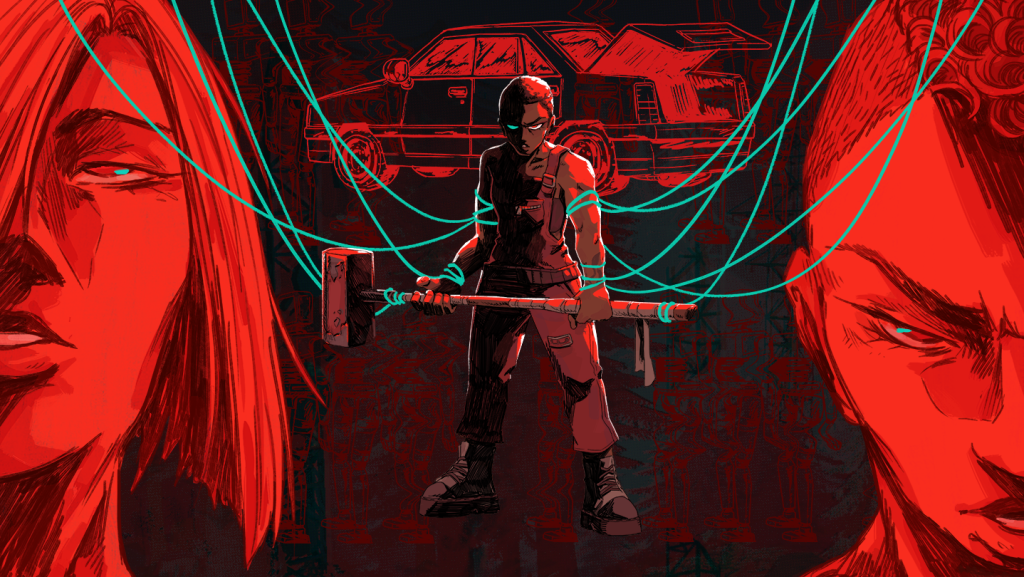

The pitch for Virtue and a Sledgehammer is sharp: Everyone in your hometown has been turned into robots by your brilliant sister, and it’s up to you to return and destroy everything with a sledgehammer. The game, out today, delivers on all of its promises: violence, AI commentary, and complicated family dynamics.
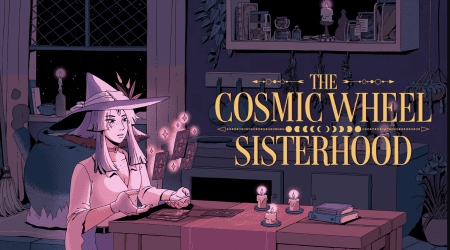
Deconstructeam is a three-person studio: co-founder and writer Jordi de Paco, co-founder and artist Marina González, and audio and level designer Paula “Fingerspit” Ruiz. I have played two of Deconstructeam’s previous titles: The Red Strings Club (2018) and The Cosmic Wheel Sisterhood (2023), and especially enjoyed the latter.
For Virtue and a Sledgehammer, Deconstructeam partnered up for the second time with two-person studio Selkie Harbour. Virtue is by far the most ambitious for both studios. Previously, these teams have focused on a 2D visual-novel style with subtle political stakes covered in charm; by contrast, Virtue and a Sledgehammer is a 3D action-adventure game with powerful, assertive statements.
The game is an experiment for all involved, and I am happy to say it’s a successful one.
Video Game as Art
Virtue and a Sledgehammer is 10/10 as art. I don’t want to say too much about the story and visual details, because, like any good film or book, it’s best experienced yourself. It’s an incredibly moving game with some really cool choices in the mid- and late-game. Still, this is a video game review, so I’m compelled to talk about it a bit as well as consider it as such.
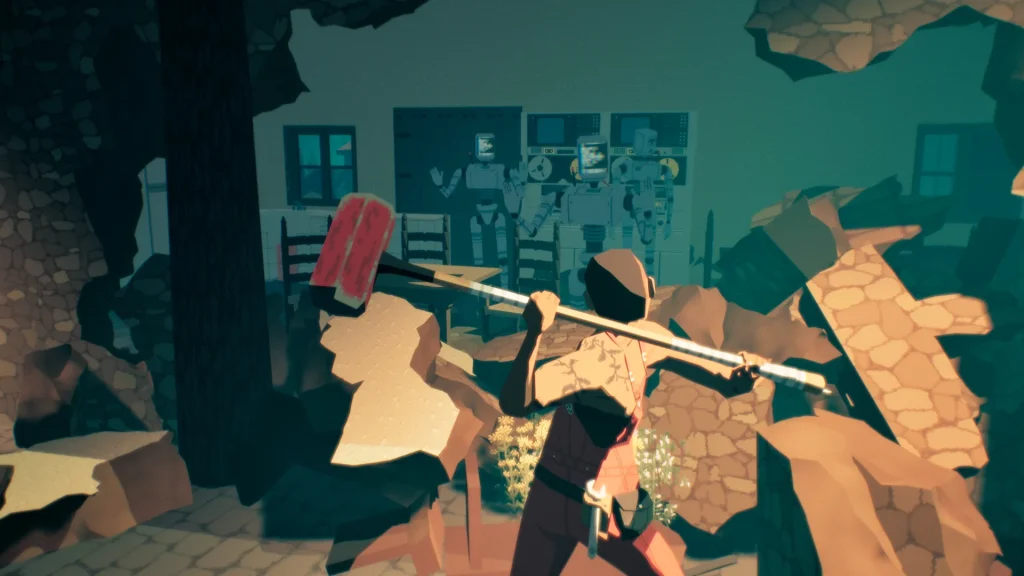
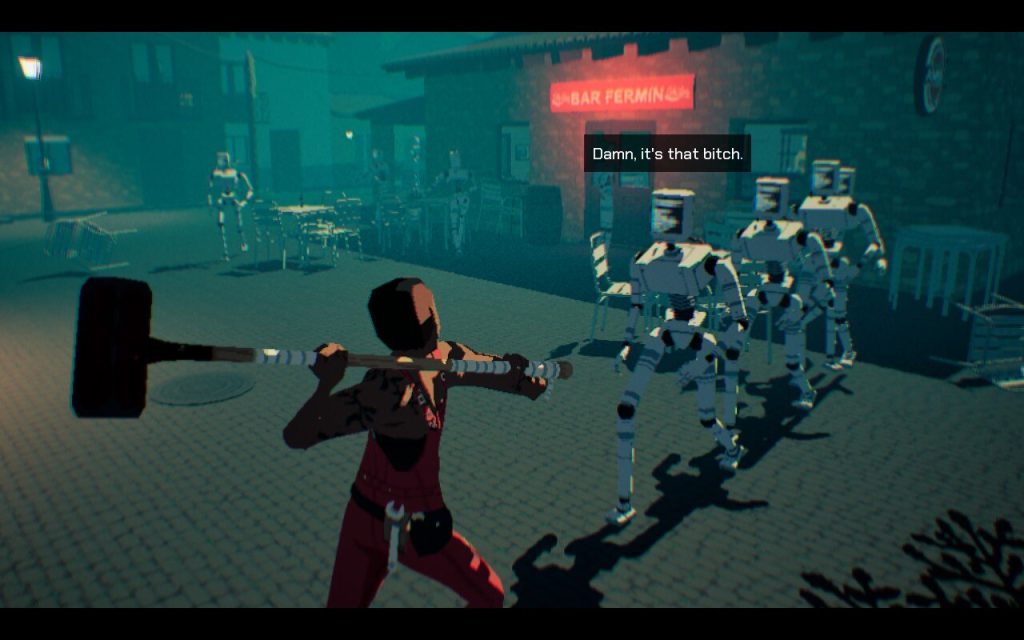
As a glorified “walking simulator,” Virtue and a Sledgehammer is one of the best I’ve ever played. Protagonist Pratelle has returned to her hometown in Spain with a mission of freeing the souls-trapped-as-robots and confronting her sister Nina. Her only aid is her giant sledgehammer. It is really, really fun destroying stuff.
There is just one action button in the game — the longer you hold the button down, the more powerful your smash becomes. Gearing up to an intensive hit with my sledgehammer feels quite satisfying. When I’m smashing racist robots, it’s incredible. Knocking down a tower just because I want to? Hell yeah! Should I bust up that data farm that’s taken over a family home? Let’s do it!
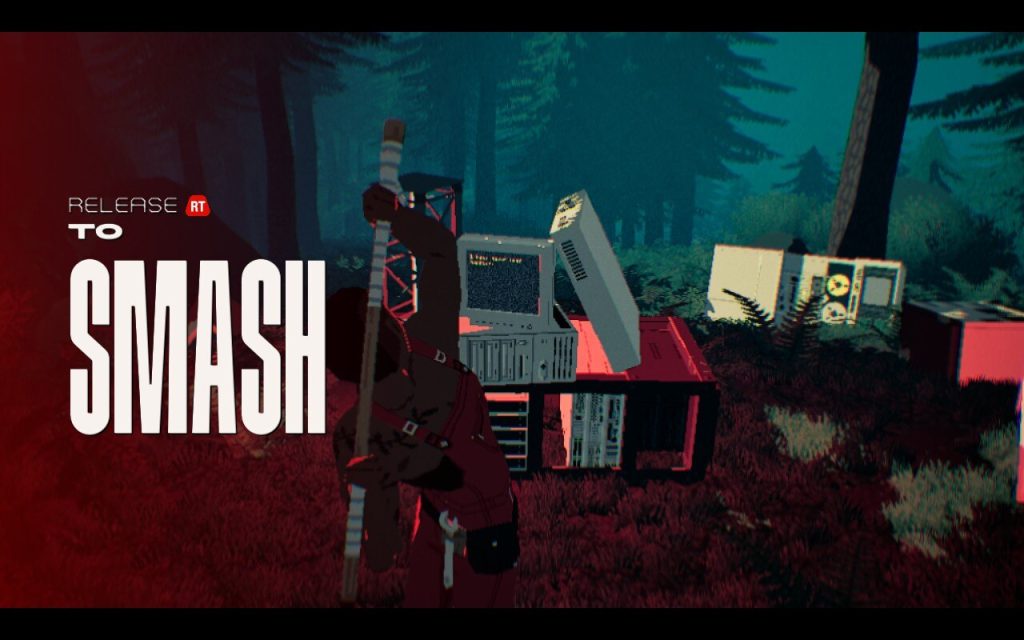
Virtue and a Sledgehammer is not a relaxing or cozy game by any means. Most robots will attack you, and some late-game enemies do so in surprising ways. Furthermore, there are some level designs that are especially creepy and disturbing. While the design of every robot is the same, each one says different things — which makes sense, because they are converted people.
The game has an impressive diversity of individual comments by robots that are a mix of insightful, funny, and heartbreaking. As art, I find Virtue and a Sledgehammer pretty incredible, but there were some “video game-y” things I did find a little frustrating.
For example, Pratelle has only one walking speed. I often wished she could run (to either get away from or chase robots, or to simply progress through an environment faster), though I understand the in-game logic of not being able to sprint with a massive sledgehammer. Her smash action is a little hard to precision aim, which makes taking down some enemies difficult, particularly when I was trying to preserve Pratelle’s health.
I occasionally got a little turned around in the big map. What Pratelle can destroy with a sledgehammer versus what she cannot is sometimes inconsistent. How come I can easily destroy a city bridge but not a car? (The latter, along with fences and steel containers, serve to create boundaries in the open world to shepherd players along in the story. Again, I get “why,” but sometimes this logic is a little flawed.) Pratelle far too easily walks through debris, though the game gets away with it due to its mix of high-res and low-res styles.
All of these critiques, however, pale when I consider the game’s writing.
Story/Destroy
For every robot that expresses something kind and beautiful, another says something deeply hateful. The latter feel quite good to smash, and the former make me question why I’m even trying to “kill” them.
When the game begins, it is clear that Pratelle is on a mission to kill every robot. I remember thinking, I bet there’s an achievement to destroy 100% of all the robots. So I went through, meticulously, each level, and smashed everything.
About halfway through the game, during the section that was personally the most horrifying to me, I found a hidden glade. There, I met a robot that spoke to me in such a way that I could not bear to kill him. I mean, it?
I left him alive.
Soon after, I ran into a few robots who were unexpectedly kind to me. I granted them mercy. Later on, two more were harmlessly wondering if they could emulate a video game on an old machine. I left them, too.
As I went through the next level, I started questioning my own aggressive destruction. That 100% achievement be damned. I would try to be better from here on out, be more intentional with my actions.
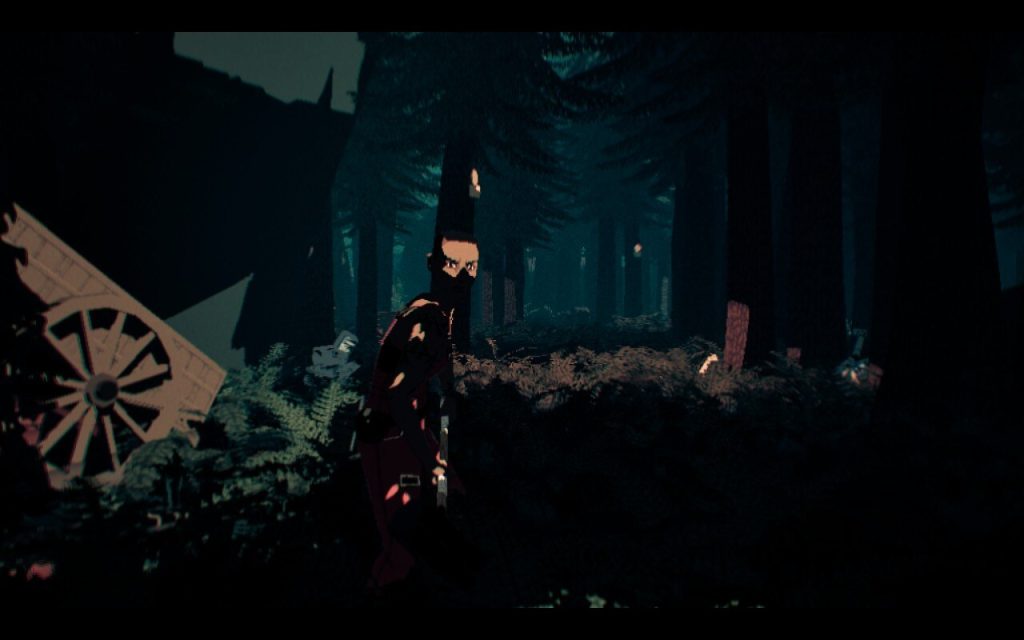
But soon, I experienced a cutscene that made me remember why I — no, Pratelle — was here. Why she had come back to this town.
This is a game, I had to remind myself. Get the prize. Kill the robots. I backtracked to destroy the five robots I had left standing.
It did not feel good.
Virtue and a Sledgehammer asked me as a player to consider what I was doing and why.1 I started to ask myself questions that made me uncomfortable even as I was having fun going smashy smash. Pratelle is furious at her sister Nina for tricking their whole town into signing away their lives to be robots with the promise of eternal life… But am I now complicit in this violence? Should I have left some robots and not others? Or perhaps only the ones who begged for mercy? Who has the right to decide what is right and wrong? All authority ultimately comes from power… But was my power righteous?
The game made me feel so many things because it was written so very well — both at the micro and macro level — in addition to being beautiful.
Virtue and a Sledgehammer is 10/10 as art. I don’t want to say too much about the story and visual details, because, like any good film or book, it’s best experienced yourself.
In the Eye of the Beholder
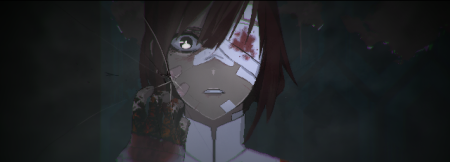
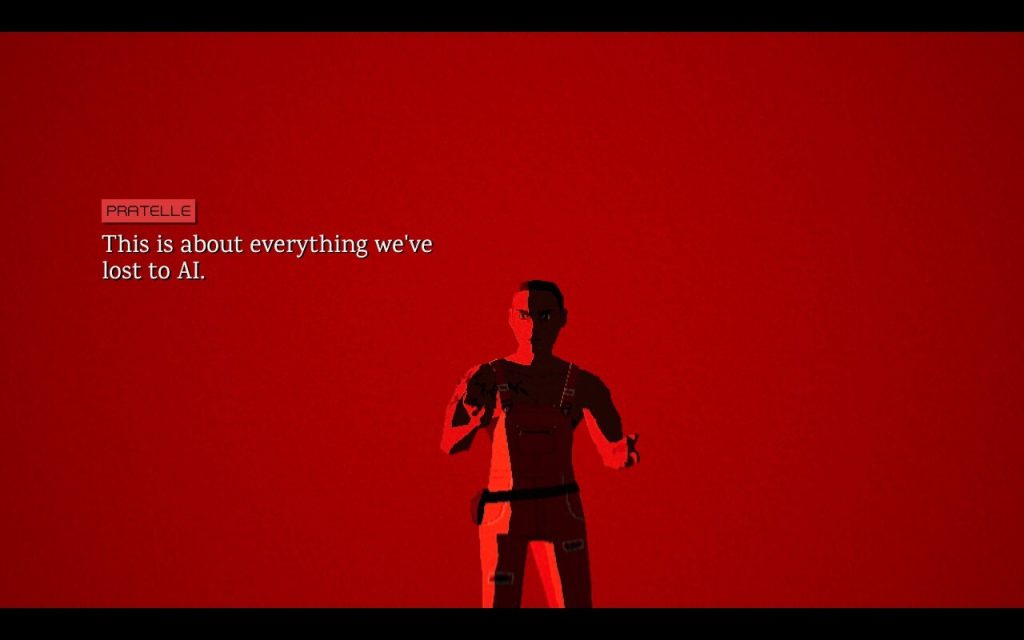
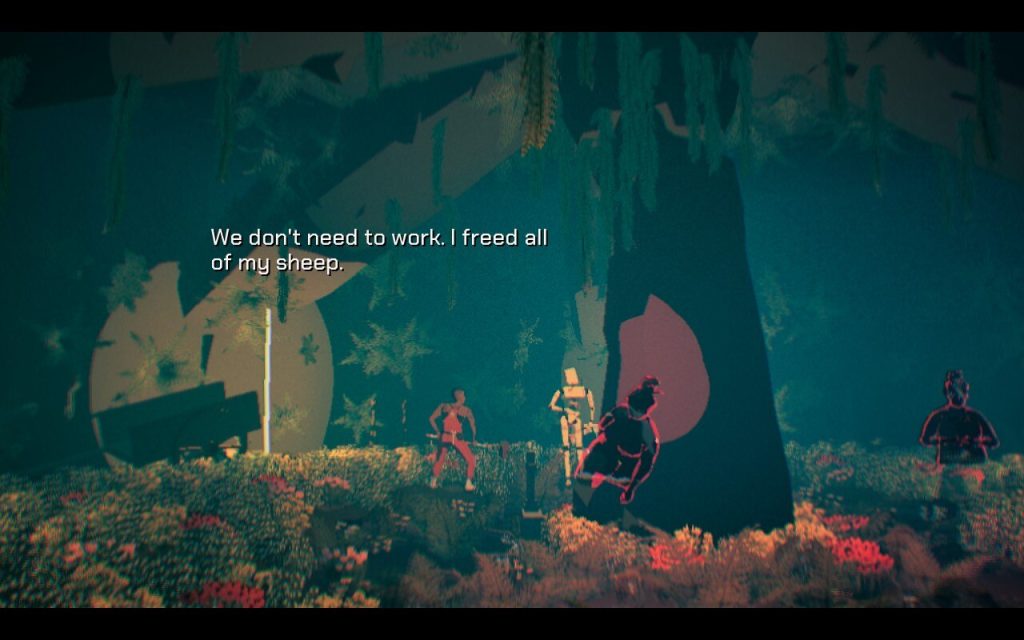
Virtue and a Sledgehammer has a strong visual style of bold modern aesthetics combined with poly low-res-inspired graphics. In terms of vibes, Virtue reminds me of Inside, Control, Crow Country, Signalis, and NieR: Automata. The last two feel especially relevant given all of those games’ interest in the intersection of technology and what it means to be human.
The game has helpful visual touches like flashing red lights or occasional red flowers to help guide the player where you need to go if you get disoriented. This is key, because to uncover the full story, players will need to scrounge each level. Players can reveal Pratelle’s memories by smashing glowing red illusions. I played on my Steam Deck with a completionist mentality, and that took about five hours but the game could probably be finished in closer to three.
Throughout Virtue, I admired the music and sound editing. The lo-fi, mesmerizing tracks vary in intensity and style based on the level you’re in, culminating in a glorious final track. Sound effects are similarly well-balanced. (This makes sense as Ruiz leads both level and sound design.) In a dark forest, I paused often, trying to listen for the footsteps of a robot crunching soil as it hunted me.
There is no voice acting, but this didn’t bother me at all as it allowed me to focus on the words. Because it’s all text, the game can more easily be translated into several languages, which is nice, especially as the developers are based in Spain.
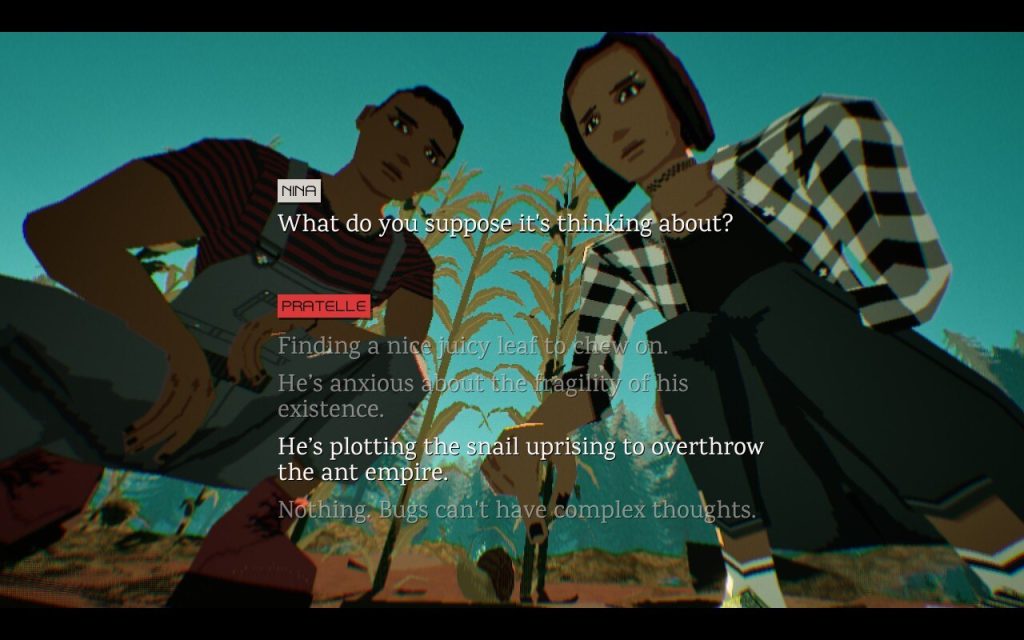
One element that needs no translation is the complexity of family. Virtue and a Sledgehammer interrogates the complicated relationship between mothers and daughters, sisters, and women and society. Sisters can simultaneously be a best friend, a judgmental additional parent figure, a role model, and a nemesis all in one — and the creators nail it.
Deconstructeam in particular has long been interested in gender, and I was really impressed by what they did here. Interestingly, Virtue and a Sledgehammer is the second indie game this year to feature generational trauma and robots, but this one held my attention for much longer.
This game is asking questions as big as its titular sledgehammer, and Deconstructeam and Selkie Harbour hold those themes with the panache and seriousness those ideas deserve.
Final Thoughts
My partner works in palliative and hospice medicine. (That’s complex and end-of-life care.) One of the central questions of his work is, “What does ‘good time’ look like? And do you want ‘more time’ or ‘good time?'” That is at the heart of what Virtue and a Sledgehammer aims to answer. (And if you are interested in exploring this topic further yourself, I recommend reading Being Mortal by Atul Gawande.)
Players who want a thoughtful story, who want to feel things, who are mad at AI, who just want to smash stuff will really love Virtue and a Sledgehammer. Others might be turned off by the game’s narrative and what it chooses to focus on. I personally felt the game did something unique with its three- to five-hour runtime. For its commentary on humanity, relationships, and technology, Virtue and a Sledgehammer might be one of the most important video games of the year. I hope people play it.
I was incredibly moved by Virtue and a Sledgehammer. As a piece of art, it is something I am going to think about for a long time. As a video game, it’s one I already want to replay for a different ending. And, I’m not going to lie to you… It’s really fun to hit stuff with a sledgehammer.
Score: 9.0/10
Virtue and a Sledgehammer, co-developed by Deconstructeam and Selkie Harbour and published by Devolver Digital, releases on October 27, 2026, for PC. MSRP: $29.99. Version reviewed: PC (via Steam Deck).
Disclaimer: A review code was provided by the publisher.
- I am intentionally not sharing if there is an achievement for killing 100% of robots or not. I also was surprised I even cared? I don’t achievement hunt normally. Again, I was asking myself a lot of questions of why, why, why? Good art makes us ask questions. ↩︎

Amanda Tien (she/her or they) loves video games where she can pet dogs, solve mysteries, punch bad guys, play as a cool female character, and/or have a good cry. She began writing with The Punished Backlog in 2020 and became an Editor in Fall 2021. Amanda also does a lot of the site's graphic designs and podcast editing. Amanda's work has been published in Mothership, Unwinnable Monthly, Poets.org, Salt Hill Journal, and elsewhere. She holds an MFA in Fiction from the University of Pittsburgh and a BA in Creative Writing from Columbia University. Learn more about her writing, visual art, teaching, graphic design, and marketing consulting at www.amandatien.com.