

Welcome back to Therapy Gaming! This month, we’re looking at Hollow Knight: Silksong and how it handles its most notable queer character.
Story spoilers ahead for Hollow Knight: Silksong.
For a long time, I referred to myself as a queer-adjacent person, but not a queer person. I knew I had some amount of queerness to my identity, but primarily a lack of language around the topic led to more shoulder shrugging at the question. Having whatever my queerness was identified directly was never particularly important to me: I just knew I wasn’t fully straight, and the rest was whatever.
This was how queerness has always existed for me: an unconscious existence that never needed a spotlight on it. In recent years, more and more media have been very explicit with their introduction of queer characters, sometimes to the point of tokenism. Often, the most interesting part of a queer character is that they’re queer. Every triumph they hold is in spite of being queer; every challenge they face is because they’re queer. Very rarely does a queer character get to be anything besides queer. As such, I internalized this deep within myself as well. Having queerness as part of my identity wasn’t ever going to be the most interesting part of me, so why give it space beyond tacit acknowledgement?
Imagine my surprise, then, when this idea was challenged in the space I never expected: Hollow Knight: Silksong.
The Reluctant Ally
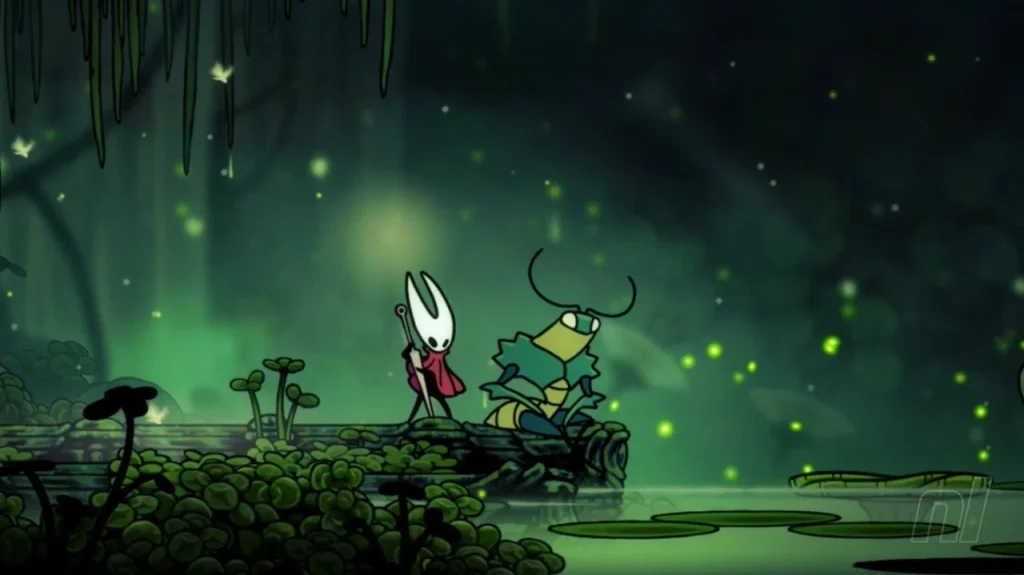
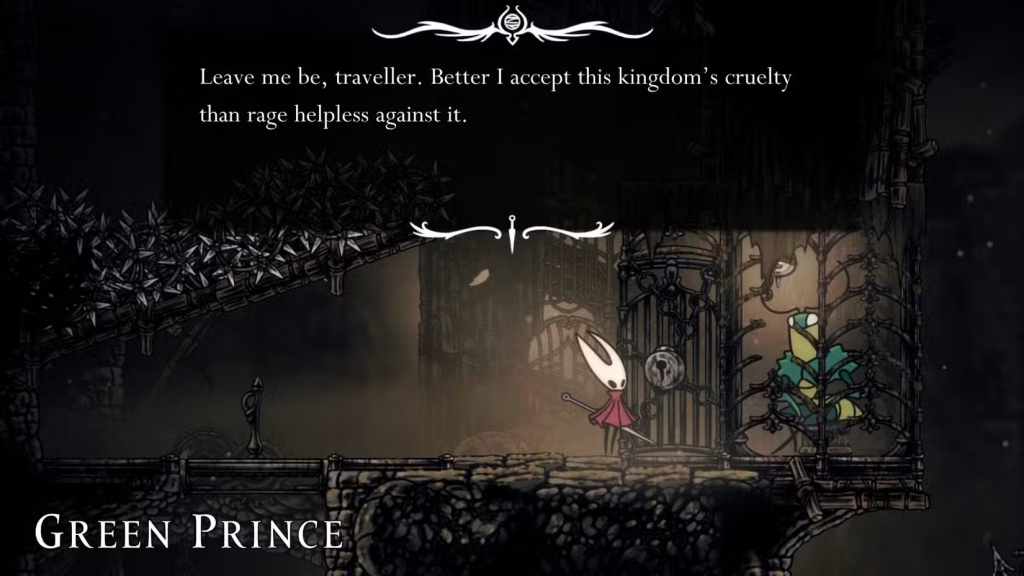
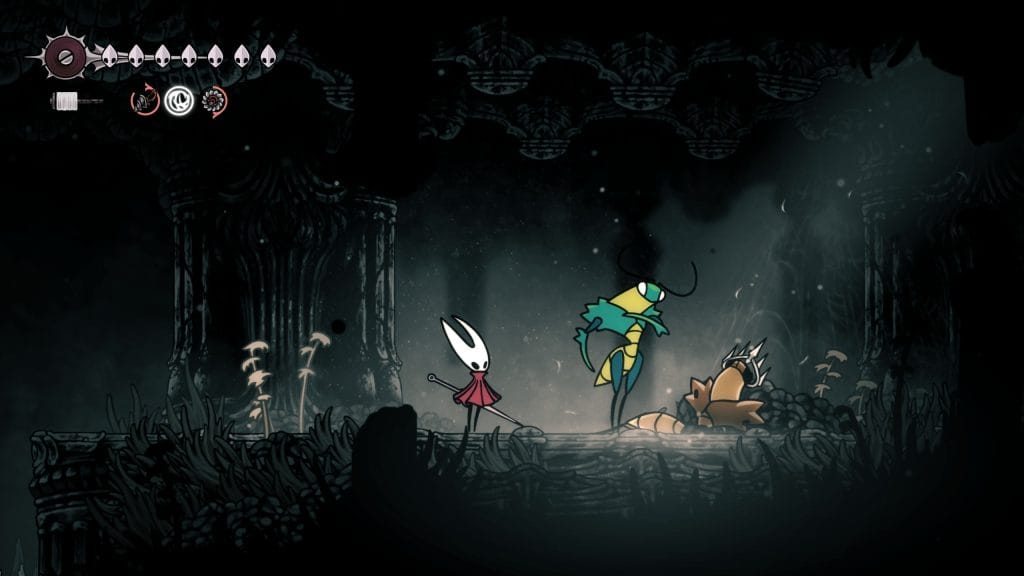
Hidden away in the Sinner’s Road area of Silksong is a tall, green mantis locked away in a cage. He speaks in a regal but defeated air, telling Hornet to let him rot in peace. This is your first introduction to the Green Prince, a stately bug of a lost kingdom, content to be forgotten by the ashes of time. How he arrived in this cell is never stated, but the stench of defeat surrounds him. The Prince had some mission, but lost. And now, trapped in despair, he found himself trapped bodily. A fitting end.
Once freed, the Prince does not thank Hornet for her kindness in allowing his quest to continue. Instead, he expresses a grim apathy that his mission must continue. The Prince moves forward almost thoughtlessly, receiving Hornet’s wish for a safe journey with that same dispassionate air: “This is Pharloom, warrior. Safety is a myth.”
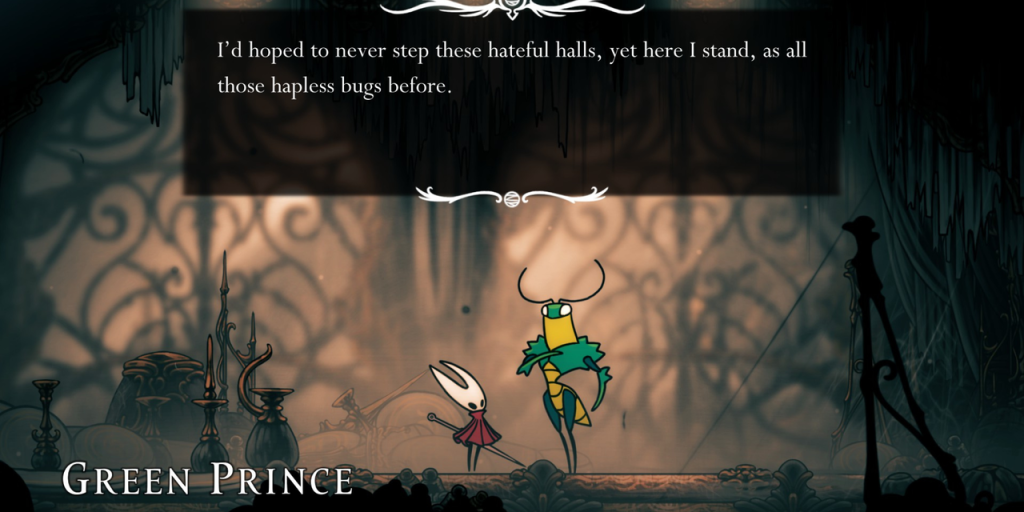
Hornet can next find the Prince roaming the halls of the Citadel above, a monument to the curse gripping the land of Pharloom. It is here that the Prince first alludes to the mission that drives him. The Prince states that he had hoped to never come to the Citadel, that the very halls feel “hateful” to tread in. Clearly carrying some kind of grudge against the Choir itself, Hornet identifies that they are comrades in arms, which the Prince accepts. He notes that it is rare now to find individuals who are free from the influence of the Choir, that only those with a strong will can stand to resist. The Prince wishes Hornet well in her battle against the Choir, promising to cross paths again, should death not calmly take them both in the interim.
“Leave me be. This kingdom’s collapse has come. Better I stay here to accept it.” – Green Prince
After the first two brushes with the Prince, I had already made up my mind about the character. A myopic soldier with a grudge against the Choir, he seemed a perfect foil to Hornet herself. While Hornet’s journey through Pharloom is driven by revenge, there is still fire in her. Her quest is not divine, but the retribution she carries burns with a similar fire. The Green Prince, on the other hand, finds vengeance hollow. Whatever he has lost, no amount of revenge will bring it back. But revenge is a duty that must be fulfilled, even to its inevitable end. At first, I was curious and intrigued by the character. I had no idea what was to come.
The Story of the Green Prince(s)
It is in Hornet’s third meeting with the Green Prince that the true scope of his failures comes to bear.
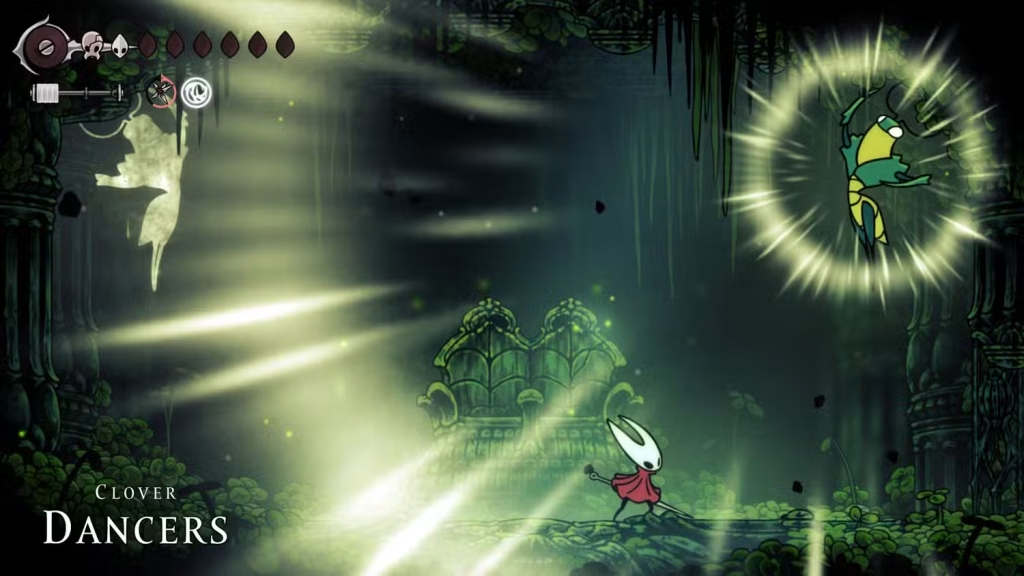
Atop the Citadel are two Cogwork soldiers, fashioned in forms similar to the Prince himself. They fight in perfect unison, a manufactured dance of death that requires careful precision and planning to survive. But there are gaps in their dance that can easily be exploited: holes left open as both move in unison. Realizing those holes exist, the fight becomes much simpler to triumph over. Hornet leaves the broken Dancers behind and continues deeper within the Citadel.
Upon returning to that room, however, Hornet will find the Prince standing above their shattered forms. He will see Hornet and remark that his quest was completed before he could even arrive. Hornet asks if it was his body that the Dancers’ were fashioned after, and if he was out to destroy them. The Prince confirms that he was after the Dancers, but it was not his form that they were modeled on. It was his partner’s body, given wholly to the Citadel in a futile effort to save their fallen kingdom. While the Prince himself cowered in the caves of Verdania, allowing his kingdom to fall to the Citadel’s threads, his partner gave shell and soul to save it. Once Verdania fell regardless, the Prince felt honor-bound to finally witness what became of his partner’s form. Only to find it destroyed.
Never again would he be able to lay eyes upon his partner. Everything that connected him to his world was lost forever.
Beautiful Queerness
Alone, the story of the Green Prince is a romantic tragedy, done wonderfully in small snippets. It’s the classic story of love lost due to tragic sacrifice, as one half of the partnership takes action while the other mourns. But what struck me most was the quiet, unspoken reveal within it. You see, I was very careful in the last section to exclusively use gender-neutral language to describe the partner of the Green Prince. Silksong doesn’t. The Green Prince specifically uses male pronouns to describe his partner. While never giving a name, Silksong specifically goes out of its way to describe the partner as male. The gender of the partner isn’t important; the story of the two lovers could have easily been done without ever assigning a gender to either character. But Team Cherry chose to do so.
I was surprised when I realized the Green Prince was specifically identified as queer. And there are no ifs, ands, or buts about that. His name is the Green Prince, a traditionally male title. His partner is referred to exclusively in male language. And lest someone try and say that “partner” could mean not romantic, the Prince later refers to Verdania as their “shared sovereignty” as joint rulers. They’re super gay! But their homosexuality never matters to their plight, their decisions, or their rulership. They just… are. Doomed and pitiable due to their fates, but not due to their sexuality.
The Rise and Fall of Queer Tragedy
I connected with the Green Prince before any explicit queerness was identified. His doomed struggle and still drive for reluctant duty were interesting and different in a world of faded cynicism. The Green Prince pushed forward despite the past failures that led to his current struggles. The love story surrounding him was moving, regardless of queerness. But it’s just as important that Team Cherry choose to make his story queer. Because queerness isn’t the point. The love and connection within is.
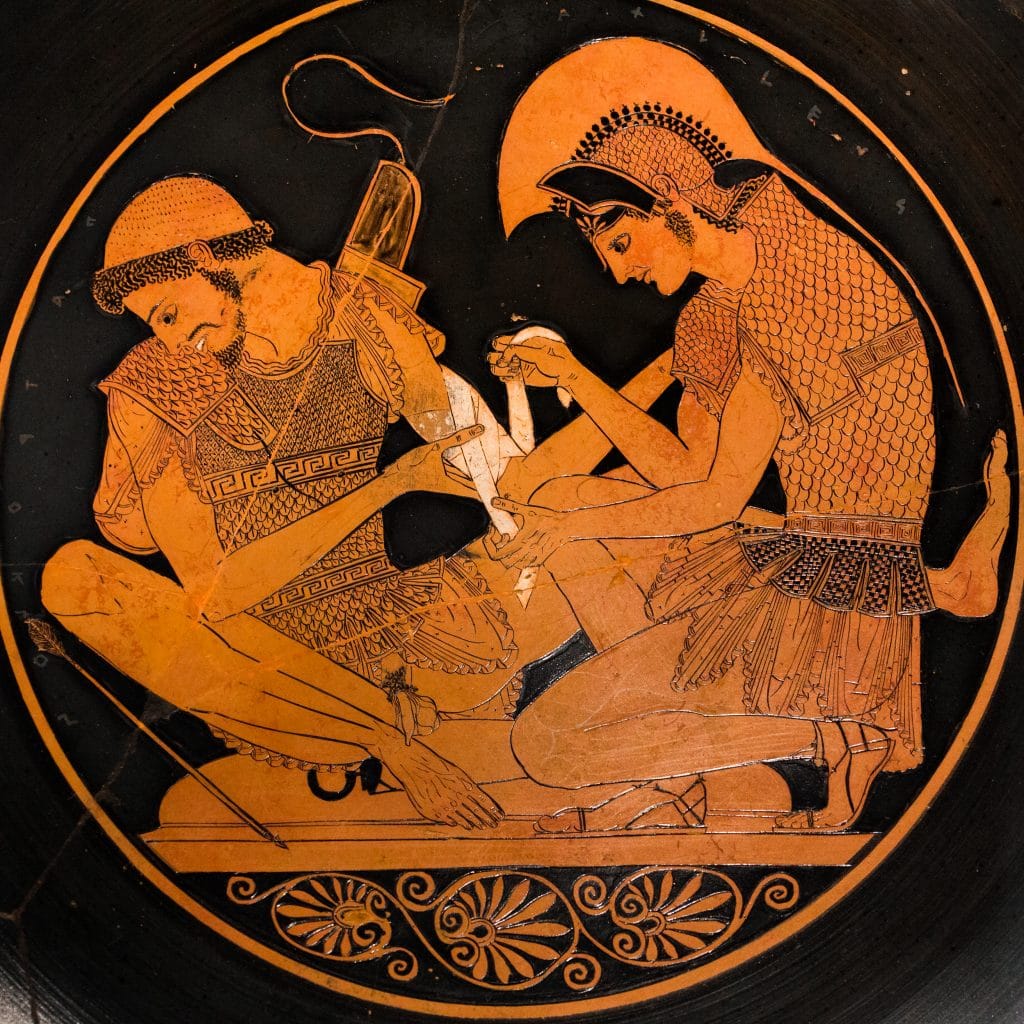
I recently finished reading Madeline Miller’s The Song of Achilles, a retelling of the Trojan War from the perspective of Patroclus, the bannerman and companion of the Greek Hero Achilles. Throughout literary history, the nature of the relationship between Patroclus and Achilles has been a hotbed for debate. Their relationship, even in the relatively asexual words of Homer, is deep and emotional. Patroclus is Achilles’ one true confidant; when Patroclus is killed while pretending to be Achilles (long story), Achilles becomes fully unmoored, refusing to give up his body for days on end. Achilles’ fight against the Trojans becomes purely based on revenge for Patroclus: He even proclaims that once he is dead, he wants both their bodies burned and their ashes to be mixed together in an everlasting embrace.
Sounds pretty romantic! Even Plato saw them as lovers, arguing that their love was one of the most divine in Greek myth. While I can’t say for certain, of course, I also ascribe to the belief that the two were romantically intertwined with each other. And Madeline Miller agrees, making it very explicit that the two are fated lovers. But at no point in The Song of Achilles is the fact that they are gay men the foundational part of the story. They just are men who love each other deeply: Their trials and motivations are more built around the difference in class strata and mortality than their queerness. In fact, their queerness is the least interesting part of the story. It just is a part of the story. No one attacks them for being gay; no one looks down upon their passionate relationship. It just is. And they suffer regardless of that.
They Say It Builds Character
Late into Silksong, Hornet has the ability to travel into the Green Prince’s memories of the last glory days of Verdania. The Prince recounts to her tales of his and his partner’s majesty, of the beautiful land they built together. At the end of the memory, Hornet finds the Prince in his throne room, joined with a spiritual version of his partner. He laments the throne he could never sit in alone, not without the balancing force of his partner. And they dance together, forcing Hornet to fight them in their purest form.
It is a similar fight to the previous Dancers, but with one key difference: The two do not move in unison. Instead, they perfectly complement each other, filling in the gaps left by the other. When one moves, the other responds, creating a push-and-pull of offense and defense. One strikes, the other defends their blindspot. A perfect compliment: a pair that would never achieve alone, but together are nigh unstoppable. True partnership is not a reflection of one soul, but the compliment one provides the other, regardless of who that partner is.
I have experienced a lot of tragedies in my time. I have overcome them and failed them in equal measure. But I realized I was failing myself by not allowing myself to be whole. My tragedies do not define who I am, nor does any label I can provide to myself. But they are parts of me, reflections of the world I lived within. I finally looked up the agreed-upon term for my queerness, and, lo and behold, it’s pretty simple: gynesexuality, the attractiveness to specific genital parts regardless of the gender expression. Feels right to know another part of myself, even if it is just a part.
After all, we are all made of parts.

Gary is a jack-of-all-trades video game enthusiast based in Boston, MA. A semi-professional fighting game player, even less professional Apex Legends player, and even less professional adult, he spends most of his time poking at strange indie gems and reading about the need for more diverse voices in gaming criticism. He invites anyone to recommend anything he's missed in the gaming world via Twitter or BlueSky, where he can found under the username @grtnpwrfl. When he isn't spending his time playing games, Gary is an avid New England Patriots fan and frequent hiker.






1 Comment
Very beautiful article they are my favorite characters