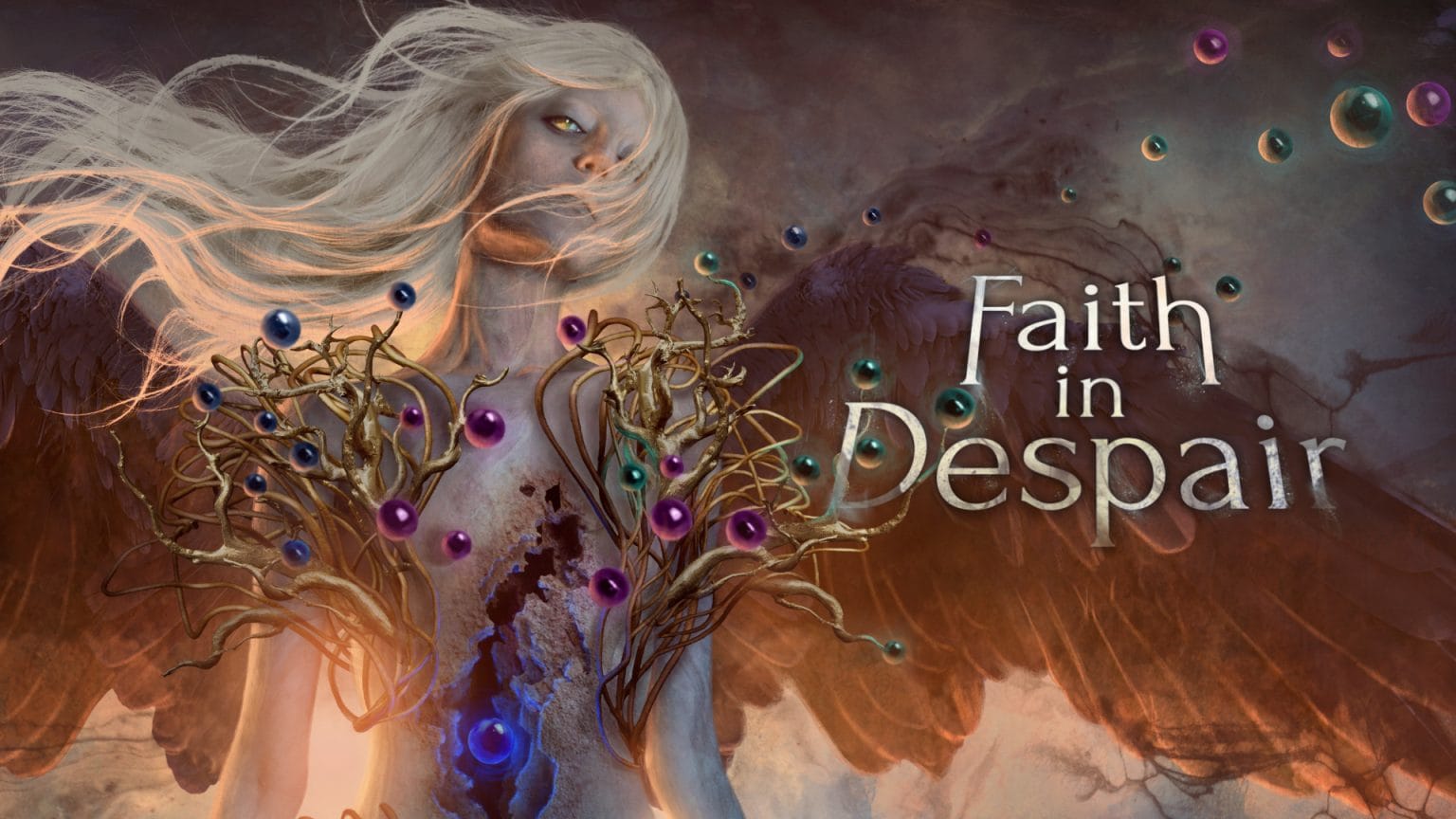

Faith in Despair is an indie roguelike from solo developer Philipp Lehner (aka muddasheep) that combines the traditional deck-builder experience of Slay the Spire with the materia system of Final Fantasy VII. If that sounds a bit daunting, that’s because it is.
By nature, deck-builders are a delicate seesaw. Players must balance attacking and defending while learning enemy patterns and finding novel card combinations to exploit. Then there’s the road to success — a map of branching paths where you must trounce a series of minions and bosses — which typically requires a healthy mix of decision-making and luck.
Faith in Despair pulls from this blueprint but leans more hardcore than you likely expect. If you’re okay with constantly planning out your moves like it’s chess, then go for it. Otherwise, you might want to find something more casual for your evening of gaming. Overall, Faith in Despair is an interesting experience that rewards the prudent planner and precise attacker, while scorning careless play and leaving little room for mistakes.
A Story of Faith and Despair
There’s not usually a lot to say about the stories in deck-builders, but there are some interesting elements at play in Faith in Despair. You play as a nameless human engaged in a card game against Death. In my 17 hours of play, I slowly learned more about a post-apocalyptic world in which humanity lost a war with demons.
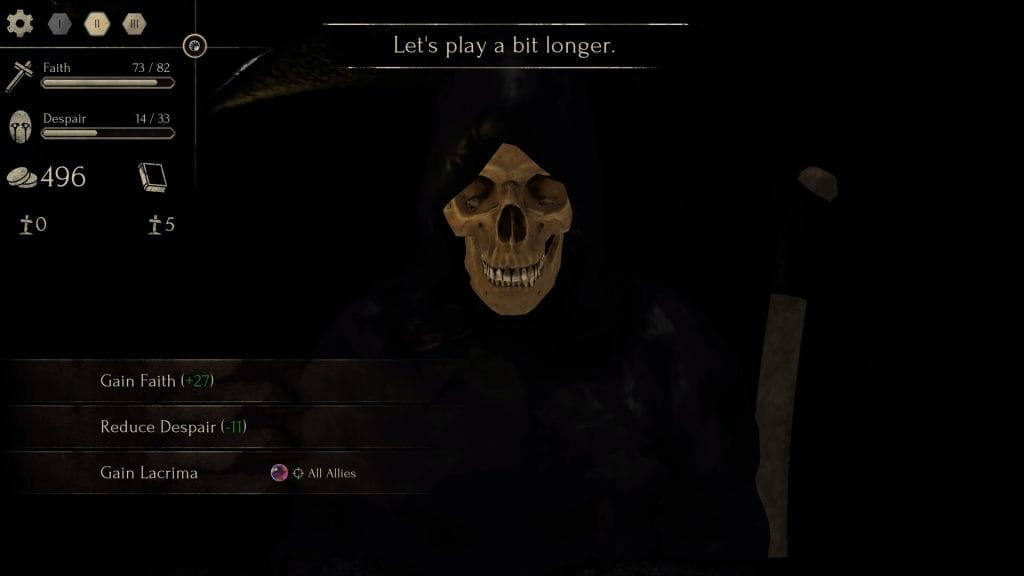
To stay alive, you must continuously play against Death and maintain hope that beating him will lead to some outcome other than a final resting place. The story is divided into a calendar of days that advances each time you beat a new run. With each new day completed, you’re rewarded with fresh dialogue from Death, who increasingly reveals more about the world and how you ended up in this situation.
The only thing keeping you alive in this situation is Faith. It’s your HP bar, and what enemies attack if you don’t stop them. Right below the HP bar, you’ll find a Despair bar, which builds as you attack and receive damage. Once this maxes out, a curse befalls you that hinders your progress, whether it be a status ailment or another debuff. Thankfully, you can also receive blessings to tilt the playing field back in your favor.

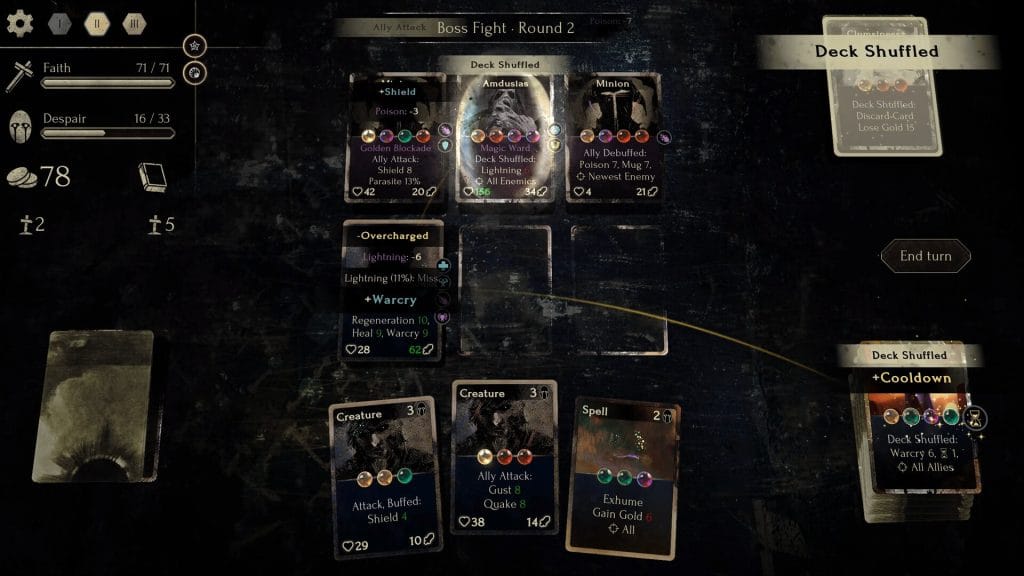
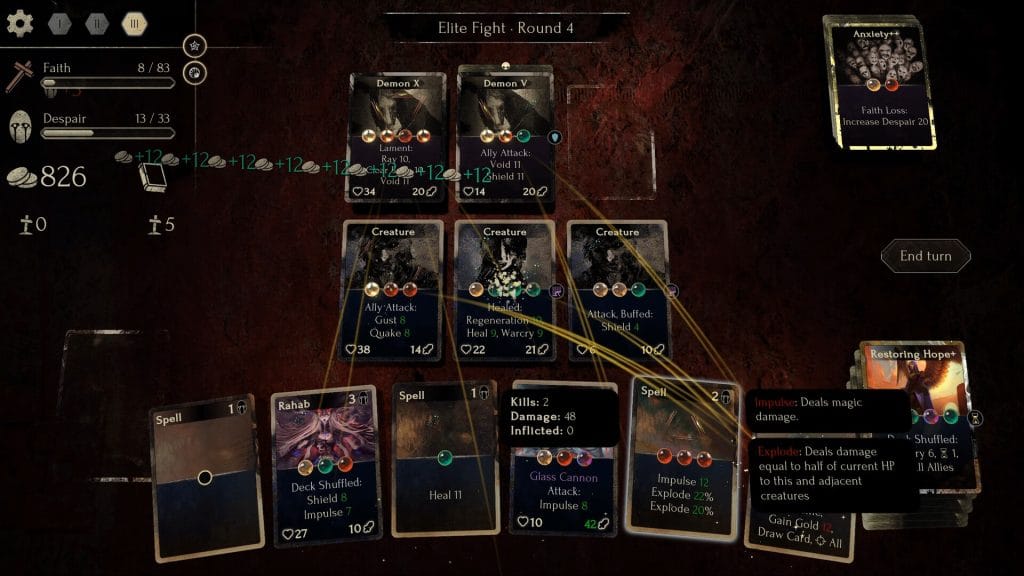
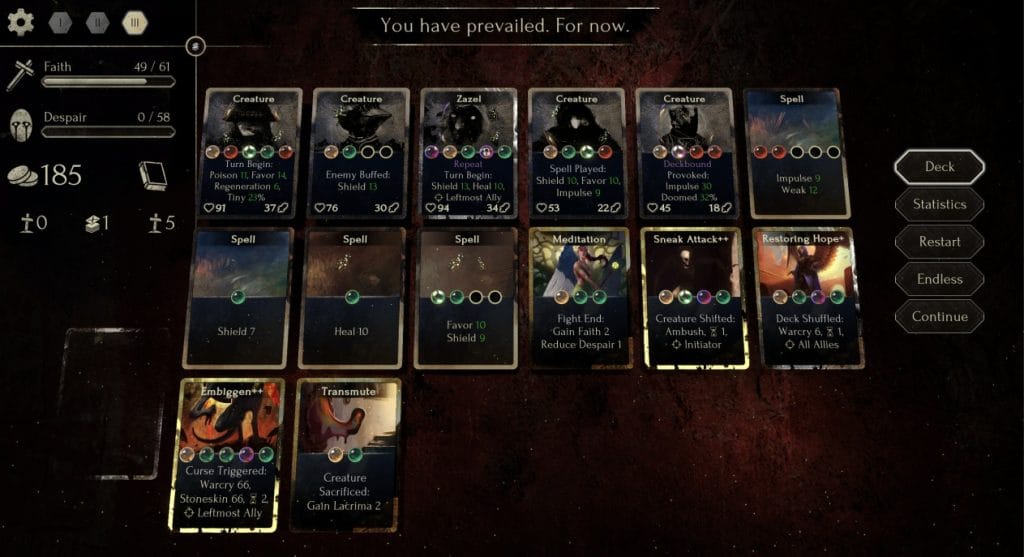
Your cards are the most important aspect of Faith in Despair. Two types of cards exist in the game: “Creature” cards, which determine how you attack, and “Spell” cards, which can be offensive or defensive. Both card types have lacrima slots (again, think materia), which are allotted based on a card’s level. For instance, a level 1 card has a single lacrima slot, while a level 3 has three.
To start a run, you are given a pre-built deck based on your current progress in the story. Decks come with certain advantages or disadvantages. For example, “Healer,” the first deck, allows monsters to revive with full health after combat, while “Gravedigger,” the second deck, focuses on resurrecting fallen monsters. The former starts with only five creatures but has more spell cards, while the latter mostly has creatures. Once you understand the setup of your deck, you’re ready to begin your journey.
Battling Through Demons
Religious overtones abound in Faith in Despair. Even the game board you travel across feels like a pilgrimage, with each board connected by hexagonal pathways (Settlers of Catan style). Your first step is predetermined, but from then on, you will choose between one of the many possibilities: Altar of Tears, Fight, Elite Fight, Sacrifice, Shop, Study, Rest, Treasure, and Unknown.
Altar of Tears are one-use opportunities to combine lacrima to create new forms. Lacrima come in six colors: dark purple (attack modifiers), shiny purple (special triggers), red (attacks), yellow (required to trigger lacrima), green (healing/buffs), and orange (special attacks). For example, a simple combination involves combining a “Heal 5” with a “Heal 3” to create “Heal 8.” In most cases, the lacrima in the first slot determines the fusion outcome of your new lacrima.
Fight pits you against two monsters before escalating to three monsters and so on. Some enemies may return from the dead in a weaker form or have multiple allies. As such, it’s always important to pay attention to enemy creatures’ lacrima so you can counter their effects. Winning a fight allows you to pick one new lacrima based on three options presented.
Elite Fight usually consists of a stronger set of monsters. These battles are longer but yield better rewards, including a new lacrima and a guaranteed blessing.
Sacrifice forces you to eliminate a card from your deck. It reduces deck bloat while challenging you to optimize your combos. In return, you receive health and decrease your Despair bar.
Shop lets you buy new creatures or spells. You can reroll the shop or buy a lacrima package. You may also sell cards here.
Study allows you to upgrade creatures or spells. Creatures gain increased health and attack damage with each upgrade, while spells increase in their value (i.e., from 1 to 2, from 2 to 3).
Rest is your main opportunity to restore Faith or reduce Despair. Any harsh statuses, like broken lacrima or exiled monsters (monsters removed from play), can be resolved here.
Treasure almost always adds gold to your pile of earnings.
Unknown, meanwhile, can result in any of the above situations.
Setting up for combat is easy. Each battle has a pre-determined number of Creature slots that you’re required to fill. If left empty, enemies can attack your Faith bar directly. You can add, remove, or replace creatures on your turn, and you can even have creatures swap places any time you’d like.
Your goal when facing enemies is to reduce their health (denoted by a little heart on the card) to zero. Unlike the player, enemies don’t have a Faith bar to attack. Using your lacrima, you can reduce incoming attack values or boost your own creatures’ attacks (denoted by a sword on cards). Combat only ends once all enemies are defeated or your Faith falls to zero.
Despite the roguelike elements, the core of Faith in Despair is still very much to win every fight with everything you’ve got. Outside of fighting, the most common action will be checking your inventory to rearrange lacrima, especially when you receive new ones after battle. Occasionally, you will need to check your Faith and Despair statuses, but as long as you consistently play creatures, the former won’t go down, and the latter will either increase until you are cursed or decrease if you win battles or rest.

Light Rogue, Limiting Lacrima
The idea of a deck-builder with a materia system initially struck me as awesome. I envisioned an experience like Final Fantasy VII, where equipping a new materia automatically activated its special (and often powerful) ability.
While it’s probably for the best that this isn’t the case, the way Faith in Despair handles lacrima ultimately becomes a limiting factor. A creature’s worth is dictated almost exclusively by its ability to grow (and gain increased health/attack). Thus, the highest-level creature you own is almost always the best one to use.
To no surprise, this makes Faith in Despair very offense-heavy, with few if any pathways to traditional “defensive” deck builds. Even a fun spell like “Demon,” which summons a minion to aid your team, is underpowered without decent buffing. Instead, you’ll most likely look to strike a balance between boosting creatures’ stats, mitigating curses, and stacking blessings. It’s in this push and pull between buffs and debuffs where Faith in Despair really shines. Just know that if you’re looking for a variety of deck builds, you’ll have to settle for offensive schemes.
Even with the focus on aggressive play, there are plenty of options here. However, it can take time to find red lacrima to evolve your attack style. For instance, the lacrima “Incinerate” causes burn damage, while “Gust” works in tandem to increase this damage. Unfortunately, you could acquire “Incinerate” in an early fight, only for “Gust” to show up in the late-game, if at all. Most often, I relied on poison and high attack damage until I found stronger lacrima in the late stages of my playthrough.
The roguelike elements of Faith in Despair work well enough to help players hone their deck into an efficient killer, but that’s about it. There aren’t many fun surprises here besides the fun combinations in the Altar of Tears and the satisfaction of building a new lacrima. When the right combination of lacrima does come together, the effect can be devastating, making battles a satisfying cakewalk. Unfortunately, these moments of triumph are rarer than I would have liked.
Hope in a World of Despair
Initially, I had complaints about Faith in Despair needing more visual stimulation (based on a preview build I’d received), but it seems developer Philipp Lehner anticipated the feedback and updated many creature cards. Even with the visual enhancements, though, I still feel like the creatures you encounter later in the story need more weight to them. I’d love to see them get special effects or unique lacrima builds.
Likewise, bosses need more visual detail than the game’s current glowing effect, as they just aren’t memorable enough as is. I’d also love to see consistent bosses for each stage, but that isn’t as big a deal-breaker. On that note, I do think you should be rewarded for winning multiple runs in a row (humble brag, my record is four — acknowledge my success, Death).
Final Thoughts
Faith in Despair is ultimately a game for hardcore deck-builder fans. The margin for error is small: Switched out a creature prematurely? No undoing it. Need to edit a creature’s lacrima mid-combat? Not possible. Played a spell on the wrong creature? Live with the consequences.
Regardless of what I want to see improved, I know Lehner has a lot of love for this project. He’s released several content updates from the game’s beta phase to its current form, and I’m sure he has plenty more planned for the future.
All things considered, Faith in Despair is a solid deck-builder that’s as satisfying to play as it is challenging. I’m curious to see what updates come in the future, but in the meantime, I’ll be busy beating Death at cards and waiting for whatever selective lore drop he feels like sharing next.
Score: 7.5/10
Faith in Despair, developed by Philipp Lehner, was released on November 12, 2025, for PC, Android, and iOS. MSRP: $11.99. Version reviewed: PC (via Steam).
Disclaimer: A review code was provided by the developer.

Vaughn Hunt is writer who has loved video games since he picked up a controller. His parents wouldn't let him buy swords as a child (he wanted the real ones) so he started writing, reading, and playing video games about them. A historian at heart, you'll often find him deep into a rabbit hole of culture, comics, or music.