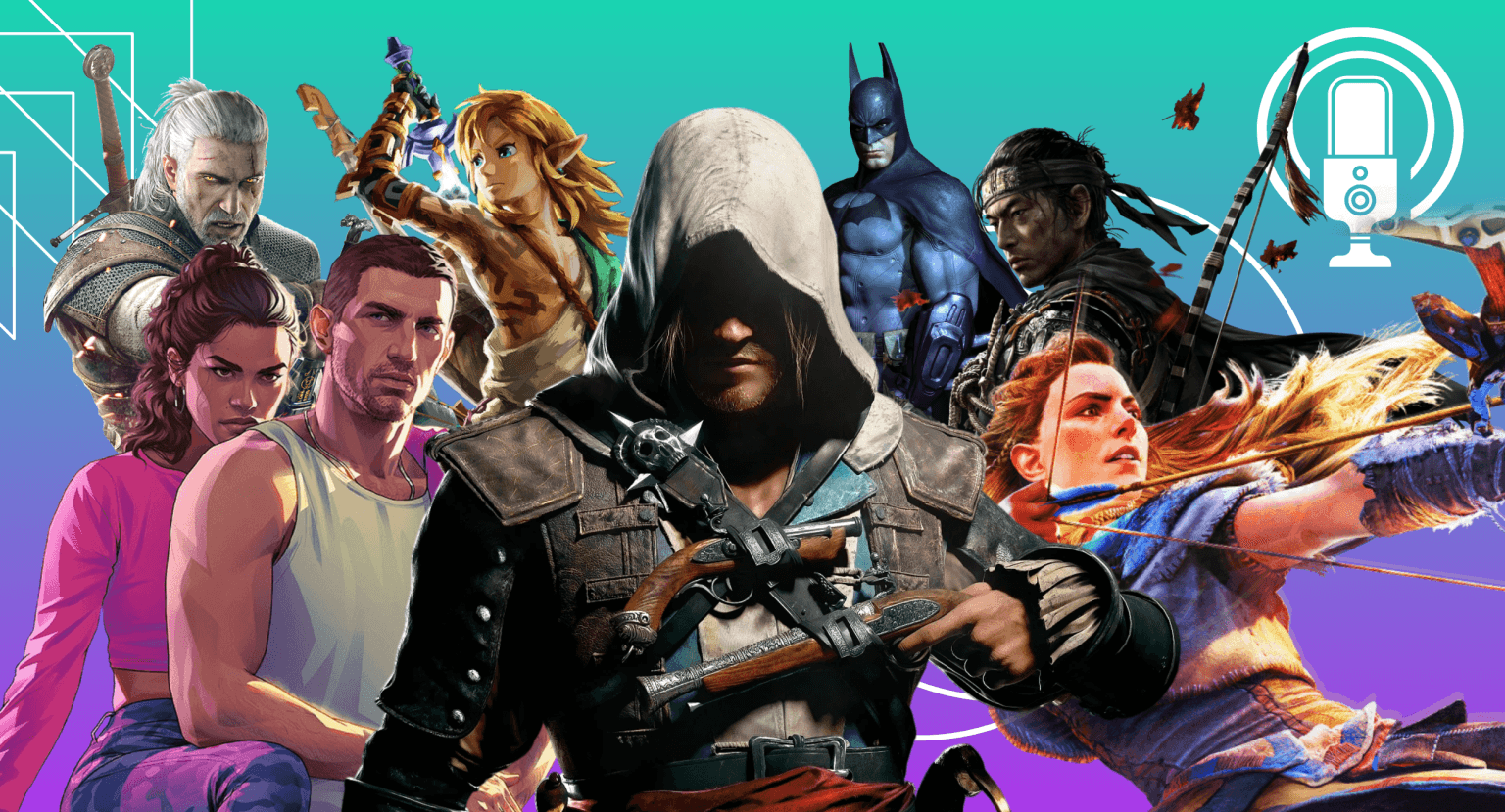

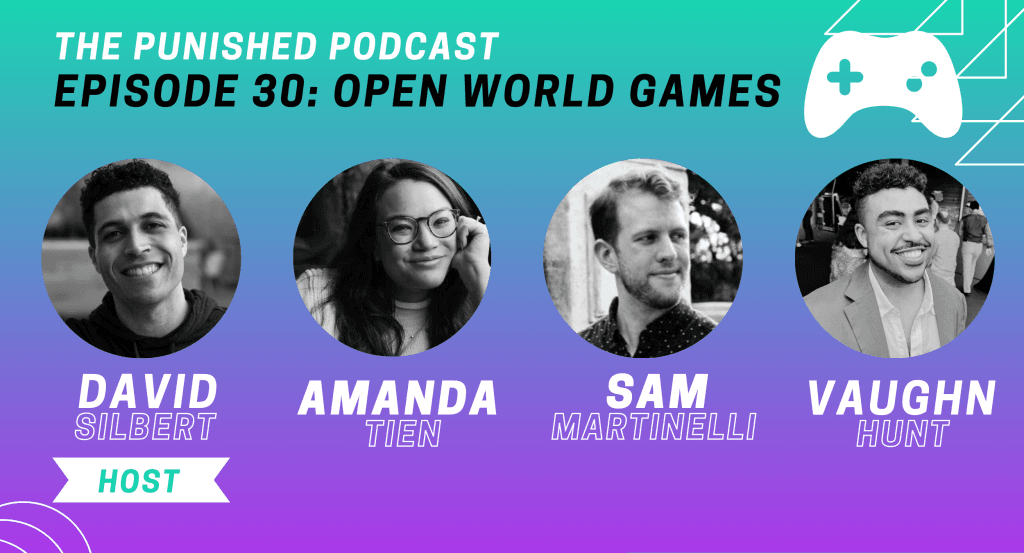
It’s a big episode for a big topic! For the podcast’s big three-o, we discuss open-world video games. From the history of the open world to the best (and worst) ones out there, we explore the vastness of this exhilarating yet often draining genre. We also dive deep into fall’s most anticipated game, Grand Theft Auto VI, before wrapping with a genre-themed knockout discussion. Enjoy!
MP3 Download | Spotify | Apple Podcasts
Note: This episode includes swearing and references to mature video games and themes.
Timestamps
- 0:00 – Intros: Best Season to Play Video Games
- 5:40 – The State of Open-World Games
- 46:40 – Deep Dive on Grand Theft Auto VI and Rockstar Games
- 1:10:00 – Knockout Bracket: Best Open-World Game of All Time?
- 1:47:14 – Outros: Whatcha Playing/Reading/Watching?
Credits and Notes
- Podcast Co-Hosts: David Silbert, Sam Martinelli, Amanda Tien
- Podcast Audio & Graphics Editor: Amanda Tien
- Podcast Distributor: David Silbert
- Theme Song Composer: Jason Hulse
Excerpt
Vaughn: The Witcher 3: Wild Hunt is a great example of a peak open-world game. Like in that first scene when you get to Velen, and you see all that swamp and that decay, and then you have to deal with all those soldiers who are just wandering around! The game opens up. Similarly, in Final Fantasy VI, you get your companions and then boom, the game is open. Explore, get lost, interact with the world as much as possible. That’s the game design mentality of that era, and it does change… Like, for the last several years, it’s the map which is very big, and it’s a lot of hand-holding.
Sam: Yes, that’s a funny thing — I’m realizing one of the reasons I think it took me a long time to get into these kinds of games is because I was so used to playing Nintendo games, in which there is a very specific thing to everything you do. Like, yes, you can mess around in the world in Mario or Donkey Kong game. But there is a very specific focus. In Super Mario 64, you go into a painting and you are trying to find a star. In a Zelda game, you complete a dungeon and then, yes, you can do side quests, but you’re supposed to go and complete another dungeon. And the lack of structure [in open-world games] was overwhelming to me for a long time. Grand Theft Auto games are so unrestricted, so open.
David: I think we’re circling the drain on the definition of “an open-world game” and honing in on what we mean by that. I think we’re describing that it’s the feeling you get — like I’m lost, but in a good way. It’s the lack of structure. Another old-school game that’s relevant here is Shadow of the Colossus…
Everyone nowadays pretty much interacts with open-world games these days. How would you say your interest in the genre has evolved over time? How do you feel nowadays? What is your relationship with modern open world games?
Amanda: That’s a good question. I’m thinking of 2017 with Horizon Zero Dawn, and 2018 with Breath of the Wild, Red Dead Redemption 2, and Assassin’s Creed: Odyssey. For that last one, I thought that was particularly incredible — I can go see these amazing ancient cities, take my boat and sail the oceans, and ride my horse through the mountains. It felt so freeing and amazing. I loved that I could choose whatever I wanted to do that day, that I could do different kinds of gameplay depending on the mood I was in… But by Valhalla and Cyberpunk 2077, it was exhausting and felt really empty… I’m pretty burnt out on new open-world games, and I’d rather just go back and play The Witcher 3 again.
Sam: I always feel that way.
Listen to the podcast for the rest of the conversation!
As always, thanks for listening and reading!
Further Reading

A video game outlet that blends quality words with inclusive voices. For business inquiries and review requests, reach us at press [at] punishedbacklog [dot] com.





David is the founder of The Punished Backlog. He has a problem finishing games he starts.
Just beat: GTA V.
Working on: Fire Emblem: Fortune's Weave.
Can't wait for: Ocarina of Time (2026), GTA VI.
Follow David on Twitter at @David_Silbert to keep up to date with all things The Punished Backlog.


Amanda Tien (she/her or they) loves video games where she can pet dogs, solve mysteries, punch bad guys, play as a cool female character, and/or have a good cry. She began writing with The Punished Backlog in 2020 and became an Editor in Fall 2021. Amanda also does a lot of the site's graphic designs and podcast editing. Amanda's work has been published in Mothership, Unwinnable Monthly, Poets.org, Salt Hill Journal, and elsewhere. She holds an MFA in Fiction from the University of Pittsburgh and a BA in Creative Writing from Columbia University. Learn more about her writing, visual art, teaching, graphic design, and marketing consulting at www.amandatien.com.

Sam has been playing video games since his earliest years and has been writing about them since 2016. He joined The Punished Backlog in 2017 and became an Editor in Fall 2021. He’s a big fan of Nintendo games and complaining about The Last of Us Part II. You either agree wholeheartedly with his opinions or despise them. There is no in between.
A lifelong New Yorker, Sam views gaming as far more than a silly little pastime, and hopes through critical analysis and in-depth reviews to better understand the medium's artistic merit.
Bluesky: @sam-martinelli.bsky.social

Vaughn Hunt is writer who has loved video games since he picked up a controller. His parents wouldn't let him buy swords as a child (he wanted the real ones) so he started writing, reading, and playing video games about them. A historian at heart, you'll often find him deep into a rabbit hole of culture, comics, or music.