
This is part two in a three-part retrospective on the Tomb Raider “Survivor” trilogy. Check out part one here if you haven’t already, and stay tuned for part three in the coming weeks.
Rise of the Tomb Raider (2015) is the best game in the Survivor trilogy.
That probably comes across as an audacious statement given that Rise and Tomb Raider (2013) share the same Metascore (86, for those averse to opening links).1 Still, I would posit that viewing Rise as the high point of the trilogy isn’t an uncommon view. It might not reach the captivating heights of Tomb Raider as a standalone narrative, but it also avoids some of its disorienting lows, the Lara in Rise aligns more closely to the classic Lara of old,2 and the game overall features mechanical improvements in every aspect compared to its predecessor.
From a gameplay perspective, the gunplay is noticeably tighter, Lara’s diversity of options in stealth encounters is vastly improved, and the game offers the most content, main story and optional, of the series. Narratively, within the scope of itself and nothing else, it is the most coherent and satisfying story of the trilogy, avoiding the ludonarrative pitfalls of its predecessor by shifting its tone entirely.
I believe the above statements wholeheartedly. Despite that, I find Rise to be unsatisfying in many ways. Its trend-chasing improvements push Lara into the prominent gameplay patterns of the time, which results in a painfully diegetic dissonance between the Lara that the canon narrative was trying to present and the way she is naturally perceived by the player. This decision also subtly sets the course for the trilogy in a way that diverts the series from ever returning to the “classic” roots of the franchise. Many of the potentially interesting character developments from Tomb Raider and the comics, like Lara’s trauma and PTSD related to the events of Yamatai, her inner conflict over her murderous nature, and her relationship with Sam Nishimura, end up abandoned and discarded. The overall product somehow feels like all of the interesting parts of it were sanded off with focus-grouped precision.3 It is both a perfect sequel and, somehow, a cowardly one.
Form, Function, and the Consequences Thereof
It would be easy to summarize the mechanical improvements from Tomb Raider to Rise as a metaphorical tightening of the screws: the slight but incremental gains made from things like engine experience and genre familiarity. Those improvements definitely exist: Aiming and shooting in Rise feels tighter and more fluid than in Tomb Raider, the dreaded betterment in “gamefeel” that reviewers struggle to explain in words.
But there’s more to it than that. Rise of the Tomb Raider conglomerates many of the trends of the early to mid-2010s era of AAA gaming in one sleek package. There is a negative connotation tied to being “generic” or a “trend chaser,” but from an overall quality perspective, I mean this as neutrally as possible: Rise is one of the most “2010s-era” video games ever. If it is to be labeled as a trend-chaser, it at least does so adroitly.
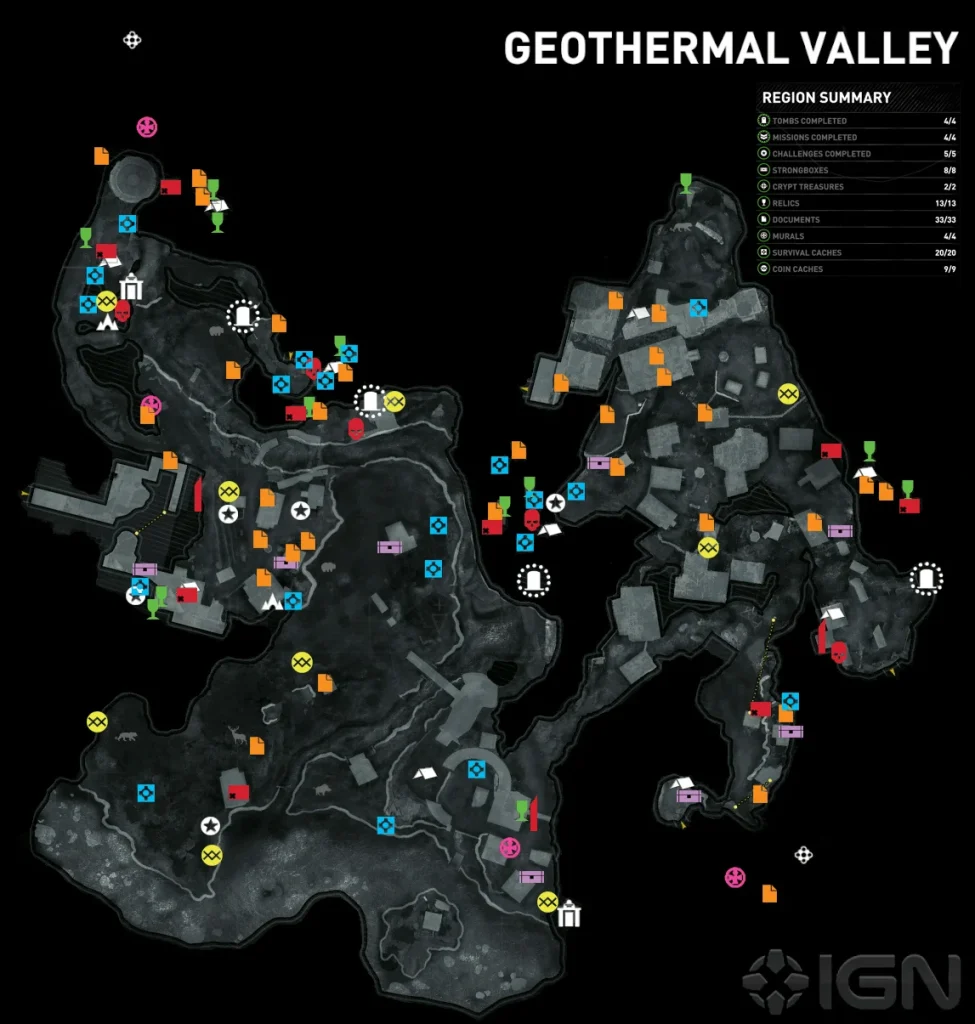
Rise unabashedly embraces the open-world DNA of games of its time. The map is glutted with collectible icons ranging from rare fauna to small caves, chasing the dopamine rush of minor task completion. Lara’s Survival Instincts — her version of the “Detective Vision” gameplay feature that permeated through the industry after Batman: Arkham Asylum — is even more powerful here. The game implements a far more detailed crafting system, allowing Lara to accrue various types of resources to be used to upgrade weapons and craft different types of ammunition on the fly.4
While Tomb Raider interspersed its traversal sequences and cinematic set pieces with cover-based shootouts, Rise adopts the stealth set-piece pace of play, where encounters place numerous wandering enemies in a curated space, offering the opportunity for a quiet or guns-blazing approach. The Last of Us, Assassin’s Creed, and Far Cry are all examples of games that pull from this flavor of encounter design. Environments are also significantly more interactable and designed with vertical movement in mind, which provides Lara the ability to tackle these situations with significantly improved dynamism. The result is that Lara moves through this game like an amalgamation of Sam Fisher from Splinter Cell, Joel from The Last of Us, and Ezio from Assassin’s Creed: She throws glass bottles to distract enemies, she scrounges for branches and salvage before crafting an incendiary arrow that immolates a pair of Trinity mercenaries, she takes cover in thick foliage before bursting out and shanking some poor soldier in the neck.
To be clear, shifting the series in this direction was a smart move that paid dividends, as evidenced by Rise of the Tomb Raider’s relative financial and critical success.5 But there were significant knock-on effects to these decisions that I don’t believe developer Crystal Dynamics anticipated, which created diegetic and narrative friction down the line.
The primary effect of Rise’s trend-chasing is that Lara becomes analogous to other video game protagonists of her time. As her gameplay mirrors her contemporaries, so too does the perceived nature of her character. Classic Lara was far from a pacifist, but she wasn’t this:

Of course, Lara is violent and brutal in Tomb Raider (2013) as well. But there is an air of frenzy and desperation to the events that unfold on Yamatai, an acknowledgement that Lara was under extreme duress, that she did what she had to do to protect her friends. In Rise, that element of shock and horror has faded, replaced by a dispassionate coldness. Firing a gun is no longer an extraordinary act for Lara, but a basic one.
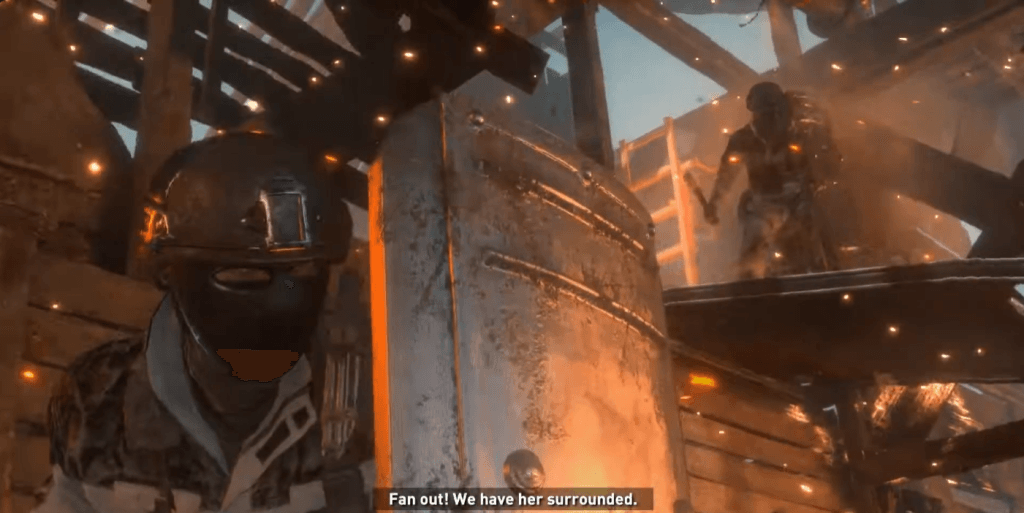
Even the enemies reflect this change. Yes, the Solarii cultists were trying to hurt Lara and the crew of the Endurance, but in the end they too were ultimately victims, untrained men in rags trapped on the island by supernatural forces. Trinity, on the other hand, is a well-funded military organization. The men Lara faces in Rise are soldiers in fatigues, paramilitary operatives whose presence wouldn’t feel out of place in a Call of Duty campaign. Explosive arrows, jury-rigged explosives, and Molotov cocktails in hand, Lara strikes with a deadly precision that is almost discomfiting. What was once desperate is now normal. In a year, she has transformed from a young woman doing everything she can to survive a horrific situation to the equivalent of an elite spec ops soldier.6
Rise represented a divergence point for the Survivor trilogy. If the events of Tomb Raider were an outlier, then its sequel surely would be a return to normalcy (by Tomb Raider standards), setting the expectation for adventures to come. Rise could have shifted focus entirely, moving back to the gameplay and tone of the previous games in the series: a globe-trotting adventure across various locales, more 3D-platforming, tombs, puzzles, with a less grim and serious air. Instead, Crystal Dynamics chose to pursue the trends of the time.
I don’t how much thought Crystal Dynamics placed in this decision, but the final outcome is this: When I think of Lara in the Survivor trilogy, I think of her scrambling through underbrush and stabbing unsuspecting military men in the neck. I see her crafting a Molotov cocktail in seconds and setting soldiers on fire. I think of her jamming a shotgun under a helmed man’s chin and blasting his head off. It’s a far cry from the Lara of old.7

A Descent Into Trauma
The first trailer for Rise of the Tomb Raider features Lara in therapy. I’ve always thought that this was a profound choice — it signifies that the narrative acknowledges the traumatic nature of what happened to her on Yamatai, and doesn’t brush it off as being a typical video game protagonist experience.8 To my recollection, it slightly predates when the mental health movement had become truly vogue, and I appreciated the display of vulnerability here (though some would argue that Survivor Lara had already shown enough of that).
The trailer interweaves the psychiatrist’s concern for Lara’s well-being with her resistance to his words and shots of her both in danger and being the danger. It’s made clear that Lara is unwell here: She’s suffering from flashbacks, nightmares, and isolating herself from her friends and family. Her knuckles are bruised, her foot taps against the floor in an anxious staccato. Storyboards for a scrapped opening to Rise show that this therapy concept was meant to play a larger role in the final narrative, with some of the alternate storyboards even showing Lara developing a drinking problem and getting into brawls with strangers on the street.

Unfortunately, these elements of the character hardly make an appearance in the game itself. The only place where they do is one series of collectible audio logs (Sessions), which showcase moments from Lara’s therapy sessions (it turns out that Lara’s psychiatrist himself is actually a Trinity agent and was manipulating her from the beginning).
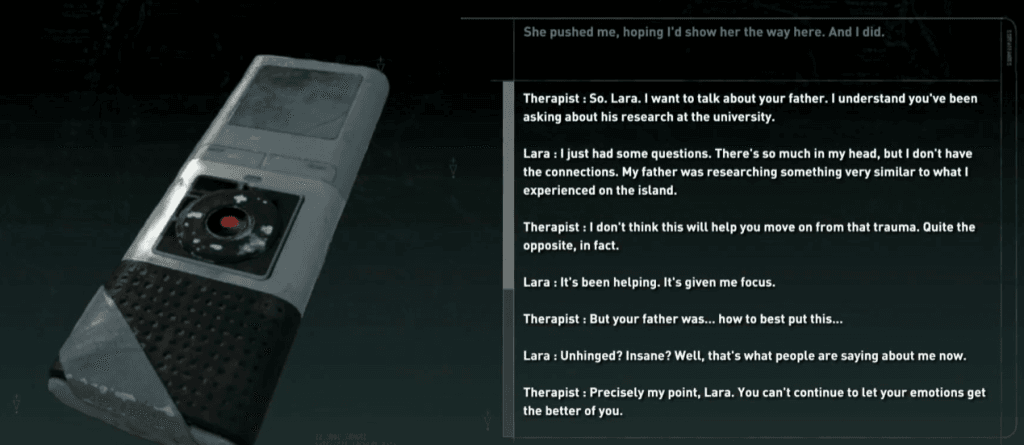
I find this look into Lara’s character utterly fascinating, which is why it’s heartbreaking that it never takes a larger share of the spotlight. That a AAA video game would readily admit to its protagonist being mentally unwell and traumatized is a notable step, but an interrogation of the murderous nature of its protagonist and her actions requires more self-awareness than I would have expected from Tomb Raider as a series.

In the end, I have to imagine the developers realized that the core gameplay loop of Rise simply wasn’t compatible with the philosophical or moral exploration of Lara’s actions as presented in this trailer. With the exception of this series of collectibles, Rise adopts the same strategy that Uncharted does: It tries its best to downplay the moral implications of Lara’s behavior as much as possible, drawing as little attention to it as it can.
Unlike Tomb Raider (2013), where death and violence carry a certain weight and Lara’s ability to commit such actions is treated as special, Rise commits to de-emphasizing these actions where it can. Outside of the trailer and these audio logs, guilt toward the enemies she murders is not an emotion Lara displays, and quite early in the game, multiple NPCs — namely Jacob and Sofia — openly murder Trinity soldiers in cutscenes. The nonchalance with which Jacob chucks a throwing knife into the back of an unsuspecting Trinity operative in an early cutscene helps set the tone that we’re not going to be agonizing over the moral cost of murder here like we did in Tomb Raider.
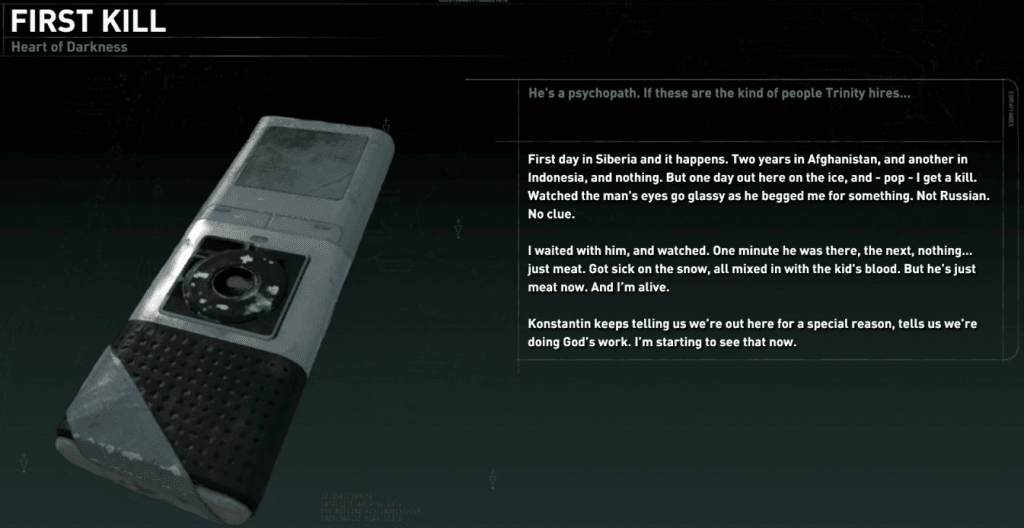
But while Lara’s guilt and trauma might have been cut from Rise, they play a notable part in other canon story materials. And that’s why we’re taking a detour into the world of the comics.
A Sidebar Into Comics Canon
There’s a decent amount of non-game story material relating to the Survivor trilogy. The most notable are two comic runs published by Dark Horse Comics. The first 18-issue run was penned by comics veteran Gail Simone and Rhianna Pratchett, the lead writer for Tomb Raider and Rise of the Tomb Raider, and takes place in the year between those two games. The second 20-issue run was penned by Mariko Tamaki for the first two arcs and Jackson Lanzing for the last two, and takes place between Rise and Shadow of the Tomb Raider. (We’ll touch upon the second run momentarily.)
The comics fill in a lot of characterization that goes unwritten in the games, and are treated as canon material, which is a bit of a rarity as far as tie-in content goes.9 That Rhianna Pratchett wrote much of the first run of comics also obviously helps in terms of their community recognition. Pratchett’s involvement in the comics is also another reason why I blame gameplay incongruities for ultimately leading to this aspect of the character being de-emphasized in the game proper — alternate storyboarded intros and the degree to which they play a role in Lara’s characterization in the comics is too much material for it to have been just ancillary potential.
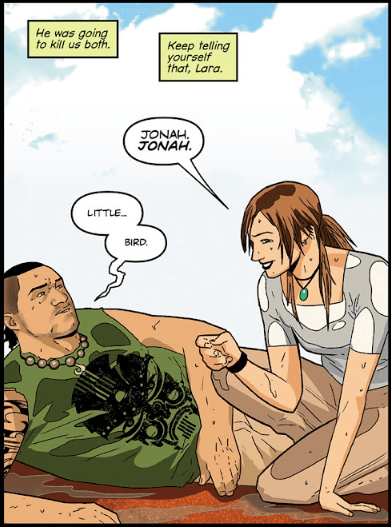
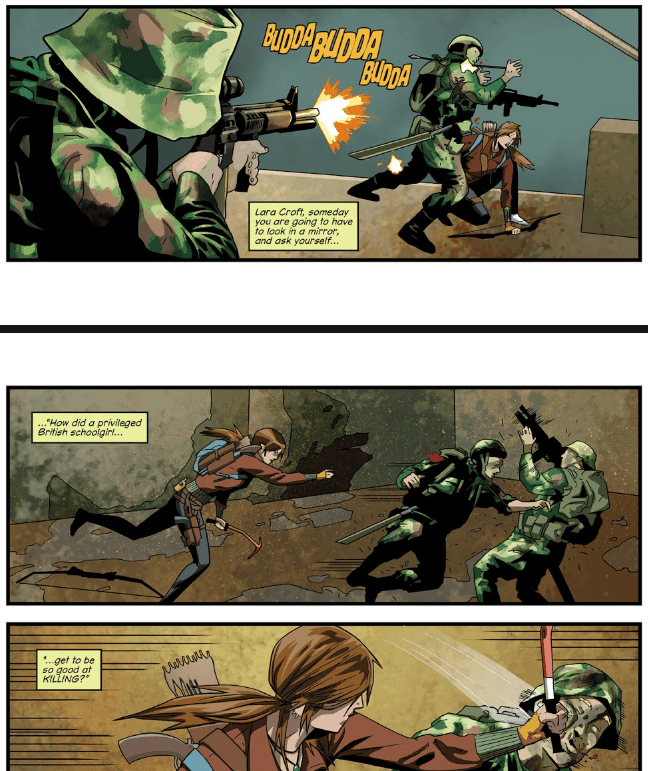
There are numerous differences between Lara’s characterization in Rise and her characterization in the comics, but if I had to choose one primary change, it’s that the comics are laser-focused on examining what it means that Lara is a killer. She agonizes over it internally:
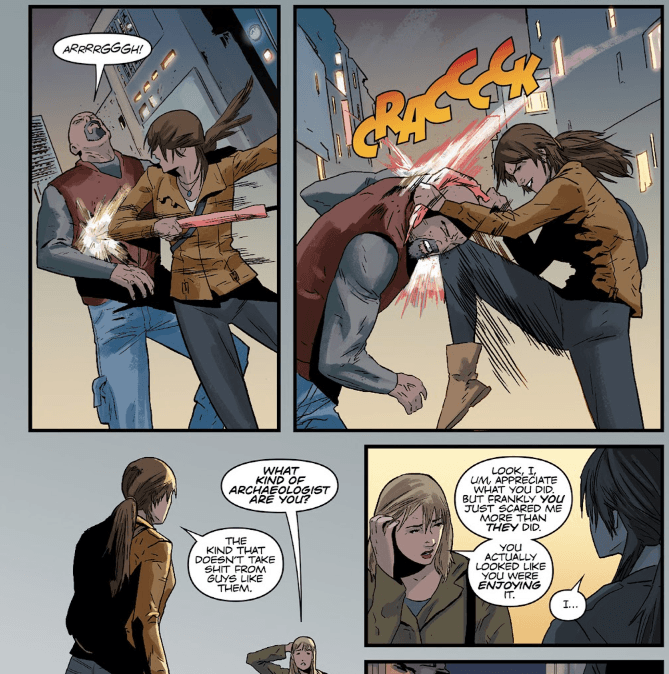
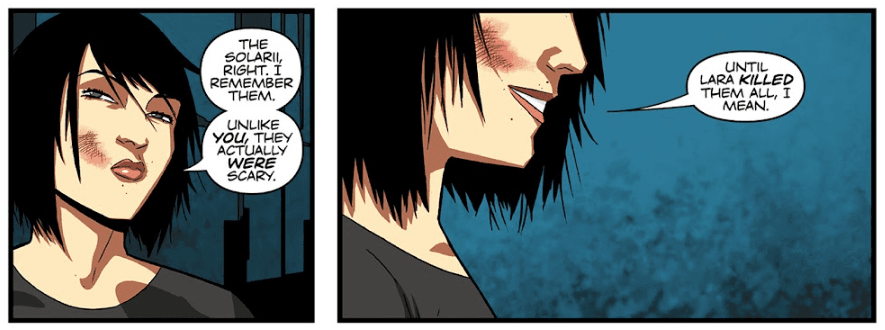
Other characters, from civilians to her closest friend10 to Trinity operatives to professional assassins, make note of her bloodlust and competency:
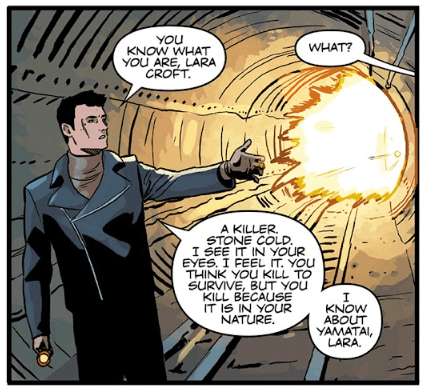
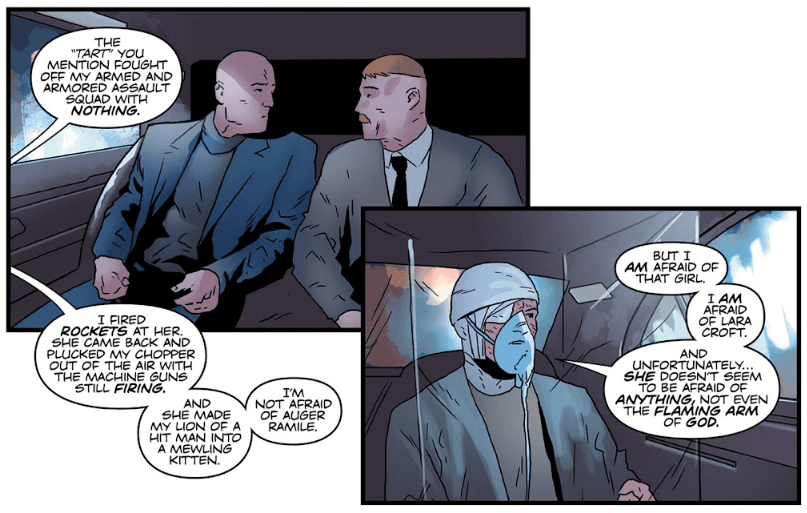
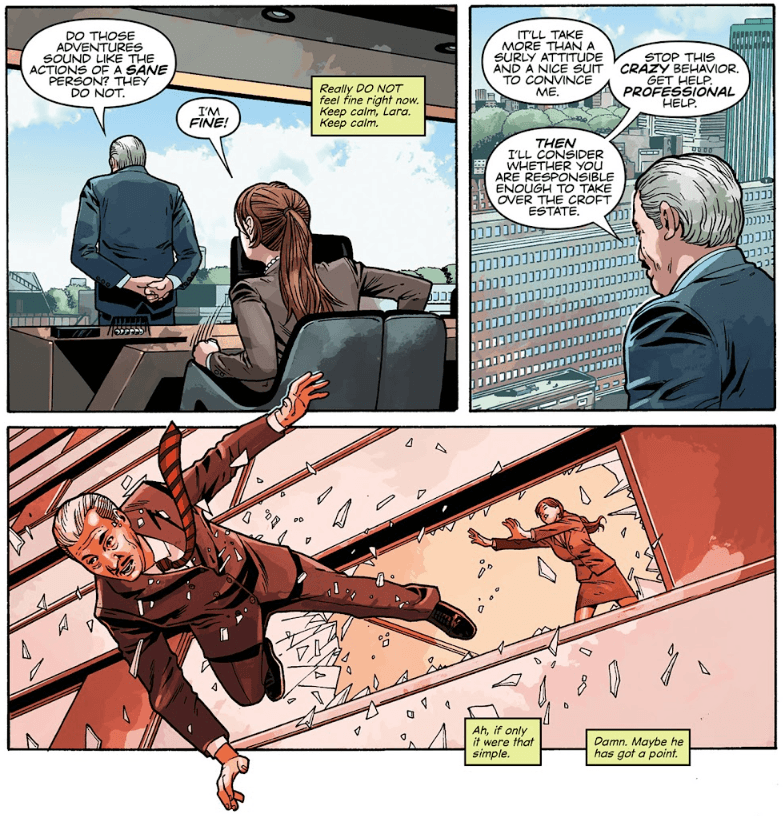
At one point, Lara has to speak to her uncle, a corporate businessman, to try to regain her rightful access to the assets of the Croft estate; when he stipulates that she go to therapy, she fantasizes about throwing him out of the building to his death:
To be fully transparent, despite Rhianna Pratchett’s involvement with this run of the comics, I do not think particularly highly of them. I would describe the pacing as frenetic in a bad way, and the villains and their plans are, frankly, nonsensical. The elements of Lara’s character that I highlighted above are philosophically interesting, but her overall attitude borders on unpleasant.
Despite these feelings, I find the comics worth showcasing here because they show both tantalizing hints of a more interesting characterization and also a clear commitment and dedication to an idea that was, for whatever reason, ablated from Rise proper. The concept of taking a beloved video game character, running them through the rigors of modern-day protagonism (read: committing incredible amounts of violence), and then making them reckon with the consequences of such while turning them into a misanthrope is a bold, bold move. It’s no surprise that they abandoned it, but it’s a fascinating idea.
A Sidebar Into Comics Canon Part 2: I’m in Lesbians With You
Now is the time to talk about the Sam Nishimura-sized elephant in the room. For those that are unaware, Sam and Lara as a pairing is the most popular form of fandom engagement for the trilogy. Even for those who feel ambivalent about the pairing in particular, there’s no denying that it struck a chord within the fandom: It’s the most popular pairing Lara has with any character by a fair margin. The vast majority of fanworks surrounding the trilogy feature Sam and Lara together.
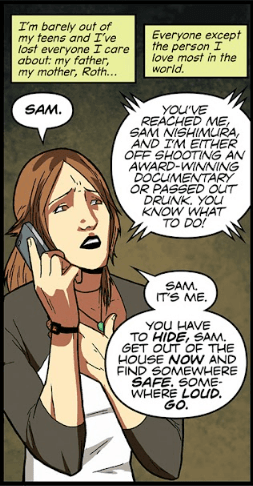
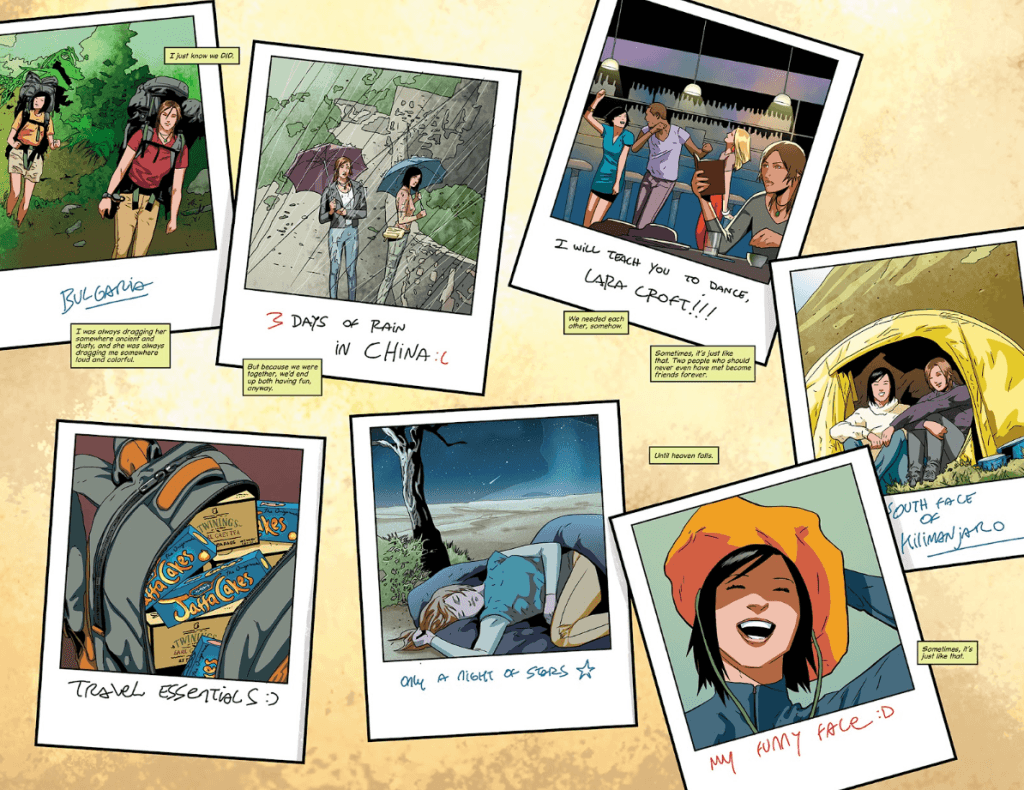
The most straightforward statements we have about it from Rhianna Pratchett are as follows (via Eurogamer), which I will quote directly with as much context included as possible11:
But, despite this discussion, Pratchett tells me Lara’s sexuality wasn’t something that Crystal and her particularly talked about during Tomb Raider’s development.
“I don’t think Crystal really wanted to explore that area of Lara and Sam in particular,” Pratchett says. “I was very open to it as a writer. But, yeah, I think they didn’t want to commit to it with the first game. I don’t know why, perhaps they felt it would be too much of a distraction.”
Pratchett adds: “I would have been perfectly happy to do it. I’ve got my own ideas… But I think Crystal…maybe [wanted to] leave that open to interpretation.
“I guess the short answer is, they didn’t want to be explicit about it. They didn’t want me to be explicit about it.” Pratchett also states that, despite some previous narratives in the media, it was never a case of Crystal saying “no” to making Lara gay.
“There was a lot of discourse about it at the time because of one interview I did where I was speaking for a long time with the journalist about general representation and I said ‘oh, I would have loved to have made Lara gay’, as in like, if that had kind of come up and that was a direction that that Crystal wanted to take it, I would have been perfectly happy to,” Pratchett recalls. “But it got changed as if I had come in with that particular agenda and Crystal had said ‘no’, and I was like, that wasn’t the case at all, but it created a sort of narrative about it.”
Even though Pratchett neither confirms nor denies Lara and Sam’s relationship, she says seeing fanfic of the couple makes her feel “proud” to this day.
Both the 2014 and 2016 comic runs make allusions to the pairing. Jackson Lanzing, the writer for the final arc of the 2016 run, has openly talked about wanting to make the relationship canon:
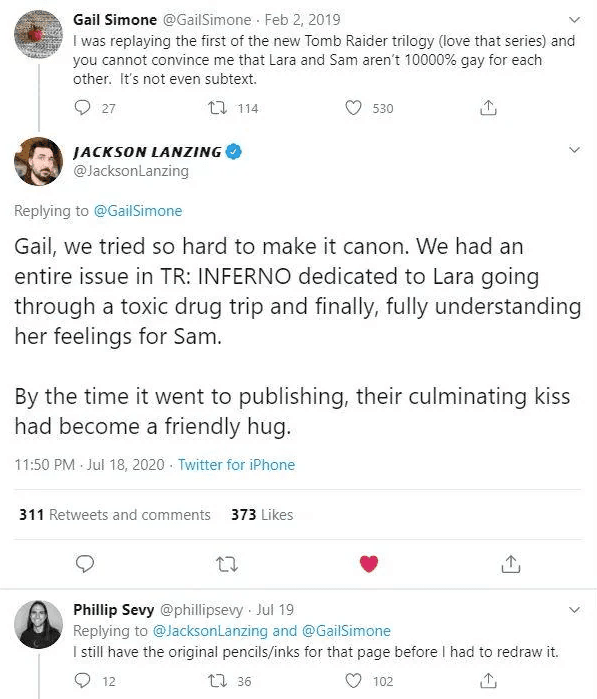
I’m sure there is some corporate reasoning that justifies why this couldn’t happen. Maybe it is my naivete speaking here, or perhaps I have a rosier view of the mid-2010s than they deserve,12 but I do view it was a missed opportunity. Sam and Lara’s relationship, and the care they show for each other, is one of the most interesting things about the Survivor trilogy as a whole. Personally, I view Lara being a lesbian — or bisexual — as actually a significantly less bold move than her being a self-aware murderous killer, which Rise alludes to and Shadow will try to tackle with tremendous aplomb and the subtlety of a sledgehammer.
That season two of the Netflix series reintroduced Sam into continuity at all is probably the most we can ask for — I would personally be shocked if she has a role in the “Unified” timeline going forward at all — but I would love to be proven wrong.
Closing Thoughts
I will reiterate again that Rise of the Tomb Raider is the most complete entry in the series. The gameplay is dynamic, the narrative beats are largely coherent, it features the least amount of ludonarrative dissonance in the series, and it even has some tombs in it. But these improvements happen because Crystal Dynamics pushed the series toward the modern gameplay trends of the time, and in doing so pushes Lara into a role analogous to other AAA protagonists of the time.
The end result is that she is a stealthy, efficient killer, better with guns and knives than anything else, a kill count that makes her rampage at the tail end of Tomb Raider seem quaint in comparison. The shift does little to establish the rise of Lara Croft, Tomb Raider, however. Instead of globetrotting adventure, puzzles, and platforming, Lara’s body of work in Rise consists of stealthing her way through military compounds, spending almost the entirety of the game in a single Siberian valley. She is less Lara Croft and more Sam Fisher. Every negative I raise here surely paid dividends in terms of Metascore and sales, and yet I find it depressing nevertheless.
On the other hand, it fails to divert the series from its traumatic reimagining toward the classic Lara of old. Its title — Rise of the Tomb Raider — is nothing more than a failed promise. On the other hand, it also fails to capitalize on any of the intriguing, if risky, narrative elements that were introduced in Tomb Raider. Lara’s trauma, her guilt, her moral positioning in relation to her gruesome actions, and her relationship with Sam are all excised in favor of a more palatable, emotionally neutered story. It is a perfect sequel, and somehow one that is defined by missed opportunities more than anything else.
Because we didn’t cover specific story beats from Rise in detail, I’ll go over some notable moments here:
- My favorite Lara moment in Rise has to go to her calling Ana, her adoptive stepmother and secret Trinity agent, a cunt. She almost gets it out!

- The only character from Tomb Raider who makes a real appearance is Jonah. (Yes, he looks very different in Rise compared to the other two games, I’ve never understood why.) The scene where he is captured by Konstantin but manages to turn the tables on him and hold him at gunpoint while Lara watches is another favorite of mine. I do love just how straightforward she is about telling Jonah that he should just shoot Konstantin in the head.
- Much of Lara’s arc in Rise, after the whole PTSD thing is abandoned, focuses more on her obsession, the potentially damaging nature of it, and the degree to which she is willing to accrue collateral damage to satisfy her pursuits. Secondarily, it focuses on her relationship and view of her father, as it’s revealed that Richard Croft shot himself and that Lara was the one who found the body as a nine-year old. For the most part, I think these arcs work, which is why I said that Rise is, at least internally, narratively satisfying. I say internally because Shadow kind of immediately reneges on a lot of the development Lara makes in Rise. But overall, the arc where Lara comes to understand her father better, makes peace with his death (which actually came at the hands of Trinity, not suicide), and reconciles her obsession with proving his research into immortality as valid with the peace and betterment of others — choosing to protect the people of the valley and allowing the Divine Source to be destroyed — is a good, functional bit of writing. Again, until Shadow undoes almost all of it.
- The Blood Ties story DLC is a pure walking simulator, but it fleshes out the relationship between Lara and her father well, and there are some really sweet moments in it.
- The Baba Yaga: The Temple of the Witch story DLC is also quite good. Nadia in particular is a cute character (and yet another woman who has bizarrely good chemistry with Lara).
- Speaking of chemistry, I do find it funny that Lara almost exclusively has chemistry with other women. I like Jacob as a character, but there is almost nothing between him and Lara.
- Overall, 9/10 game. Definitely the best of the trilogy gameplay-wise. The stealth sections are great, and I wish there were more.
Thankfully, Shadow of the Tomb Raider is an extraordinarily interesting game, warts and all. Stay tuned for part three where I go completely insane!
Footnotes
- I’m going to chalk this up to a concept I’ve just now coined called “sequel-induced score deflation.” Video games are still viewed as more akin to technology than literature, which means they suffer from the expectation that, like all technology, they must show marked improvements over time. This belief is often baked into expectations for AAA games, as a video game sequel often has to be transcendently better than its predecessor to make that jump from one tier of perceived critical quality to the next. ↩︎
- The Lara in Rise isn’t that similar to the classic Lara, but she at least isn’t framed as a victim for most of the game, which is a welcome tonal shift from Tomb Raider (2013) and more in line with the rest of the franchise. ↩︎
- I’m not privy to any insider knowledge about Rise’s development. It’s far more likely that these issues I bring are as much, if not largely, due to time pressures and the overall difficulty of game development as opposed to a specific desire to cater to any given audience. ↩︎
- I’m aware that the skeleton of some of these features existed in Tomb Raider, but they actually feel fleshed out in Rise. For example, while Tomb Raider has only one collectible resource (“salvage”), which is used solely for linear weapon upgrades, Rise has several different collectible resources, used to craft special ammunition for each of her weapon types and also to develop an expansive weapon upgrade tree. ↩︎
- There are some complicating factors here, like Rise initially being a timed exclusive for the Xbox One and publisher Square Enix’s elevated expectations for its games during this period of time. Rise may not have been maximally profitable for Square Enix, but it was a success. ↩︎
- Or, a later game might argue, it has revealed the kind of person she was all along. ↩︎
- Another way of looking at it: Tomb Raider compilations feature Lara dying horribly, whereas Rise of the Tomb Raider compilations feature Lara killing awesomely. Both feel somewhat transgressive, though if I had to pick which is more transgressive, I would go for the former. Rise does feature some gratuitous death as well, of course, but they don’t feel as voyeuristic as they do in Tomb Raider. ↩︎
- Lara wouldn’t be the first video game protagonist to go to therapy, but it is rare. Michael in Grand Theft Auto V goes to therapy, but Dr. Friedlander, like many elements in the world of Grand Theft Auto, is mostly a parodical satire of his profession more than anything else. Until Dawn and Silent Hill: Shattered Memories feature therapists as framing devices. There’s also more than a few psychiatrists who turn out to be evil, though naming and shaming them would be spoiler territory. ↩︎
- There’s also a tie-in novel called The Ten Thousand Immortals, co-written by Dan Abnett and Nik Vincent. The Ten Thousand Immortals directly contradicts a few established facts in the comics and games, however, so it’s generally considered non-canon. ↩︎
- “Friend,” yes, I know. We’ll get to it later. ↩︎
- I’m aware that she has commented on this pairing numerous times — some of it lost to the trenches of Twitter — and not always with high degrees of consistency. ↩︎
- Square Enix published Life is Strange in 2015! ↩︎

Huge video game, comic book, and anime fan. Spends way too much time watching things he doesn’t like. Hates Zack Snyder. Mains Falco.