
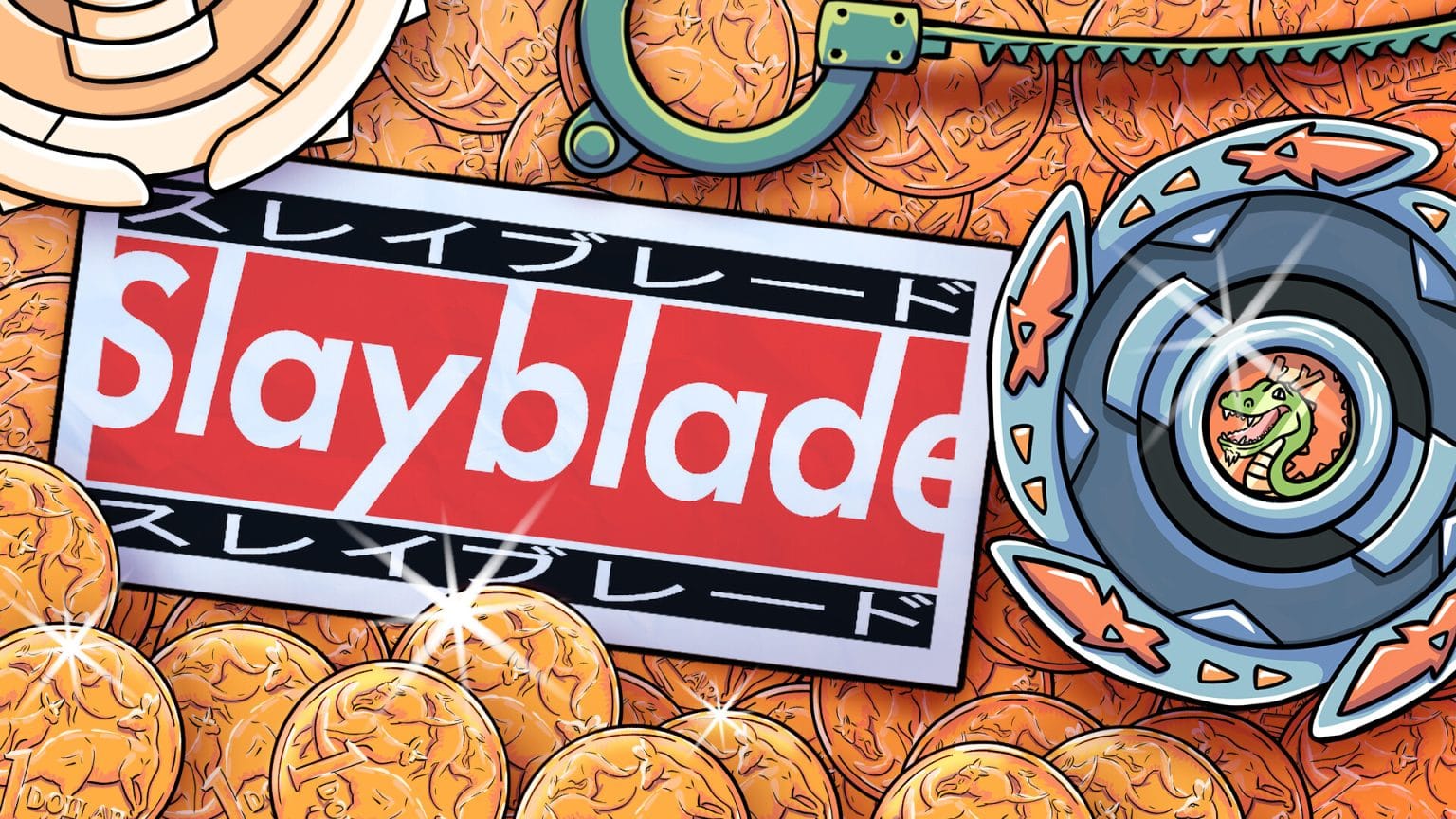

When I first heard about Slayblade, the debut game from Australian developers Rob Gross and Oscar Brittain under the name Henry’s House, I had to get my hands on it. A roguelite built around a definitely-not-Beyblade battle? I needed to know more. Henry’s House was gracious enough to provide a pre-release code for their top battler, and I’ve spent the past couple of evenings poking away at Slayblade’s retro-inspired city.
The good? Slayblade is exactly as advertised: a kinetic roguelite where you slam tops into other tops set to a fantastic soundtrack. The bad? That is all Slayblade is, with a difficulty curve matched only by the sloping sides of the arenas. Folks looking for in-depth mechanics will leave Slayblade wanting for more, but if you’re looking for a simple yet good time, then Slayblade can provide. Your mileage may vary.
Slamming in the ‘00s
Slayblade drops players straight onto the streets, slayblade in hand and ready to make some money. Why? Doesn’t matter. Slayblade provides no story other than that you want to win a tournament that will start in four days. All you have is time, a few bucks, and a mission to make the best slayblade possible while maintaining the $40 needed for the entry buy-in.
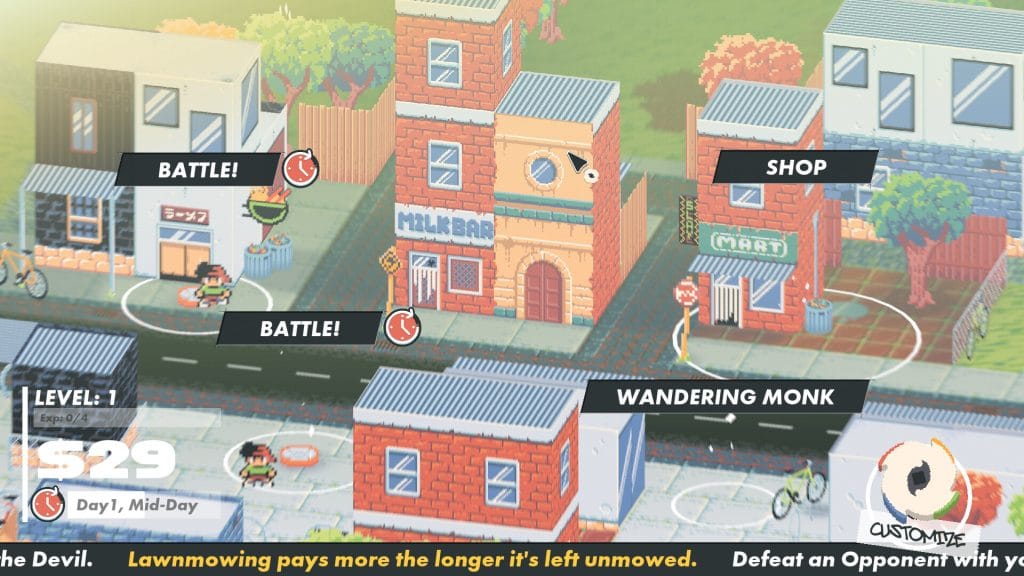
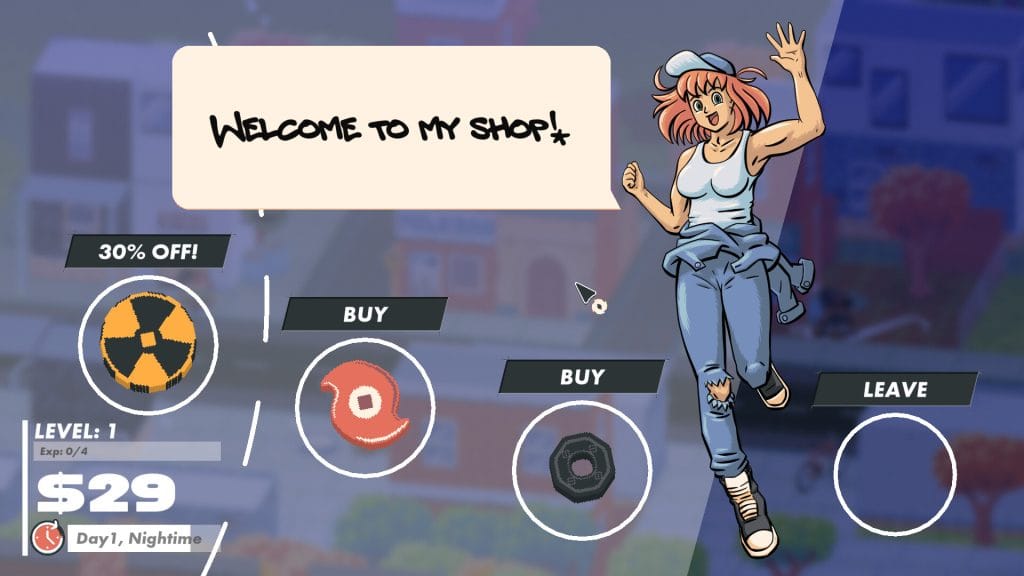
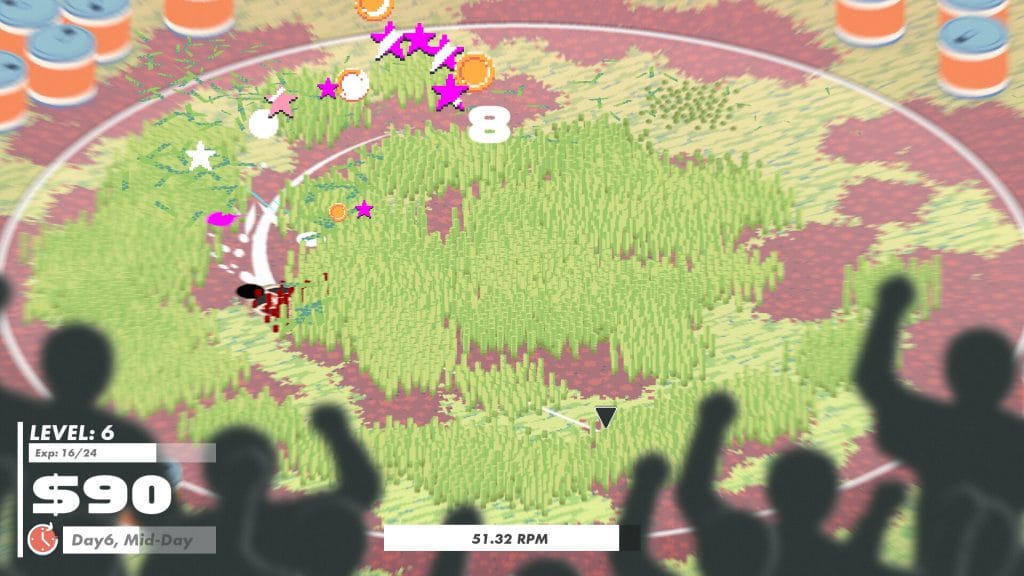
This minimalist approach works for Slayblade; after all, the focus of the game should be on the slayblade battling itself, right? Players skate around a circular city while engaging in various tasks. You’ll find loose change on the ground, engage in side activities like mowing a lawn with your slayblade, or check out shops that provide additional slayblade parts. We’ll get into the customization side of things in a second, but this is really your moment-to-moment in Slayblade: Search for random events, maybe upgrade your top, and then dive into battles.
While I found the skating fun at first, it quickly became tedious. Rotating the world is done by dragging your mouse to the far corners of the map, which also drags your character behind it. Doing an activity or entering a shop requires your character to be within a small circular icon, which turns out to be tricky when the map is also spinning as you move your cursor. Tedious and annoying, but not dooming.
Given you’ll spend most of your time either on the world map or in battles, you’ll have plenty of time to take in the aesthetics of Slayblade. The game’s artwork is sharp, hitting the mid-2000s aesthetic that the development team is aiming for. The music pumps, the pixels jump, and full character portraits pop. The slayblades themselves also look fantastic, with each customizable part bringing its own unique flair.
But enough about all that; you want to know about the fights! The reason we’re all here!
Drag on Drag
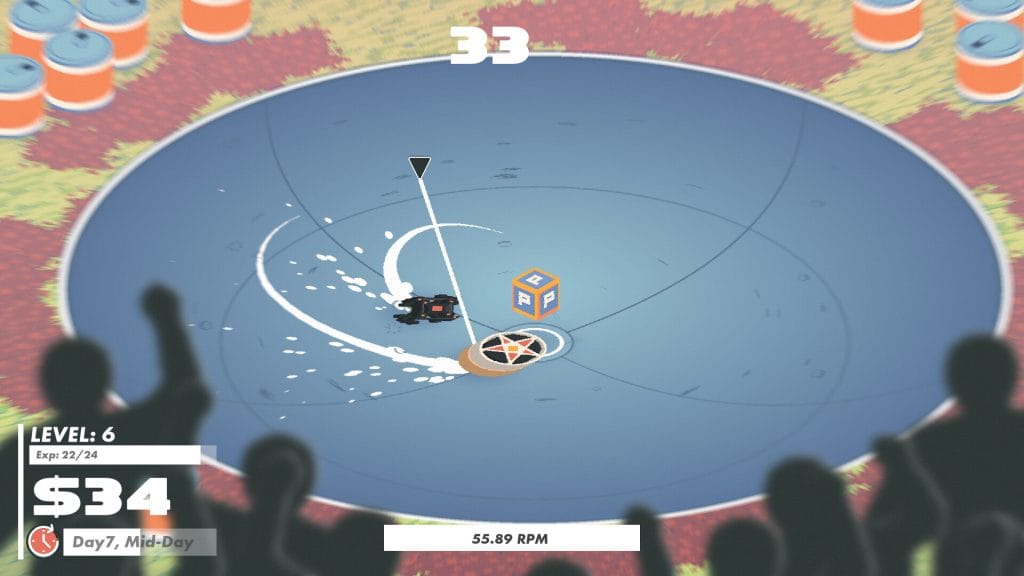
To battle with your slayblades, you first bet a predetermined amount of cash ahead of a match. (If you can’t complete the bet, it’s game over for you, pal.) After you accept the terms, you’re brought into an arena. You see the slayblade launcher in your hand, and your opponent’s across the field. An all-too-brief pop-up lets you know any special abilities your opponent is bringing into the battle. Then your slayblade fires.
Once the battle starts, you drag your mouse from side to side to slap your slaybade into your opponent. You can gain speed on the sides of the bowl, but be careful not to go too far out, or you’ll take damage (something the game doesn’t make clear, especially as some enemies don’t suffer that drawback at all). Gain some momentum, hit your opponent, bounce away, and repeat. Occasionally, Mario Kart-esque boxes will spawn on the field, activating your special abilities (if you have any). And that’s it. Hope you win, slap your opponent’s slayblade, and try to make sense of what’s happening.
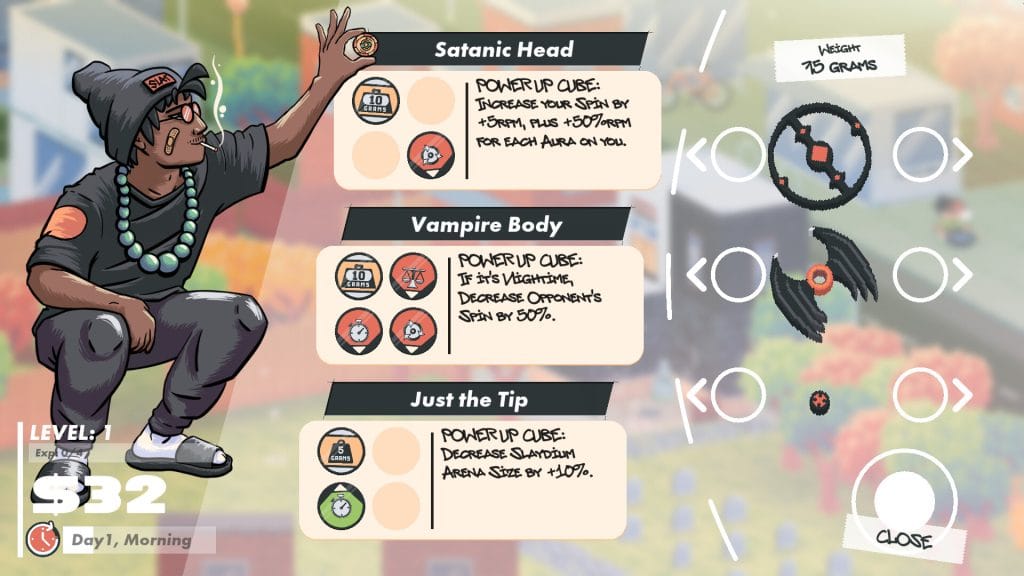
Your slayblade’s abilities are determined by what pieces your top has equipped. These are broken up into three categories: head, bod(y), and tip. There is a weight tradeoff to pieces as well: Heavier pieces lower your max health (known as “RPM”) but do more damage, and vice versa for lighter pieces. Abilities are neat effects, like spawning ghosts that slow your opponent or dropping the occasional missile, but they don’t provide major benefits. It is still very easy to just magically lose immediately, without so much of a blink.
The Oil on the Field
Slayblade has a difficulty problem. The opening tutorial does a poor job of explaining mechanics, leaving certain interactions up to you to find out. This wouldn’t be so much of a bad thing if matches lasted longer than 20 seconds, but for the most part, they are either a crushing victory or a crushing defeat. Leveling up during runs isn’t readily explained; it’s also not clear what the three skills that you grow actually do. There is a layer of obfuscation to the mechanics in the pursuit of “Figure it out as you go!” And that’d be great… if the game wasn’t incredibly difficult right from the jump.
As you play through Slayblade, you’ll unlock various “Episodes” (essentially a set of universal modifiers you can add to your run to spice things up). The most prominent of these modifiers is a dog that occasionally stomps onto the field, doing damage to whatever is underneath. You can try to knock your opponent into the dog, or vice versa, to inflict some damage… Or you can suffer all the damage, since it’ll shred about 75% of your health and slow the game down in such a way that you’ll fly off the side of the arena, dealing the other 25% needed to lose.
Even in free mode, without any “Episodes” assigned, the difficulty ramps up incredibly quickly. You’ll find your first two fights to be cakewalks, then get bounced by an “illegal fight” during the night period. Because your cash is your life, and you need it to buy upgrades, it’s difficult to upgrade quickly enough to match up against these tough opponents. On top of all that, the game offers no graphical or performance settings to tweak, so if the slowdown is due to your PC not being up to snuff, you’re sadly out of luck.
Final Thoughts: Twirling Tops
After several hours with Slayblade, I’m not entirely sure what to make of it. Lovingly crafted, with electric music and killer designs, Slayblade works well toward its goals: a simple roguelite built around whipping tops at other tops. But the lack of full explanation for its mechanics, frustrating difficulty, and minimal graphical options make Slayblade an experience that’s hard to recommend.
Slayblade opens with a fake Nintendo Wii caution screen and fake DS start screen, harking back to those Nintendo consoles. And every time, I found myself wondering: Would Slayblade be a more enjoyable experience if it were launched on those consoles? There is joy and fun to be found in the pixelated city, and for $6, you can do a lot worse. But perhaps that fun’s not meant for a long time.
Score: 6.5/10
Slayblade, developed and self-published by Rob Gross and Oscar Brittain (a.k.a. Henry’s House), releases tomorrow, August 20, 2026, on PC (via Steam). MSRP: $5.99.
Disclaimer: A review code was provided by the developer.

Gary is a jack-of-all-trades video game enthusiast based in Boston, MA. A semi-professional fighting game player, even less professional Apex Legends player, and even less professional adult, he spends most of his time poking at strange indie gems and reading about the need for more diverse voices in gaming criticism. He invites anyone to recommend anything he's missed in the gaming world via Twitter or BlueSky, where he can found under the username @grtnpwrfl. When he isn't spending his time playing games, Gary is an avid New England Patriots fan and frequent hiker.


1 Comment
I loooooove this art style