
XCOM: Enemy Unknown is one of the most important games I have ever played. Before XCOM, I was not a tactics person. Besides a brief dabble in Final Fantasy Tactics, I never understood the genre. It’s also worth noting that I am bad at chess; there are too many pieces with too many things they can do, and too many things that are smarter than I am. So the tactics genre passed me by. XCOM changed that. I finally got it: the movement, the spatial awareness, the resource management. I was obsessed, and have been devouring the genre since. I have also, it’s worth noting, gotten better at chess.
Luckily for my obsession, pioneers of the genre continue to do great things. Some go big, like the excellent Mario + Rabbids games. Some go small, like Fights in Tight Spaces. But few hit the narrative highs, combat highs, and pure enjoyability of developer Bit Reactor’s first game, Star Wars Zero Company. As a new studio founded by veterans of Firaxis, the studio behind XCOM: Enemy Unknown, it makes sense that Bit Reactor would return to the genre they know so well. To do so with a license as beloved (and fraught with game failure) as Star Wars is also a bold swing.
As it turns out, any apprehension around Zero Company was unneeded. Zero Company is a rare home run, a package built for fans of tactics games as much as for Star Wars fans. Tactics-focused folks will find an engaging, class-based system with a ton of depth and versatility. Star Wars folks will see a sharp story set during the Clone Wars that fits perfectly within existing canon. And as a fan of both, I came away from my time absolutely thrilled.
A Story Set Far, Far Away
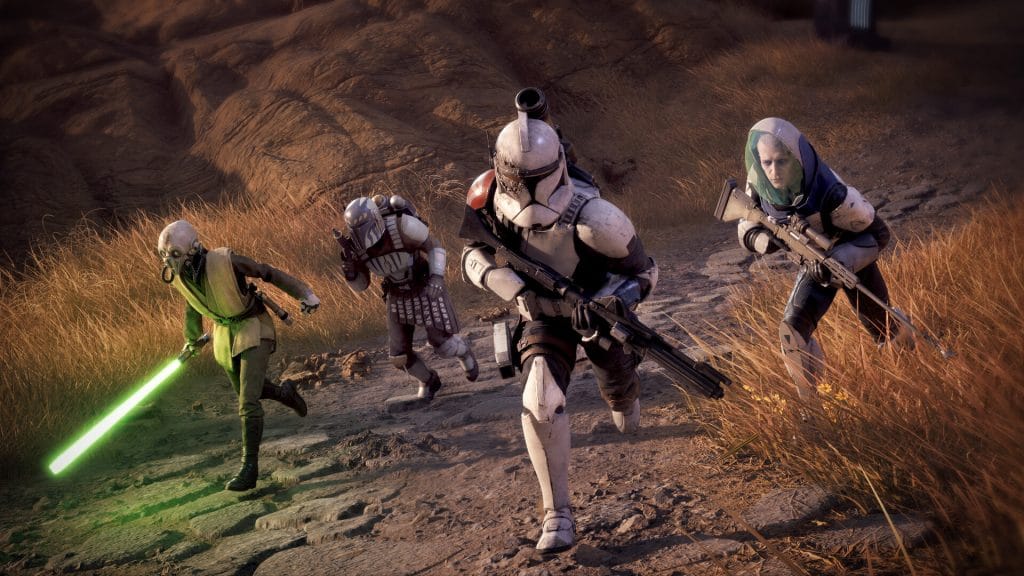
Rather than being a story of Jedi and Sith, Star Wars Zero Company wisely tells the story of just a regular person in the galaxy. Players take control of Hawks, former Republic hero and current splinter company operator, as they and their crew, the titular Zero Company, get dragged into stopping a parallel threat to both the Republic and Separatist forces. Joining him are a ragtag team of ne’er-do-wells from throughout the galaxy, including a clone trooper from Hawks’ former unit, a sassy medical droid voiced by D.C. Douglas (Legion in Mass Effect), a Separatist business pioneer as the money woman, and many others.
Unlike its Firaxis predecessors, Zero Company combines named characters with history and motivations with randomly generated squadmates that fill out your squad. Unlike “hero-units” in other games, all squad members carry the same strengths and potential for death. Koruk Demino, a generated hired-gun medic who joined my squad early on, became a perennial face alongside Hawks and storyline companions Trick, a clone trooper, and Jae Mordant, the baroness with a rage problem. Each character can build bond levels with one another by hanging out or going on missions together, which unlock further training opportunities. Players will naturally find the people they connect with and want to keep alive, but the danger is always there.
While I can’t share too much about the story itself for fear of spoilers, I can say that while the traditional Star Wars trappings are present, the story skews away from the magic of the Force. Zero Company is more interested in the human (or Zabrak) side of the Star Wars universe: the people in the margins, the folks devastated by war, and the worlds left behind. The Jedi aren’t swooping in to save the day; Hawks can’t wave their hand and convince a guard to let them by. The wit, strategy, and guile of everyday people are what saves the day. And Zero Company is better for it.
It’s All About Tactics
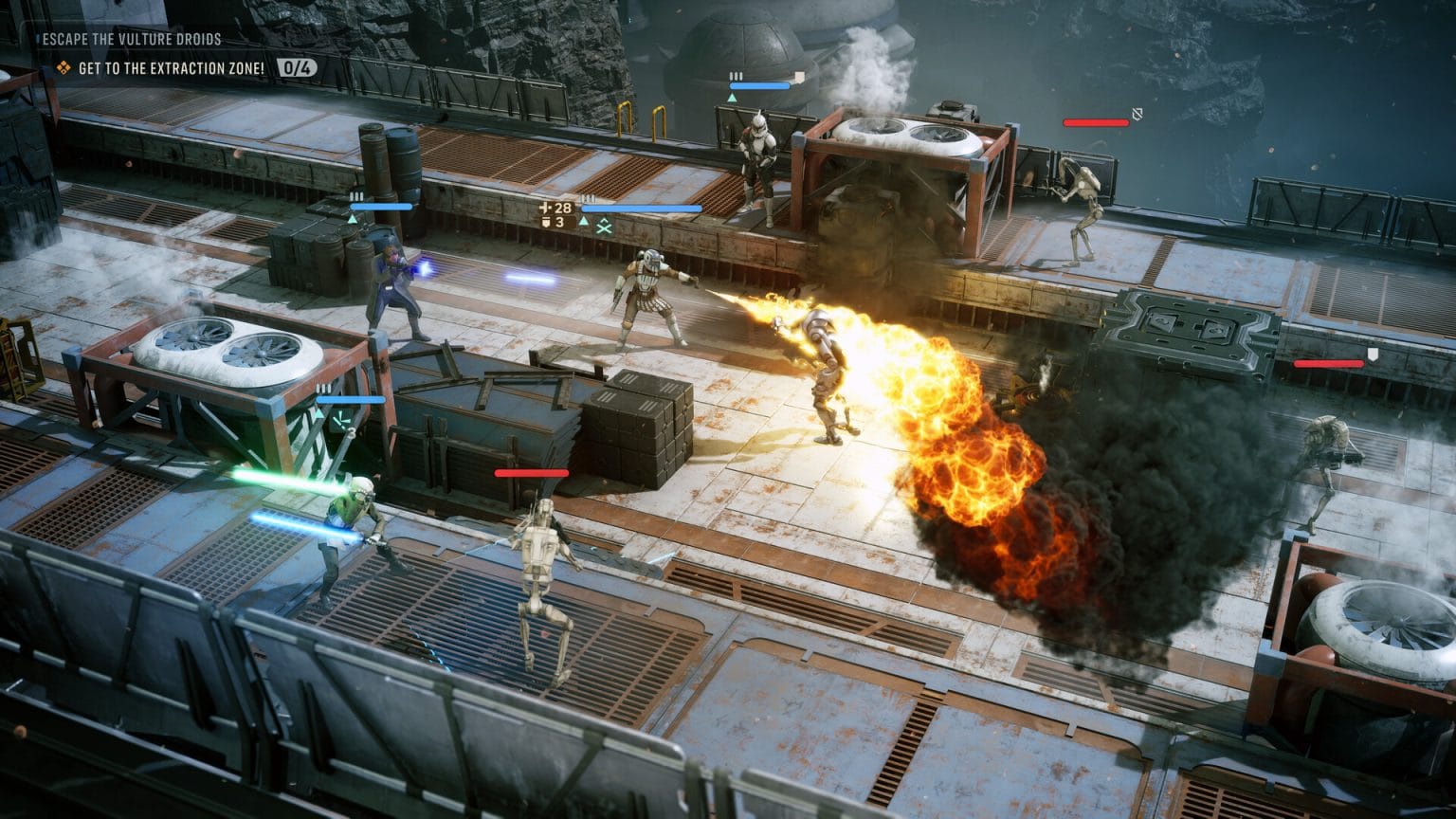
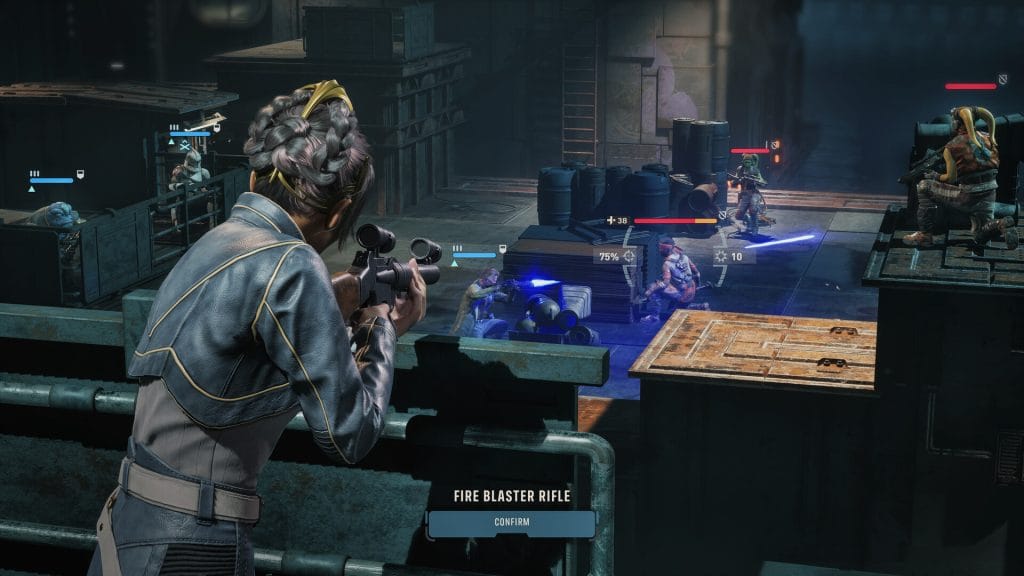
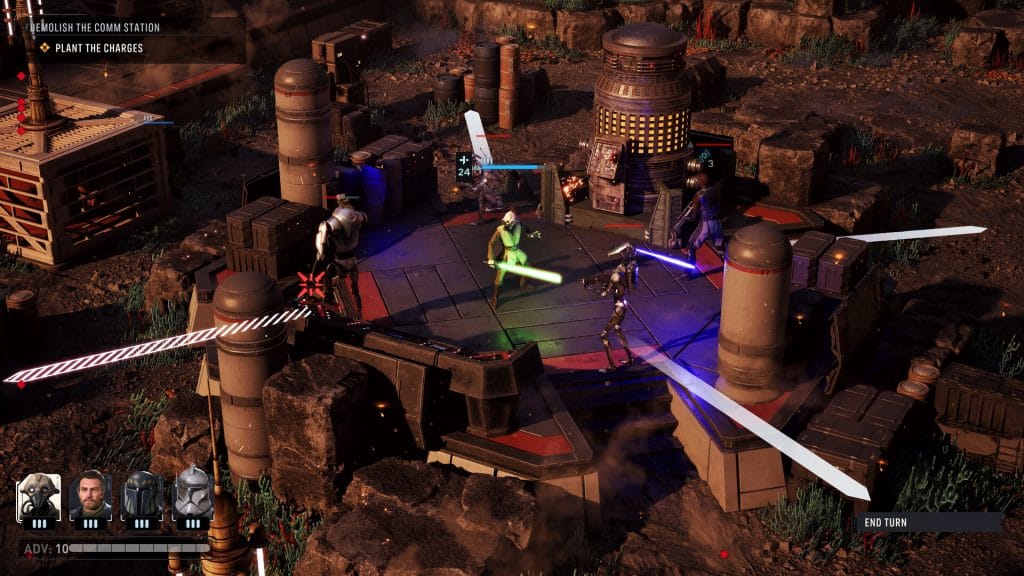
Combat in Star Wars Zero Company takes the traditional “tactics” formula and mostly plays the hits. Players take squads of four chosen operators onto maps with two primary objectives in mind. Operations are split into either “eliminate all the enemies” or “hit the button and evacuate,” with that button taking a few, mostly symbolic forms, such as Plant Explosives or Steal the Data.
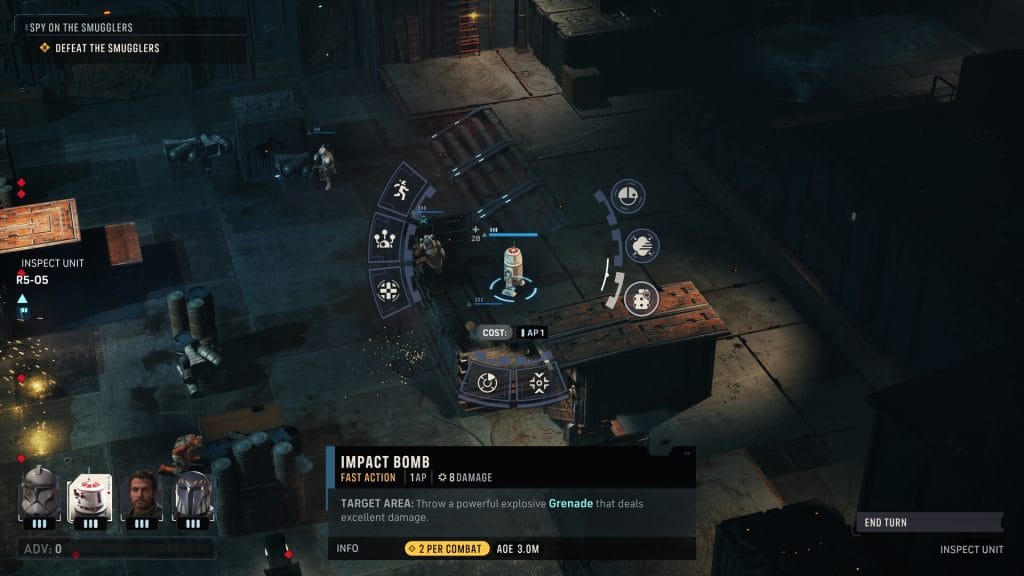
Each Operator has three Action Points they can spend each turn, with different actions costing a different number of points. A turn by Hawks, for instance, may look like this: Move a set distance (as determined by an Operator’s “Movement” stat) for two points, then use the “Overwatch” ability, which allows Hawks to react to opponents entering their field of view for an additional point. Unfortunately, that would end Hawks’ actions for the turn.
But wait! Players can also gain a resource called Advantage throughout an Operation, which can be used to activate special abilities for each Operator. These abilities are based on the Operator’s class, and can be adjusted back at the Den, Zero Company’s base of operations. So now, after burning all their action points, Hawks can activate their Precision Shot ability, spend six Advantage, and take a guaranteed headshot against the person in front of them. Advantage abilities do a wide variety of different actions, from large-radius rocket launcher attacks to mass heals, so balancing your spending of that resource is key to success.
If Operators are knocked down in combat, they can be picked up by squad members but suffer an injury. Take three injuries, and the Operator is permanently dead, for good—no take-backs without a save reload. This includes named story characters, so players should be cautious regardless of their squad. And Operations can get hairy: More than once, I was left with the impossible choice of risking one Operator to pick up another, or letting them go. While my memorial wall is not large, those names will forever be a source of shame to me. I’m sorry, Druw Tasko, Twi’Lek Heavy Gunner: I should have done more to save you.
The Interstitial Moments
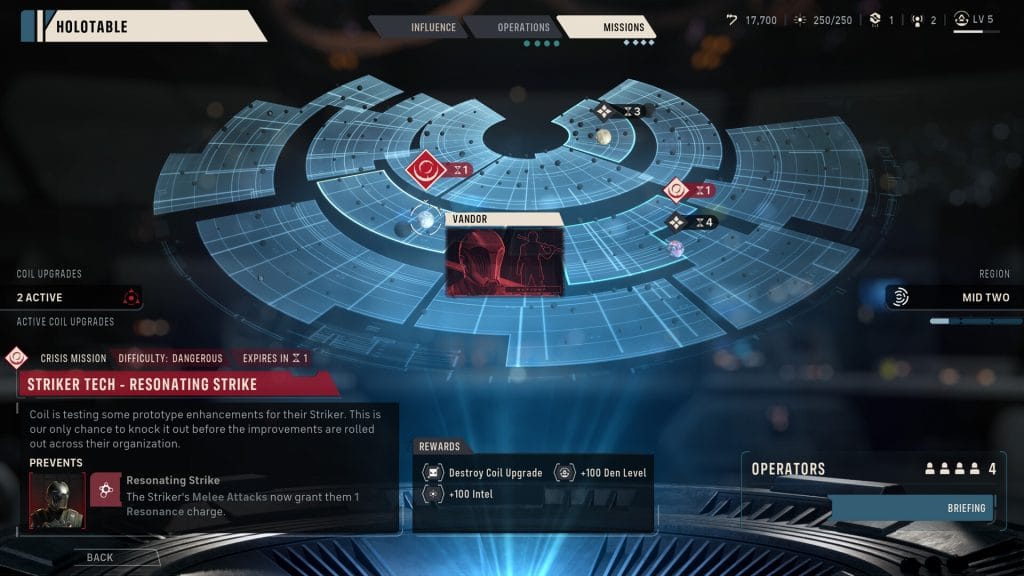
In between Operations is where Star Wars Zero Company truly shines. Taking a cue from XCOM: Enemy Unknown, players can spend their hard-earned credits to upgrade their base, recruit additional Operators, or just get to know their coworkers. Conversations can be had, fights can be broken up, and mourning can be found in these quieter moments. Zero Company expands the tried-and-true Star Wars universe in unique ways, leaning into what people think rather than monolithic ideas.
A personal favorite moment of mine came during a heated conversation between a Separatist militia man, whose people are ravaged by the Republic, and the clone trooper Trick. Luco, the Undaaran in question, goads Trick into a fight by pointing out how many clones died in the invasion just to break the Undaaran will. Trick tries to deflect, as his brothers were just following orders, but Luco points out that this is cowardice: Regardless of orders, if you pull the trigger, the responsibility is still on you. Trick fires a warning shot past Luco’s head and tells him he’s not following orders anymore.
I appreciated that Zero Company never tries to justify the actions of either side of the conflict. The Republic is a corrupt bureaucracy, driven to war by the selfish actions of the elite. Its military is propped up by a slave class of clones, who both have free will and no agency. Meanwhile, the Separatists are techno-elite business people, willing to strip and destroy entire civilizations for a dollar, whose military is built on its own slave class of droids with debatable free will. Both are committing atrocities, and all are just following orders.
Time in the Bacta Tank
Unfortunately, Star Wars Zero Company is not the most polished game in the galaxy. While I never ran into any game-breaking issues, it was rare that an Operation wasn’t plagued with visual bugs. Menus would disappear randomly, the camera would occasionally lock into random corners, and Overwatch activations were… variable. Hilariously, many of these bugs were also in Enemy Unknown, so at times, it did feel like a fun throwback to long evenings in my childhood basement.
Zero Company is also not the most visually impressive game, with one exception. While the environments and backgrounds can be a little muddy, the facial animations are top-notch. My Hawks, a dark-skinned Zabrak male with intense facial tattoos, was stunning up close and fantastically performed by Jonathan Freeman. All the voice work in the game is stellar: In particular, Vic Michaelis’ work as Zero Company’s financial advisor Runa Blask was a treat every time we got to chat. On the music side of things, long-time Star Wars video game composer Gordy Haab doesn’t take many swings, but it’s all perfectly cromulent.
In the end, you shouldn’t be coming to Zero Company expecting a design masterpiece, but instead, a competent wrapper around an incredible core.
Final Thoughts: Strong Company
I loved my time with Star Wars Zero Company and will be going back for another playthrough very soon. Between the flexibility offered by the combat, the Operations not taken, and the lives lost (we miss you, Druw), Zero Company invites players back for hours and hours.
Fans of the tactics genre will find a love letter to everything that makes them special. I would also recommend Zero Company to anyone who wants to be introduced to tactics games, as its beginner-friendly tutorial is very robust. Fans of Star Wars, meanwhile, will find a fantastic narrative with appropriate stakes in the universe that stands alone as just a good damn story. As for me, I am just a fan of Zero Company.
Score: 9.2/10
Star Wars Zero Company, developed by Bit Reactor and published by Electronic Arts, released on August 27, 2026, for PC, PlayStation 5, and Xbox Series X/S. Version reviewed: PS5.
Disclaimer: A review code was provided by the publisher.

Gary is a jack-of-all-trades video game enthusiast based in Boston, MA. A semi-professional fighting game player, even less professional Apex Legends player, and even less professional adult, he spends most of his time poking at strange indie gems and reading about the need for more diverse voices in gaming criticism. He invites anyone to recommend anything he's missed in the gaming world via Twitter or BlueSky, where he can found under the username @grtnpwrfl. When he isn't spending his time playing games, Gary is an avid New England Patriots fan and frequent hiker.