
One of the more uniquely satisfying things video games can give to players is the feeling of being indestructible, powerful beyond all others even in the face of seemingly endless hordes of supernatural beings whose sole purpose is to try to kill you. So-called “boomer shooters” — first-person experiences such as DOOM and Wolfenstein — embody this feeling particularly well, as do roguelike games (at times).
Abyssus combines these two concepts to present a roguelike boomer shooter, one where repeated failure is all but assured and victory always feels thoroughly earned. Luckily for me, it (mostly) nails both genres.
Into the Brine
Abyssus, developed by DoubleMoose Games and published by The Arcade Crew and Dotemu, presents itself as a single- or multi-player roguelike first-person shooter set in a “brinepunk” environment, where players dive into hidden underwater lands populated by mysterious denizens. Think Disney’s Atlantis: The Lost Empire but with a little more creepiness and a lot more blood.
Much like you’d expect from the roguelike genre, the game offers multiple levels (or “depths”) full of challenge rooms, with each room featuring a randomly generated slew of enemies and each depth featuring various completion rewards that help you on your expedition, as the game calls it. Such rewards include gold (which you can use occasionally to buy new items), blessings (which upgrade your weapons and give them elemental abilities), charms (wearable accessories that provide various buffs), health upgrades, and soul fragments (which you can use to unlock new abilities, buffs, and bonuses at the Soul Wheel before embarking on an expedition).
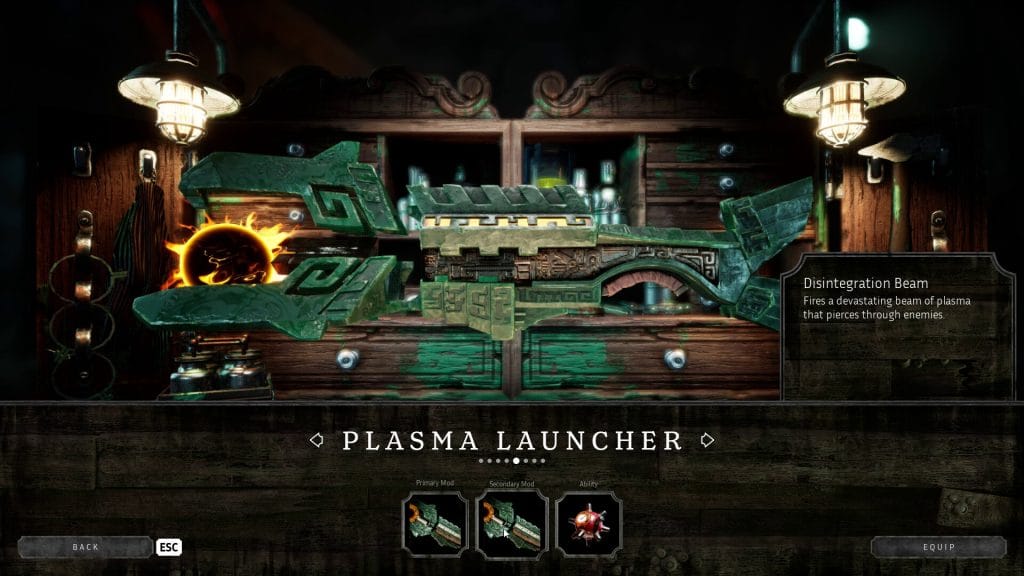
Before each run, players can equip different weapons and abilities they find along the journey, as well as additional modifications for their weapons. Additionally, each weapon has a secondary function (a la Perfect Dark). For example, the shotgun’s primary function works as one would expect, but its starting secondary function is a stronger blast with more recoil and recovery time.
The variety on display in Abyssus isn’t especially broad in theory, but it certainly feels that way in practice. New weapons can be difficult to find in the depths, and you have to unlock various in-game achievements in order to gain access to most mods. As a result, you rarely begin early expeditions with a ton of options, but that’s where the blessings come in.
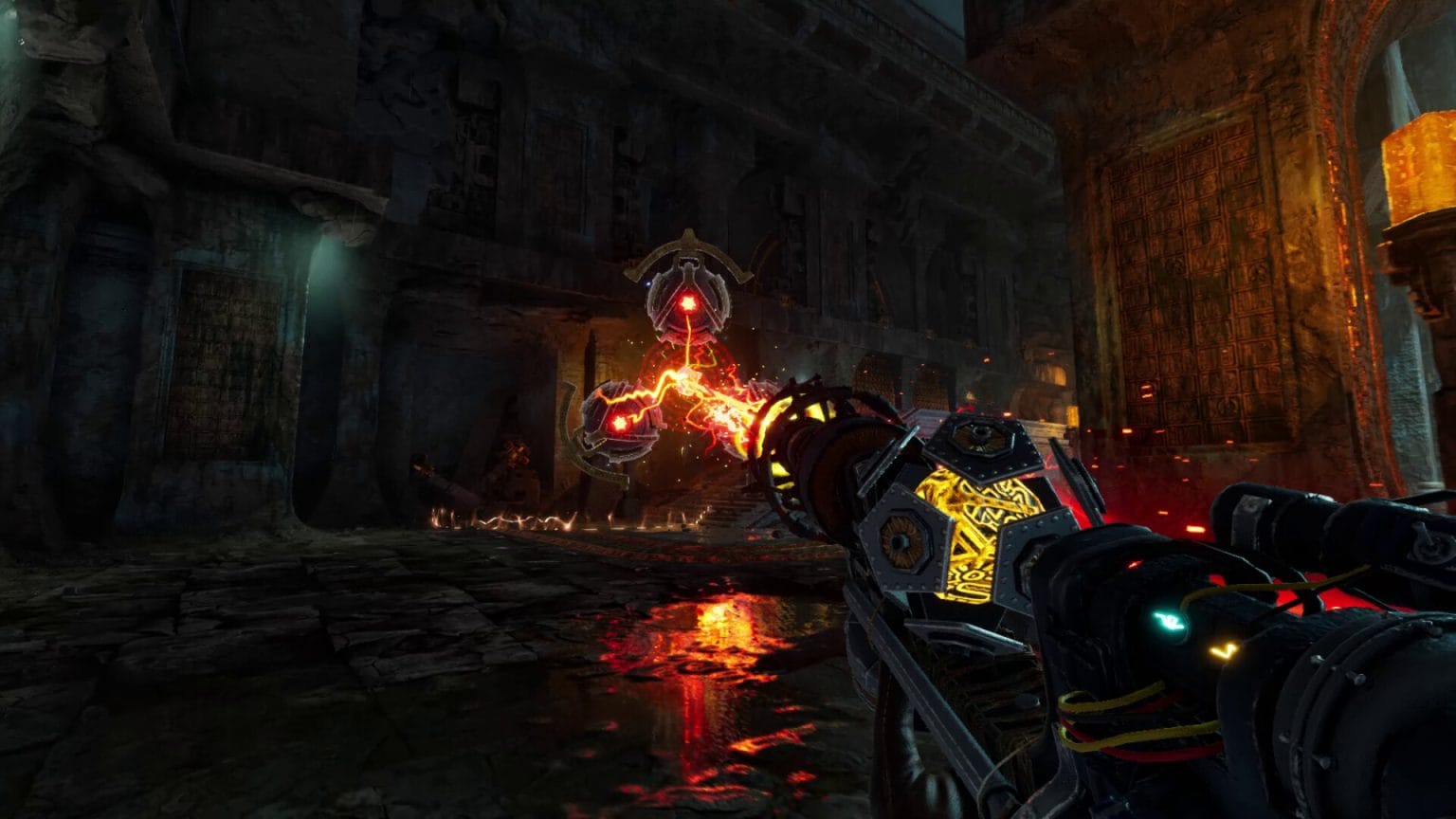
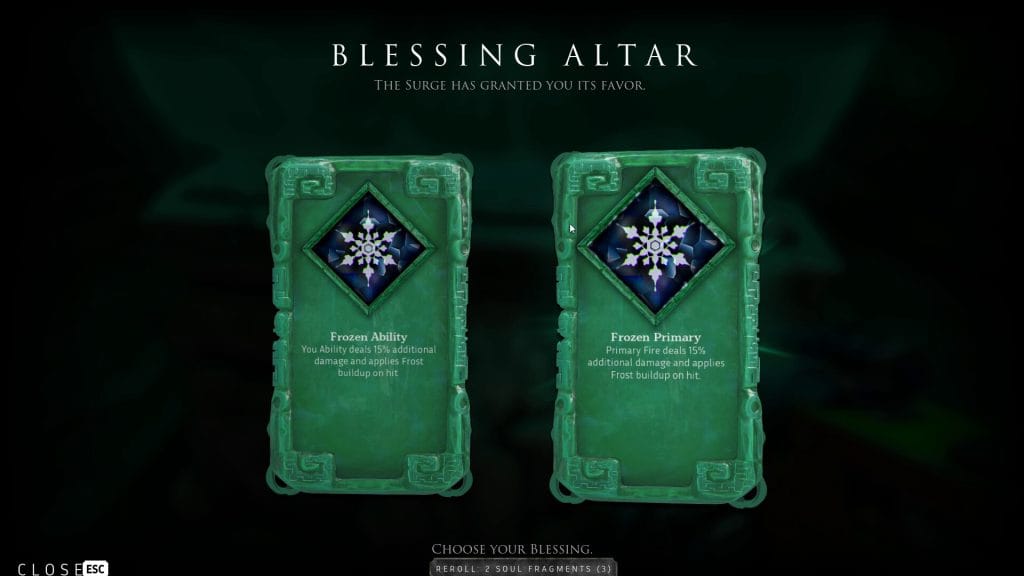
Once you assign a type of blessing to one of your three modes of combat — your weapon’s primary use, your weapon’s secondary use, and your equipped ability, such as frag grenades or a deployable turret — you can only add more of that same blessing to the assigned mode. If, say, you choose the Aspect of Lightning to your primary, which increases your primary’s damage and gives your primary lightning-based advantages in combat, you can keep stacking additional Aspects of Lightning to your primary to make it even more of a chain-lightning, stunning menace, but you can’t swap it with an Aspect of Frost or Aspect of Blood later on.
The variety on display also makes a big difference depending on what enemies you fight.
So, if you can only have three kinds of blessings during each run, where does the variety come in? In short: The different weapons, mods, and abilities you can equip before each expedition allow for a myriad of different strategies for selecting and stacking blessings.
If you choose the Brine Revolver with the Charge Scope as your secondary, it might make sense for something more offensive-minded for your quick-shooting primary (such as Lightning or Fire) and something more defensive/auxiliary for the slower-shooting secondary (such as Fortune or Defender). Without getting too into the weeds, you can clearly see after a couple of runs how many different combinations exist, as well as the benefits of thoughtfully selecting which blessings go with which weapons and abilities.
Mixing Things Up
Abyssus successfully makes additional runs more interesting with these systems. Sure, most rooms within each region are aesthetically and architecturally fairly similar, but it rarely feels like I’m doing the same thing over and over again. Using a shotgun blessed with Wind powers feels completely different from using frag grenades blessed with Frost powers, and you never know what blessings will even be available until you have to pick from two options the first couple of times you reach a Blessing Altar. Despite existing in a genre famous for repetition, Abyssus never feels overly repetitive, nor does the cyclicality of the action grow stale over time. Dozens of runs in, I’m still having a good time and discovering new strategies.
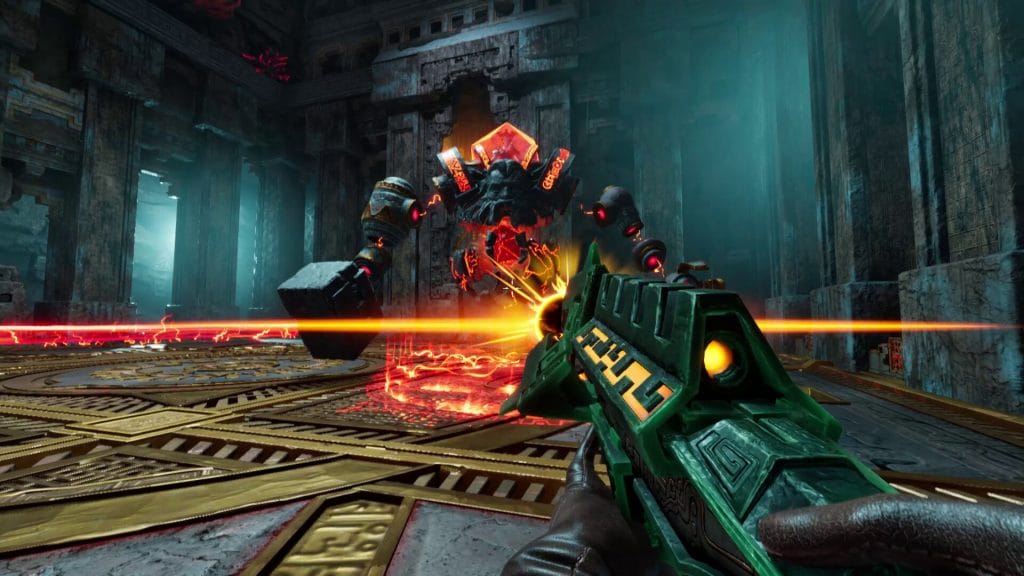
The variety on display in Abyssus also makes a big difference depending on what enemies you fight. Early foes can be easily destroyed with simple shotgun blasts or by nailing hits on their obvious weak points, whereas enemies providing support or summoning functions in later biomes have to be dealt with differently. Sometimes an approach you’ve taken works perfectly against small, quick frog-people but poorly against armored automatons.
Additionally, you might breeze past certain bosses and elites (effectively mini-bosses) with a shotgun blessed with lightning but struggle against others with the same setup. Abyssus will frequently make you second-guess the choices you’ve made, but never in a demoralizing manner; you just have to learn from your successes and failures and make better decisions in subsequent runs.
Also, before I forget: The boss battles in Abyssus are fantastic. They thoroughly test the player’s skills, decision-making, and patience, and never feel particularly cheap or unfair. I can’t say the same for battles against the elites, which feel a little more repetitive and frustrating. Still, the main boss fights in Abyssus present some of the most fun moments in the whole game, even if a couple are incredibly difficult on a first try.
Nailing the Basics
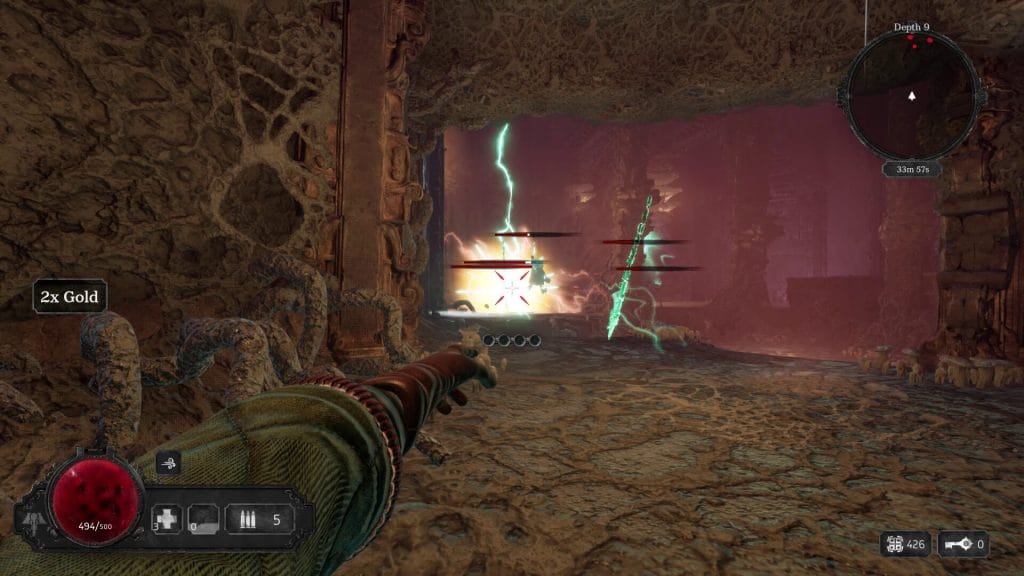
The inherent creativity of Abyssus’ weapons and systems also nicely complements its boomer shooter framework. Much like classic id Software shooters like DOOM, Abyssus largely tasks the player with moving quickly through various spaces and killing everything in sight. It nails the classic “shoot at things while running toward them” gameplay, and its added platforming controls — including a double-jump and a dash — allow for non-stop, endlessly thrilling action.
The actual mechanics are fairly basic on their face: Press R2 for your primary, L2 for your secondary, R1 for your ability, L1 for dash/strafe, and X for jumps. But even within these rudimentary functions lies a buffet of tactical options, especially when considering the various charms and blessings you find along your journey. Do you want to mostly strafe to the left and right and shoot enemies from afar? Do you want to jump from high ground and slam a Blood-blessed anchor from above? However you want to wreak destruction on enemies, Abyssus gives you myriad options for that, and nearly every combination I’ve tried has been a blast, even if they’re not always successful (do NOT assign Aspect of Brine to the turret).
Think of Abyssus as an experience defined by controlled chaos. Each time you enter a room, you might find yourself surrounded by enemies without knowing where new ones are coming from, yet over time you get used to figuring out the right approach to taking them down without losing too much life. Playing with up to three other players online ratchets up the chaos even more, but either way, it never feels like success is out of reach or fully determined by randomness.
A Lot To See, Less To Hear
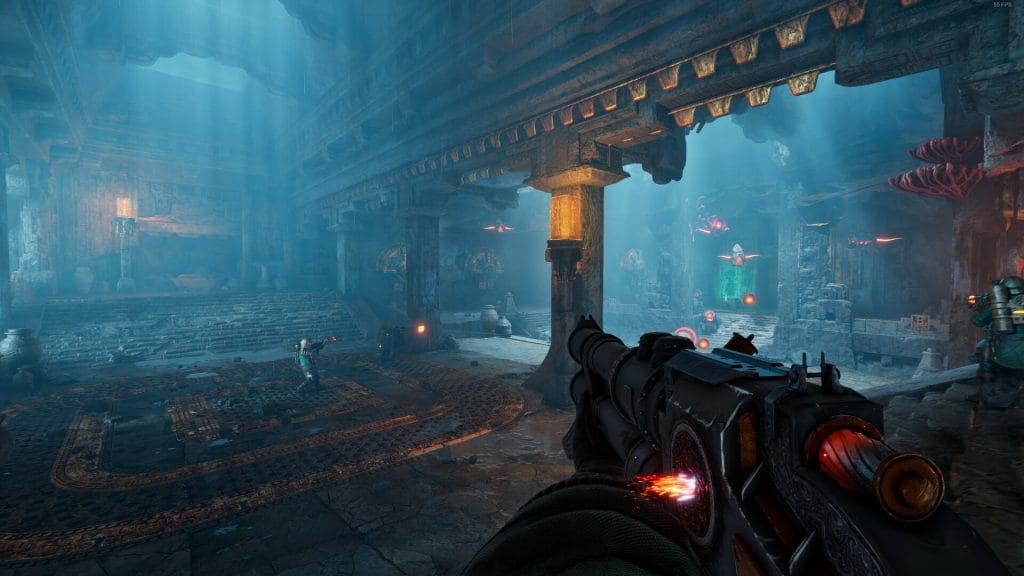
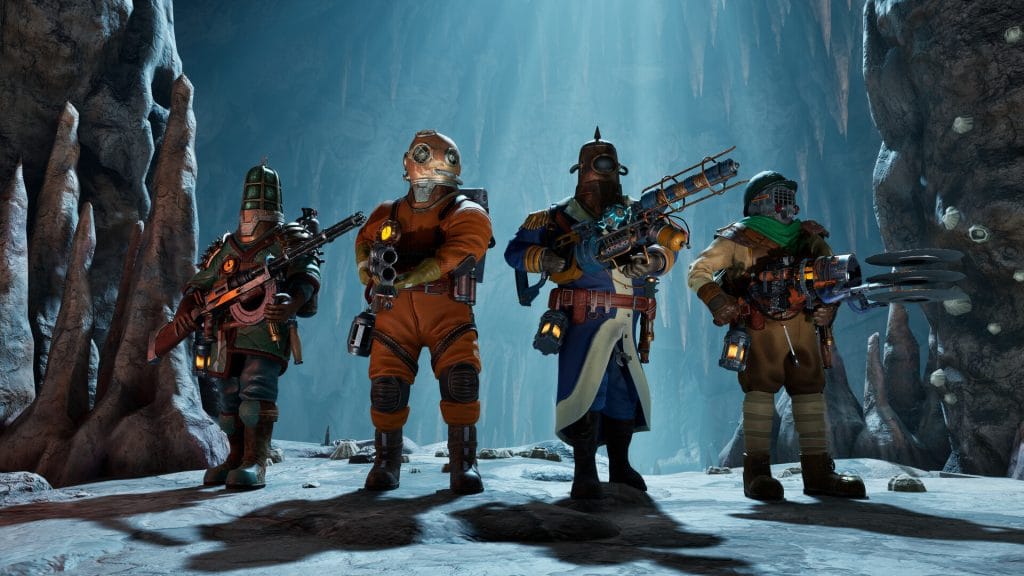
Visually, Abyssus is a delight. It’s surprisingly sharp graphically, and its approach to color combinations can be striking. One biome in particular — the Sanctuary — presents a gorgeous contrast of light blue and purple in otherwise dimly lit rooms, making firefights in these locations simultaneously beautiful and haunting. Similarly pleasing color palette choices and architectural design make each biome — four of which the player must pass through in order to complete an expedition — a wonder to exist in, even if most of the aesthetic details add basically nothing to the gameplay (it’s not like wading through a small pool in the Submarine Gardens makes you move slower, for example).
Sonically, though, it’s less of a delight. The basic sound design is mostly fine, but the soundtrack is completely forgettable, and the enemies don’t have many unique sound effects or lines of dialogue. You can play this game on mute (which I often did while listening to podcasts) and miss basically nothing.
There’s not much story to speak of in Abyssus… but it still feels like a missed opportunity.
The more damning part of Abyssus’ presentation, however, is its story, or lack thereof. The game never explicitly states why you want to go on these expeditions (that is, until you complete one, but I won’t spoil what happens), nor does it really do much worldbuilding outside of environmental design and the occasional note from previous expeditioners you can find on the ground outside of battle arenas. These notes mostly exist as comic relief, with jokes about expeditioners wondering why they feel weird about potentially eating the frog-people, but sometimes describe the amazement and wonder of discovering what civilizations really exist beneath the surface.
I also don’t love its stereotypical depiction of undiscovered societies, with imagery reminiscent of Aztecs and Mayans abound. I don’t view it as uniquely offensive — it utilizes many of the same tropes found in Tomb Raider and Indiana Jones — but it is a little discomforting, and the absence of really any other narrative context suggests that the player has to take it all in at face value, which is… not great.
Otherwise, there’s not much story to speak of in Abyssus. While that’s not inherently a problem — it’s not like I need a grand motivation to shoot things and collect loot in a video game — but it still feels like a missed opportunity, especially considering how thoughtfully crafted each depth appears to be.
Final Thoughts
Overall, Abyssus takes a fairly straightforward concept and manages to do a lot with it. There’s never a dull moment, and even if certain challenges can get a little frustrating — every run presents a couple of objective-based rooms, and they’re never as fun as just killing guys — I never got tired of the experience as a whole. If anything, one of the most positive things I can say about the game is that even after writing this review, I plan on going back for even more expeditions just for the hell of it. It’s got its blemishes for sure, but it’s an undeniably great time if you’re in the mood to wreak havoc in dimly lit rooms.
Score: 8.0/10
Abyssus, developed by DoubleMoose Games and published by The Arcade Crew and Dotemu, released on PC (via Steam) on August 12, 2025, with PlayStation 5 and Xbox Series X/S ports released on June 25, 2026. MSRP: $24.99. Version reviewed: PS5.
Disclaimer: A review copy was provided by the publisher.

Sam has been playing video games since his earliest years and has been writing about them since 2016. He joined The Punished Backlog in 2017 and became an Editor in Fall 2021. He’s a big fan of Nintendo games and complaining about The Last of Us Part II. You either agree wholeheartedly with his opinions or despise them. There is no in between.
A lifelong New Yorker, Sam views gaming as far more than a silly little pastime, and hopes through critical analysis and in-depth reviews to better understand the medium's artistic merit.
Bluesky: @sam-martinelli.bsky.social