
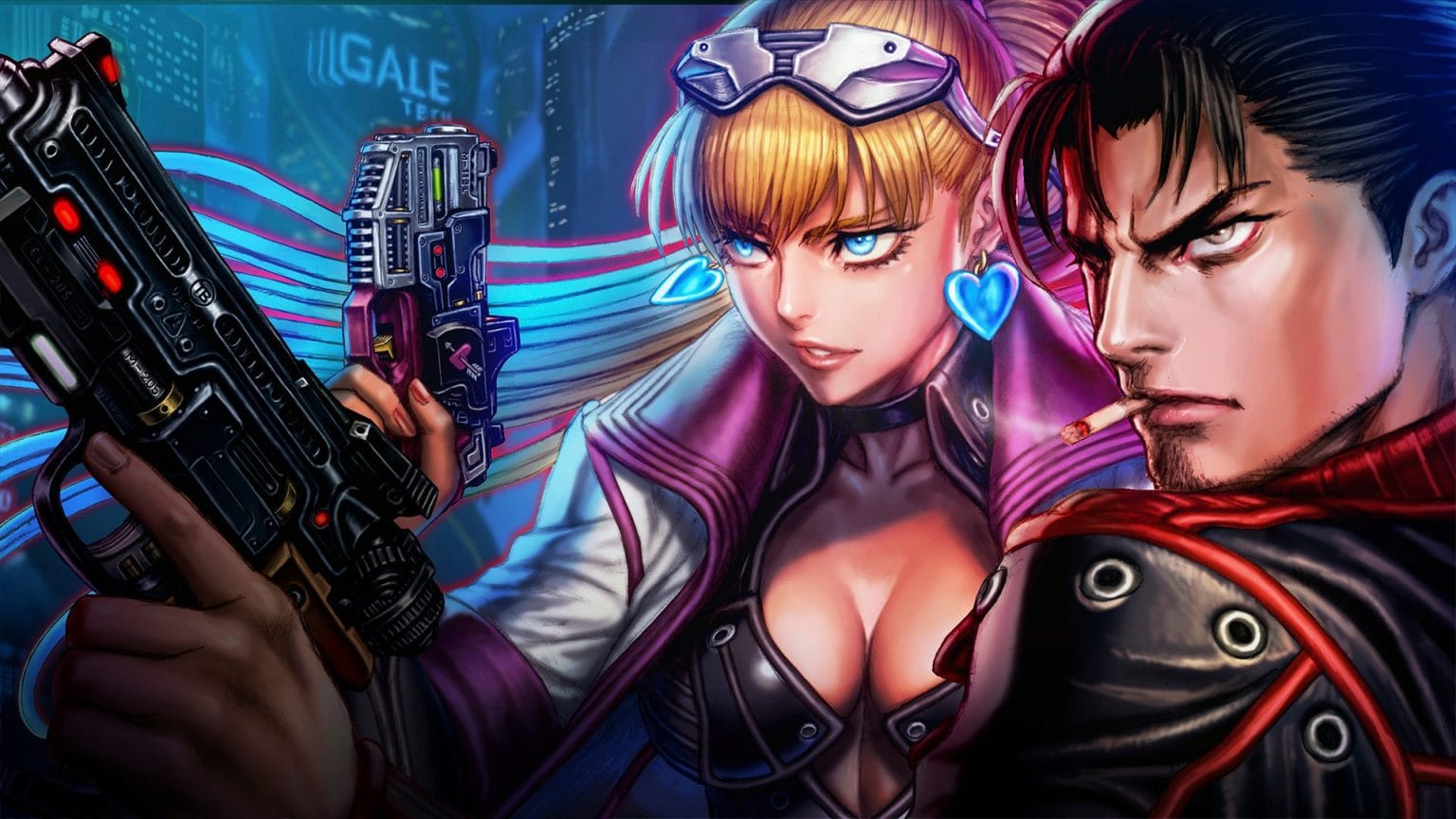

Neon Inferno opens like a grimy VHS tape you found tucked behind a busted arcade cabinet — a neon-drenched New York City, crime spilling into every street, and a future that already feels lost.
It’s the year 2055. Manhattan is cut in half by a massive wall separating the rich from the poor. Criminal syndicates and a corrupt NYPD wage war across the boroughs. The city isn’t asking to be saved; it’s daring you to survive it.
Then the game hands you a gun, a plasma knife, and a mission briefing that might as well read: Raise hell — with style.
The city isn’t asking to be saved; it’s daring you to survive it.
Zenovia Interactive’s follow up to its 2021 release Steel Assault, Neon Inferno is an explosive fusion of 2D run-and-gun action and gallery-shooter chaos — a lost arcade fantasy built to test your reflexes, your patience, and your willingness to keep coming back for more.
From the jump, Neon Inferno feels like a game that forces you to earn every inch of progress — occasionally for worse, but mostly for the better.
Assassins, Syndicates, and Trench Coats
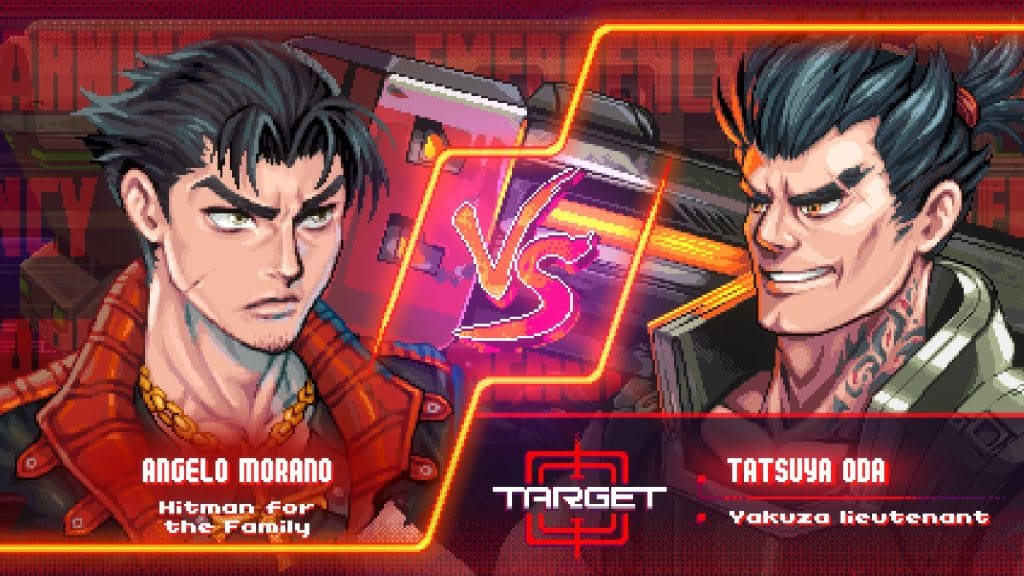
You play as one of two characters. The game opens with Angelo Morano: an assassin for “the Family,” a crime syndicate formed from the remains of Italian and Irish mobs plus smaller fractured groups. Then enters Marianna Vitti, a skilled suburban shoplifter and pickpocket who steals Angelo’s gun. Angelo hunts her down — for a date. They fall in love. Marianna eventually joins the Family and adopts the Morano last name, as is custom for newcomers. The two become assassins for the Family. After some time, they both want to get the hell out of the city — and I can’t blame them.
The story unfolds through conversations with your boss and the targets you’re sent to eliminate, with gently animated sprite scenes filling in the gaps. You’re tasked with taking down members of rival factions, the corrupt NYPD, the yakuza, and the Pangaea corporation, the latter of which is the evil, mustache-twirling cyberpunk corporation selling crazy tech to your enemies.
As you work your way through criminal underlords, corrupt power players, and even a politician, a larger conspiracy slowly reveals itself. Neon Inferno’s narrative is straightforward cyberpunk crime noir — simple, effective, and never overstaying its welcome.

Shoot Close, Aim Far
At its core, Neon Inferno feels like playing Metal Slug, Contra, and Wild Guns at the same time. Your default handgun has unlimited ammo, and you’ll need every bullet. Enemies swarm the foreground from all angles, filling the screen with gunfire. Neon Inferno takes a page straight from Wild Guns’ playbook, letting you aim at enemies attacking you from the background. It feels chaotic by design, forcing you to constantly split your attention between two 2D planes at once.
In addition to a gun, Angelo and Marianna have a plasma knife that ties the combat together. You can use it for both melee combat and to deflect incoming bullets. Holding the deflect button down triggers Bullet Time, which slows the action and lets you aim deflected shots back at enemies at the cost of your Adrenaline gauge. Deflected bullets deal extra damage, which feels especially good when the game decides to test your patience.
Neon Inferno supports two-player co-op, which feels appropriate given how quickly everything descends into chaos; you’ll need all the help you can get. However, both Angelo and Marianna play the same mechanically. Given their different backgrounds, I was hoping to see some character-specific moves, interactions, and attacks to help mix things up. I would have also liked to see each character offer their own perspective on the events of the story. These feel like missed opportunities to add variety and replayability.
Unlike in the aforementioned spiritual inspirations, enemies don’t drop gun upgrades mid-level. Instead, Neon Inferno forces you to commit. After each mission, you’re paid and graded based on how fast you beat each level, how much damage you take, and for how many civilians you kill by accident. You spend your cash at a gun shop, choosing how to upgrade your load-out before the next run.
There are some fun options for combat upgrades. You can enhance your plasma knife to fire waves of energy, or upgrade your gun with one of the following specializations:
- Chaser shots: homing bullets that don’t require precise aim
- Rapid shots: ideal for melting tanky enemies faster
- Flame shots: massive fireballs that deal heavy damage and can wipe out multiple enemies
- A plasma shield: buys you a few precious seconds of extra life
Each upgrade comes with limited ammo per mission, adding a sharp strategic layer. You’re not just reacting to chaos; you’re planning for it. Do you burn special ammo early to control the screen, or save it for the moment when the game stacks multiple damage sponges, background snipers, and a wall of bullets all at once? No matter what loadout you choose, the game’s difficulty is merciless. You will die, time and time again.

Quarter-Draining Chaos
Neon Inferno offers two game modes: Story and Arcade. Story mode lets you choose between Hard, Medium, and Novice difficulties. By comparison, Arcade’s default difficulty is brutal. Arcade mode dares you to run through the entire game with no checkpoints and “one credit.”
No matter what difficulty level you choose, Neon Inferno feels like something designed to eat quarters in a dingy backroom cabinet. Enemies rush from every angle, half the bullets can’t be deflected, and the game demands split-second decisions at all times. The game never stops pushing you to keep up.
The game’s difficulty is merciless. You will die, time and time again.
Although a majority of enemies drop in one shot, the difficulty sometimes flirts with feeling cheap — especially when multiple tanky enemies and background threats stack up. This extends to Neon Inferno’s assassination targets. Each mission culminates with a unique boss fight that is challenging and intricately designed. Some flee and hop into giant mechs after you take down their first health pool. Others just power up through sheer hype. You’ll be pushed to your breaking point as you try to take down each boss.

Ultimately, more often than not, the difficulty does feel fair. Neon Inferno is a challenge that demands improvement rather than brute force. By the time I learned enemy and boss patterns, cleared a level and took out a target, I was exhausted in the best possible way.
Neon Inferno is a challenge that demands improvement rather than brute force.
Engaging with the game’s approach to difficulty is what gives Neon Inferno heft — I completed its story in just under two hours. Thus, the tough challenge and additional difficulty options are what extend the game past its admittedly short length.
The biggest friction point in the combat, for me, is the background aiming. Snapping to background enemies usually works, but when targets are mobile or spongier, aiming can feel slower and a bit janky compared to the foreground gunplay. Repositioning often helps, but doing so interrupts the otherwise relentless flow.
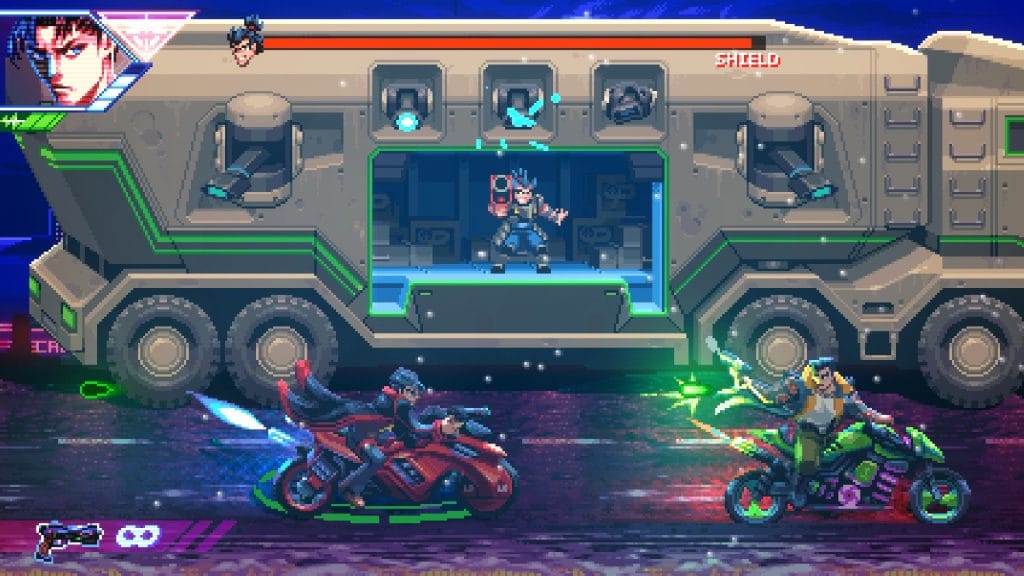
Additionally, there are some chase sequences that are hit or miss. These sequences, which are inserted partway through levels, seemingly to add some variety, feature the main characters riding on a bike or a jet ski. They add a bit of occasionally frustrating padding to what is otherwise a tight arcade experience. It reminds me of my least favorite parts of Battletoads and Double Dragon, when the developers made you ride jet bikes with damn-near impossible obstacles popping up constantly. Luckily, those very same levels look so good that I can forgive some of these annoying moments.
A City of Spectacle
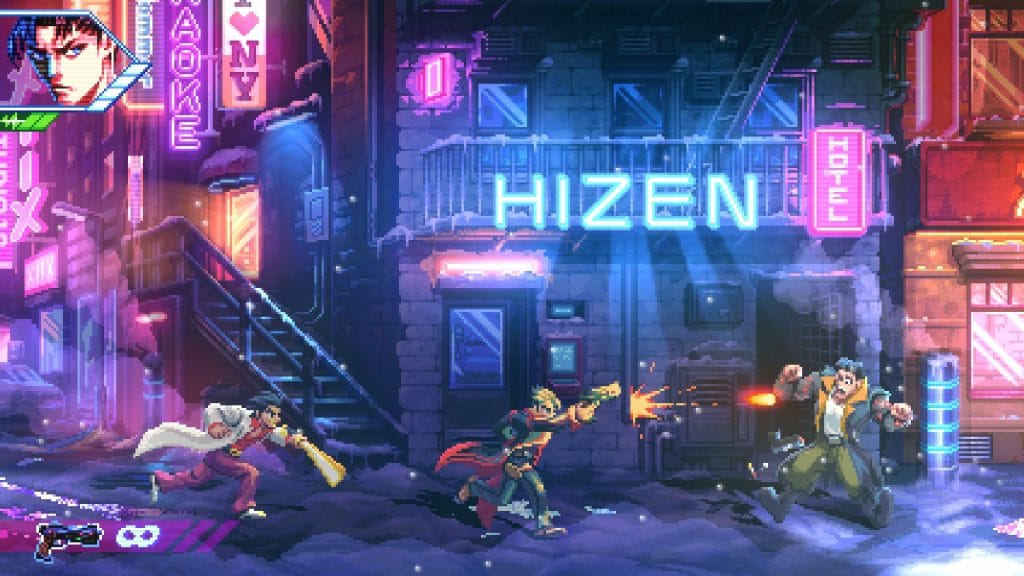
Where Neon Inferno really shines is its level and character design. The set pieces are stellar — dynamic, colorful, and deeply cyberpunk. You’ll run through extravagant penthouses dripping with excess, tear across dilapidated neighborhoods left looking like full-on warzones after gang fights, and battle through spaces that feel lived-in, ruined, and hostile. The lighting on the sprites as you advance is incredible.
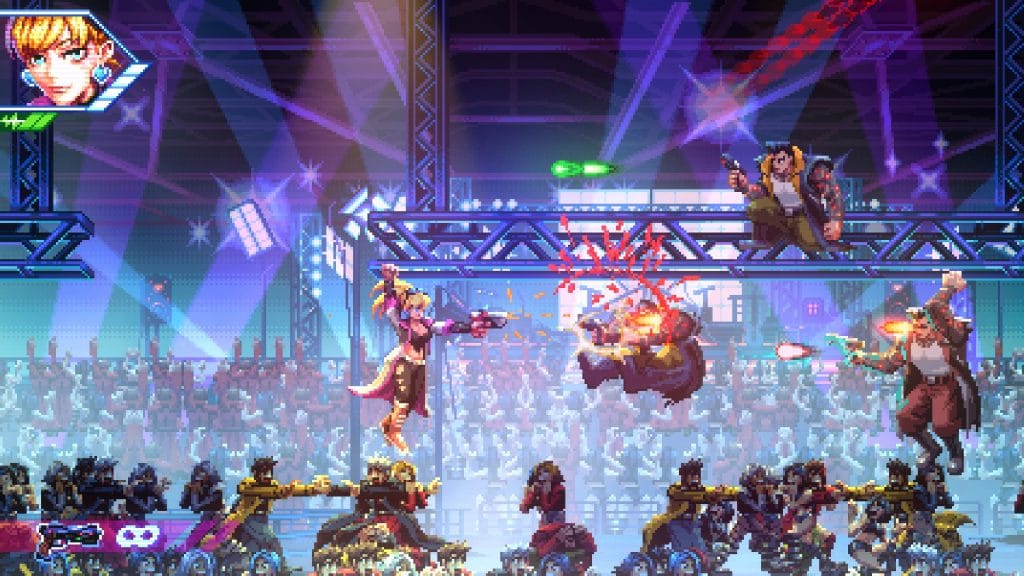
You’ll hop across stage lighting during an opera performance, take out corrupt NYPD officers while leaping from flying car to flying car, then bound from building to building as enemies pour in from every direction. The spectacle never lets up.
The 32-bit-inspired pixel art is brilliant, packed with detail and animation that pops off its CRT-style presentation. Colors glow aggressively, and enemy designs go hard: you’ll encounter Judge Dredd-looking cops, cyborg yakuza with laser cannons, sword-wielding maniacs charging in from off-screen, and screen-filling energy blasts straight out of Akira.
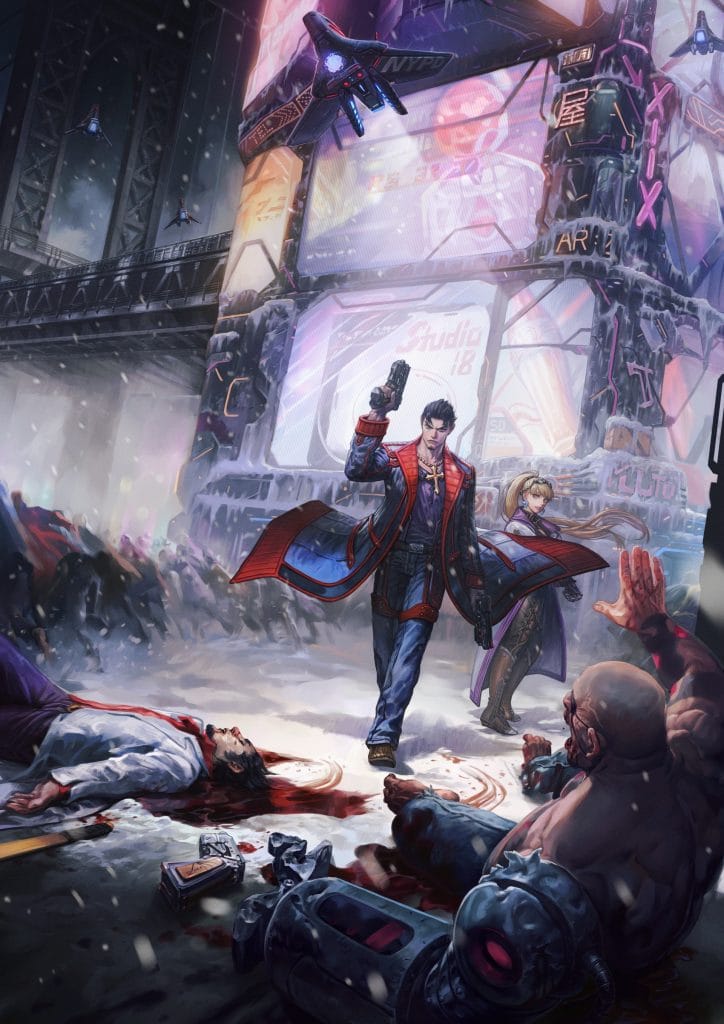
The protagonists were designed by Japanese illustrator Tsukasa Jun — known for his work with Capcom and Psikyo — and that pedigree is immediately obvious. Every pose, animation, and silhouette is doing work.
Angelo in particular looks like a lost member of Tekken’s Mishima family — a sharp silhouette wrapped in a long trench coat, with a kick-ass, cold-blooded, one-note attitude to match. The coat flaps dramatically during gunfights, sells every idle pose, and gives the game serious Blade Runner energy. Marianna carries that same confidence. Together, they feel less like player avatars and more like action-movie leads who wandered into an arcade cabinet and decided to take over the city.
The soundtrack seals it, bouncing between high-octane ’80s rock, eerie synths thumping techno, and even opera. Neon Inferno has the energy of a cult, campy ’80s action movie — dramatic set pieces, absurd waves of enemies, and zero interest in subtlety. It wears its inspirations on its sleeve, and that confidence carries it a long way.
Final Thoughts
Neon Inferno is an incredibly polished experience, but it is ultimately quite a short one. If you’re quick to learn its patterns, the game can be completed in under two hours. That brevity feels deliberate. The game tells a full, complete story without padding itself too much or overstaying its welcome (frustrating chase sequences aside). It trades length for momentum and clarity. Coupled with the gorgeous visuals, Neon Inferno is a flame that burns brightly and fades quickly. Its layered combat, relentless pacing, and unapologetic spectacle make every clean run feel earned.
When everything clicks — bullets slowing, guitars screaming, looks popping — Neon Inferno hits that rare arcade sweet spot where survival feels like a performance. This is arcade violence dressed in a trench coat, and Neon Inferno wears it well.
Score: 8.7/10
Neon Inferno, developed by Zenovia Interactive and published by Retroware, released on November 20, 2025, for PC (via Steam), PlayStation 4 & 5, Xbox Series X/S, Xbox One, and Nintendo Switch. MSRP: $19.99. Version reviewed: PC (via Steam Deck).
Disclaimer: A review code was provided by the publisher.

Donovan is a lifelong gamer with a love for fast-paced, single-player action games—especially Devil May Cry, Metroidvanias, indies, and action RPGs. He’s also an “advanced scrub” at fighting games and will play just about anything fun. Donovan is passionate about seeing more diverse characters and creators in the industry—or at least better hair options for Black people. With over a decade in journalism, he joined The Punished Backlog in 2023 to write more about what he loves. Follow him on Twitter and Instagram @dono_harrell.