


There’s something to be said for the interactive immersion video games can breathe into being. Most of us are common mortals, neither capable of slaying hordes of Covenant grunts nor able to dunk a flaming basketball from 50 feet above the rafters. None of us will ever experience pulling with our own hands a glinting and glimmering Master Sword from beleaguered wood. While there is plenty of pleasure to be plumbed in lifestyle simulations like PowerWash Simulator or Nintendogs, often this peculiar virtual immersion allows for the greater possibility of intimately fantastical experiences.
Right now, I drive my partner’s Hyundai. The appeal of games like Gran Turismo or Forza (and its Motorsport counterpart) is that for a fraction of the price, I can feel some of what it’s like to drive a Porsche Taycan, a Lamborghini Aventador, or even a Koenigsegg Jesko, and I have truly no idea what that is. It’s a thrilling experience to be able to sit behind the wheel of something you know is out of reach, and a greater thrill still to rev its engine.
But you know what’s more fun than whipping a Koenigsegg Jesko?
Sebulba’s f-ing podracer.
Welcome to the Galactic League, Come Again
After playing just two hours of Star Wars: Galactic Racer (and making one major mistake), it was clear to me the developers at Fuse Games had made something profound. Galactic Racer drops you in medias res, effectively using three one-time race scenarios to establish the tutorial and introduce each of the three initial vehicle types: Landspeeder, Speeder Bike, and Skim Speeder. Upon doing so, you’re presented with a brief background in classic Star Wars font, then immediately whisked to the first of the planets on which the journey toward qualifying for the Galactic League commences.
This is where the road ahead began to lose clarity, albeit only temporarily. The terminology used in-game is specific enough to the larger Star Wars universe, but not wholly dissimilar from other prominent games in its genre. For example, Star Wars: Galactic Racer is advertised as a “runs-based” game — and it 100% is one. So, upon making a mistake and starting a race before I intended to, I went to the “Abandon Tour” option. I assumed — as you would when playing Mario Kart 8 Deluxe, for example — that I was simply exiting from that planet’s next series of races. Instead, I was taken back to the very first planet, because the entire “tour” was in fact a single “run.”
The racing is excellent. I mean truly, utterly sublime.
My disappointment in what felt at the time like a rookie mistake on my part quickly ramjetted its way into delirious excitement: Fuse Games had made a racing roguelite. (In their press review guide, Fuse Games acknowledges that though the game “sits within the roguelite framing,” the team prefers to use the term “run-based” adjectivally when referring to Star Wars: Galactic Racer.)
I was over the moon; roguelikes/lites are two of my favorite subgenres. Hades II is one of the best games I’ve ever played, and Pyre might be even better. Moreover, the choice to infuse a runs-based gameplay loop into the racing genre is a bold and inspired one, perhaps particularly because this is not any ordinary racing game. Constantly fixing and tinkering with your build, using every bit of juice, illicit parts, credits, elbow grease, luck, whatever, to get over the finish line just a gasp before the field is a concept that feels especially thematically resonant against a shady underground galactic speedracer league as its backdrop.
Very significantly different from any Rogue-adjacent games, and intriguingly more similar to games like As Dusk Falls or Detroit: Become Human, you possess full visibility of the branching path of options during each tour. Players are regularly afforded choice in direction and reward at each tour stop, including the liquidation of the choice entirely for credit tokens. Yet, it was impossible for me to play through each of the planets in Act I alone without thinking of games like Dead Cells and Hades, complete with the incessant boon-acquiring, level-upgrading strategy applied to your vehicle instead of your combat weapon.
For every tour, you are eligible to race until you either crash your vehicle too often within one race (determined by your specific vehicle and other in-game variables I won’t spoil), or if you run out of league tokens, which are provided upon fulfilling certain race conditions. When you are eliminated, a screen of all of the abilities, vehicle parts, character favors, and other rewards you’ve earned in total, and for that individual tour, is displayed. Again, I immediately thought of Rogue Legacy 2, which is dependent upon the continuation of the main character’s familial lineage, and therefore hinges upon a progressive, if albeit cyclical, gameplay loop.
“If You Have Nothing of Value To Say, Don’t Speak.”
Herein lies my first, and most persistent critique of Star Wars: Galactic Racer: The story is not very good. To be clear, this review will take into account the relative narrative depth and heft of the average Star Wars property; it will acknowledge, and then decline to engage with because of the sensitivities of the aforementioned property’s fans, the vaguely ethnicist renderings of all the non-human characters in its narrative universe while simultaneously utilizing a (usually white) human protagonist for a story about national political disenfranchisement.
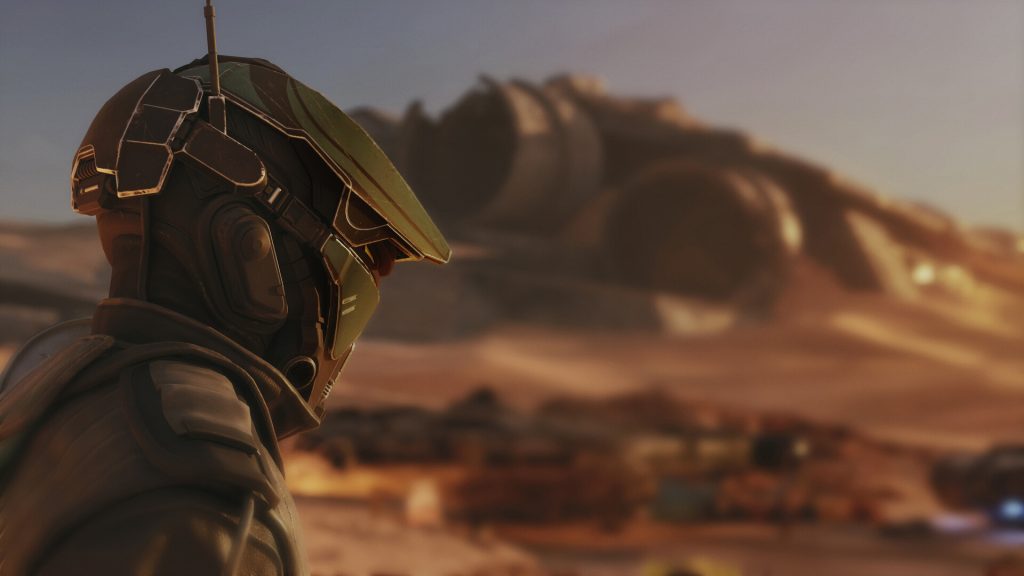
Still, this particular story is disappointing. Shade, a constantly helmeted and therefore literally faceless protagonist (likely because of how notoriously safeguarded LucasArts has been in the past about customizable characters infringing upon the Star Wars IP), reveals meager details about his past that are generic at best and completely inconsequential at worst. I won’t enumerate those details here — not because they’re spoilers, but because they are predictable and pedestrian once you’re simply aware that the point of the single-player campaign is to dethrone an elite, entitled bureaucrat’s son. This is not even a critique of the redundancy of the thematic narrative, as much as an observation that within this game, a specific iteration of it doesn’t exist with force.
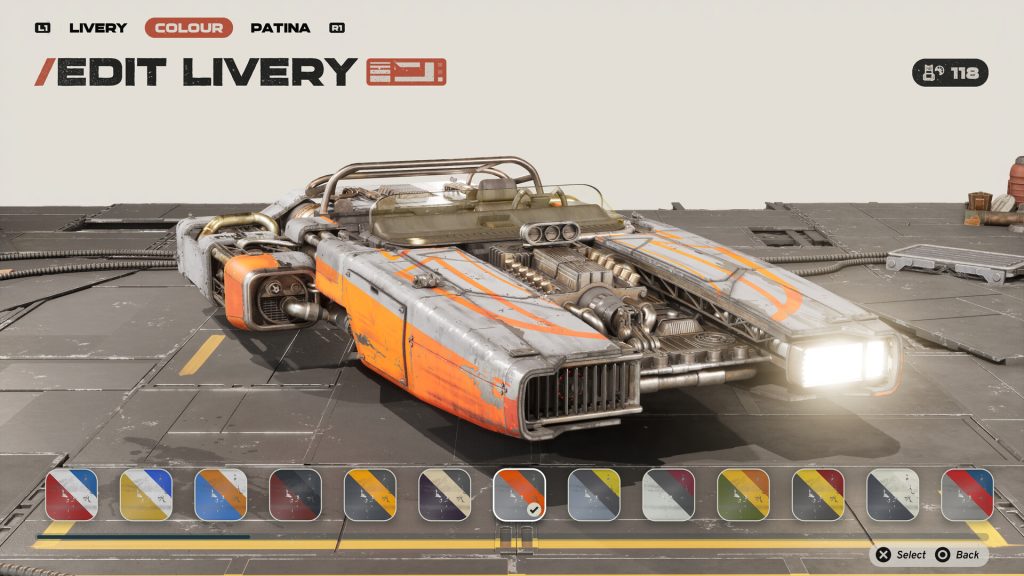
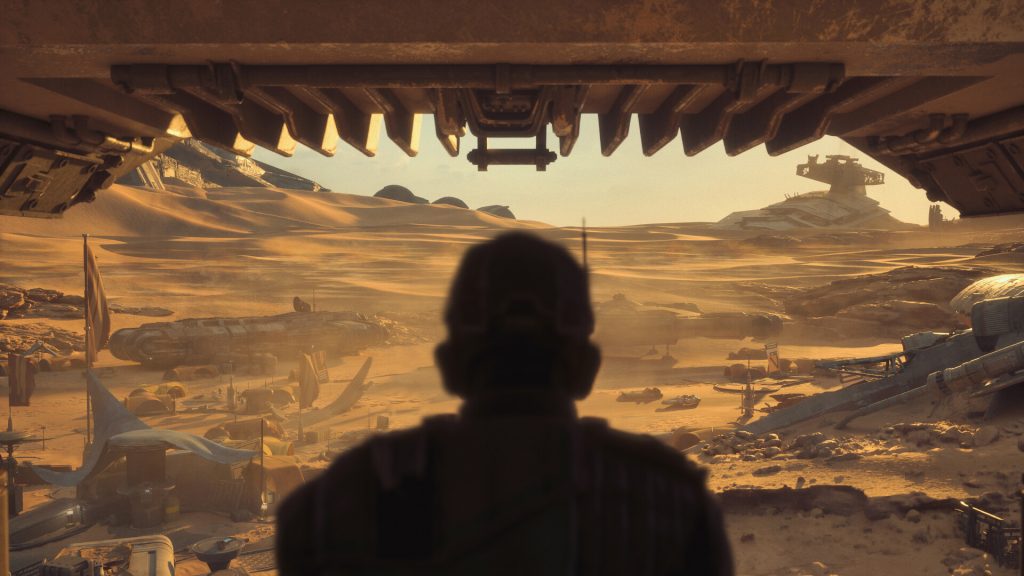
Additionally, the hub world that exists (think Marvel’s Midnight Suns or Death Stranding 2) is clunky and uninteresting. It exists as a way for you to, between planets, upgrade or repair your vehicle. In doing so, it also yielded in its wake: different base camps with nearly identical configurations each time; eavesdropped-upon dialogue between NPCs that, by generous estimate, reveals a specific bit of broader Star Wars lore, instead of arbitrary and pedantic exclamations, once every six conversations; and cutscene dialogue that began to routinely and verbatim repeat after Act II, including NPC-initiated, story-interrupting dialogue.
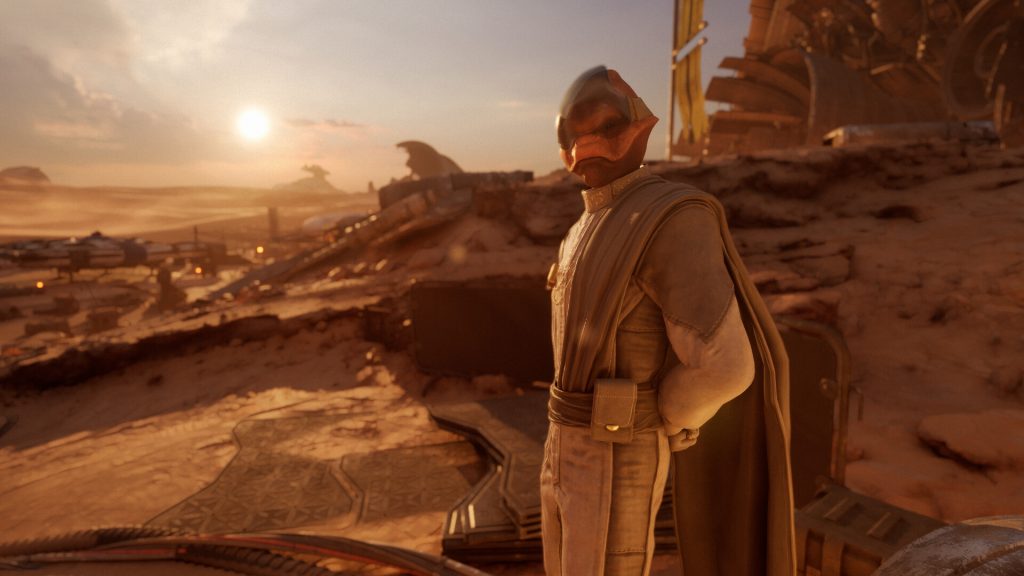
While the visuals are highly impressive, more than half of the conversations that I watched featured wildly obvious asymmetry between the voice acting and character modeling. Once, I went toward a cat-like creature positioned on top of a barrel with an “interact” icon, similar to the ones for Hibi, your mechanic, and other significant characters. I hit interact once the on-screen “PET” text appeared, only for Shade to respond, “I’m just here to race.”
This was not a tongue-in-cheek reference to a specific memory Shade had, or their overall personality or disposition, as it would be unfair to say we have a good sense of what that personality is. If the character that I’m controlling thinks that the action is inconsequential, why would it be inserted into the game, only for the player to be told that it is indeed inconsequential? How is that advancing the campaign’s narrative? It is a small and perhaps trite point, but this kind of empty and arbitrary story choice is emblematic of what keeps this game from being an undeniable contender for Game of the Year, and then some. The most irksome was an NPC conversation on Derven Acos that was seemingly mandatory — in that I could only enter the final two races upon engaging with that individual — and wholly unnecessary, as the character just insulted me, using the exact same insult they used in a previous encounter.
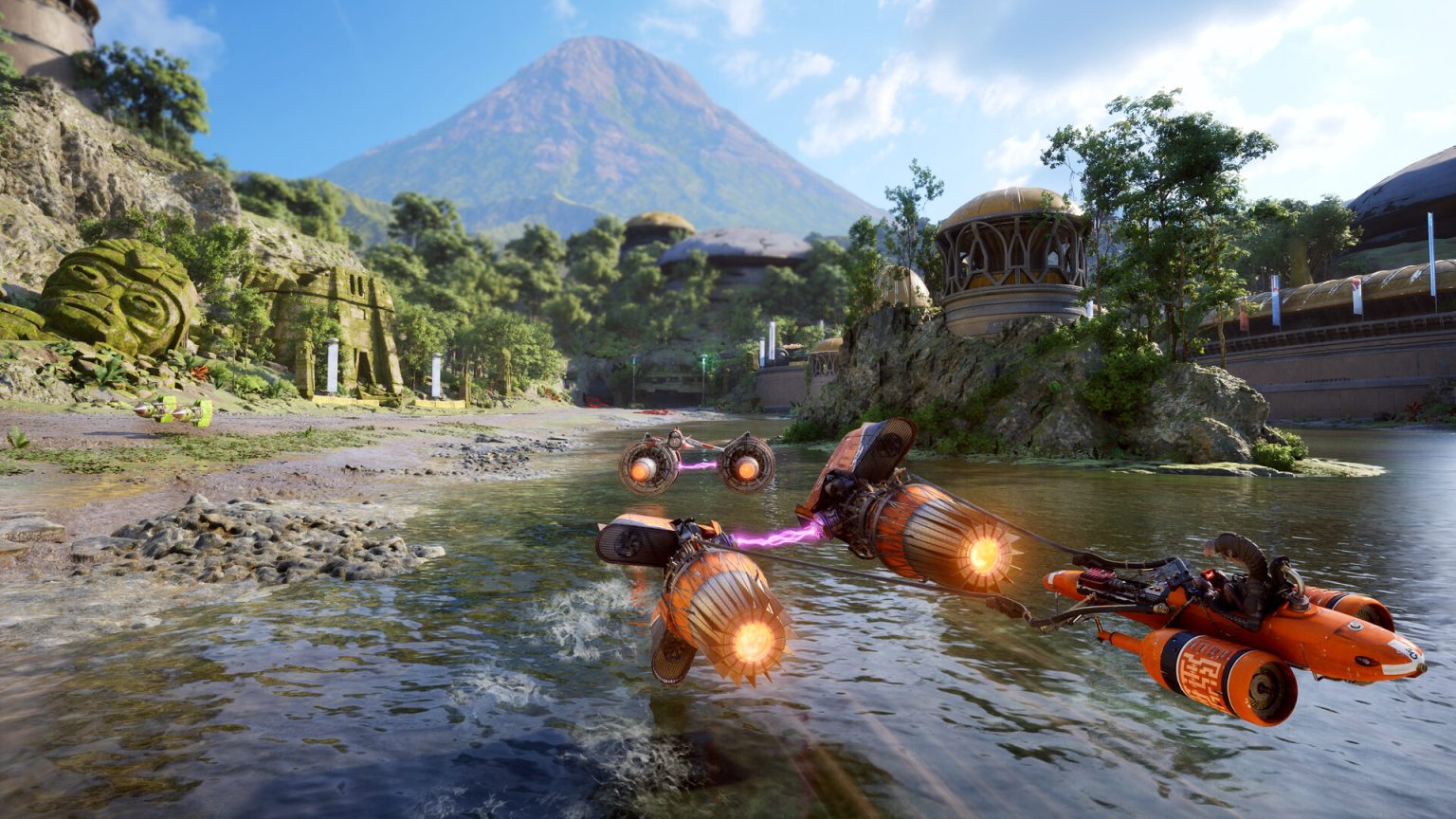
If you’re reading this thinking, “We didn’t come here to play school, how is the racing?” it’s a valid question with two seemingly evident prongs. We can start with the unequivocally positive one: The racing is excellent. I mean truly, utterly sublime. If you have seen clips and thought of the Burnout racing series, there’s a reason. In January of 2023, a handful of leaders within EA’s Criterion Studios, creators of the high-speed combat racing series, left Electronic Arts to form Fuse Games. Star Wars: Galactic Racer is their first game, and that inherited DNA is on display throughout the gameplay, in all the best ways.
Burn After Afterburning
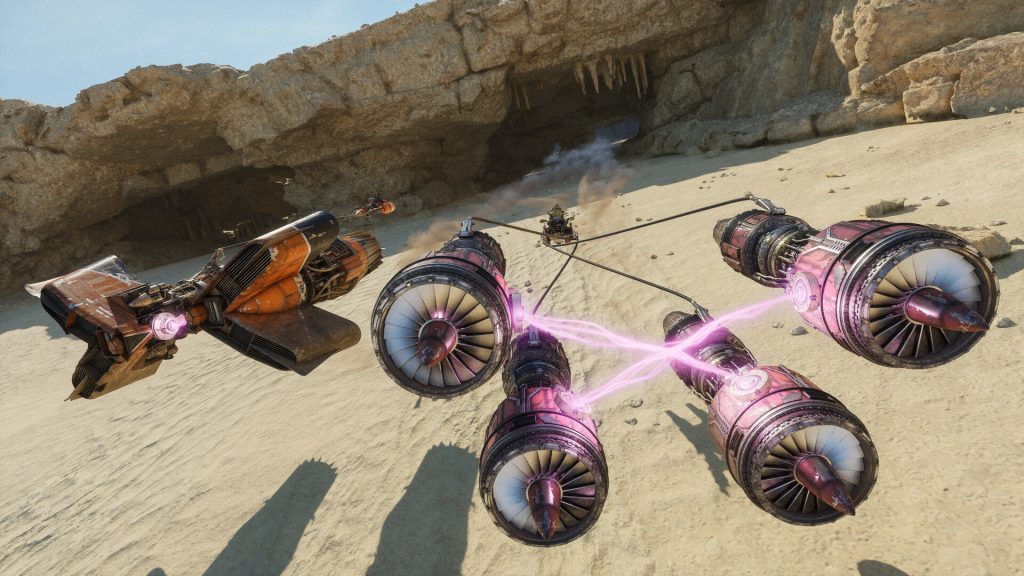
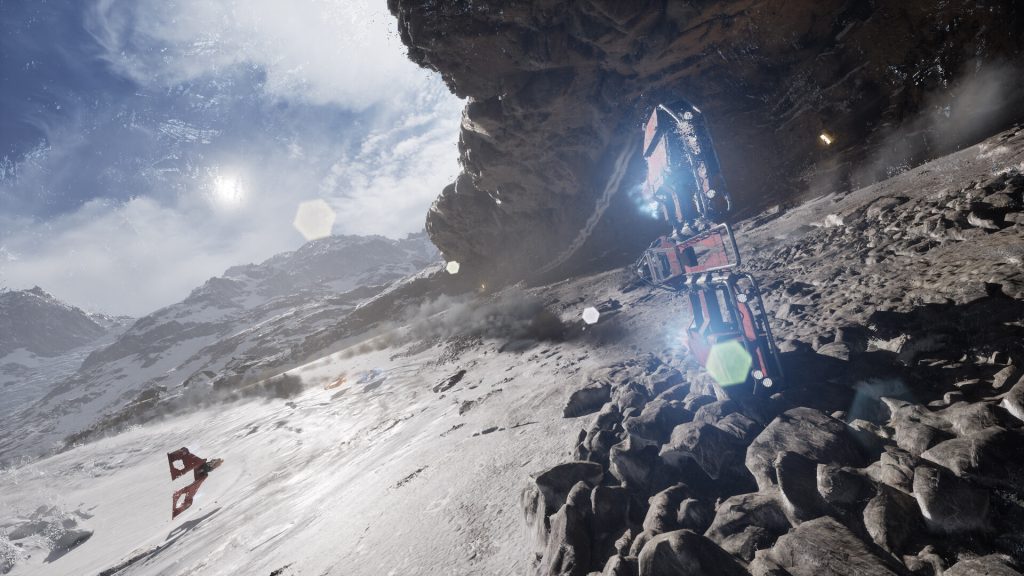
This is not a racing game in which your vehicle’s upgrades and parts will win you the race; they won’t. You won’t be able to simply memorize all of the shortcuts for each of the tracks; if someone on tour has a better machine than you, you will lose. Fuse Games has somehow perfectly balanced the game’s meta such that it requires, if not a mastery, then a deft and calculating proficiency at different components of winning a race, at different times for different tracks, to be consistently successful. Drifting, for example, is not optional. In any of the vehicles, but especially in the podracers, you will wreck out of the race without mastering drifting and handling sharp corners.
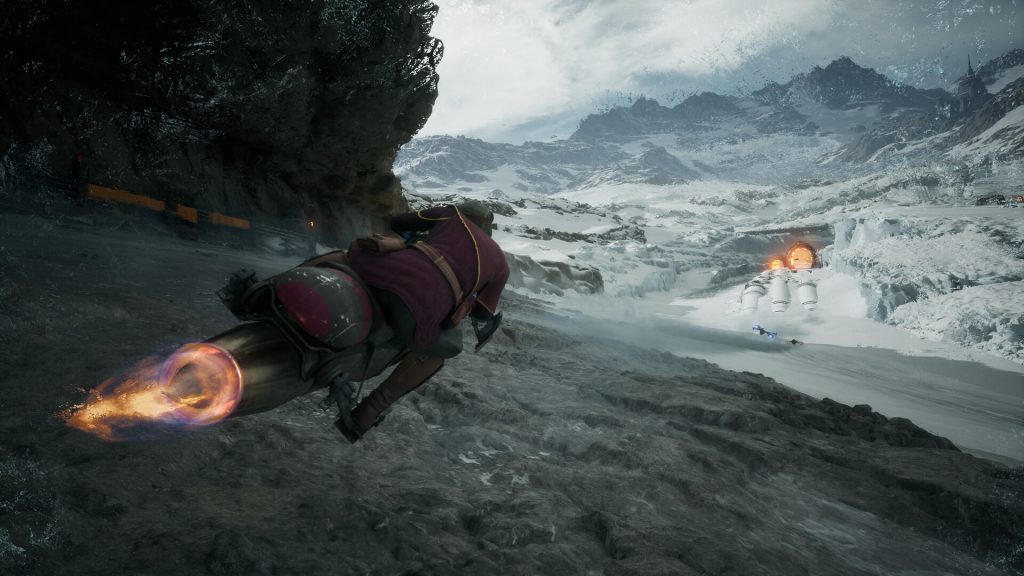
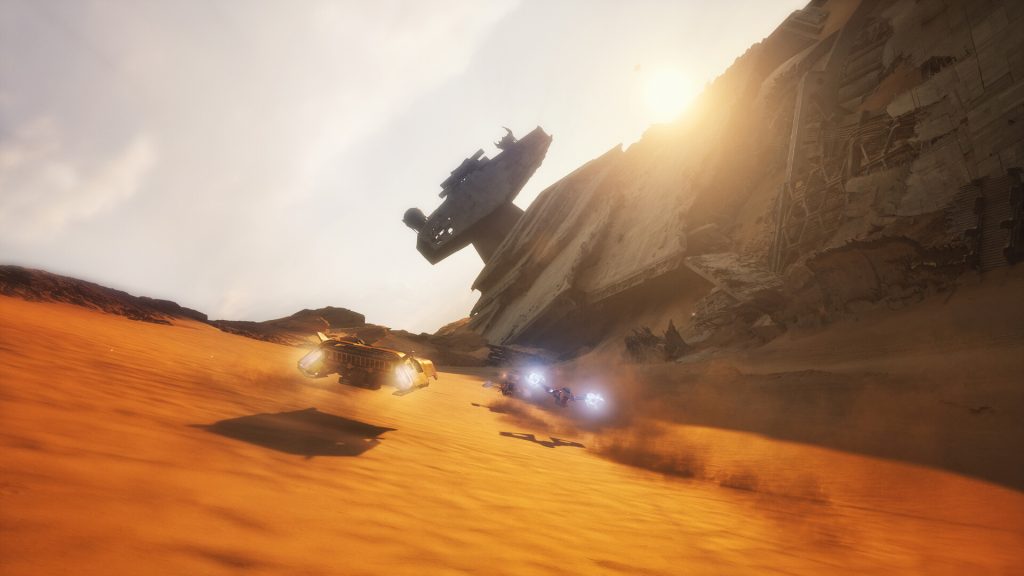
And then, of course, there are the takedowns. The gameplay mechanic that made Burnout 3 a widely considered racing masterpiece feels just as good in Star Wars: Galactic Racer. In fact, a high-speed lateral vehicle takedown makes infinitely more sense mechanically and locomotionally between a speedracer and a podracer than between a Dodge Challenger and a Mitsubishi Eclipse. Some of the most thrilling, beat-per-minute-bursting adrenaline I’ve felt in a long time has come from flooring the skim speeder’s ramjet into a perfectly timed knife-edge maneuver, pivoting vertically and slicing between a rock and a cliff face with zero room to spare.
The gameplay is not without its flaws, however. Some tracks are lit such that it’s almost unplayably difficult to tell where the track bends. The more you upgrade an ability, the longer its string of pre-race check commands becomes, making it harder to optimize your abilities as you make them stronger between races. Likewise, some of the terminology for the build upgrades is unclear, which impacted my build strategy during my first several tours, and there doesn’t seem to be any substantive narrative justification for why the repair shop isn’t available at all until after a significant amount of the first act. I even came across a few typos in dialogue subtitles, including the misspelled “proprieter” well into Act III. None of these were debilitating to my overall experience, but I did notice them, and remembered them enough to include in my notes.
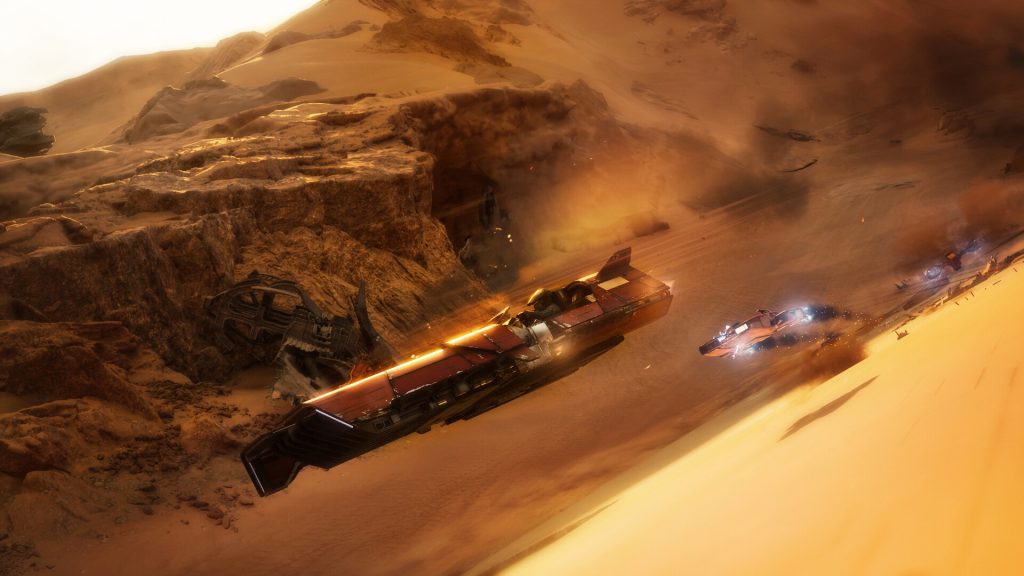
By the same token, the visuals (on performance mode especially) are a bold reminder of just how much game engines have advanced over the last decade. (I played a review copy for Xbox Series X, provided by representatives at publisher Secret Mode.) Crashes and explosions on the track happen in a slow-moving spectacle that immediately transported me back to my homie’s basement playing Burnout 3 on PS2. The sound and audio design should win awards at the end of the year. The score, done by Grammy Award-winning composer Gordy Haab, is an accomplishment on par with the contributions made by John Williams to Star Wars’ cinematic renderings. Playing this game with headphones on at 3 in the morning with only the glow of the television and the brighter spark of my speeder’s afterburner is even cooler than it sounds.
Star Wars: Galactic Racer is such a significantly sensation-altering experience that one night, after playing for multiple hours, I needed to run an errand, only to remind myself after a block of driving in my very real Hyundai SUV to drive like a normal Earth human who had less than one crash to spare on a much more ordinary, often just-as-unforgiving planet. The developers at Fuse Games know how to put you behind the wheel and make you feel exhilarated, and for the first couple of days with the game, I couldn’t stop thinking, I can’t believe no one has done this with a racing game.
Runs-Based Improvement
But, of course, someone did. Star Wars Episode I: Racer for the Nintendo 64 released in 1999 to slightly above-average critical reception. As I sifted through old YouTube gameplay videos, the skeleton of Star Wars: Galactic Racer became more evident, as did the places in which Fuse Games greatly overtook its in-name predecessor. There are side bets and parlays that you can make with other rival racers, as well as a sponsorship system introduced in Act II, requiring you to perform to certain standards depending on which intergalactic financier is investing in you for that run, or be penalized if you underperform. There are certain character favors that, when equipped, allow for noticeably different racing gameplay or major in-tour bonuses. Each of these improvements, as well as the runs-based gameplay loop, meaningfully push the experience further and further toward full immersion in the simulation of being a galactic racer.
The problem is that seemingly all of those advancements were made exclusively on the track. The bigger problem still? Runs-based games, especially all of the ones I’ve named in this piece so far, excel precisely because they are built upon or amid substantial, inspired narratives. The repetitiveness of Supergiant’s games is always forgivable because of how fun and varied the gameplay is; the repetition is yearned after and sought out because of how unequivocally riveting the main story is, as is the character development of Zagreus, Melinoë, and their respective games’ suite of characters. The choices you’re forced to make in a game like Pyre matter not simply because they’re presented, but because they have real consequences for the characters that matter to the player, because those characters have expressed a relatable, vulnerable series of emotions and experiences.
The beauty within the Star Wars universe exists not merely because the technology is awe-inspiring and unfamiliar, but, and perhaps more so, because the stories informing who wields power are internalizable and familiar. We get neither in Star Wars: Galactic Racer. There is a moment at one of the base camps in which you can overhear a conversation between two racers, Skandaro and Quill, and the former remarks to the latter: “If you have nothing of value to say, don’t speak,” and that bit of art imitating itself, exhibiting what it also exposited, was one of the deeper, and entirely coincidental, moments of NPC dialogue I encountered during my playthrough.
The very quality that pushed this racing game, and undoubtedly others that will be made by developers as enthralled with the runs-based system, is what required Galactic Racer’s storytelling to be that much more intentional. There is perhaps a frustrating irony: Were this a more traditional racing game, I’m not sure the story would matter to an even noticeable degree, and I would view it comparably to games in the Tekken or Mortal Kombat series. Only, if this were a more traditional racing game, it wouldn’t be nearly as compelling, with gameplay as fiendishly addictive and replayable.
That microcosmic paradox unfortunately, as of this writing, bleeds into what is otherwise a rather enticing suite of multiplayer modes. You can enter in tour-based or single-race formats. You can enter a pre-made lobby and, similar to multiplayer in Call of Duty, you are automatically entered into the next race until you leave the lobby. I finished eight races before I realized that I should move on to another part of the game to review. As of writing, there are no custom lobbies, and matchmaking is limited to three players. Functionally, this prohibits you from setting up races just against your friends.
On a Discord server for the game, Secret Mode released a statement on the continued development of multiplayer modes, which reads, in full:
Galactic Racer multiplayer brings up to 12 players together online, with up to 8 players in Podracing. We’re seeing the conversation around playing with friends, particularly party sizes and private/custom racing. Good news! We’re already working on increasing the current 3-player limit to 6 players and are targeting an update within the first few weeks after launch. We’re also seeing the requests for private/custom racing. We don’t have anything to announce there today, but we’re listening and looking at how people want to play. Launch is really the beginning for us. We have ideas for how Galactic Racer can grow, but how the community actually plays – and what matters most – will help inform where we take it next.
Consequently, it is currently difficult to fully assess the multiplayer experience. The overall racing gameplay and racer customization options would suggest that this should be the perfect pick-up-and-play experience with a group of friends. At the current moment, apart from cunning timing and a bit of luck when trying to join the same automated lobby, it seems that is not yet fully possible.
Final Thoughts
Still, after 25 hours, I don’t subscribe to the Ricky Bobbian ideal that an imperfect finish is the same as a last-place one. Star Wars: Galactic Racer is an invaluable addition to the racing game canon precisely because it is excellent, and because it is a game wholly different in style than each of the Forza, Gran Turismo, Need for Speed, and Mario Kart franchises before it. It is important and healthy for the continued development of the art form to experience innovation not only in licensed property but also in the very ways in which we play our favorite games, in genres we falsely believe to have already traversed their creative limits.
With a stronger narrative, Galactic Racer wouldn’t just be making a case as one of the better games of the year; it would be in the conversation for one of the best Star Wars IP releases this century.
This is the first offering from Fuse Games, and it only took them three and a half years’ worth of development time. They are led, in part, by Matt Webster, a former Burnout developer and the producer on the very first FIFA game in 1993. They have demonstrated multiple times that they know how to make fun video games, and in a year that has also seen releases of games like Screamer, it is evident that there is an appetite for bespoke racing games. I am confident that how I feel about the game now is the lowest I will feel about it and any potential future sequels.
As was learned by the citizens and residents within the Galactic Federation of Free Alliances following the subsequent falls of both the Empire and the New Republic, there is always work to do, even after winning.
Score: 8.0/10
Star Wars: Galactic Racer, developed by Fuse Games and published by Secret Mode, released on October 6, 2026, for PC (via Steam and Epic), PlayStation 5, Xbox Series X/S, and Amazon Luna. MSRP: $59.99; available for free via Luna. Version reviewed: Xbox Series X.
Disclaimer: A review code was provided by the publisher.

Miles E. Johnson is a poet and essayist from northeast D.C., a Cave Canem & Tin House alum, born-and-raised Washingtonian, and lifelong gamer. Miles loves his home of D.C. but believes the world would be better off without borders. You can find some of their work at blackandoutside.com and on Bluesky and IG at @blackandoutside.



1 Comment
ok first of all thank you for this pyre love!!!!!
second, great points here about where the game doesn’t succeed as a star wars game even though it also can only really succeed as a star wars game