The light is fading. The light is fading and nobody knows why.
Let me start at the center. Leagues below the surface, entombed in the dirt and shadow of The Abyss, pulses a massive brain large enough to exert a gravitational pull on the islands in its orbit, sending psychic dreams of flailing limbs to the denizens in its ambit. Sentient brain-worms tunnel through the environs, feasting on the living burials of crude beetle creatures and, in turn, glutting the digestive sacs of their anglerfish-like predators. Unbeknownst to all, a group of undying, time-traveling, and definition-defying entities maintains the structure of this bizarre biome.
Also, the worms wear hats, and the light is fading because the phosphorescent mushrooms are depressed. That’s a whole thing.
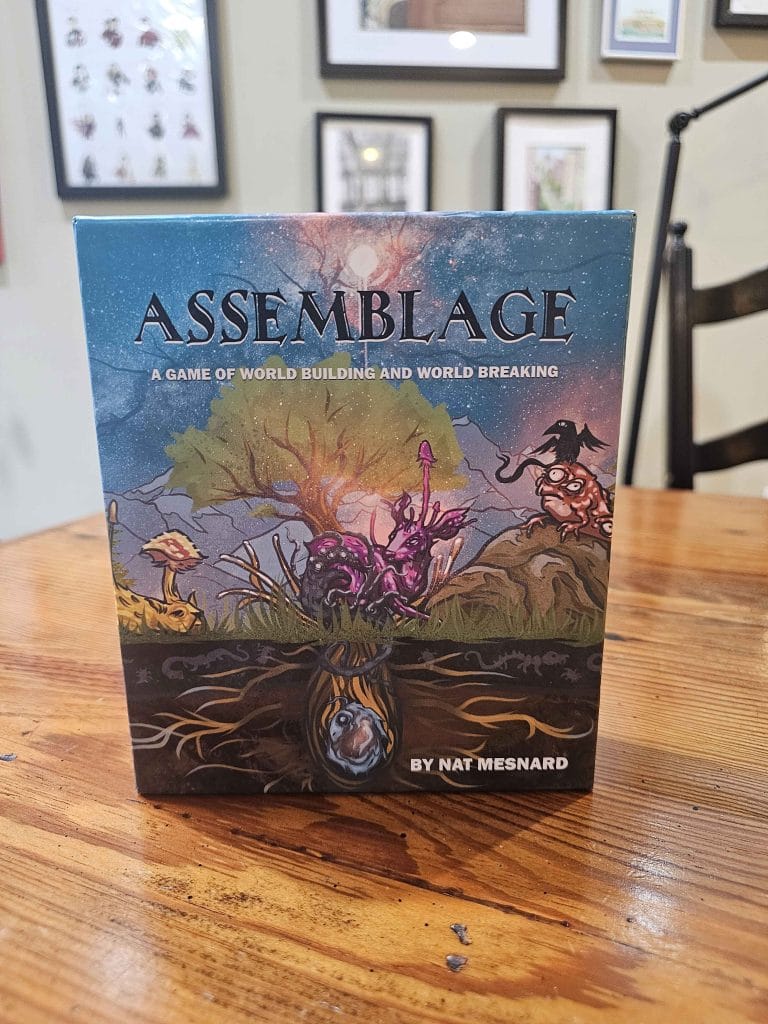
Despite what it may sound like, this story did not appear to me in some fever dream. It’s actually just a portion of the collaborative and improvisational world-building prompted by a game of Assemblage, a tabletop role-playing game designed by Nat Mesnard and published by Scryptid Games (a project of Mesnard’s). Mesnard and collaborators launched a successful BackerKit campaign in spring 2025, and the game is now being released more widely.
Assemblage is pitched as an “eco-storytelling game of world-building and world-breaking” that uses card-based prompts and collectivist narrative mechanisms to tell the tale of an ecosystem as it is made, shattered, and remembered. It offers a group of two to six (but ideally four or five) players the opportunity to co-create an ecology, its species, and its end. My primary playthrough featured a virtual group of five, using Assemblage’s thoughtfully free digital version.
Assemblage aims high. Unfortunately, it also falls short. The game’s design language is both too narrow and too expansive; its mission of interrogating traditional power hierarchies in tabletop gaming experiences interrupts flow without introducing interesting tension.
Playing Assemblage felt like attending a surprisingly intimate birthday dinner of someone you’re not particularly close with: It was fun enough and had its moments, but it also felt a little forced and lasted too long by half. For all of Assemblage’s ambitions and charms — and despite the wildly inventive world we built in our playthrough, or perhaps due in part to its unbounded idiosyncrasy — the game ultimately misses its mark.
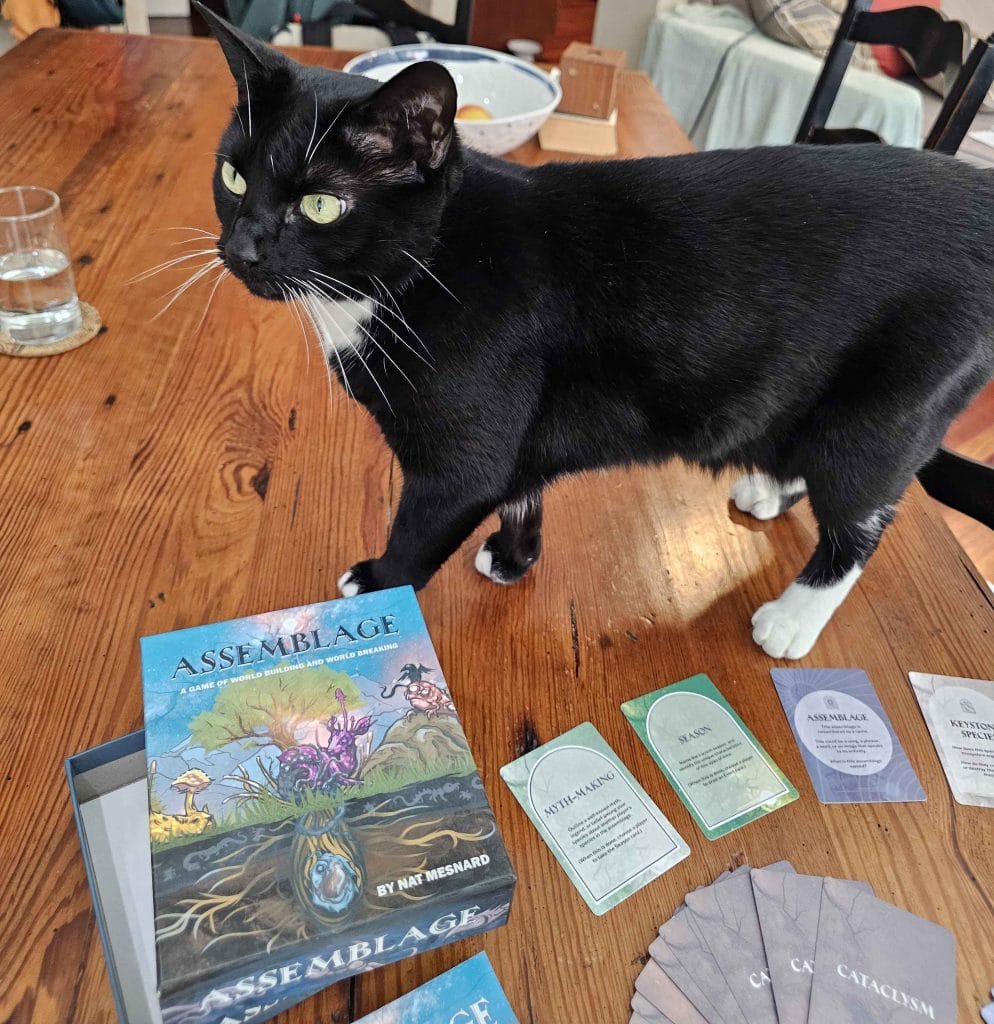
Presentation: Cards in Conversation
As a game in a box, Assemblage is a straightforward affair.
First, you get a 37-page guidebook with instructions and examples of play. The instructions are serviceable and generally evocative, but sometimes unclear and more narrative than concise in places. The guidebook would have benefited from an FAQ and clearer explanations for some central concepts.
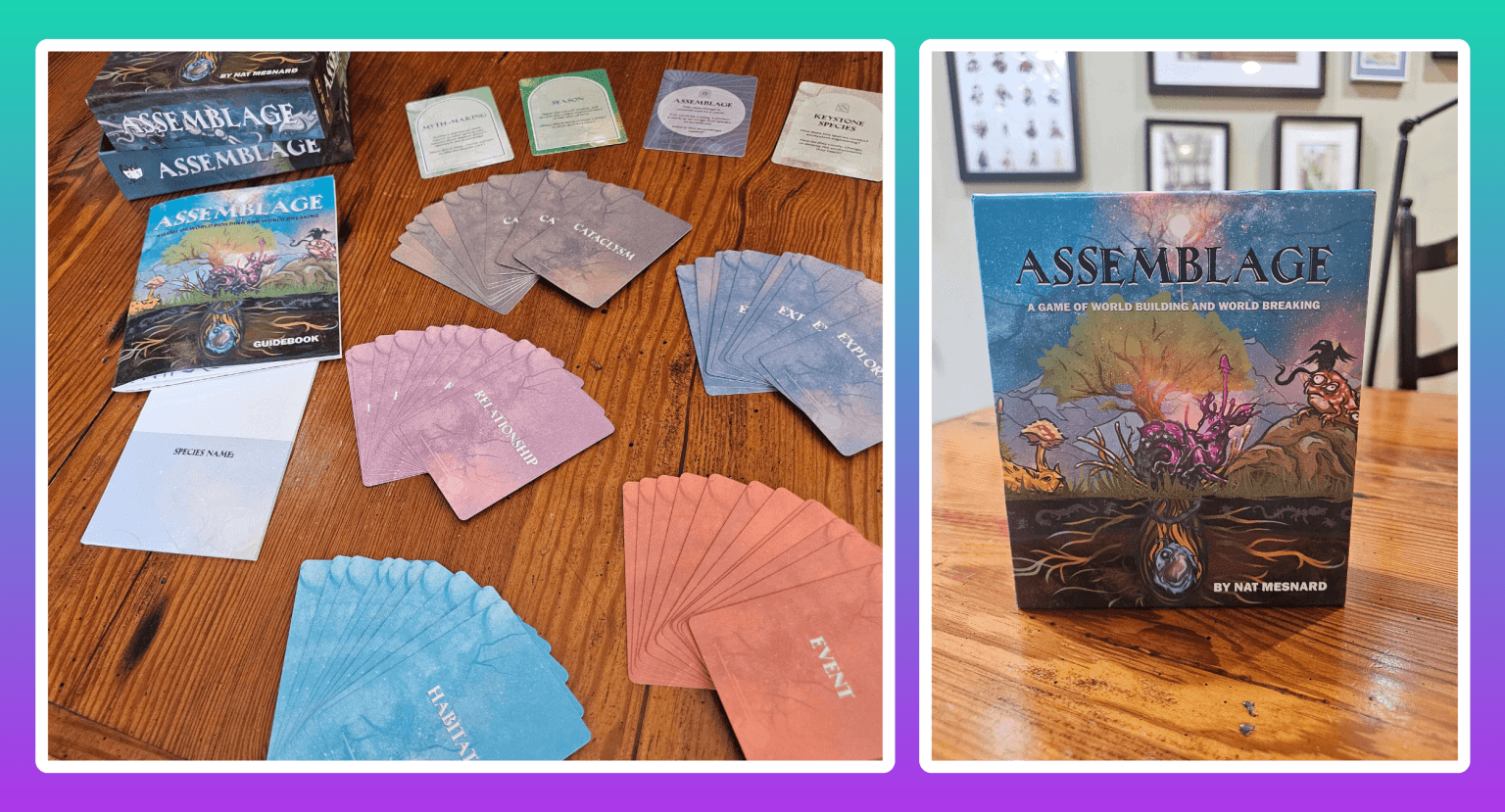
You also get a booklet of double-sided tarot-sized slips of paper for your species names and other scribbles. There are enough for a fair amount of Assemblage games. This is a nice touch; it’s always appreciated when games provide scoresheets and the like.
Finally, the pièce de résistance: You get a deck of around 45 cards used to play Assemblage, including cards to determine your ecology’s habitat, the relationships between each player’s species, random events occurring across the timespan of the game’s midsection, and the possible cataclysms that will eventually spell doom for one of your species, as well as a few one-off cards. My review playthrough ended up being virtual with other writers from The Punished Backlog, but the cards do still function well in the Screentop.gg version.
These cards are solid components. The physical copies feel good in the hand and are clear for their purpose. A slight majority are illustrated, though the visual design language of the game doesn’t quite hit for me. The illustrations trend more toward washed-out or cartoony, even a bit Neopets on some cards, where a weirder and more evocative tone may have fit better.
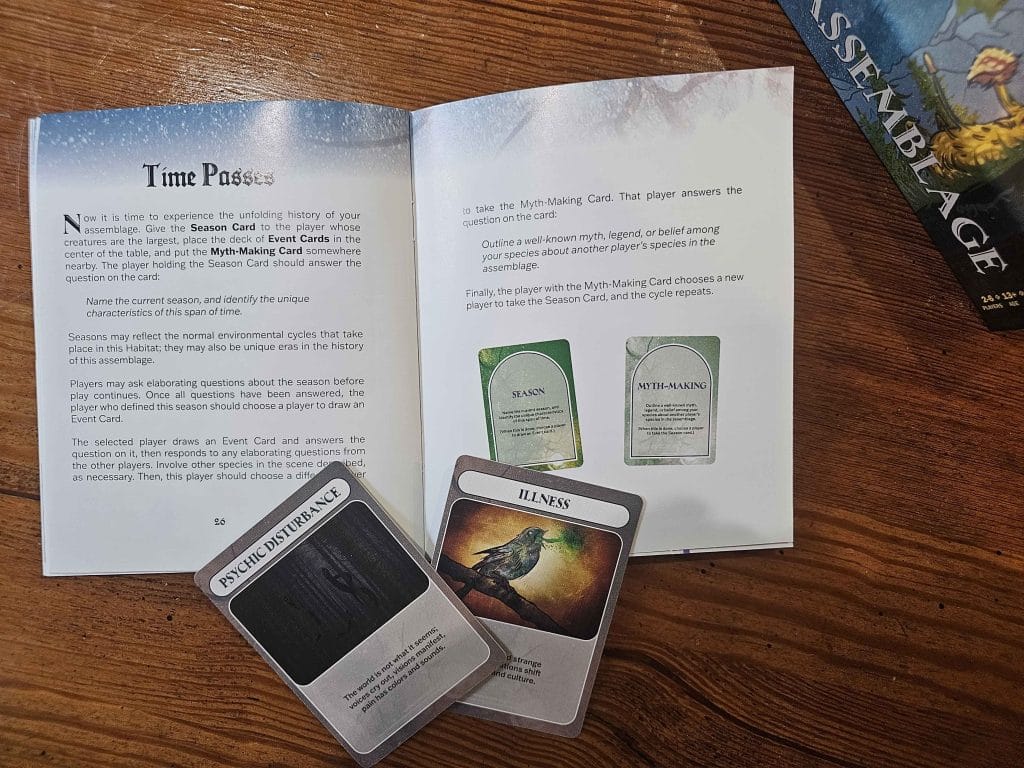
Overall, my lingering question on the presentation of Assemblage is why we needed a box and deck of cards rather than a book with random tables to roll on or pick from, the more standard fare for TTRPGs. In a talk they gave on Assemblage, designer Nat Mesnard explained that they opted for the former because “cards automatically imply a collaborative, turn-taking flow of play and they put the game rules physically within reach of all players.” Fair enough; I certainly enjoy drawing cards! But with a deck like this, where some cards repeat themselves and many are simply a short sentence or question with no graphics, I would expect the cards to occupy the table with some meaningful presence.
For example, take Dialect, a game “about language and how it dies” from 2016, designed by Hakan Seyalioglu and Kathryn Hymes and published by Thorny Games. Structurally, Dialect and Assemblage are nearly identical. Both are card-and-book, one-session, gamemaster-less, collaborative improv and world-building games that imagine the birth, evolution, death, and aftermath of something meaningful, leaving players with a story all their own on each playthrough.
Dialect’s cards are spare, mostly just words with some motif designs, but they get played to the table in ways that demarcate certain phases or ideas. You scribble your ideas on top of them and connect them with string. They become a part of the space of play. In Dialect, the use of cards as components is not just fun; it’s critical to the experience.
While the deck for Assemblage is a welcome feature, it ultimately contributes more to vibe than experience. In our playthrough, I ended up just reading prompts out loud and the cards fell to the background. This could be in part due to our virtual playthrough, but the same happened in my physical (though solo) game. The cards don’t add an important table presence beyond their content.
Gameplay: Back and Forth
Assemblage has several phases, each oscillating between group improv and individual storytelling as you collectively wind your way toward extinction. Each phase is fueled by the deck of cards in some way, either by pushing you to riff on a random question or by (less successfully) just passing a “role” card around to denote whose turn it is to solo storycraft.
Many of the particular design decisions in Assemblage, though, feel more focused on diffusing decision-making authority in the gameplay experience than helping to suggest or curate an evocative narrative for a living assemblage.
In the first phase, your group selects one of three randomly drawn habitat cards to build a world atop. Some of these habitats evoke the weird science-fantasy atmosphere of the game’s illustrations, like “Belly of a Titan” or “Brainforest.” Others, like “The Dunes,” “Atacama,” or “Primordial Stew,” fail to generate those creative juices. For example, our playthrough pulled “Atomic Wasteland,” which did not inspire us after years of Fallout content.
While I appreciate those tamer options for the possibility of more grounded sessions, it seems like Assemblage would have benefited from a thicker stack of habitat cards to play with, particularly because your choice of habitat informs every aspect of the rest of the game session.
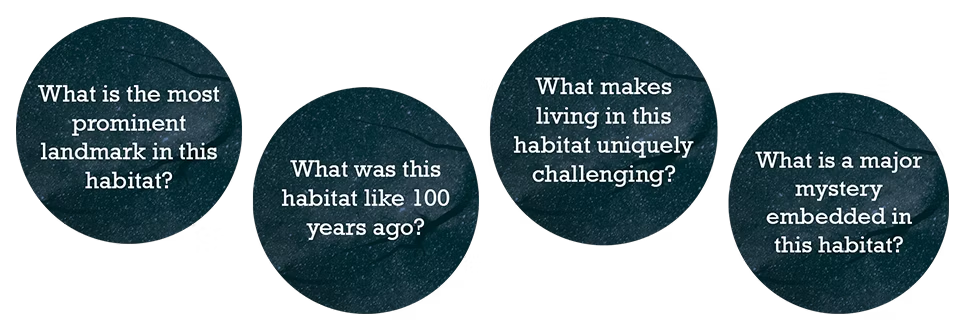
Building Together
Your group members then draw and answer a series of “exploration” cards to further flesh out your habitat. These cards may ask about your habitat’s landmarks, resources, mysteries, weather, and other such features. Other players interject with questions and suggestions until everyone is satisfied, then the next player draws their exploration card. This back-and-forth co-creation brings out the best in Assemblage: directed collaboration, a defined but nonjudgmental playground, the promise of what’s next.
In our playthrough, we enjoyed the thematic resonance that developed underneath our biome. The mysterious Abyss became a physical place and a metaphor for grief and repression, and many of our group decisions spun off from that common ground. Because we knew that something would go extinct, but not which species or how, we had to leave things open to various possibilities. We took our time in this phase, lavishing our world with strange textures to play with.
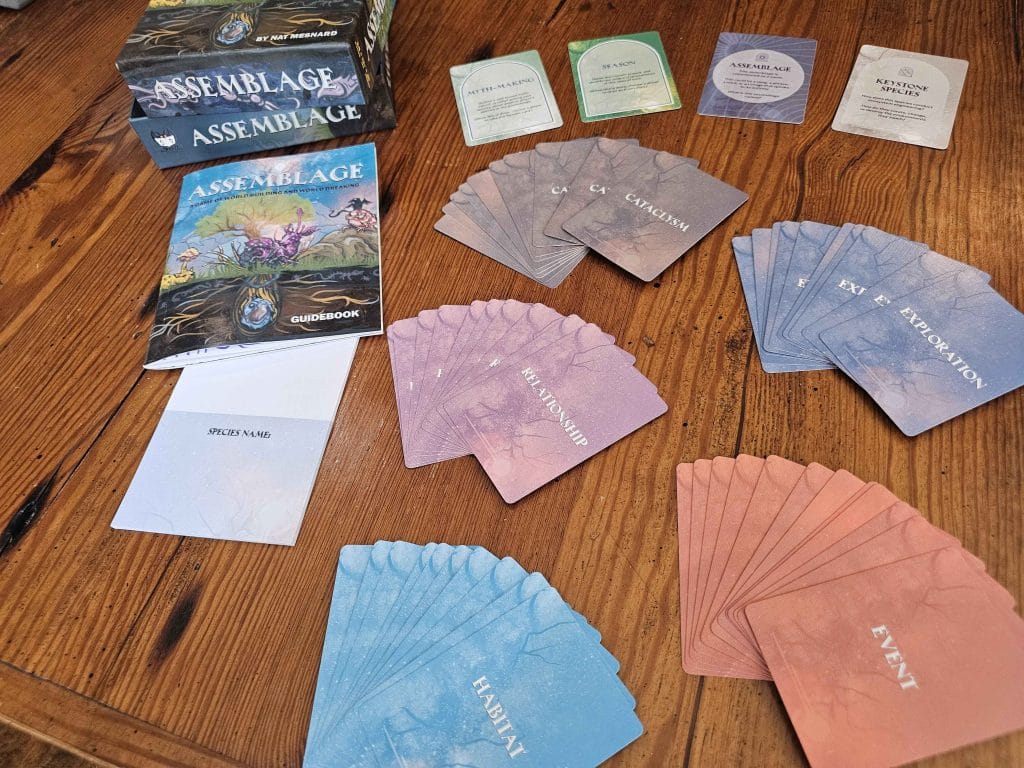
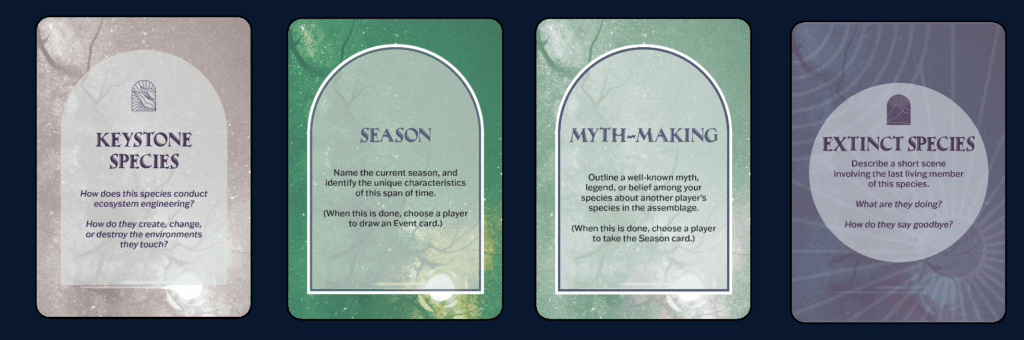
Then you begin what feels like the actual meat of the game, where each player represents a species in your shared ecology. One player volunteers to create and represent a “keystone” species that acts as a central “ecosystem engineer,” a design decision that didn’t quite land, in part perhaps because there is little explanation of what this means in practice. We assumed that the game was gesturing at something like humans, but the booklet offers a single example of “pirate worms” that burrow through the carcass of a space whale, and designer Nat Mesnard has elsewhere mentioned beavers as another useful reference: not examples that altogether exemplify a non-obvious concept. While I think I can see the outline of Mesnard’s goal with this feature — emphasizing some sort of natural hierarchy and setting up possible tensions — the keystone species should either have been expanded, co-created, or cut altogether.
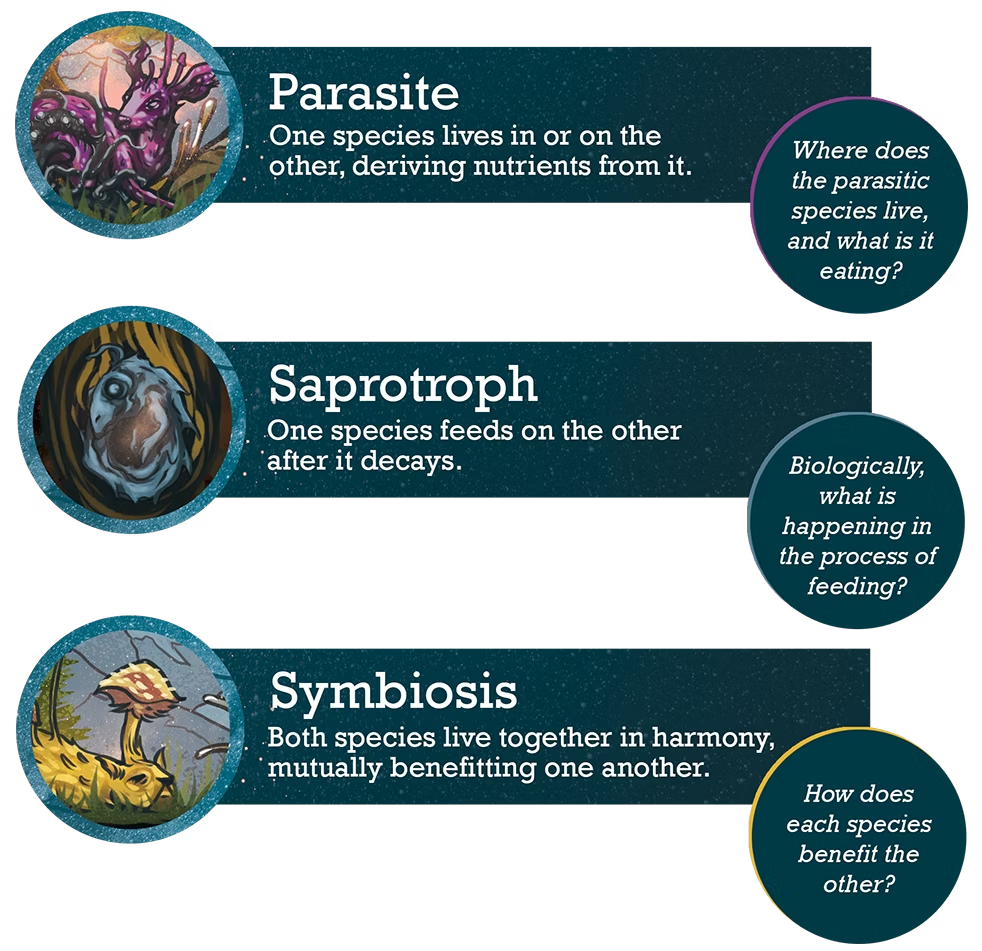
Players then randomly select one of five “relationships” between their to-be-invented species and the species of the player to the right. I could choose to create a species, for example, that is a parasite or predator of my neighbor’s, and in this brick-by-brick fashion the shared ecology is built.
As with the small habitat selection, it’s similarly unclear to me why Assemblage limits its species to five relationships only. There is no option for straight-up competition, for instance, and we can easily imagine more creative relationship types that cohere with Assemblage’s science-fantasy genre, like “alternate dimension clone” or “cursed descendant of common ancestor.” In a game so compact, every foregone opportunity for flavor and direction feels like a missed trick. Each species is also fit with a secret “special vulnerability,” which comes into play at the end of the game.
This back-and-forth co-creation brings out the best in Assemblage: directed collaboration, a defined but nonjudgmental playground, the promise of what’s next… We took our time in this phase, lavishing our world with strange textures to play with.
While our species and their relationships were ultimately compelling, the process was long and uneven. Accessibility in a game like Assemblage typically takes the form of directed creativity: clear and evocative prompts that help players who are less accustomed to fantastical improv or weird monster-mashing. We had little help in that way, though, and so each player’s impulses were either a constraint or unrestrained, without the middle ground that game design could help nurture.
A Long Winter
The following phase, “Time Passes,” caused us the most trouble. The “Season” card is passed around, with the cardholder naming the “current season” and identifying its “unique characteristics.” Someone else then draws and responds to a random “Event” card, most of which are compelling and provocative. Finally, a third person takes the “Myth-Making” card, with that cardholder outlining “a well-known myth, legend or belief among your species about another player’s species.” Then the cycle starts again.
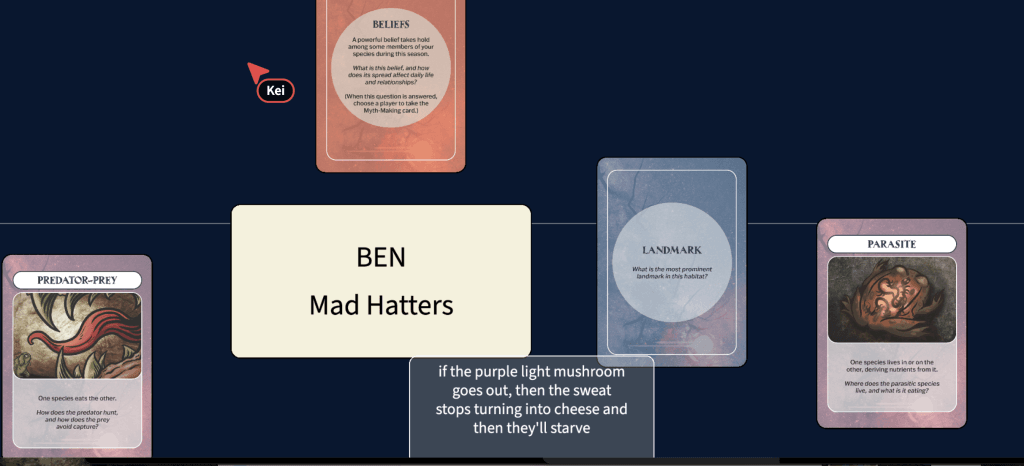
There are no examples of play provided or creative restrictions imposed in this phase, where both were arguably most needed. As a result, our table’s seasons fluctuated without much poetry or purpose from “Deep Winter” (the mushrooms all freeze!) to “Too Late” (time-traveling spores mess with everyone’s internal clocks!) to “Headache” (giant psychic brain needs aspirin!).
The “Myth-Making” bookend served up similar ambiguity, especially because the guidebook goes out of its way to assure you that “sentience” is a matter of choice, or perhaps perspective, when players first define their species. But how could a non-sentient colony of cyber-bacteria meaningfully foster any “legends” or “beliefs” about another species? Maybe we were not creative enough here, but I believe this lore-building phase offloads too much agency — and with it, expectations — to its players.
For a phase entitled “Time Passes,” I felt we were adrift rather than propelled in the world we created. Furthermore, we ended up cutting this section short because the game was nearing two hours — far beyond the ideal 90-minute playthrough.
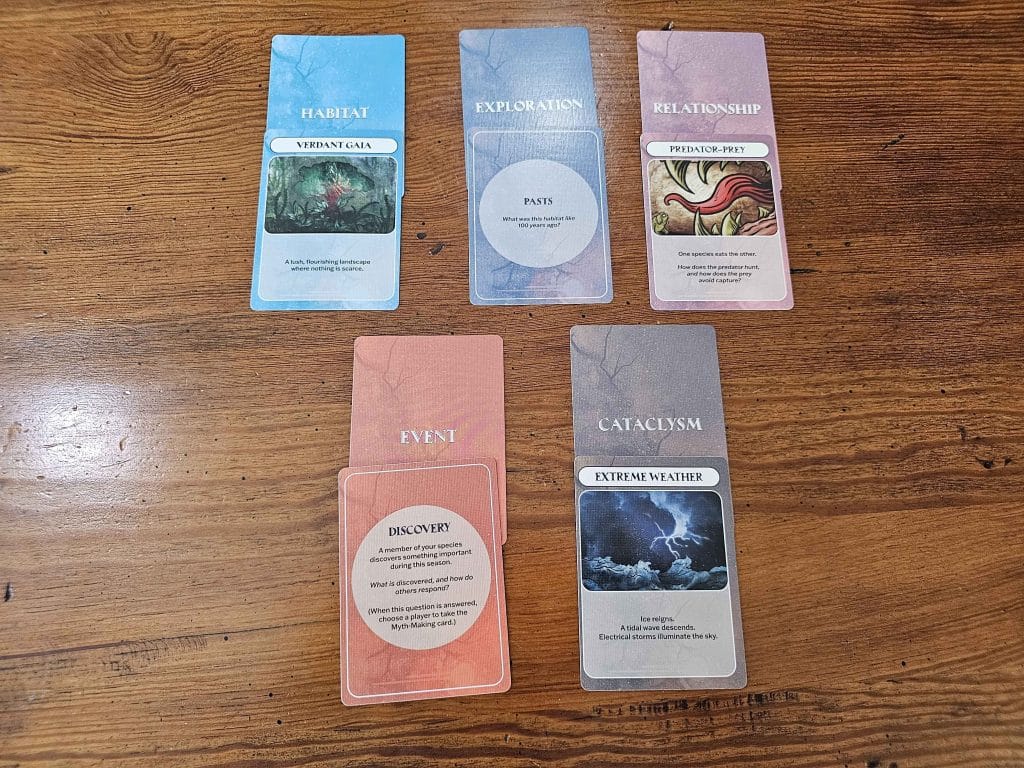
Finally, the “Cataclysm” phase mirrors the habitat-building introduction, with the group selecting one of three randomly drawn cataclysms to befall its assemblage, unless nobody likes the cards, in which case you simply draw again. From “Extreme Weather” and “Scarcity” to “Illness” and “Interloper,” these cataclysms are broad; in all likelihood, one or two make a lot of sense with your assemblage and the rest feel like random events. Each player must then choose the cataclysm that will have the biggest impact on their species based on its previously determined secret vulnerability.
I liked this design choice in theory, but it had a probably unintended effect on our session: With an explicit goal, everyone shifted from collaborative improv world-builder to more traditional board game player as we angled for why this or that cataclysm just “made more sense.” Rather than being emotionally rooted in the species we had spent over an hour creating together, we instead talked vaguely through all the ways these creatures could die. Of course, there is no backstop to cataclysm selection other than “vote for it” and all of the cataclysms are sufficiently vague, so this momentary dissonance passed peacefully before it gained enough momentum to become interesting.
After everyone reveals their species’ vulnerabilities and collectively picks which one gets wrecked the hardest by your cataclysm, each player narrates how their species narrowly survives, flourishes, or (at last) goes extinct, ending the game with a scene of the extinct species’ last living member and a postscript of how they — and the assemblage as a whole — are remembered generations later.
I can imagine this ending providing a moving and cathartic coda to a rich and layered tapestry of stories about ecological inter-reliance and collapse; that is clearly the intended experience, and I have no doubt that it can happen. Many of the particular design decisions in Assemblage, though, feel more focused on diffusing decision-making authority in the gameplay experience than helping to suggest or curate an evocative narrative for a living assemblage. It’s not hard to see how a game about ecological codependence and collapse might serve as an experiential metaphor for power and hierarchy. Failure to realize the former goal in a compelling and considered way, though, means the latter is that much harder to achieve.
Story: High Goals of Hierarchy
Assemblage wears its goals and influences on its sleeves. Designer Nat Mesnard named the game after a concept explored in Anna Lowenhaupt Tsing’s The Mushroom at the End of the World (Princeton University Press, 2015), a popular nonfiction book about the world’s most valuable fungi and its impact on history, politics, ecology, and economics.
Tsing introduced the concept of “assemblage” as an alternative to “community” so that, as Mesnard quotes in the first page of the Assemblage rulebook, we can “ask about communal effects without assuming them.” Mesnard also echoed another focus of Tsing’s study in a presentation they gave on Assemblage, where they articulated their core design question: “What is a tale of collaborative survival that aligns with neither progress nor ruin? And how can play transcend this binary and become something else?” Assemblage seeks to sit between these expectations, or deny them entirely, and thereby challenge its players’ worldview assumptions.
Mesnard designed Assemblage to explore hierarchy. As they wrote in an essay from October 2025 titled “Role-Playing Queer Assemblages Amidst Capitalist Ruins,” they are interested in “identifying and resisting social hierarchy through narrative play,” in queering the tabletop role-playing space by “reject[ing] systems of unequal narrative power by staging their gameplay as ‘GM-less,’” or sans gamemaster. Mesnard nods to some major players in the recent GM-less TTRPG movement as influences. For example, Mesnard mentions Avery Alder of Dream Askew and The Quiet Year, as well as Jay Dragon of Wanderhome and Yazeba’s Bed & Breakfast. Insofar as the indie TTRPG scene fosters space for micro-celebrity, Alder and Dragon have carved their niche, and one that is well worth the excavation.
While Assemblage decentralizes and mobilizes the joys and burdens of world-building, that destabilization appears to be an end in and of itself rather than a design decision in service of fostering certain gameplay experiences.
But in my view, these GM-less games succeed most when they play with the tensions that arise between a flat hierarchy and a group of people with distinct goals or when they eschew the gamemaster role because it is simply not additive to the experience. Either the theme and design align — or they don’t.
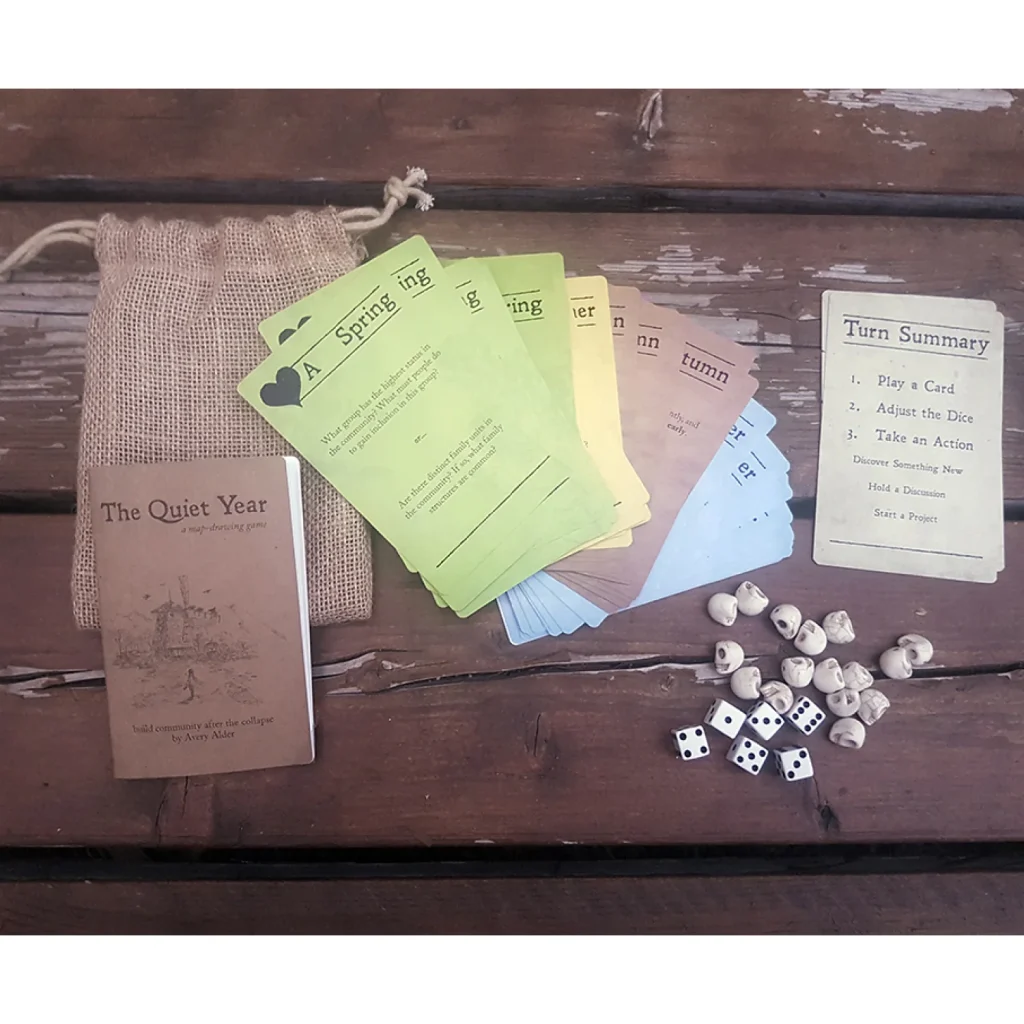
Take The Quiet Year, Avery Alder’s masterpiece game that uses mapmaking and card-drawing to tell the story of a community and its struggles to survive a challenging time. Two players may push and pull the narrative as they disagree on whether to prioritize, say, building a rocket ship or a fallout shelter. Absence of a gamemaster provides the fuel, not the fix, for the game’s interrogation of power and hierarchy in community decision-making: there is no higher authority to decide what “makes sense.” Either the community comes together, or it splinters, or the dumb luck of external pressures moots the decision altogether.
Assemblage does not quite manage to position itself as a vehicle for players to experience some deeper truths about power and hierarchy. Unlike The Quiet Year and Wanderhome, for instance, Assemblage doesn’t present a design system that is fundamentally about power. As I mentioned, The Quiet Year foregrounds the kinds of power we can hold over one another in an ostensibly non-hierarchical community. In Wanderhome, a (mostly) cozy RPG game featuring anthropomorphic animals traveling together in the aftermath of war, gamemasters are an optional feature because the game’s design articulates a gentle framework for small-group collaborative decision-making that reflects the placid tone yet potentially post-traumatic lore of its story interests. Authority has no place in Wanderhome: The war is over. While Assemblage decentralizes and mobilizes the joys and burdens of world-building, that destabilization appears to be an end in and of itself rather than a design decision in service of fostering certain gameplay experiences.
That’s not to say that all GM-less games require this sort of commitment to interrogating hierarchy. The aforementioned Dialect, for instance, ditches the gamemaster because such a role would disrupt the game’s reflections of linguistic evolution as uneven, organic, stochastic. Hierarchy has no place there, but Dialect is not about power, so while the absence is meaningful, it is also not the game’s core concern. Instead, Dialect is about language, and so its various systems all coalesce in service of the game’s thesis and aims in that domain. Assemblage, in comparison, struggles to fulfill its promise.
While we all had fun playing Assemblage, I think that’s more likely because we all enjoyed hanging out together, talking about worms with hats, and less because the group was guided toward co-building and co-destroying a world.
Final Thoughts: Room To Grow
Assemblage is a game that wants to use the player experience of ecological “worldmaking and worldbreaking” as an argument against our assumptions about power and hierarchy. But the game seems to care too little about what it means to make or break worlds, to craft or inhabit or exterminate species, to balance an ecology, to perish, to remember. We don’t learn anything about nature. The game is not interested in that. But as a result, we learn little indeed about hierarchy and power as well.
In their essay I alluded to earlier, Mesnard stated that “[w]ith Assemblage, I’d fomented a particular set of creative bonds, ones invested in transgressing the fractal reiteration of hierarchical power.” This essay is titled “Role-Playing Queer Assemblages Amidst Capitalist Ruins.” Though Mesnard’s own playtests may have enacted those creative bonds, mine did not, for one simple reason: The rules and design features of Assemblage do not push you toward any queered ecology, any capitalist ruins, any fractal iterations whatsoever. I would love to play the game that Mesnard describes. I hope they make it someday.
Assemblage: A Game of World Building & World Breaking, designed by Nat Mesnard and published by Scryptid Games, was released in a limited run in spring/summer 2025 and releases more widely in spring/summer 2026. The box kit is available to purchase for $30.00 from Scryptid Games and various storefronts, a download print-and-play is available for $15.00 on itch.io, and a free virtual version is available here.
Disclaimer: A physical review copy was provided by the publisher.
Editor’s note from Amanda: We received the opportunity to review this game through a personal work event of mine. I did not review the game, but I did offer it to Ben to review. Still, because of that connection, we have chosen not to score the review.

Ben is a lawyer by day, gamer by night, and overactive board game Kickstarter backer by dusk/dawn/witching hour. He loves metroidvanias and Soulslikes, pixelated RPGs, and games about games. He's also passionate about board games and tabletop role-playing games, and is fascinated in a mega-nerd sort of way by academic theories about play. He’s got a new Twitter account for writing at @BenRashkovich.