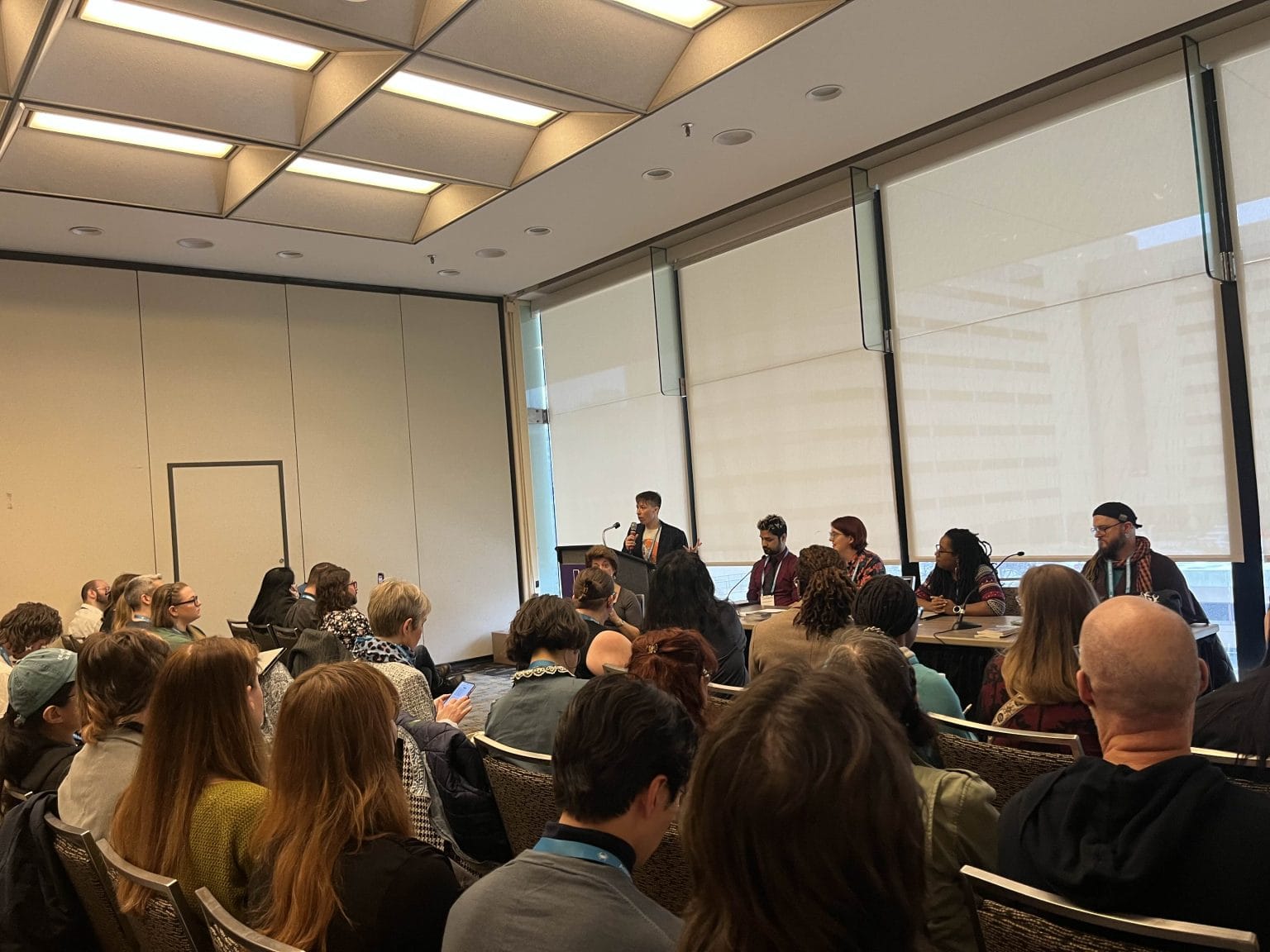

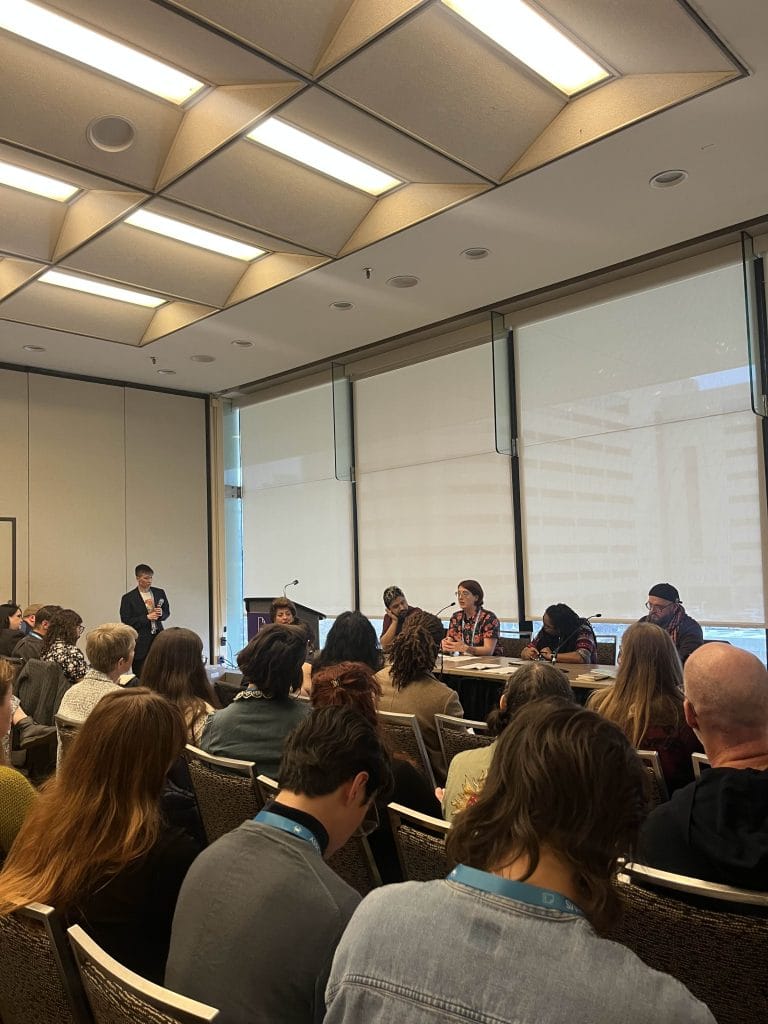
I knew I was in good company in Baltimore last week when I joined a line of bespectacled, excited, colorful, proudly geeky people queuing up 20 minutes early to get into a conference session called “Prose, Poetry & Play: Game Design as a Literary Practice.”
I was at the annual conference held by AWP, the Association of Writers & Writing Programs. Over the last two decades, AWP has become one of the places to go if you’re an educator, (aspiring) author, indie book or magazine publisher, agent, program administrator, or just an extra curious reader. It can be very overwhelming. I mainly went to network and meet up with old friends, but this was one of the few sessions I was really excited by — and I was not alone. The session marked the first time I had seen game design on the conference agenda (but to be fair, I didn’t go last year, and I’ve only been a handful of other times before).
My wait paid off, and the session was brimming with energy. There was a discussion of what makes a tabletop role-playing game (TTRPG) work, some of the nuances comparing video and tabletop gaming with friends, and much more. As I listened, I knew I had to share some of these beautiful ideas. Below are many of my favorite quotations from the conversation, reflections on game design, and an upcoming workshop to get started in creating games if you’re interested.

About the Session
Title: Prose, Poetry & Play: Game Design as a Literary Practice
Where & when: Held at AWP 2026 in Baltimore on Friday, March 6, 2026
Session description:
The world of narrative games is a site of rich literary possibility, expanding notions of genre and inspiring the invention of new storytelling forms. In this panel, writers who have also published tabletop “story games,” narrative video games, and interactive fiction will explore the practice of writing games. Is there a narrative games canon? How might a writer of “traditional” prose find pathways into games? What stories are best told through interactive, collaborative experiences of play?
Moderator:
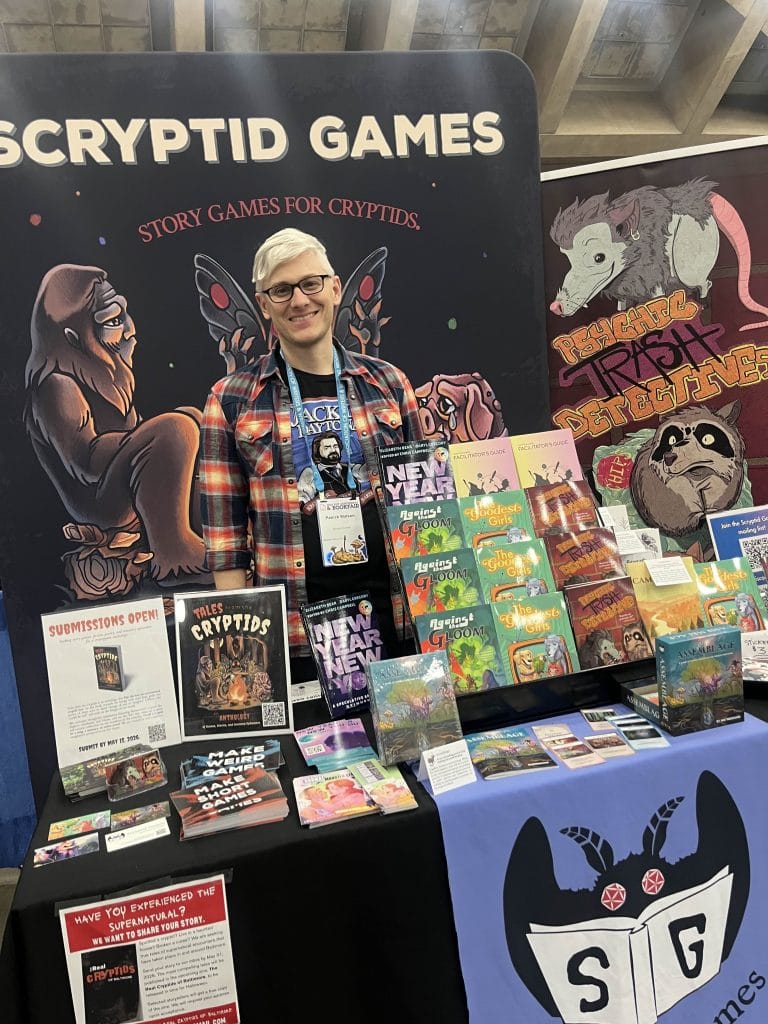
- Nat Mesnard, a game designer and writer based in NYC, and a co-founder of Scryptid Games and Unquiet Games. They have published poetry, fiction, and nonfiction in Vol. 1 Brooklyn, Autostraddle, Bodega, Blackbird, Kenyon Review Online, Ninth Letter, and elsewhere.
Speakers:
- Erin Roberts, a speculative fiction, game, and script writer currently working on Dungeons & Dragons. Among many other titles, she also worked on a quest for Triangle Agency, which fellow writer Ben Rashkovich covered in 2024. Author of award-winning short story “Sour Milk Girls” (2019).
- Brigitte Winter, a co-founder and co-director of Scryptid Games, a TTRPG studio and small press publishing innovative narrative games with a queer punk ethos. Author of upcoming book The Normal Monster Club (2027, Generous Press).
- Sharang Biswas, a designer and writer of TTRPG games and interactive media, a writer of speculative fiction, and an adjunct professor of game studies at NYU Game Center. He has published poetry, fiction, and commentary in Fantasy Magazine, Lightspeed Magazine, and elsewhere.
- Dave Ring, a writer and editor of speculative fiction, as well as a publisher and managing editor of Neon Hemlock Press. Author of The Hidden Ones (Rebel Satori Press, 2021).
Selected Game Design Discussion Quotes
Below are some of my favorite quotes from the conversation that I feverishly transcribed by hand in my notebook. Please note that comments have been edited for clarity and length.
Why Talk About Making Games? Why Here?
Nat Mesnard: “Being at AWP, for me, is an opportunity to invite more creative writers into game design… It’s about creating a collaboration that is unique, radical, and fun.”
Erin Roberts: “The stories we tell change depending on the format we use to tell those stories. The element of play inherent in games can, in turn, shape the story.”
The Pathway and Practice of Making Games as a Writer
Nat: “I want to hear about your pathway into the intersection of fiction, poetry, and games. What do you find exciting about that overlap?”
Dave Ring: “People have different reactions to different genres. I started in games, and I found it interesting to see how people approach stories in writing vs. in interactivity.”
Brigitte Winter: “I have a background in theater, but I never played Dungeons & Dragons or anything like that growing up. At the time, I didn’t see a lot of women or openly queer people playing D&D, so it didn’t seem like it was for me. Furthermore, D&D was always about solving a conflict through violence, and that didn’t interest me. But over the past 10 years, we’ve really seen this boom of fantastic indie RPGs that do something different.
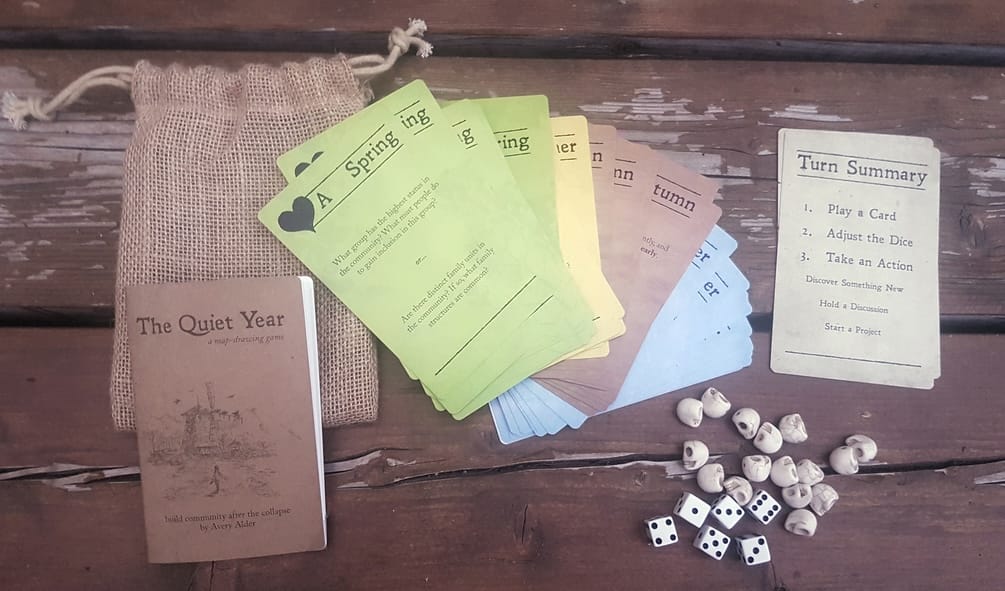
“For example, Avery Alder’s The Quiet Year (2013, updated 2019) was really revolutionary for being about building a society and everyone playing as part of a community. What I like about games is that they aren’t passive. Games, especially TTRPGs, demonstrate theater in a way. Every player is director, actor, and audience. By creating a story framework, games are an exciting platform to release control.”
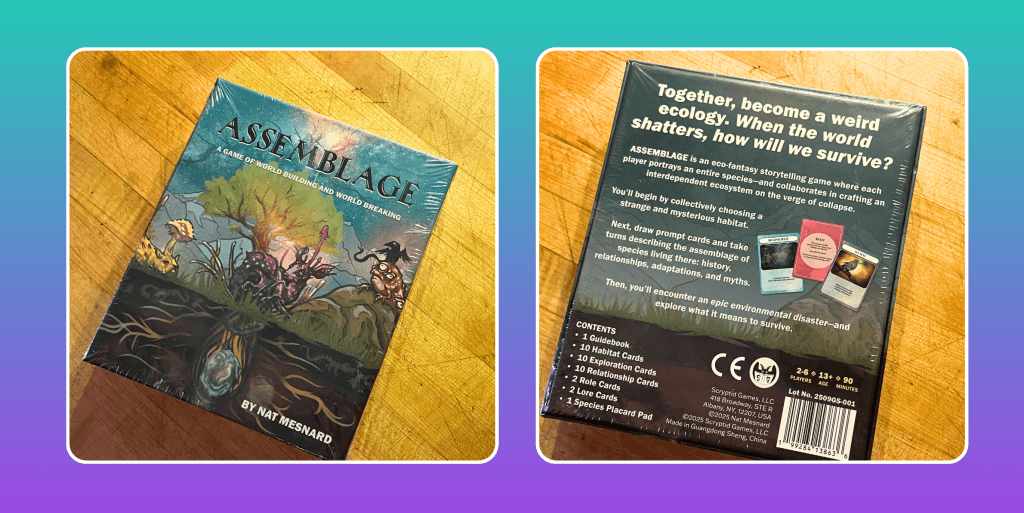
Erin: “As a kid, I was always accidentally making games. Many of us as children played and had fun, making up things. But it took many years until I realized I could make games as an adult… Every time I think about creating a narrative, I always come back to how. How do I want players to feel playing this game? For example: Do I want them to feel that they have agency, or do I want them to feel trapped? It’s so exciting to shape people’s experience.”
Sharang Biswas: “The barrier between games and fiction is often driven by capitalism, and the reality is that artists work across genre and make what’s interesting to them — but it’s capitalism that is forcing boundaries… whether a story is sold as a game that comes with pieces, or a book that is marketed a certain way, or a blockbuster movie.”
“I also want to challenge Brigitte’s idea of passivity. I don’t think all reading is passive. For example, some poetry asks you to really focus, to be engaged, to fill in the gaps, to understand, to make leaps. The similarities between ‘traditional writing’ and games are more interesting to me than the differences, which are decided by executives. It is important to not bend yourself out of shape too much about genre — fiction, poetry, theater, games, etc. Just make your story, your art.”
Dave: “I challenge your challenge! I actually really like constraints. I like going into a project with an idea of what I’m trying to do. Am I trying to make a special snowflake that is perfect and complete, or a treasure chest for you to open up and experience? Furthermore, even game design is not fully malleable — as a player and a creator, you’re limited by what the game machine, digital or physical, allows to be possible.
“For example, Twine (which is a great entry point for people in the game-making space) is not infinite in its technological capabilities, but it allows for branching paths and hidden variables like exhaustion or friendship — knowing you can do those things shapes how you might tell that story. It’s part of why I like calls for submission from journals or publishers; I think it is a challenge to fit within that.”
Erin: “I don’t think I’m challenging anyone but I think what constrains your possibilities is not your publisher, but your purpose.”
You cede control when you make a game. You create a narrative and try to anticipate it, but you don’t know what players will do. You can’t guess everything, and what is so amazing is when you’ve made something that is real enough that other people can create their own narrative within it.
Erin Roberts

Shaping Story by Medium
Erin: “For example, I’ve been playing the video game Return of the Obra Dinn.” (Crowd cheers, including me! Read about why I love Obra Dinn here.) “An abandoned ship appears, and we know a LOT of people died on it. Your job is basically to be an investigator and figure out how everyone died. What’s interesting there is that the narrative has already happened. As a player, you can create your own narratives and understanding, and that’s shaped by how you play it.
“For example, there was this guy that kept evading death, but on the ninth time, he’s done for. However, depending on which event you see in which order, you might think, ‘Wow, he might survive!’ or know with creeping dread the whole time what eventually gets him. The game is interesting to me because you can’t change the death around you. It makes me think about the war zone, which is top-of-mind right now, of course. To stop things, the changes would have had to happen before you even get to the battlefield…”
Sharang: “When we talk about a history of games, we typically talk about the history of technology, instead of art movements. We talk about what technology can do. Nick Montfort, who is at MIT, writes about this a lot. Tech bros love to pretend they invented everything, but they did not. Choose Your Own Adventure books, which is a copyrighted phrase by the way, were tracking hidden variables decades ago. People have invented games for years… I think it becomes a question of, ‘Am I making art? What is the process I need? What are the technologies I need?’ There’s a tension between the artistic impulse of ‘I must make art’ and the economic impulse of ‘I must pay rent.'”
Telling a Story in Game vs. Prose
Nat: “I think what we’re talking about here is that popular idea in game design that ‘The medium is the message’ from Marshall McLuhan [in his 1964 book Understanding Media: The Extensions of Man]. So, as a game designer, think: What is being said by what your players are doing? In traditional prose, the first thing you’re often thinking about is the story. In comparison, in game making, design is the first thing you think about.”
Erin: “Sometimes I come up with an idea of a story, and I think about what medium best fits the story. What mechanics could I do in a game that would reinforce that experience? Alternatively, what narrative elements would I lose if it’s a game?”
David: “I’m thinking still of Alder’s The Quiet Year. In that game, players don’t play individual people, but rather represent the collective thoughts of this community. There is a game mechanic called Contempt. If you buy the full set, this is a specific little skull token, but you can play with buttons or random objects — I played once with my family using costume jewelry so we all looked like robber barons. But basically, any time that another player does something you don’t like, you give them a Contempt token. It creates an energy between you and the other real person. It makes things tense! If you do that in a video game, if you handed an NPC an object to say, ‘I’m mad at you,’ nothing would really happen. But in real life, someone you’re making eye contact with? There’s resonance. A fizzle. The medium can change what you can do.”
Brigitte: “Exactly. I took one of Alder’s workshops, and I learned these three fundamental questions. And you can do these in any order, and perhaps even the order that you do them in shapes the story:
- What is this game about?
- What are the players doing?
- What are the characters doing?
“I learn so much about what the story is that I’m telling by exploring those questions. I often start with question #2. For example, I had the idea that I wanted players to go through real-life trash and make meaning of it. So I thought, how do I make that fun? Then I went to question #3, thinking, okay, who and what goes through the trash? Animals like raccoons and possums, and I think: That’s fun. Now, that leads me back to question #1: They’re trying to solve a mystery, but really it’s about connections. And all of this led to me making Psychic Trash Detectives.”
What I like about games is that they aren’t passive. Games, especially TTRPGs, demonstrate theater in a way. Every player is director, actor, and audience. By creating a story framework, games are an exciting platform to release control.
Brigitte Winter
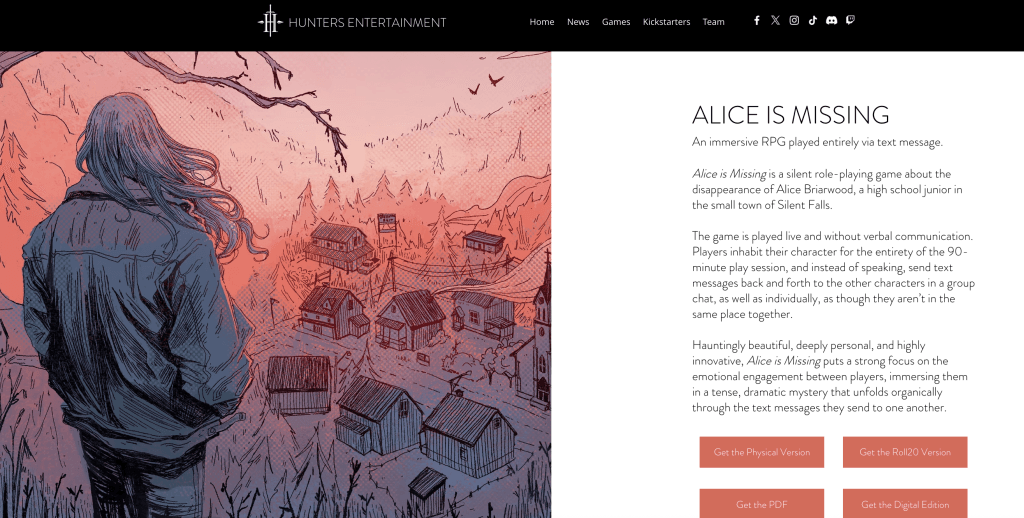
David: “Exactly, there are constraints in character. For example, with those questions, I recently played a game called Alice Is Missing. The game is about a friend who is missing. The characters are texting, trying to find their friend. The players use their real-life cell phones to text and sit silently together. It’s a very surreal experience. It actually led to one of my most strong ‘bleed’ experiences I’ve ever had, which is what happens when the game reality kind of bleeds into your regular life outside of the game.”
Sharang: “I love bleed. I had such an intense bleed experience where I had, for hours in a live-action role-playing game, played being in love with this other character. After we’re done with the game, we all went out for drinks. But I was so confused, like, am I actually in love with this other person?!”
The Poetry of Game Design and Playing Games
Someone asked a question about “catastrophe” having an active role in poetry and in games. What happens when there are bugs, glitches, catastrophes — anything that goes wrong?
Erin: “You cede control when you make a game. You create a narrative and try to anticipate it, but you don’t know what players will do. You can’t guess everything, and what is so amazing is when you’ve made something that is real enough that other people can create their own narrative within it.”
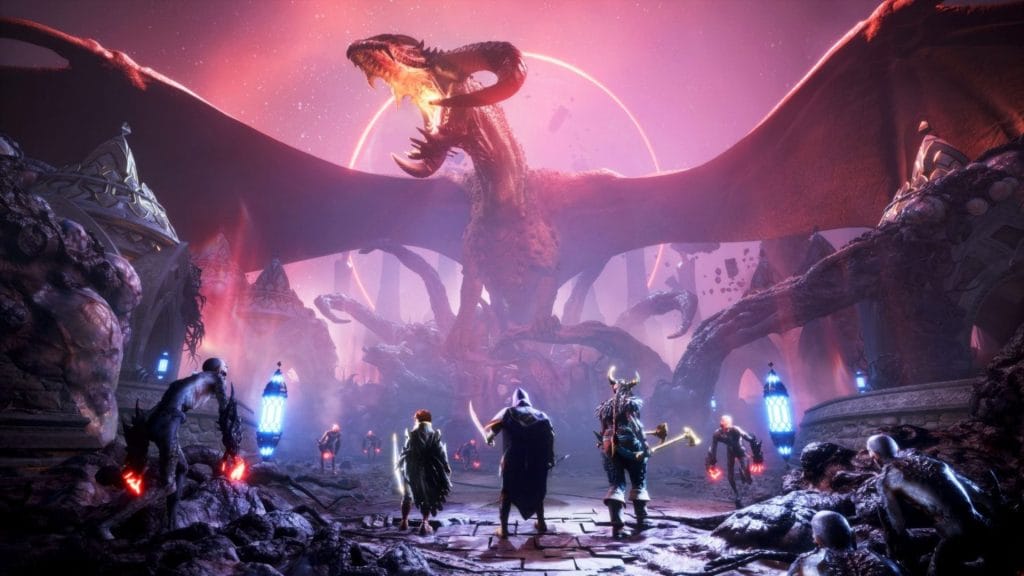
“For example, a friend of mine went to play Dragon Age: The Veilguard. He thinks it’s about a game to hunt dragons. It’s not.” (Crowd laughs knowingly.) “But there’s all this lore of the seven Old Guard dragons, and they’re spread out all across the map in these hard-to-reach locations. And seven, that’s often a special, mystical number in games, so it feels like a big thing to him. So he goes out of his way to go and kill these dragons. And nothing happens. He texts me being like, ‘I didn’t get a cool sword or an achievement or anything for this!’ Which was funny but I think also cool that BioWare created this world where those seven dragons felt special enough for him to create his own story.”
Brigitte: “You design by playing. You have to be messy and show people your rough draft. You won’t know how people react until you show it to them. You don’t know how rules will shape the game or how systems will break down. I’ve taken that to my prose practice as well. To playfulness, you have to test, to try.”
Suggested Reading About Game Design by Panelists
- Nat Mesnard: “I recommend 9th Level Games’ yearly Level 1 Anthology as a starting point for game publishing that resembles a literary magazine context. Much as new writers of fiction and poetry cut their teeth by publishing smaller pieces in lit mags, new game writers can experiment with game publishing by submitting to Level 1 and similar anthology projects, in addition to self-publishing on itch.io. The Level 1 Anthology is distributed for free as a physical version on Free RPG Day at game stores across the U.S., and the digital version is also available online.”
- Multiple panelists suggested playing (and/or studying) The Quiet Year by Avery Alder.
- Erin Roberts suggests The Game Narrative Kaleidoscope: 100+ Essays on the Craft of Game Writing, edited by Jon Ingold (which I heard about — and bought — from inkle founder Jon Ingold while I was en route to Baltimore!).
- Brigitte Winters suggested in the session outline: Many independent publishers and creators distribute their games via Indie Press Revolution (IPR) and itch.io. IPR is a sales network that acts as a fulfillment house and distributor for publishers of indie role-playing games. It offers games directly to the public and to game retailers. itch.io is an open, indie-focused marketplace for independent digital creators to host, sell, and download video games, game assets, comics, and music.
- Sharang Biswas suggested reading Twisty Little Passages by Nick Montfort.
- Dominique Dickey, co-founder of Sly Robot Games, was featured on Scryptid’s second AWP panel (“Story Game Presses: Pitching, Submissions, and Publishing”), suggested the weekly Indie RPG Newsletter curated by Thomas Manuel as a “great way to stay up to date on industry news, projects currently crowdfunding, and articles/podcasts/other media engaging with game design.”
- C.J. Linton, co-founder of Sly Robot Games, also featured on the second panel, suggested reading Rascal News, a worker-owned outlet for journalism about tabletop.
- Justin Sirois, founder of Severed Books, also featured on the second panel, suggested playing Calvary Games’ Ten Candles.

The Magic Circle of Tabletop Games
A few years ago, I wrote about what board game analysts called “the magic circle” as the experience of playing a game with others. (The piece, which you can read here, was about playing Nancy Drew computer games with my mom and sister.) I had written:
In their 2003 book, Rules of Play: Game Design Fundamentals, Katie Salen and Eric Zimmerman describe how “the space of play is separate in some way from that of the real world,” both psychologically and physically, so much so that “the frame of a game creates the feeling of safety.”
I love this idea of the “magic circle,” and I think about it often when gathering. It’s exactly what I felt in taking a board game class during grad school, while playing those Nancy Drew games, while playing Avery’s A Quiet Year with friends in Pittsburgh.
I have been working hard on writing and rewriting my debut novel for the past few years, and that experience has been profoundly lonely. In comparison, writing and podcasting here at The Punished Backlog often feels like a constant magic circle. I’ve been considering how I might bring “the magic circle” into my creative writing. Or, maybe, I just need to make a game!

How To Get Started Making TTRPGs and Board Games

I never got a chance to ask my question, “What do you recommend for someone who has never made a game but is interested in doing so?” But luckily, Mesnard talked about an opportunity at the end.
They are hosting a virtual workshop on Sunday, March 28, 2026, in which everyone will make a game; you can learn more and register here. I’ll be traveling that day, but it might be worth pulling into a gas station for a pit stop so I can dial in. After all, a magic circle can be made anywhere.

Amanda Tien (she/her or they) loves video games where she can pet dogs, solve mysteries, punch bad guys, play as a cool female character, and/or have a good cry. She began writing with The Punished Backlog in 2020 and became an Editor in Fall 2021. Amanda also does a lot of the site's graphic designs and podcast editing. Amanda's work has been published in Mothership, Unwinnable Monthly, Poets.org, Salt Hill Journal, and elsewhere. She holds an MFA in Fiction from the University of Pittsburgh and a BA in Creative Writing from Columbia University. Learn more about her writing, visual art, teaching, graphic design, and marketing consulting at www.amandatien.com.