
Welcome back to Therapy Gaming! We’ll be taking a look at the levels of trust and connection that developer House House asks of players to complete their latest multiplayer game Big Walk. Spoilers will be clearly marked.
Walk and Talk
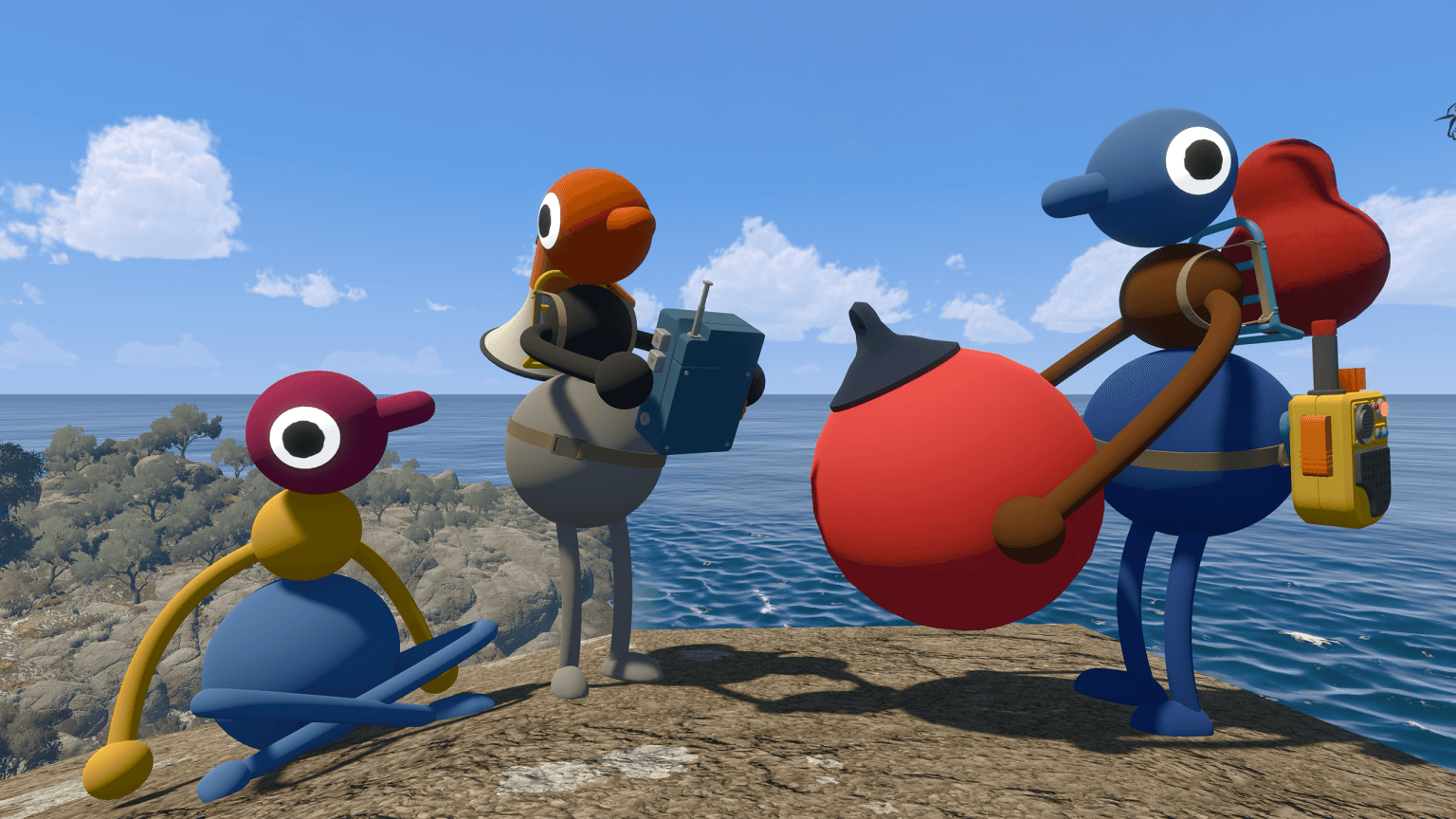
I can’t stop thinking about Big Walk. I can’t stop talking about Big Walk. The goofy character designs. The hilarious interactions. The joyfully designed puzzles. Big Walk is a true masterpiece, one of those experiences that I will never have again. It is clever, funny, thoughtful, and kind, all in one smooth package. It is catharsis, it is a beacon of light, it is as many similes for joy as you can express. And all of it, every single thread, comes down to using one of gaming’s most notorious features to its pure benefit.
Since the days of Ventrilo, voice chat is notoriously difficult to get right. At its best, voice chat can be the strategic difference, allowing faster communication than a keyboard or emotes could ever convey. At its worst…well, we all know a femme or feminine-sounding person who has been harassed on Xbox Live. Even with its complicated history, Big Walk explicitly says that it is best used with proximity voice chat, whether with friends or with strangers. The game asks every time you start to not use private parties or speak to folks in the same room. Big Walk wants you to talk to people while looking them in the virtual eye!
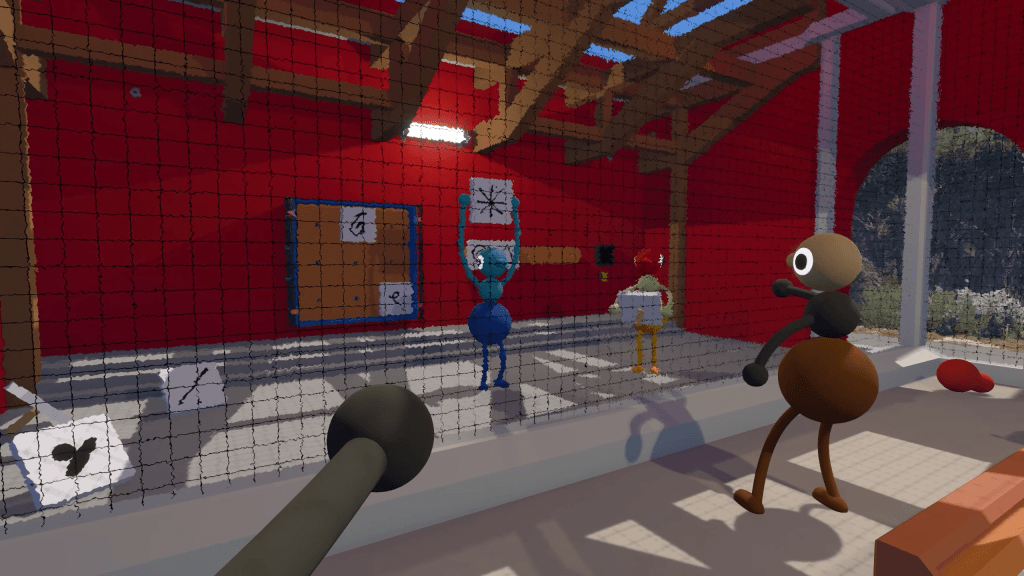
And it works! The proximity chat of Big Walk is a triumph, aided by the additional tools you can find to expand your voice. For much of my time, I was designated Bullhorn Carrier, shouting instructions and SOS messages across canyons to try and combat the restrictions of proximity chat. This all helps Big Walk in its journey to being a game about communication and trust. You won’t always be standing next to the person you’re puzzling with. Sometimes you can only communicate via jumping or hand motions or morse code lightbulbs or shouting in a bullhorn, all hoping the message sends. Big Walk works by forcing its players to communicate, full stop. All to reach one glorious moment.
MAJOR BIG WALK SPOILERS TO FOLLOW
SERIOUSLY, DO NOT READ FURTHER UNTIL YOU’VE SEEN THE CREDITS
THIS IS THE LAST WARNING
YOU READY?
HERE WE GO!!!
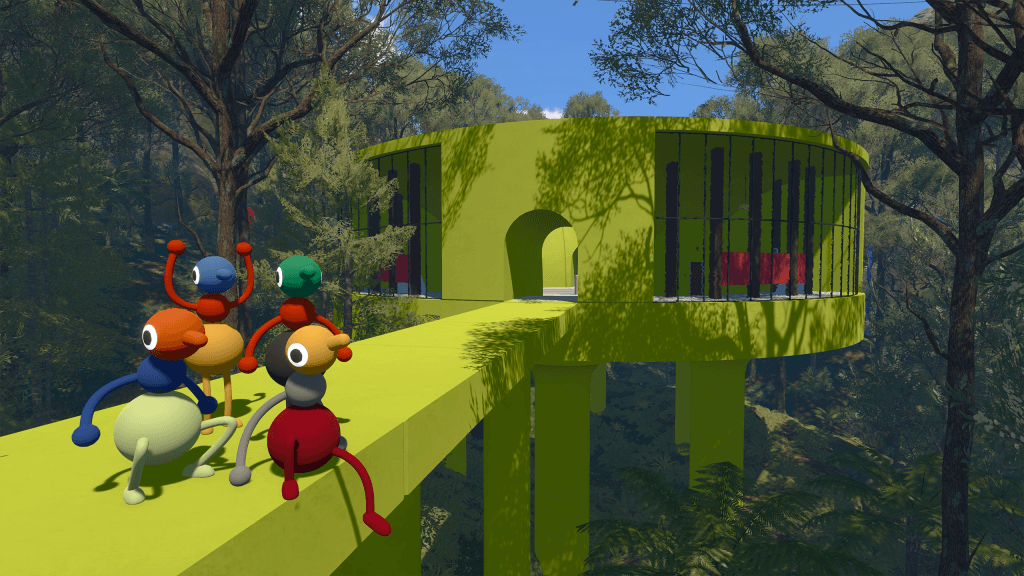
The Gates of Mystery
I was very lucky to have a consistent group of people to play through Big Walk with. There were five of us: high school friends Craig and Emily, and their respective spouses Christine and Ryan. While we weren’t all there all the time, we made the major strides together. Puzzles fell before us as we collected kong after kong.
(Quick sidestep: Puzzles in Big Walk reward players with a red item that operate like keys for further exploration. Place a number of them in towers around the map to unlock keys that open various things. These red items look suspiciously like Kongs™, the dog toy, so we referred to them as such. I will continue to do so.)
There was always latent love and trust between us, between the skills we knew we possessed. But Big Walk let us bask in that love, bask in that trust, and give ourselves to each other in a genuine way.
Eventually, we started to see how the game’s “narrative” (for lack of a better world) would unfold. Once we successfully konged all four towers in the game, we would be able to enter an ominous obelisk stationed near the starting area. Said obelisk would provide a key that would unlock the even more ominous black gate on the western side of the island, behind which loomed a triple ominous Black Orb. Now, we were aware of the Orb for some time: An early unlock was a large room with a gigantic map that revealed uncompleted puzzles around the world, and also showed the looming dark sphere. However, it took us some time to find the gate itself. Why, you may ask? Well, dear readers, we just forgot to investigate the western side of the map for more time than it should have taken us. Whoops.
Regardless, we made our way to the gate and set ourselves to the task of unlocking it. Even stranger, as we approached the gate, the world shifted around us. The color drained from our characters, our voices distorted, and the world slowly muted into a dull hum. We quickly retreated to discuss what just happened, chalking up what we saw as some spooky weirdness, but nothing intimidating. It didn’t take long for us to discover there was much more to be found.
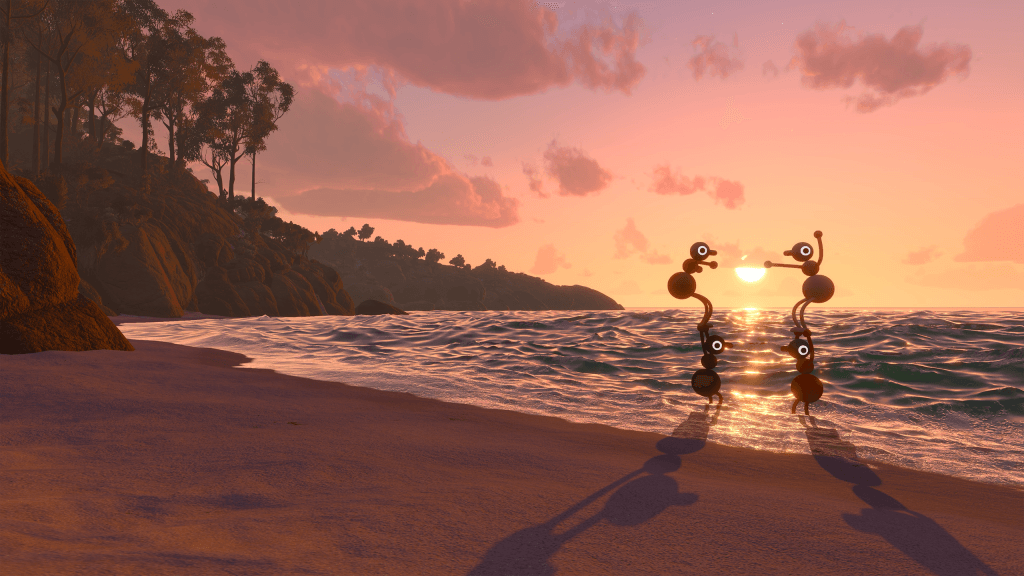
The Orb of Darkness
The monolith was conquered, and the gates opened. Beyond them was a barren wasteland, dominated by the looming orb in the far west. Hooting and hollering, the five of us barreled across the plain, anxious to find what this orb held for us. Just due to timing, we ended up approaching the orb in the darkness of the game’s night cycle, creating some havoc as we tried to stay grouped in the brush. Eventually, the decision was made to travel as one tall tower with a light on top. I was designated as bottom rung, and I definitely didn’t drop us all down small cliffs. Definitely not.
It’s important at this stage to note that the joy of playing games with people for years and years is understanding the roles you all fall into. Craig and Christine are solvers, exceptional at looking at puzzles and seeing a solution with speed. Ryan is a do-er, sometimes to his (and our) detriment. If he’s got a thought, he’ll follow it. Emily is laser-focused, rarely participating in additional shenanigans and dedicated to the task at hand. And I am a motivator with a sharp memory: While I’m not the best at solving the problem on my own, I can remember instructions and dish them out with confidence. We are a well-oiled machine prone to flights of fancy and first try attempts, with plenty of trust that we can solve things together.
Big Walk wants you to talk to people while looking them in the virtual eye!
The Orb loomed large over the dusty plain as we approached. Quickly, it became apparent that the weirdness that greeted us at the Gate was not a one-off: The world became dull as we approached, voices pitched down, until eventually we were left in monochrome silence. The five of us retreated to discuss: How would we tackle puzzles without being able to communicate at all? Sure, there had been puzzles that required coming up with new forms of communication beyond speech, but we had been able to rely on knowing each other. I could trust Craig to remember instructions; trust Ryan to find specific objects; Emily to lock in until a problem was done; and Christine to get creative and define language. Now, we couldn’t even tell each other apart.
In the end, we decided to just go for it. No ducking out to get our voices back, no pre-planning puzzles. We decided to lean on each other, lean on the trust we had for each other, and see what happens. And so, the five of us descended into silence. Afterwards, I found out that even the two couples playing in the same room as each other did not speak either.
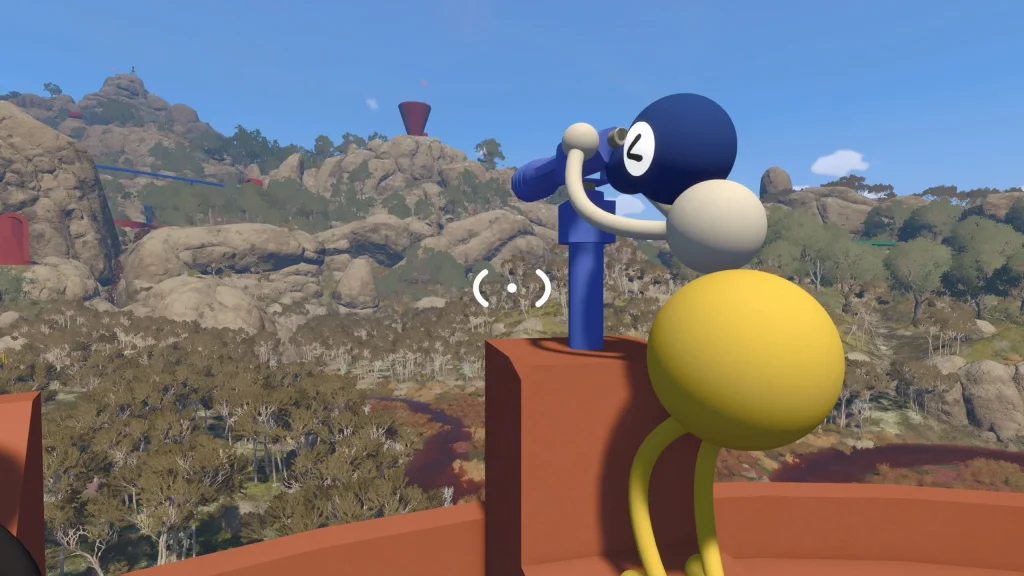
Believe in the Me That Believes in You
What followed was one of the most beautiful experiences in video games I’ve ever had. We didn’t need words to communicate; we developed new languages through gestures and taps without setting a dictionary. We leaned on the skills Big Walk had taught us in previous puzzles, but more importantly leaned on the trust that we all could do it. No worries about weak links, no over explanation. We had to trust that we’d all pick up the solutions through our motions, or solve things on our own and bring it to the group.
Reader, it was breathtaking. Puzzles that we struggled with using voices outside the Orb now crumbled before us without them. Not without frustration, of course. Multiple times I found the model that I thought was Ryan and threw him to get him to lock in. But we were a team, the same team as when we could speak. There was no singling anyone out, so we couldn’t define people to roles. It happened organically, as we puzzled our way through the Orb. And, in one session, we did it.
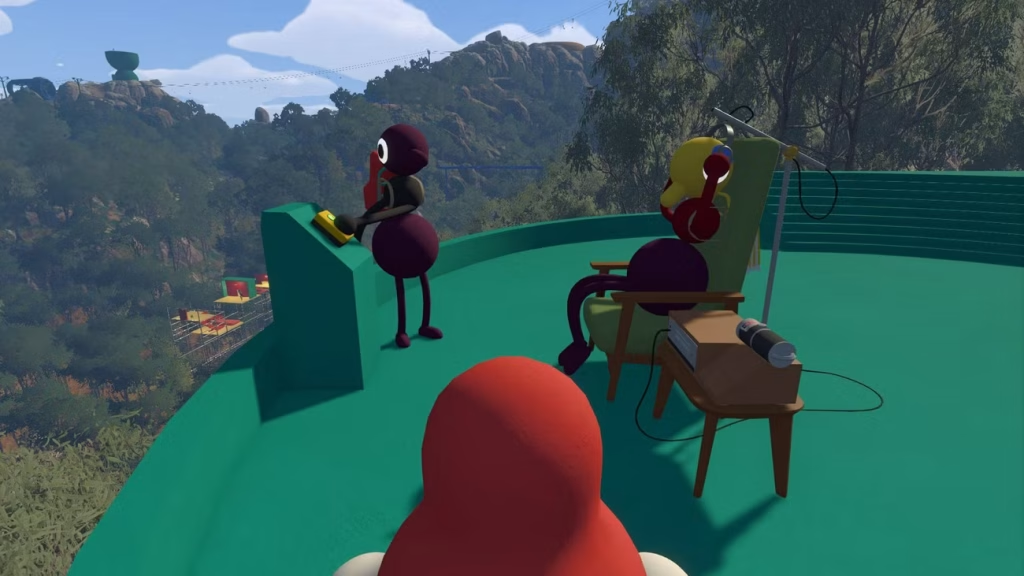
No “I” in Team
Big Walk wasn’t just training our own individual skills. Sure, the game was giving us the tools to solve its various mysteries and puzzles by repetition. More importantly, however, it was asking us to look at the people we were with and trust them. Genuinely trust that one person doesn’t have to take control and do everything. Trust that information will be shared, solutions found, and achievement reached. While from the start Big Walk was never about one person due to its only co-op nature, it quickly became clear that it wasn’t about one person in a group either. It was about The Group as a whole, and the love you can have for them.
My friends and I have been together for going on twenty years. There was always latent love and trust between us, between the skills we knew we possessed. But Big Walk let us bask in that love, bask in that trust, and give ourselves to each other in a genuine way. I didn’t need to solve every problem, I could just play my role and know that my friends would lift their parts too. Even if Ryan was doing backflips in the corner sometimes.
As we got to the final room, our voices returned. Color returned to our faces. And cheers filled our microphones as we swapped stories, asking who was who and who did what. As it turns out, I was throwing Emily a lot. Whoops.
Big Walk, developed by House House and published by Panic, released on August 4, 2026, for PC, Mac, PlayStation 5, and Nintendo Switch 2. MSRP: $19.99.

Gary is a jack-of-all-trades video game enthusiast based in Boston, MA. A semi-professional fighting game player, even less professional Apex Legends player, and even less professional adult, he spends most of his time poking at strange indie gems and reading about the need for more diverse voices in gaming criticism. He invites anyone to recommend anything he's missed in the gaming world via Twitter or BlueSky, where he can found under the username @grtnpwrfl. When he isn't spending his time playing games, Gary is an avid New England Patriots fan and frequent hiker.