
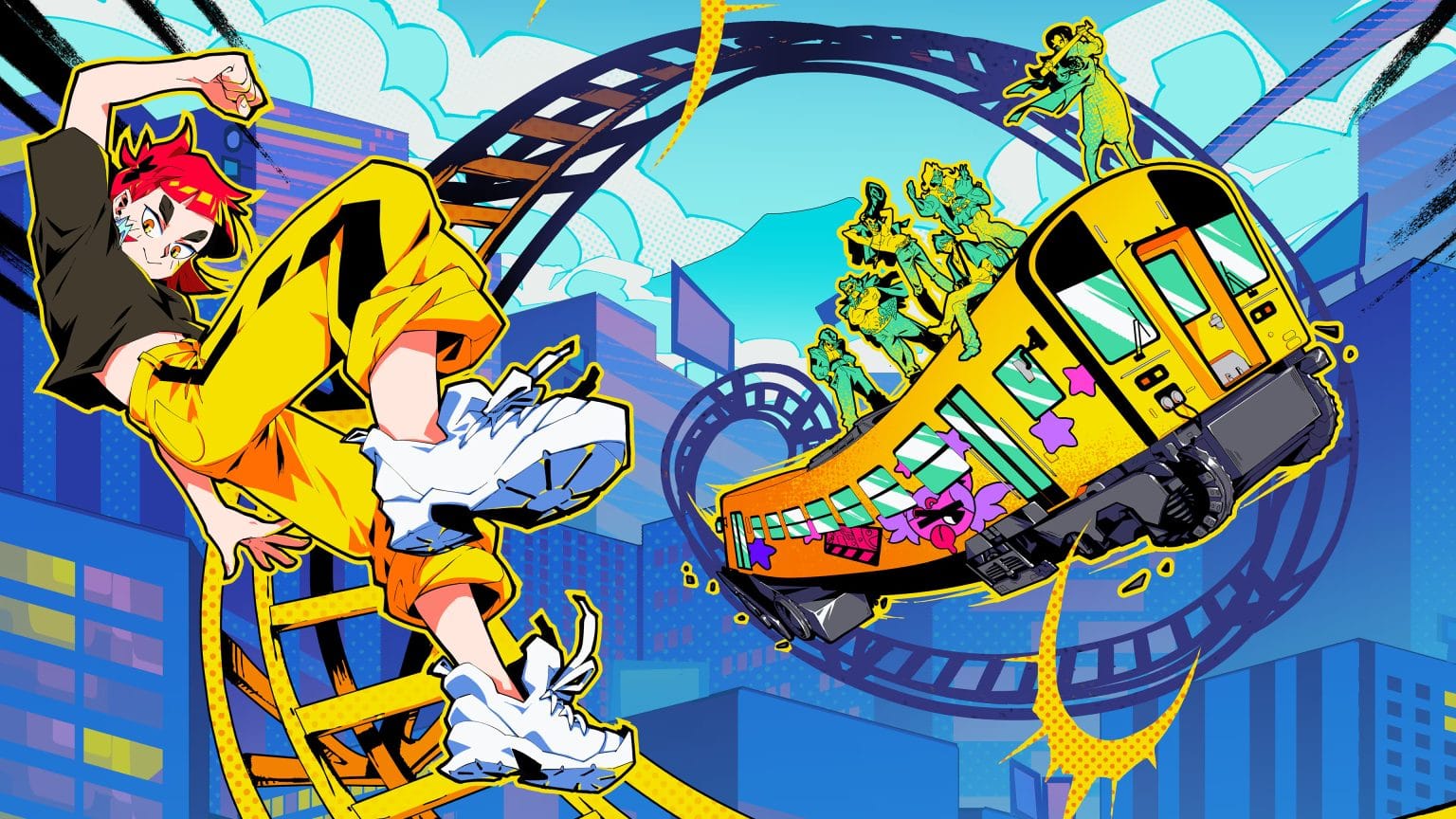

Somewhere above a smoldering caboose carcass, roughly a quarter of the way into my playthrough of Denshattack!, I paused to jot in my game journal, in whimsical, facetiously looped capital letters:
M A R X V E R S U S T H E M O N O R A I L
Did I expect a game described in part as “Flip, trick and grind your train in a fast-paced, off-the-rails ride through a colourful Japanese dystopia” to be relatively straightforward?
I did.
After the first two levels, was I already thinking ahead, expecting to invoke games like The World Ends With You, I Am Not Your Beast, Tony Hawk’s Pro Skater, and Jet Set Radio Future when discussing the art style, music, and on-rails gameplay?
I assure you, I was.
And, even with that same game description invoking dystopia, telling players they will “outmatch rival gangs, wreck a shady megacorp, and take back the tracks with nothing but skill, speed, and style,” did I, deep down, think that the extent of the game’s political analysis would be: “corporations bad, people good”?
Reader, I won’t lie to you: I expected a simple ride.
Fortunately for us all, I was very wrong. The latest offering from developer Undercoders is neither expected nor simple. Each time I thought I had Denshattack!’s gameplay or narrative pinned down, I was delightfully lurched in another screeching direction.
There are a few key stops that Denshattack! makes during its nine-part tale that — no spoilers — make this well worth your time, and it boasts a vibrant world and cast of characters who have something critical to say.

“This Is a Story About Those Who Remained Outside”
Denshattack! drops you off in a fictionalized future Japan, transformed indelibly by climate collapse. Now, cities like Tokyo or Hiroshima exist within sterile domes, locked and controlled by Miraido, a mega corporation that, in conjunction with the national government, controls and monitors movement within and between each dome. To boot, Miraido owns and operates the only mode of inter-dome transportation after all other forms of road and, crucially, rail travel were outlawed during the climate apocalypse. Those who could afford to relocate to the safety of a city traded that much more of their privacy and autonomy in exchange for physical shelter and safety. Those who could not, or chose not to, were left to fend for themselves in the wilderness.
That’s where you come in.
You play as protagonist Emi Araki, a ramen delivery driver who befriends a freelance photographer named Fernando Tamashiro. Fernando, bewildered and impressed at your prowess piloting your densha (train, in Japanese), encourages you to enter the underground world of Denshattackers, gangs of street-racing and trick-nailing outsiders who live beyond the domes. Emi’s world is starkly divided between those who do and do not have resources, where freedom of movement is a privilege that is highly surveilled by the ever-unfeeling panopticon.
(Thankfully, this fictional tale is far removed and extremely distant from our present reality, or else this premise would really have shaken me!)
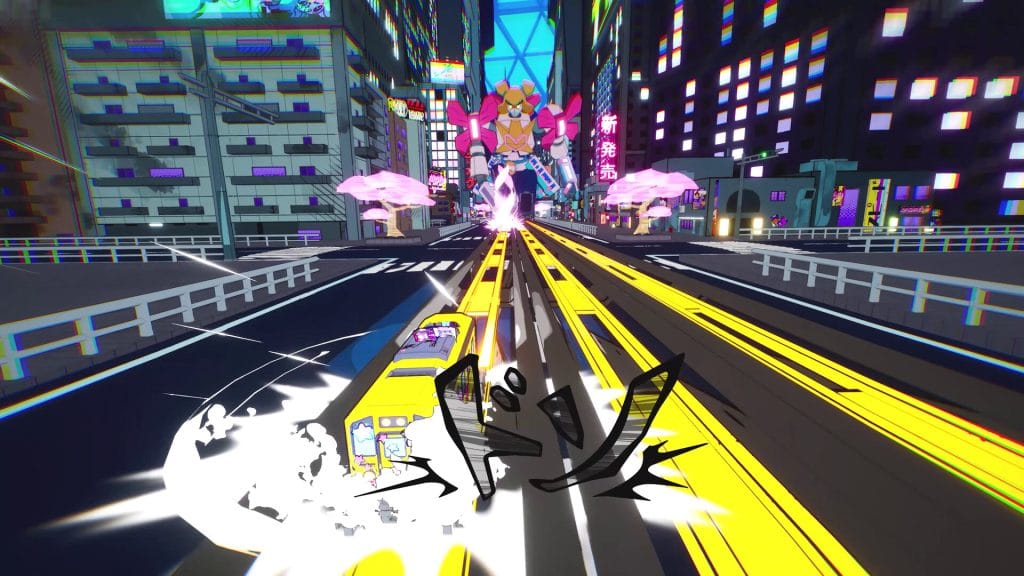
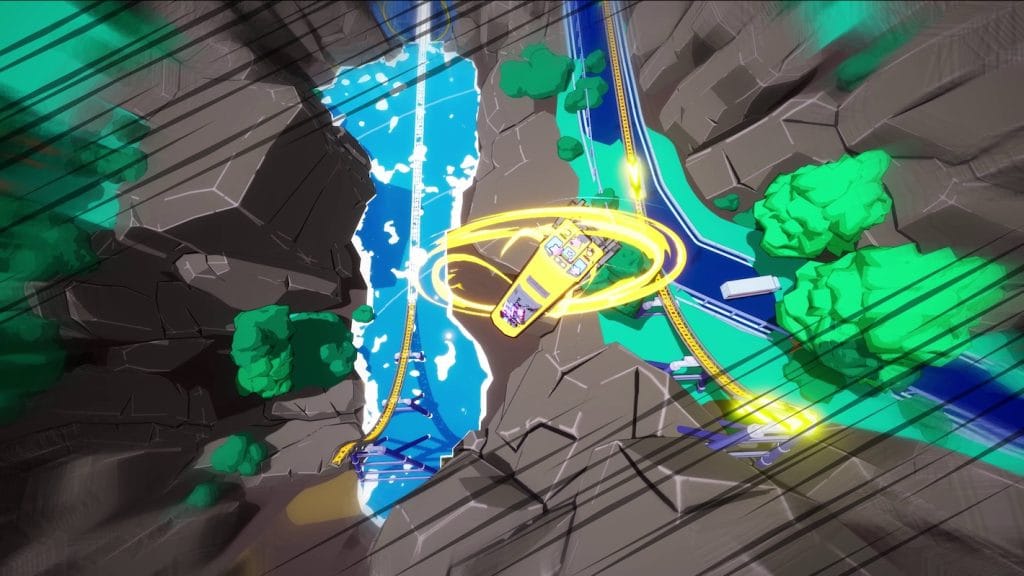
The gameplay is decidedly on-rails. There is an overworld, similar to many of the 2D Super Mario games, where Emi, Fernando, and others who will join your journey along the way travel throughout Japan’s five main islands. There is no open world, and there are no open zones. Each of the destinations on the map is another level of on-rails, densha-engaged gameplay. Similar to many board traversal sports, Denshattack! levels can be broadly categorized into either races or trick contests that vary in particular objective, complete with individualized bonus objectives (“Dares”), and connect to the narrative in ways unique to each level. Don’t expect races similar to Mario Kart, however, as these races seem to be more about completing objectives than speeding past other Denshattackers. No matter the kind of level, though, the goal is always to post the highest score possible, and to outdo yourself on the next level.
In that way, it reminds me of games like Neon White or I Am Not Your Beast, where the game can be played for the completion of its base story but is designed to be replayed over and over again; the fun is had in trying to best your high score. It is unclear from the review build (a PC version of the game provided by developers, played on Steam Deck, both docked and undocked) whether there will be a multiplayer component, or even just a way to view leaderboards to compare scores online, but it is easy to see the potential for countless hours spent trying to one-up your friends.
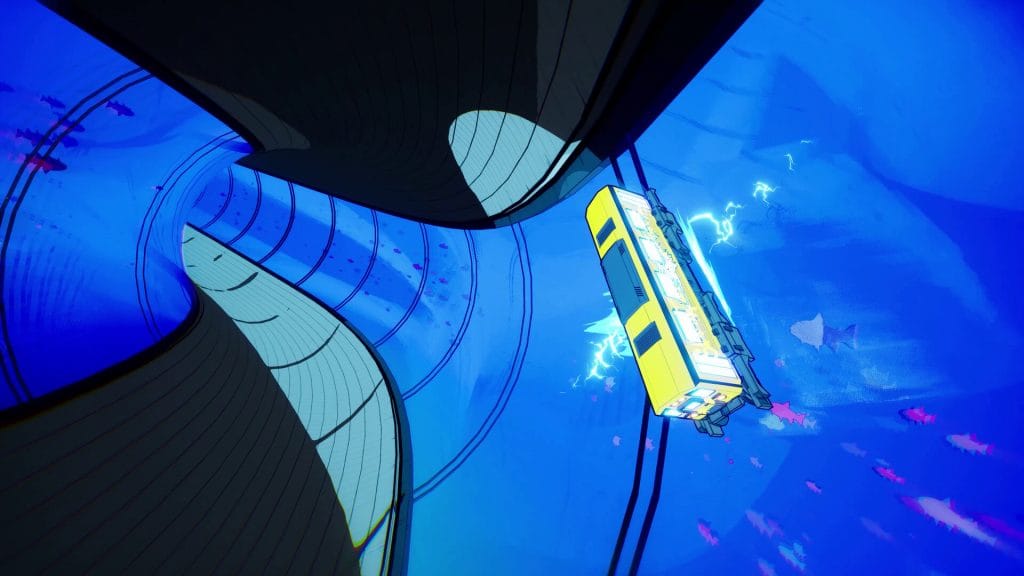
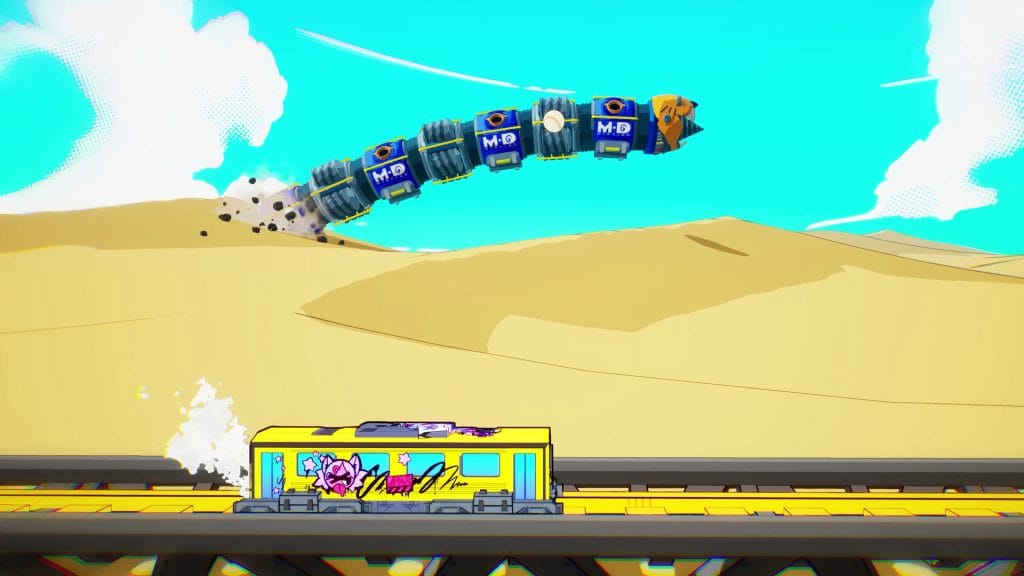
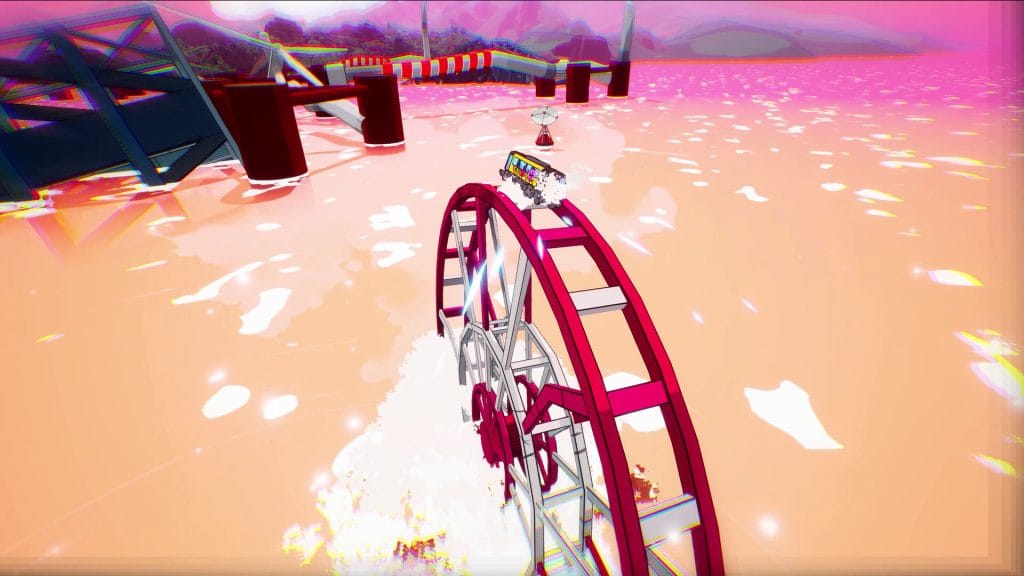
Your train movement is controlled by your left analog stick, whereas the right stick is used almost exclusively for pulling off increasingly complicated tricks. There is a drift mechanic that is much more necessary to remain upright than you’d think — and that’s it! Those three core concepts are the foundation for Denshattack!’s gameplay throughout the nine levels. What impressed me until the very last boss level was the amount of variety in play style and level design accomplished while adhering to that fundamental constraint. Despite its simplicity, or maybe even because of it, Denshattack! is unconstrained and expansive. Part of this is because of its art style, oscillating between anime cutscenes, 2.5D saturated overworlds, and cel-shaded blurring neon that felt part JSRF, part Crazy Taxi. And it’s partly because of how many different ways the Undercoded devs figured out how to take players from point A to point B.
More than that? It’s just plain fun. Some of the most exhilarating moments I’ve had playing games in the last few years have been when I have surprised myself at the quickness with which I switched from a track to a rail right before hitting a perfect sideways drift into a 540 cancel kickflip, or times when what I thought was going to be a simple downhill race turns into something more akin to an ethereal LSD trip, and the train I was piloting is now just a stand in for some other kind of radical movement.
Without delving into spoilers, there is a wide variety of trains that have materially different gameplay attributes, as well as ways to aesthetically customize each of your trains, using the garage and sticker shop of Shin & Fumihiko, and Kaoru, respectively, characters you meet along your journey. During each of the levels, there are different spray paint cans, gear wheels, and film reels to collect. Each of these grants fungible points to be used to buy sticker packs to customize your trains, buy new train builds with specialized abilities, and for photos and footage for Fernando to complete each of his zines, respectively.
I finished the game and was able to roll credits at 22.5 hours (all but four of which were played docked, though during the handheld hours I spent I noticed no discernible difference in gameplay quality, and only experienced two crashes during the entirety of my playthrough) and I had the immediate, burning urge to go back and try to get gold rankings on each of the levels, collect all of the missing items so that I can unlock all of the possible denshas and, more crucially to the narrative of the story and its love letter to different minutiae within Japanese culture, to complete all of Fernando’s zines. It is more than just a fun way to display another dimension of the striking art style within Denshattack!; rather, it’s the glue that binds the gameplay to the narrative, to the history of Japanese transportation industrialization and the game’s larger thesis — that what matters most on a train are the people who ride it.
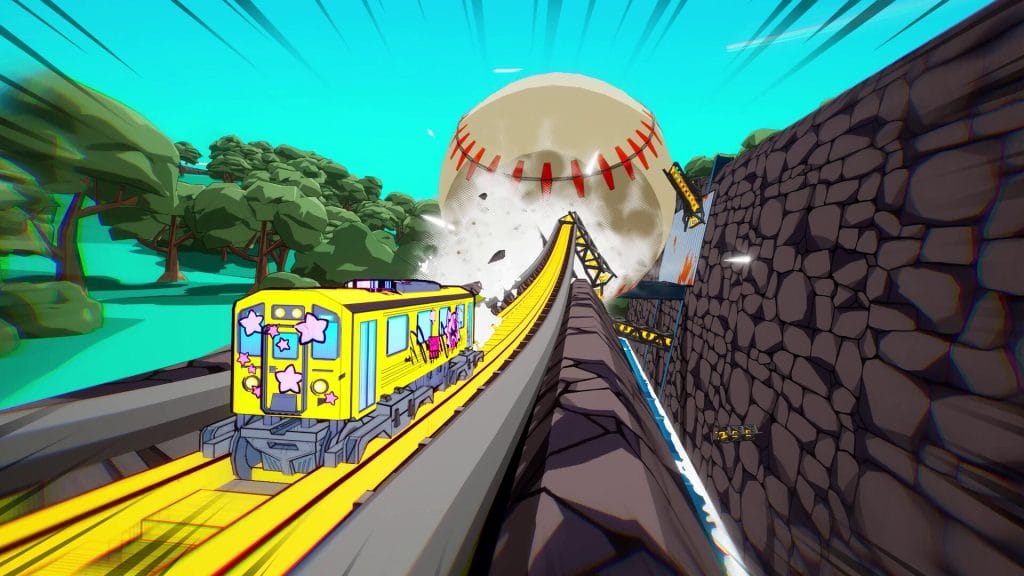
“MONO-RAIL, MONO-RAIL, MONO-RAIL”
It is 1992. The writers of The Simpsons are together with co-creators Matt Groening and James L. Brooks at a retreat, ahead of its fourth season, which will air in January of 1993. Mike Reiss, the showrunner, is pleading with his precocious, always “just out there” young writer to only pitch the first two of his ideas to Brooks and Groening, and to hold onto the third. It was perhaps too sprawling in scope or too surreal in concept — or just “too weird,” and it would be better to pitch the other two ideas, as Reiss recalls in a Vice-produced oral history.
The young writer, Conan O’Brien, decided to pitch all three instead. Each was greenlit, including the third, “too weird” idea: “Marge vs. the Monorail.”
In the three decades since, “Marge vs. the Monorail” has become a cult classic episode of a show that itself is one of the most iconic North American cultural products. Originally only an animated show, The Simpsons became an entire brand, replete with theme park attractions, movies, video games, and everything in between serving as conduits to the fictional world of Springfield. You can make the argument that that very capaciousness, and the rounding out of the world of The Simpsons, would not have existed without this episode.

In “Marge vs. the Monorail,” Springfield experiences a sudden windfall of cash when, in a settlement with the city for illegal dumping of hazardous waste in a nearby wooded area, maniacal nuclear power magnate Montgomery Burns bequeaths Mayor Quimby with three million dollars. At a town hall meeting, Springfield residents suggest ideas for how to spend the money, with Marge’s idea to repave Main Street receiving the lion’s share of agreement before a shady, Music Man-homaged-and-Phil-Hartman-voiced traveling salesman, Lyle Lanley, uses the magic of a catchy showtune to win over the town for his idea, the construction of a monorail.
The episode (which I will spoil because it is older than I am) unfolds about how you would expect: Lead protagonist and alleged everyman and patriarch Homer Simpson is inexplicably tasked with being the monorail conductor, and Marge, in a bit of muckraking, discovers Lanley to be a crook but not before the monorail’s shoddy work is already completed, leaving Homer, their son Bart, a conductor’s closet home to a family of possums, Lard Lad Donuts, and the citizens of Springfield to save themselves from their own misdoings.
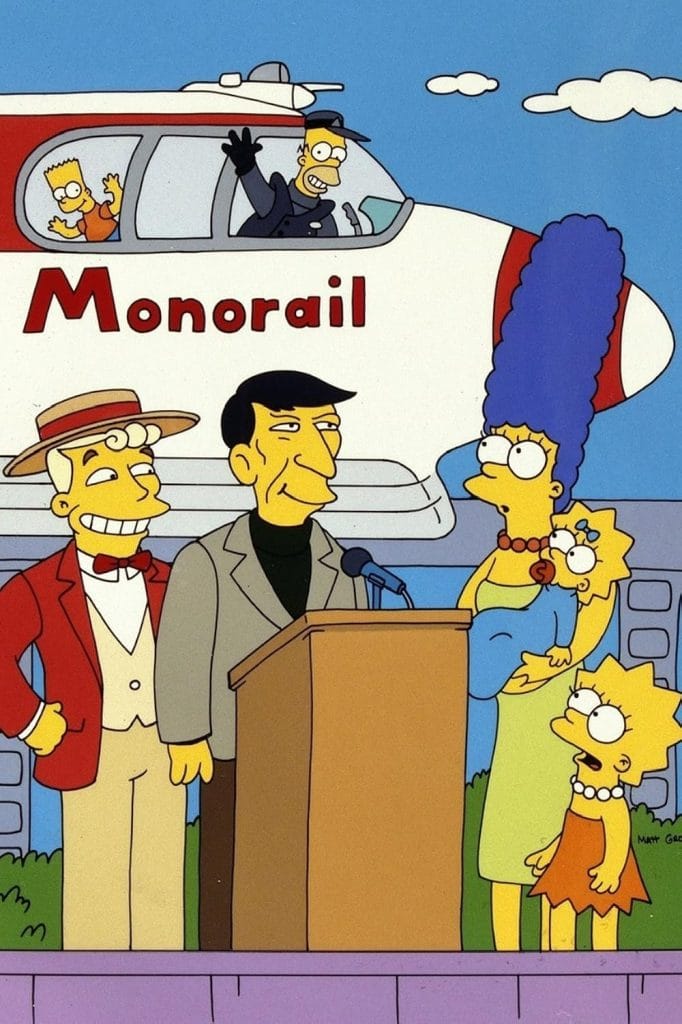
Though “Marge vs. the Monorail” needled an antiquated method of public transportation (so much so that, according to DVD commentary provided by O’Brien, Groening, Reiss, and Al Jean, George Takei turned down his casting — which ultimately went to fellow Star Trek actor Leonard Nimoy — because he was then on the board of the San Francisco Board of Transportation and felt uncomfortable with how monorails were depicted, to the amusement of O’Brien and the other writers), it was so much more emphatically about the susceptibility of larger groups of people to salacious, seemingly quick fixes and other grand ideas, and the ways in which community is ultimately accountable to itself, no matter what kind of private business or industry intercedes.
Before this episode, The Simpsons was more or less contained to the happenings of a singular family. After the monorail was introduced, the show became that which it is now instantly recognizable, for its delicately balanced, grounded surreality and its wide-ranging, sprawling world of characters, including hundreds of cameos from both real people and other fictional characters (“Marge vs. the Monorail” begins with a tasteful but pointed homage to The Flintstones).
In the oral history, supervising director David Silverman closes by noticing, “I don’t know if it was a dawning realisation or just an organic sense that the more that we expand, and the more that we invest in characters beyond the five Simpsons, the better it was for the show. I think that’s one of the pillars of our success, our longevity.”
Mind the Gap
In Chapter 4 of Denshattack!, a certain character Emi meets tells her:
“The climate catastrophe wasn’t something that happened one day; it was the point of no return that led people to take refuge in domes. But we were already used to wearing facemasks, or even respirators, when near any city or industrial area.”
Widespread mask usage has been happening in countries around the world for decades, to curb adverse health effects from air pollution as well as to mitigate viral spread, including during the SARS outbreak of the early 2000s. For the last six years, of course, masks and respirators became ubiquitous, then less popularly worn, and perhaps now only synonymous with the idea of a bygone concerted fight against the COVID virus.
Denshattack!, much like the Conan O’Brien-pitched cult classic episode, is only about transportation insofar as it is about telling the story of how people move together.
At this point, nearly halfway through my 22.5-hour playthrough, I went back in my notes and circled “Marx vs. the Monorail.” Though I was initially joking, Denshattack!, much like the Conan O’Brien-pitched cult classic episode, is only about transportation insofar as it is about telling the story of how people move together. I was reminded of Marx, the theorist who posited, roughly (truly, extremely roughly, please do not consider this a substitute for reading The Communist Manifesto) that the class struggle between labor (the proletariat) and the owners of capital (bourgeoisie) was the primary driver of social change, far too often during Denshattack!’s just-barely-futuristic narrative. Questions of the very legitimacy of land ownership and for whom it is easily attainable, concerns about a militarized police force that is funded by and betrothed to the whims of private enterprise, explorations of non-hierarchical leadership structures, and the issue of treatment of people in rural enclaves versus booming metropolises are all invoked as you kickflip, ollie, and grind your way throughout Japan.
Frankly, by the time I’d reached the seventh chapter, I was fully convinced that the densha as a motif was merely a vehicle — pun absolutely intended — for what is decidedly an anticapitalist romp. And while it would be impressive enough to make me consider Marx or Frantz Fanon while I play your video game, Denshattack! perhaps truly shines in that its gameplay exhibits the traits that its narrative espouses.
It is one thing to say in-story that the collective is more powerful than the individual, and quite another to model that in your gameplay and level design. Denshattack! manages to do both, with very few stumbles.
There are levels that take clear inspiration from other games and movies, placing itself in a lineage of other forms of referential modern art. There are a wide variety of ways to accomplish goals and earn points, and though Emi is the only playable character, she is by no means the most intriguing, nor is she who is solely responsible for the propulsion of the story or the improvement and customization of each densha. It is one thing to say in-story that the collective is more powerful than the individual, and quite another to model that in your gameplay and level design. Denshattack! manages to do both, with very few stumbles.
Final Thoughts
There are points in each world where it would feel unclear where to traverse, or where I would jam my left stick to the right, to take the right turn at the fork in the track, and my densha would stubbornly plod straight ahead. As much as I loved the soundtrack, I wish it was twice as long so there was more song variety. These are nitpicks, and they are few. What stuck with me was the feeling of getting a “No Crash” run the first time, the brilliance of the artwork in the zines, and its clear-eyed thesis.
And yes, Denshattack! is perhaps simply an indie video game that some will play and enjoy. And no, perhaps it is not a clarion call for revolution, stoking a demographic of gamers and developers to realize they, too, are pieces within a larger economic structure.
But it is significant that it exists as the political overture it clearly is. It would have been quite simple, expected even, to make this exact game without any of the social commentary. I would have likely had many of the same praises about the innovative gameplay, or the thumping, synthy, alt-pop soundtrack that accentuates the experience.
But the devs at Undercoders decided that wasn’t enough. They decided a larger, more expansive story needed to be told, one that took stock of where we are as a society not just for the people enshrouded in domed safety, but for everyone, including those who have to steer themselves with no track to guide them.
Maybe remembering that to live is to exist in relation to one another is the pillar of our success, key to our longevity as people who have the power and agency to shape our communities to be in service of people, not conglomerations.
And maybe, just maybe, it is worth remembering that we can shape that community with some speed, a grind, and all the style we can muster.
Score: 9.0/10
Denshattack!, developed by Undercoders and published by Fireshine Games and Boltray Games, releases today, July 15, 2026, for PC, PlayStation 5, Xbox Series X/S, and Nintendo Switch 2. MSRP: $19.99. Version reviewed: PC (via Steam Deck).
Disclaimer: A review code was provided by the publisher.

Miles E. Johnson is a poet and essayist from northeast D.C., a Cave Canem & Tin House alum, born-and-raised Washingtonian, and lifelong gamer. Miles loves his home of D.C. but believes the world would be better off without borders. You can find some of their work at blackandoutside.com and on Bluesky and IG at @blackandoutside.