

I got to Supergiant Games’ incredible sequel a few months late, but wow, I absolutely loved it. I started playing it at the same time that fellow writer Zack Gulinello did, but he’s got a toddler and a baby at home and so, understandably, I was able to make progress a bit faster than he did. Zack began asking for tips in our site’s Discord, and I wrote up some advice. He liked my notes so much that I’ve decided to share them with the internet in case you too are wondering how to level up faster in Erebus and beyond.
Hades II is notable for having many different systems and economies compared to its 2020 predecessor. I personally found all of these mechanics to pose interesting challenges (and I loved the witchy theme, just as fellow writer Lauryl Fischer said I would), but they can be overwhelming. (To read more about where all of those systems are at the Crossroad Camp, click here.)
This (as spoiler-free as possible) guide is geared toward players who are within their first 0-20 hours of the game, but it may be useful for people beyond as well!
7 Beginner’s Tips To Level Up and Survive in Hades II

1. Use the Forget-Me-Not Incantation to Gather Resources and Create Tools
If you find that you’re struggling to get stronger or make progress in Hades II, you’ll need to invest in upgrades at base camp, and to do upgrades, you’ll need resources. You can gather yellow flowers called Moly by hand in Erebus, the first region, and you only need one to craft the Forget-Me-Not incantation in the Cauldron, which you’ll unlock pretty early in the game.
The Forget-Me-Not incantation is, quite literally, a game-changer. Once you unlock this, you can tag any recipe — in the Cauldron, at the Shop, in your Weapon Upgrades, in your Arcana, in the Training Grounds — as a “don’t forget” ingredient list. Then, when you’re making your way through the map beyond the camp, the game will tell you which doors have the materials you need by showing a little hand icon with a string tied around its fingers. This is a huge gift and basically helps you prioritize which routes to take to find what you need! Gather everything.
Similarly, you can make more tools in the “Training Ground” (the circle where the weapons surround you). To get tools, you’ll need to craft the Night’s Craftwork incantation in the Cauldron. Flag all of these with Forget-Me-Not notes: Crescent Pick, Tablet of Peace, Silver Spade, and the Rod of Fishing. Prioritize making tools as soon as you can. More tools equals more resources, which you can use for everything else.
There’s another incantation, Reagent Sensing, which is also useful. Basically, Selene, the Moon Incarnate, will point out any resources in a level before you leave. (Resources are called Reagents in the game, which is a fun word for basically a chemical ingredient.)
2. Extend Your Grasp for Arcana Cards
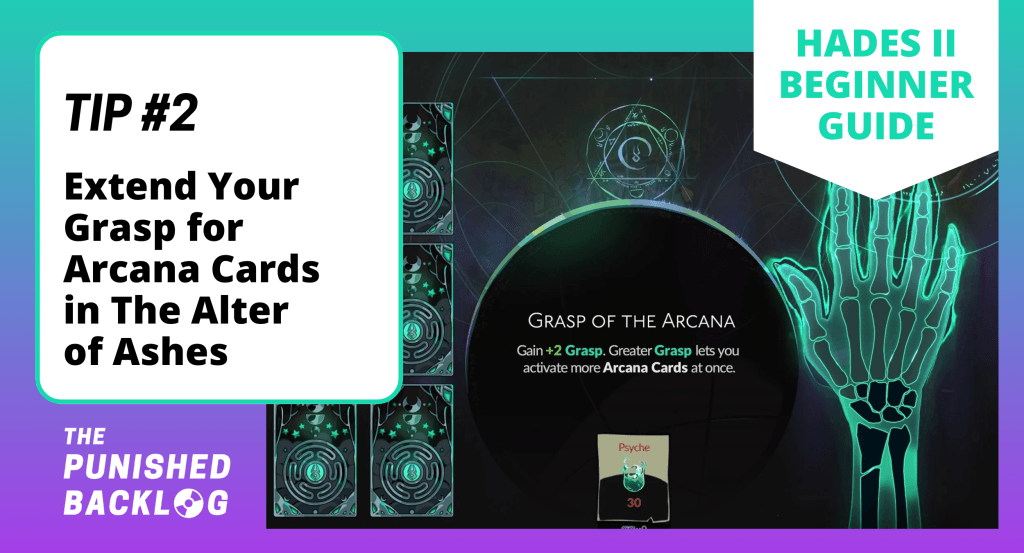
Melinoë is a cool witch with that ghostly green arm, and basically, that’s her way of accessing magic. The stronger her ghost arm is, the more Arcana Cards she can use at one time. Carrying more cards will make you much stronger on each run.
To extend your grasp, you enter into The Alter of Ashes and click over to the right, where you can see her ghostly hand. It can be easy to miss this, aside from a quick initial pop-up, so be sure to invest Psyche (a green ghostly resource) to extend your grasp. While you’re here, you can Forget-Me-Not your grasp as well, so that way you’ll note Psyche resources while out and about!
Psyche is found by talking to wayward spirits that you can coax back to the Crossroads camp by doing a simple “Simon Says” mini-game once you have crafted the Tablet of Peace.
3. Invest in Your Arcana Cards, Starting With These
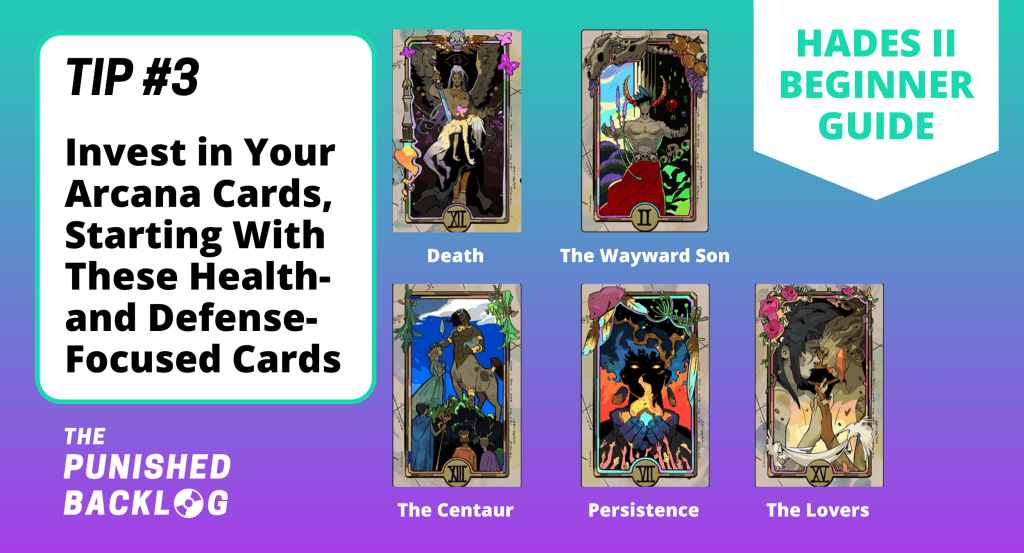
The Arcana Cards are a really fun approach to changing up how you play as Melinoë. Cards require certain materials to upgrade, first with Ashes (found as a reward out on the map), then Shadow and Moon Dust and other materials. I recommend you focus on these health-related and defense-related cards first since the main issue you’re probably facing is dying too quickly:
- II – The Wayward Son — gives you health back after each room
- XII – Death — gives you extra lives (called Death Defiance)
- VII – Persistence — gives you more max health and max magic
- XIII – The Centaur — boosts your max health and magic each time you finish a room
- XV – The Lovers — protects you for the first hit(s) of a Guardian encounter (aka boss fight)
After the above cards, I recommend the following, all of which will make you stronger when using your Cast and Hex powers (read here for more combat tips):
- VI – Furies — automatically does damage to any enemies caught in your Cast
- IX – The Unseen — automatically restores your Magic, which is needed for Omega attacks
- IV – Eternity — slows down time when using Omega attacks
- V – Moon — automatically charges up your Hex
All of the Arcana Cards are interesting and fun to play with, but I recommend prioritizing and unlocking the above to make you stronger early on in the game.

4. Prioritize These Top Keepsakes for Hades II in the Early Game
Similar to the original Hades, giving a Nectar to someone means that they’ll give you a gift in return, typically in the form of a powerful keepsake. I recommend that you change out your keepsakes often in the early game to help level them up and make them stronger.
These keepsakes are particularly useful for the early game:
- Luckier Tooth from Schelemeus — gives you a bonus life
- Knuckle Bones from Odysseus — increases your damage against Guardians (i.e., the bosses at the end of each region) and resistance to them
- Ghost Onion from Dora — allows you to recuperate health between rooms
- Evil Eye from Nemesis — gives you increased damage against the enemy that last killed you, which is very useful when you’ve got a tough Guardian fight
- Moon Beam from Selene — will make sure that Selene appears soon with +5 additional upgrade points whenever you see the moon path; note that you won’t see the moon path until the second time that you see Selene on any given night. Upgrading your hex per run (see more here) makes you super strong!
As you make progress in the game, I recommend getting the Fig Leaf from Dionysus, the Crystal Figurine from Circe, and the Blackened Fleece from Medea, all of whom are located on the upper level toward Olympus. All three of these keepsakes are especially good for creating super-powered, successful runs when you’re focusing on defeating a major enemy.

5. Follow These Combat Tips and Guidance for Runs for Hades II
- Use Cast liberally. Cast is a super useful passive attack that creates a circle that traps enemies. You can drop a Cast and sprint away, making it helpful to create distance between you and enemies. Holding it down until it hits Omega level makes it attack enemies within. You can find many helpful boons from gods that will also automatically attack enemies within your Cast. Zagreus didn’t have this version of the attack in Hades (his cast functioned more like arrows), so this is one way that really lets Melinoë feel different as a character than Zagreus.
- Try an Omega attack by holding down any of the attack/skill buttons until the blue circle fills up. This is basically a super-strong version of the same attack. You can make a huge impact in a fight this way. Each time you use Omega attacks, you build up a blue bar that allows you to use a very cool special called…
- The Hex attack! Hex is another cool new power in this game. Think of it like Melinoë’s super. It varies from run-to-run based on your interactions with Selene, the Moon Incarnate (and if you don’t see her at all, you won’t get one). There are a lot of different Hex powers, but I personally find Lunar Ray, Wolf Howl, and Moon Water to be the most beginner-friendly. You can upgrade your Hex per run by seeing Selene more and more (that’s why her Keepsake is so useful). For example, with Lunar Ray, you can upgrade it so it stands alone and fires automatically at enemies — so helpful! From a lore perspective, think of Selene’s different offerings changing along with the moon cycle.
- Sprint and dash often. Just like her older brother, Melinoë is a very fast protagonist, and her speed is super handy for avoiding enemies and quickly attacking then running away. You can pick boons that also augment your dash or sprint. For example, I love Zeus’ boons that auto-attack with lightning nearby enemies whenever I dash!
- Try God Mode! God Mode can be turned on in the game’s settings. It makes you both stronger and increases your defense significantly. This will make the combat much easier but still fun, and the more that you play, the more impactful your God Mode will be. From a lore perspective, imagine it as an opportunity for Melinoë tapping into her godliness and evolving faster. Fellow writer Gary Wilson says he personally recommends that anyone try God Mode until you beat the Big Boss for the first time. There’s nothing wrong with playing a game on an easier mode if that makes it more fun for you and makes it more digestible to learn all of the game’s systems. You can turn God Mode off or on at any time.
- I recommend bringing at least one Nectar whenever you go out so you can level up relationships and get additional gifts from people. If you’ve gotten to this point, carry a Witch’s Delight in your pocket as well so you can befriend Familiars (read more here).
- Vary your runs between the upper level (once you unlock it) to Olympus and the lower level toward the Underworld. This will help you gather more resources that are critical for getting stronger. You might also try to meet challenges from theList of Minor Prophecies to farm additional resources that way!
- Be intentional about choosing rooms on your path. I recommend choosing any room that will give you the resources you need (found by using the Forget-Me-Note incantation), rooms with Selene boons (indicating by the moon icon) as you can constantly be using that whole extra power, rooms with the chat icon so you can speak to NPCs who might give you interesting or helpful gifts, and rooms that augment the skill set you currently have. For example, if you have a boon from Poseidon already, and you have a room with a door either to Poseidon or Zeus, choosing more of the same can actually make more of your existing skills stronger. (There are some boons that give you bonuses for diversity of boon-givers, but by and large, doubling down on a certain kind of boon is a straightforward way to be stronger. Later in the game, they will introduce the concept of “Elements,” but you don’t need to worry too much about it.)

6. Upgrade Your Weapons and Choose the Best Familiars
In the early game, I recommend choosing whichever weapon is glowing that night, as this means you will automatically harvest Bones, a helpful resource, in each room. You can unlock more weapons (I personally love the jetpack-style Black Coat, which comes with little homing missiles!) and, eventually, you will get the chance to upgrade weapons. You can upgrade these in the Silver Pool in the Training Grounds.
Each weapon’s upgrades are known as “Aspects” which are different versions of the same weapon. The Aspect of Melinoë is always the most straightforward and easiest to get materials to upgrade. Read the descriptions for each before doing a Forget-Me-Not or investing materials; if you’re not interested in trying out a different aspect, don’t sweat it! Weapon Aspects are just a fun way to try playing the game in a different way.
Over time, you will eventually get Familiars, starting with your trusty frog pal! Later, you can befriend more Familiars by doing the Faith of Familiar Spirits incantation in the Cauldron and crafting Witch’s Delight to make them stronger. You must have a Witch’s Delight in your pocket to befriend a Familiar. Each Familiar will help you harvest more resources, and has another bonus skill. I love each and every one of these critters.
The cat, Toula, is particularly helpful as she gives you one more life (called a Death Defiance) and she will attack enemies — though after each attack, she’ll take a nap, so you’ll have to sprint through her to wake her up! Classic cat. You can find her in the second region of the upper path; she will run away from you the first time, so patiently return with a treat.

7. Get Familiar with the Crossroads Camp
- The List of Minor Prophecies — This is the scroll right outside your camp that you will unlock early on in the game. These are basically mini “side quests” that ask you to play runs with certain challenges (e.g., Use all of Aphrodite’s boons or something) to win resources as a prize. Some are completed automatically through the game, so any time you see an exclamation mark, make sure to check the scroll.
- The Cauldron — In the center of camp, there’s a large witch cauldron next to Hecate. You’ll unlock more and more incantations and spells as the game goes on. Check the Cauldron every time between runs to see if there are any new spells that would be useful to you. I recommend prioritizing the following when they’re available:
- Forget-Me-Not, Reagent Sensing, Night’s Craftwork — All help you gather resources
- Summoning of Mercantile Fortune — Brings the Broker to the Crossroads so you can buy things
- Kinship Fortune — Allows the Broker to sell items that help build relationships
- Propensity Toward Gold — Shows gold vases in some levels that can be broken for coins
- Kindred Keepsakes — This allows you to change keepsakes between regions
- Abyssal Insight — This will unlock Chaos Trials in the Training Grounds, which are basically challenge runs that allow you to earn Star Dust, a valuable resource.
- Empath’s Intuition — Upgrades your notebook (called the Book of Shadows) so you know what friend level you are at with everyone and what gift to give them next
- Note that you will start unlocking the chance to upgrade the Crossroads with different locations, like baths and a tavern. These spaces are places where you can hang out more with companions as the game continues, but you likely won’t be able to unlock that level of kinship for quite a while, so save your precious resources until you’re close enough with a pal to actually use those hangouts!
- The Broker — The Shopkeeper can be upgraded in the Cauldron to buy more things off of you or to sell new things. Kinship Fortune (above) is particularly useful since it lets you buy one Nectar per night, and Nectar is the key gift to making friends and progressing a lot of relationships in the game!
- The Garden — You can plant seeds that you gather on your way in the little garden by Odysseus! This is useful for creating more of the resources that you need right at home.
- The Altar of Ashes — This is the archway that Melinoë enters right when she goes into the Training Grounds. She can sit here to extend her Grasp (read more here) and choose/upgrade Arcana Cards (read more here).
- The Silver Pool in the Training Grounds — This is the circle in the middle of the Training Grounds surrounded by weapons where Melinoë can, eventually, upgrade weapons. She will also, eventually, be able to choose animal familiars here!
- The Keepsake Display Case in the Training Grounds — This is where you can choose keepsakes — different items that you got from other characters by giving them Nectar for the first time — for certain runs. Read more here about my recs for beginner-friendly choices.
- The Abyssal Stone — Once you unlock this (first you need to talk to Chaos a few times while out and about, and then do the right incantation for it), you can do Chaos Trials. Chaos Trials are useful for two reasons: 1) When you do one successfully, you’ll get Star Dust, a valuable resource; 2) It counts as a “night” regardless of if you succeed or fail, which means that it refreshes everything in camp. This means you can go give more gifts, garden more, start a new Cauldron spell if you were brewing something timed, and so on!
- Make friends with the other people at camp, particularly Nemesis. Nemesis is also on a journey for revenge, and she is often out and about as well. It’ll make your life easier if she likes you; just trust me.
The Most Important Tip: Have Fun!
I think Hades II is a brilliant game, and I hope that you have as much fun with it as I do. Please let me know if these tips are helpful to you.
If there are more tips you recommend, please leave a note in the comments!

Amanda Tien (she/her or they) loves video games where she can pet dogs, solve mysteries, punch bad guys, play as a cool lady, and/or have a good cry. She started writing with The Punished Backlog in 2020 and became an Editor in 2022. Amanda also does a lot of the site's graphic designs and podcast editing. Amanda's work has been published in Mothership, Unwinnable Monthly, Poets.org, Salt Hill Journal, and more. She holds an MFA in Fiction from the University of Pittsburgh. Learn more about her writing, visual art, graphic design, and marketing work at www.amandatien.com.