


I’ve been reflecting a lot recently about art.
In an era of AI slop, widespread plagiarism, and influencers saying or doing practically anything to make a buck, authenticity is quickly slipping away from us. Packaging up some shit and calling it art has always existed in the creative world — sometimes literally — but at least artists of old could feign honor under the guise of “deconstructionism” or “anti-consumerism.” Unfortunately, too many bad-faith actors exist in 2026; it doesn’t matter how much Hayao Miyazaki decries AI if billionaires in Silicon Valley and crypto bros on Twitter have no scruples.
The point I’m making is this: If you’re making art the “old-fashioned way,” in this storm of garbage, you have my utmost respect. I can’t say I’ll vibe with every painting you produce, or every poem you put to words, but I’ll always approach your oeuvre with open eyes and ears. Art is wonderfully subjective, and the wackier you want to get, the more power to you.
Having said all of that… I’ve never been much for avant-garde. Give me bebop over free-form jazz any day. Impressionism steals cubism’s lunch money (sorry, Picasso). And, much as I hate to admit it, I just can’t get into David Lynch films. The abstract can delight, but I tend to prefer what’s tangible.

Love Eternal, developed by indie studio brlka, is the latest offering from publisher Ysbryd Games. Known for titles like World of Horror and Demonschool, Ysbryd is no stranger to the world of horror, the occult, and the far-out. And my, oh my, Love Eternal is out there.
In its brief runtime, Love Eternal serves up a smorgasbord of cluttered, seemingly disparate parts, only for everything to come together in a fashion I cannot help but admire. Unfortunately, the experience frustrates along the way, and I’m not sure the destination was worth the journey. But to the right person, and the right palette, this may just be the next Mulholland Drive.
Guess Who’s Coming to Dinner
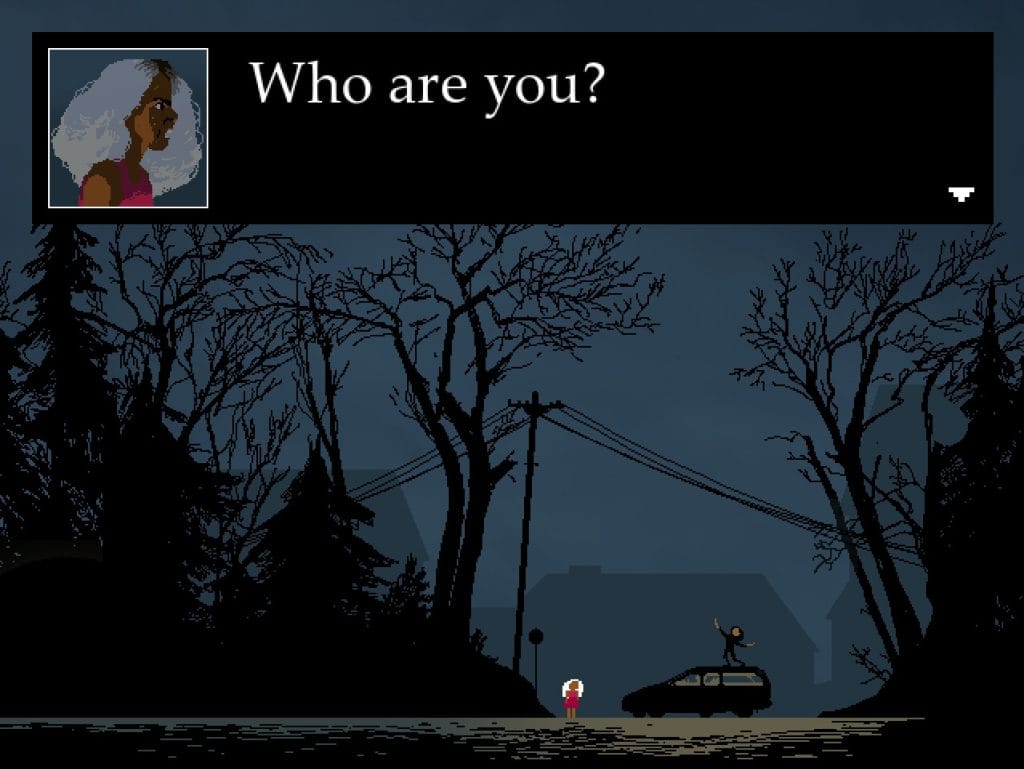
Love Eternal centers around Maya, a young girl who finds her world — both literally and metaphorically — turned upside down. One evening, in the middle of dinner with her parents and sister, the hallway phone rings. At the request of her mother, Maya goes to answer it, only to get a dial tone. Upon returning to the kitchen, she finds the table empty and the front door agape.
Outside, Maya is met with a scene out of a nightmare. Her home is no more, its windows shattered and its walls destroyed. As the player proceeds, they are introduced to the game’s controls.
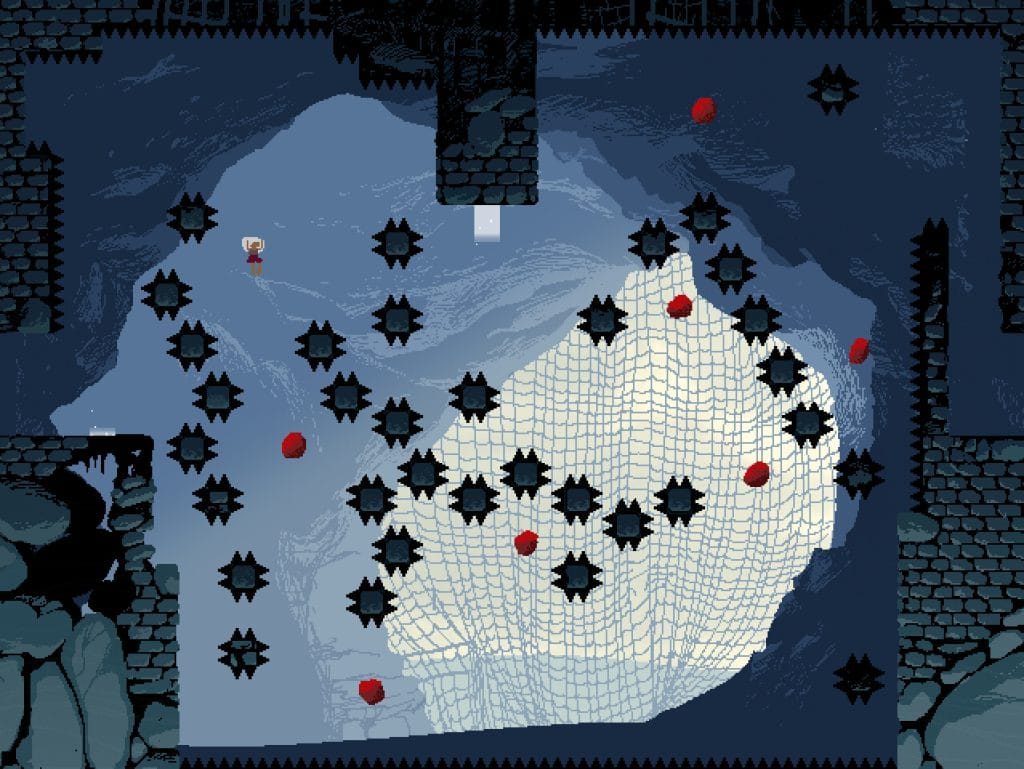
What follows is, at first, a rather straightforward 2D platformer. You can run, jump, and interact with various save points in the environment. The hook, however, is Love Eternal’s “flip” mechanic. With the touch of a button, gravity will shift, flipping Maya to the top of the screen. You can flip once in midair, after which you must land before taking advantage of the ability once more.
Across a few introductory screens, the implications become clear. By flipping at just the right moment, you can avoid incoming spikes, gain a foothold on moving platforms, and dodge various lasers blocking your progress. Further still into the nightmare, you’ll encounter the final piece of the gameplay puzzle: a red stone. Not too dissimilar to the diamonds in 2018’s Celeste, Love Eternal is littered with these red stones, which, upon being touched, reset Maya’s flip ability.
Thus begins a roughly four- to five-hour journey from one dreamlike screen to the next, flipping gravity while trying not to die. Much like Madeline’s ascent in Celeste, however, Maya’s journey is filled with peril. You will die a lot; hundreds of times, even.
We Have Celeste at Home
On the surface, Celeste and Love Eternal have little in common. One is an uplifting tale of perseverance and self-care; the other is a total descent into madness (more on that in a bit). Mechanically, though, much of my time controlling Maya reminded me of those complex platforming sequences that made Celeste a bona fide classic.
There’s a flow state to the action that, at times, feels terrific. The controls are snappy, death is swift, and levels have a crisp “just one more attempt” allure to them. Manipulating gravity is far from a novel concept, but seeing it woven into a horror game feels just fresh enough to give Love Eternal some staying power.

Here’s the problem: The shtick gets old quickly. After the red stones are introduced, levels quickly plateau in their ingenuity. About 40 minutes in, I felt I’d seen everything Love Eternal’s platforming had to offer. It doesn’t help that some screens are downright infuriating; the margin for error is slim, and the focus on pinpoint accuracy feels like being thrown into a kaizo-Mario gauntlet. The final challenge alone took me half an hour to conquer — and not in a way that was remotely satisfying.
In Celeste, the hard-as-nails difficulty served a purpose. Challenging gameplay supplemented a story of hardship; just as Madeline had to steel her resolve, so did the player. In Love Eternal, difficulty distracts more than anything else. And that’s a shame, for there is quite a novel melding of story and gameplay that I’d be remiss not to mention.
Maniac McMansion
Warning: I’m about to share some serious gameplay spoilers. Given the short nature of the game, you may wish to skip this section. That said, if you’re otherwise thinking of skipping Love Eternal, I implore you to read on, as you’re not getting the full review without this context.

While Love Eternal is largely marketed as a “precision platformer,” that doesn’t tell the full story of this adventure. To appreciate the artistry on display here, it’s important to note that Love Eternal is also a narrative adventure game. And it’s quite a good one, at that.
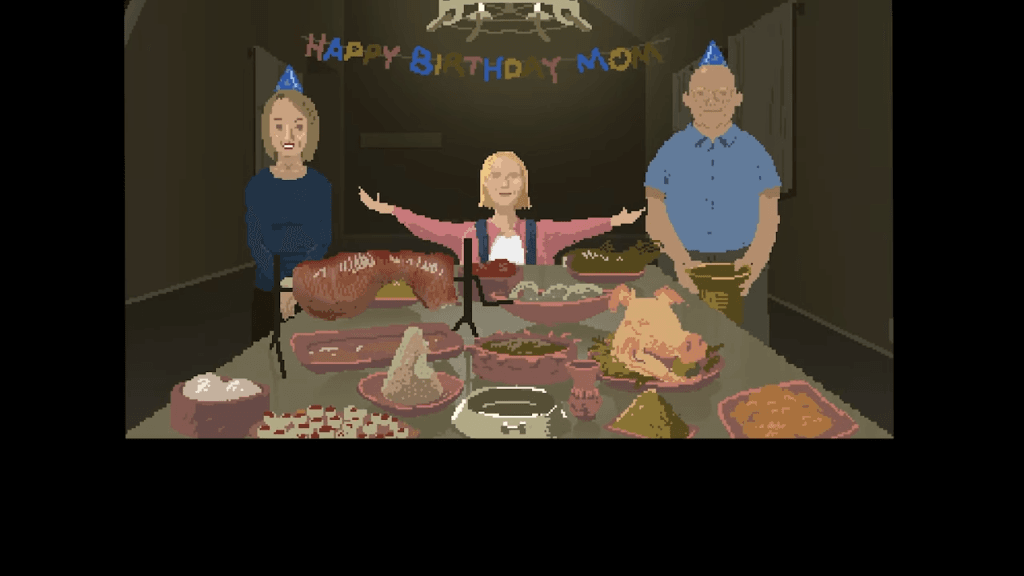
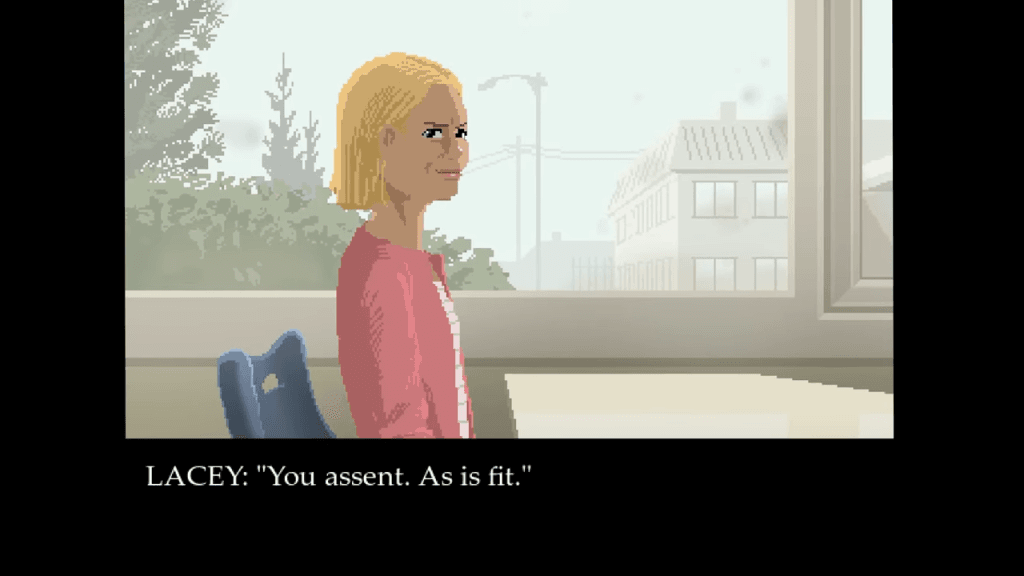
About 90 minutes into the adventure, I was shocked when the game suddenly shifted perspectives — and genres. Gone was the frustrating hellpit that was its platforming sequences; in its place was a first-person view of Maya’s home. While certain (short) cutscenes had peppered the experience up until now, the meat of Love Eternal’s story takes form via a traditional point-and-click.
Over the course of the next hour, I participated in a Groundhog Day of sorts. I awoke as Maya in her room, spent breakfast with her mom, and traveled to school for the start of a new academic year. There, I met an unlikely friend… only for shit to hit the fan.
I won’t spoil more; in truth, I’ve already given too much away. But the shift in tone cannot be understated. This is where Love Eternal truly comes into its own, telling a story of a possessed family, a surprise neighbor, and a deceptive goddess. It’s wild, it’s a bit all over the place, and yet it’s something I won’t forget anytime soon.

To be clear, the story of Love Eternal isn’t terribly coherent. I found myself with far more questions than answers. But somehow, it manages to entertain. If it weren’t for the headache-inducing platforming segments, I would have immediately started a new game to pick up on story threads I might have missed before. This is a narrative that, if found by the right community, has potential to become a cult classic.
Love Actually
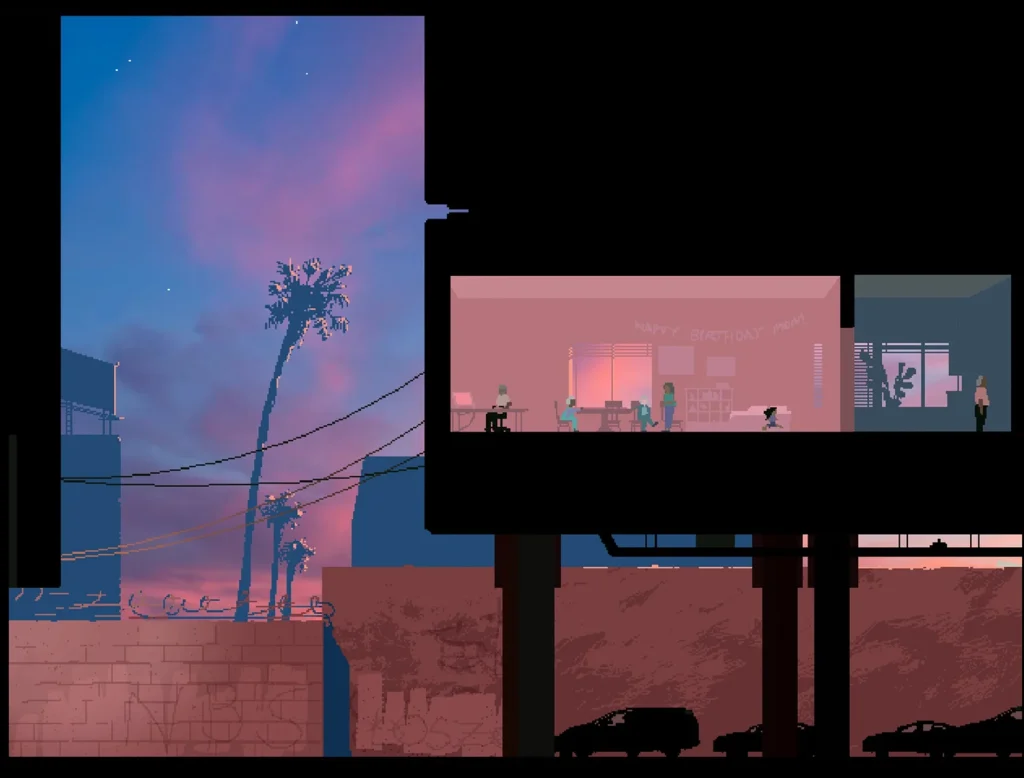
Tying Love Eternal together is an audiovisual style that is delightfully creepy. Backdrops are varied, depicting everything from derelict Los Angeles apartment complexes to haunting statues of massive gods and goddesses. Brlka employs a wonderful array of colors, bringing surprising light to an otherwise dark narrative.
Make no mistake, though: This is a dreary adventure through and through. Love Eternal’s sound design only enhances the vibe, punctuating various jump scares and making Maya’s experience feel like even more of a fever dream than it already is.
Even when I was swearing at my Steam Deck (which ran the game flawlessly, by the way), I was appreciating all the sights and sounds that Love Eternal has to offer.
Final Thoughts
As a platformer-meets-horror game, Love Eternal is equal parts aggravating and enlightening. The story is opaque, with an ending that had me scratching my head, and yet I found myself wildly engrossed. The platforming is woefully undercooked, but a mid-game genre shift almost (almost) redeems the entire experience. Add in a late-game curveball that, while I won’t spoil here, is bound to invite plenty of speculation, and Love Eternal is a work of art that deserves praise.
Now, is that art fun? Is it something I’d recommend to a majority of people, or even to diehard platformer fans? I can’t say I would — the goods just aren’t here. However, if you’re willing to compromise your sanity a bit, you’ll find a dimension to Love Eternal that’s worth exploring. And who knows, perhaps it’ll all just click seamlessly, and you’ll discover a masterpiece.
Score: 6.5/10
Love Eternal, developed by brlka and published by Ysbryd Games, releases on February 19, 2026, for PC (via Steam), PlayStation 4 & 5, Xbox Series X/S, Xbox One, and Nintendo Switch. MSRP: $9.99. Version reviewed: PC (via Steam Deck).
Disclaimer: A review code was provided by the publisher.

David is the founder of The Punished Backlog. He has a problem finishing games he starts.
Just beat: Splatoon Raiders.
Working on: GTA V.
Can't wait for: Ocarina of Time (2026), GTA VI.
Follow David on Twitter at @David_Silbert to keep up to date with all things The Punished Backlog.