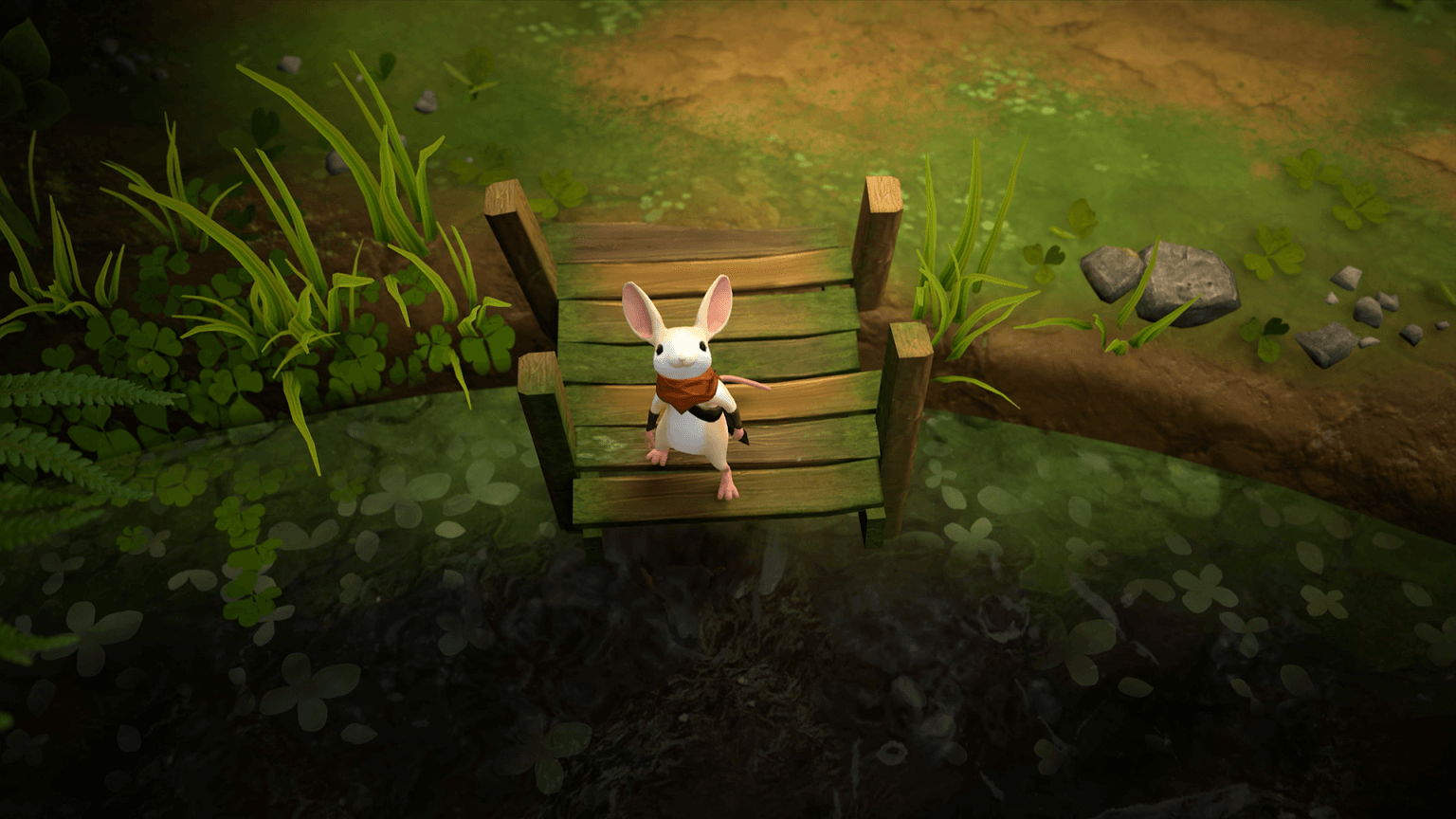

I love cute lil’ mice guys doing things. As a kid, I often reread the Redwall series, The Tale of Despereaux, and The Rats of NIMH. One of my favorite films is Ratatouille. When I heard about Mouse P.I. For Hire on The Punished Podcast (here at 1:22:05), I started to cry with joy until I realized it wasn’t the mouse mystery game of my dreams (I’m still gonna play it, though). So, you can imagine how desperately I’ve wanted to play Polyarc Games’ Moss ever since I saw the first trailer of a mouse in a red bandana and a sword sprinting through a forest.
Released exclusively for PlayStation VR in 2018, Moss was so appealing to me that I genuinely considered dropping $400 for the headset. But I’ve learned a lesson about the value of patience! Moss: The Forgotten Relic releases this Thursday for PC and console players; it’s a non-VR version of both Moss and its 2022 sequel. I had a great time with the game, in no small part because of its awesome little mouse guy (I mean, girl).
Her Name Is Quill
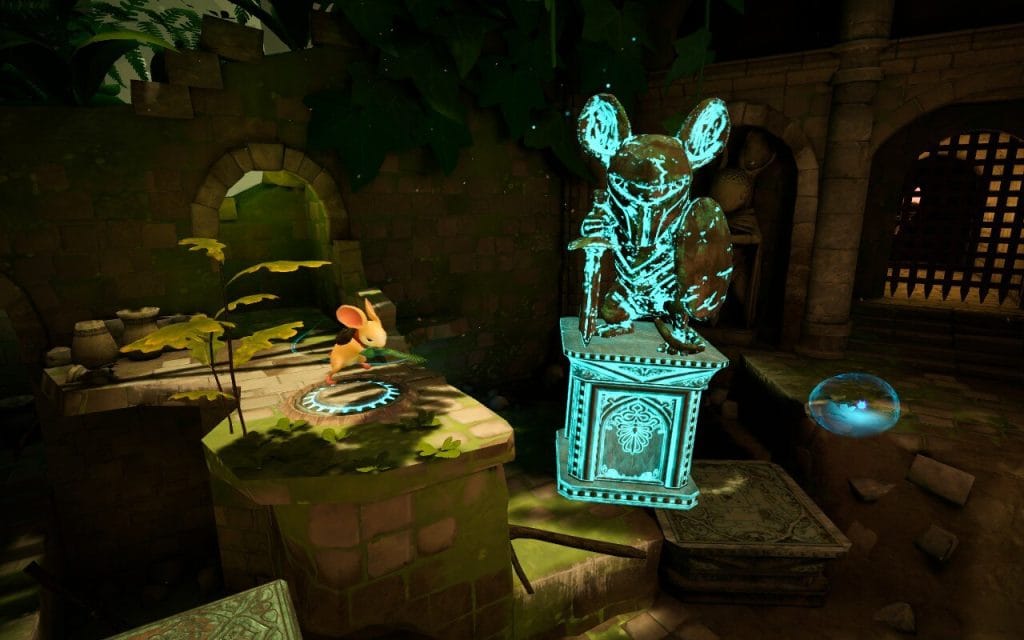
Quill is, without a doubt, the best part of Moss: The Forgotten Relic. She has a ton of spunk, which fuels her journey to rescue her uncle and then, in Book II, the entire kingdom. In a clever usage of the once-VR viewpoint, players are “part” of the game too. As the Reader, we have a special relationship with Quill so she can “see” us too.
Quill is a delightful protagonist, in no small part because of dozens of thoughtful animations. For example, the first time I healed Quill, she did a gesture that could be blowing a kiss or the American Sign Language gesture for “Thank you,” and I knew then that I’d do anything for this mouse. The way she occasionally flip-rolls over a ledge or fist-pumps after winning a big battle is incredibly endearing. Even if you fall into the water (which I did often), she appears back at the level’s start, cleaning her ears.
Whether she’s fighting mechanical scarabs with swords or scrabbling up a rock face, Quill successfully held my attention throughout. I could tell how much the developers loved their protagonist, too. There are so many special touches, like the way she might point and chirp if you’re stuck on a puzzle or the way her tail swings as she’s about to leap.
As the game continued, I realized it was indeed ASL that Quill was using occasionally to communicate. I suddenly remembered a lovely piece that Mike Fahey (RIP), a great games journalist at Kotaku, wrote years ago about this.
And while Quill is the star of the game, there’s plenty more beauty to see.
A Big, Beautiful World
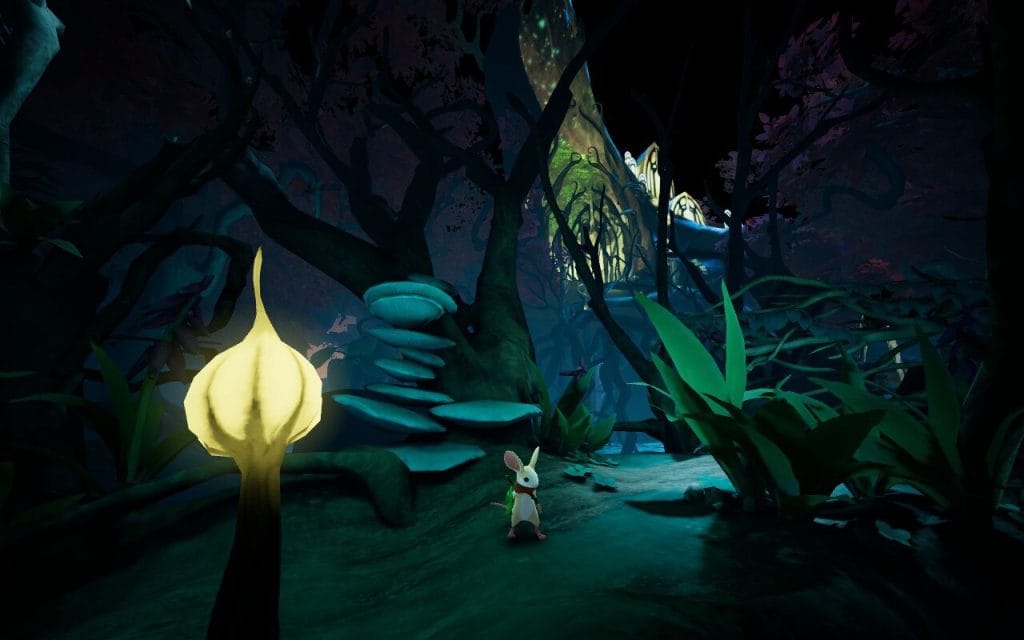
The environments in Moss: The Forgotten Relic are gorgeous. I can only imagine how these lush settings looked in VR. The game’s camera moves elegantly, zooming in and around as Quill moves throughout any given level. This is much smoother than the original VR point of view, which I familiarized myself with by watching YouTube playthroughs.
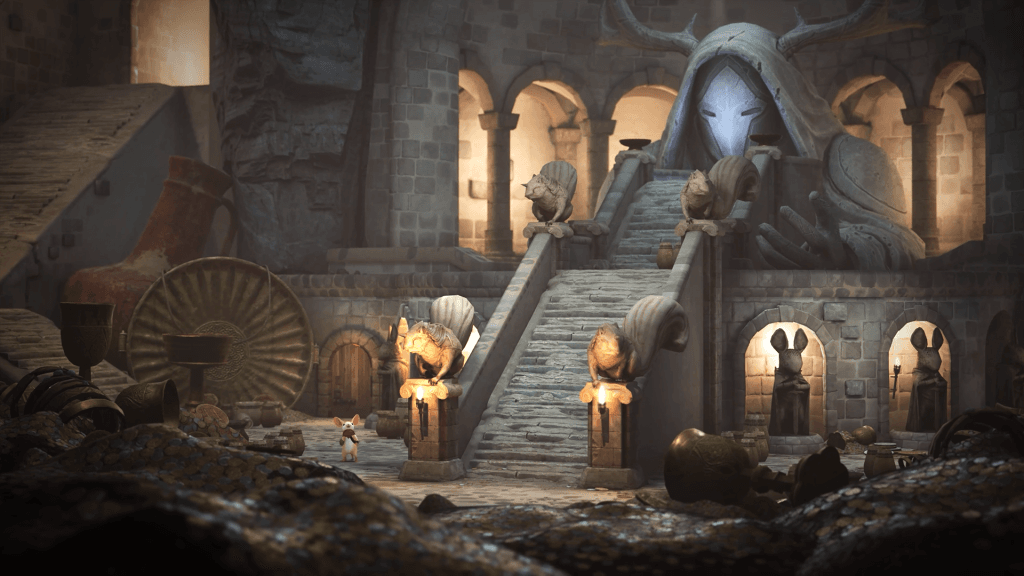
The most charming setting is in the opening hour when Quill returns home. It’s a medieval village filled with cute little mice doing cute little mice things — fishing, playing games, walking home from work. I gasped with delight; all of my Redwall dreams were coming true! However, you can’t talk to any other mice or interact with any buildings besides solving puzzles on the way home, which was a letdown. I didn’t know it then, but this forecasted a game with a lot of fairly empty environments.
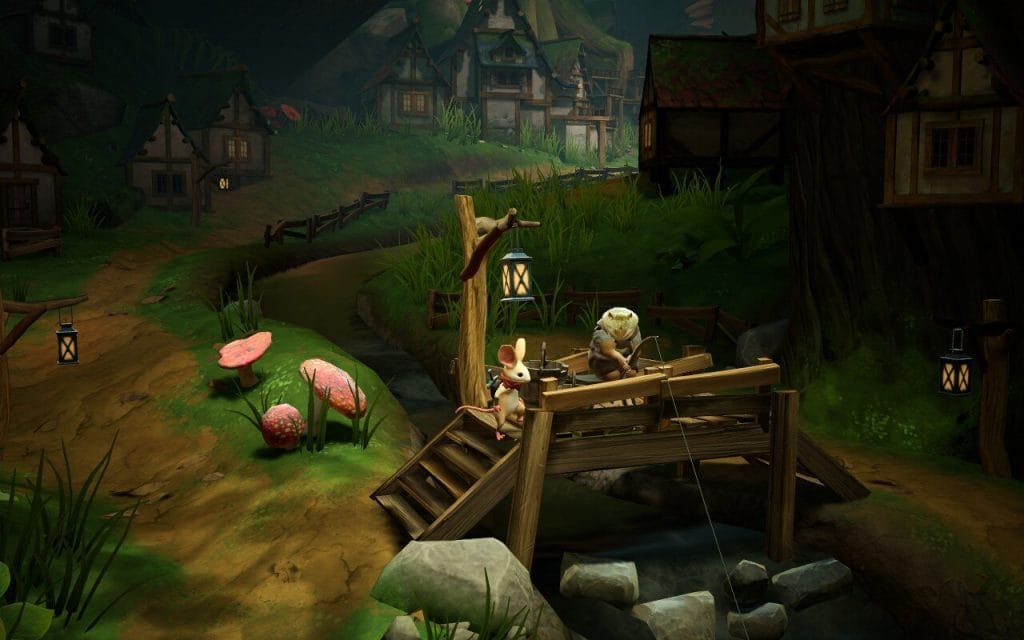
Moss: The Forgotten Relic follows Quill as she journeys through forests and castles. Each room features a task to complete that contains 1) an environmental puzzle, 2) straightforward platforming, and/or 3) completing waves of combat. Most rooms have the first one, so fans of dungeon crawlers will be happy.
Unfortunately, these beautiful environments largely have little to do or explore beyond solving the immediate puzzle. This might have been more interesting and awe-inspiring in VR, but as a port to flat screens, it’s disappointing. There are a few lackluster collectibles scattered throughout levels, but oftentimes, I’d search around rooms and run into nooks and corners only to find nothing at all of interest. Book II is a bit more detailed than part one, but overall, the vision is clear: This is a puzzle game, not a story game.
A Messy Fairytale
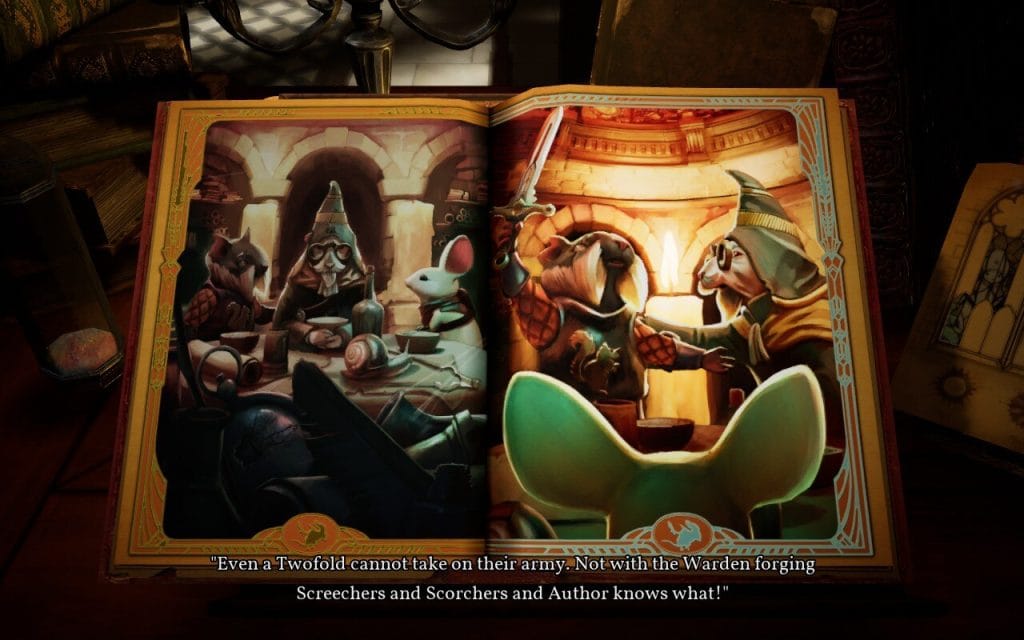
Both the original Moss games and Moss: The Forgotten Relic share narrative through a storybook visual with slightly animated picture books and voice-overs. The game opens like this with a long, fairly convoluted lore dump filled with fantasy tropes and a lot of dramatic proper nouns. I did not have fun watching mostly still characters talk for multiple lines per storybook page, so I put on subtitles, but this was worse. I read lines faster than they were said out loud, and players cannot skip individual lines without skipping the entire page. As a result, the opening minutes are a bit of a slog and not the most invigorating start.
Overall, the vision is clear: This is a puzzle game, not a story game.
If this were just the beginning, I wouldn’t mind so much, but unfortunately, the game is regularly interrupted by “cutscenes” back to the storybook, and all momentum comes to a screeching halt. Many scenes felt like they took a long time to share not that much information. Simply cutting down the number of times Quill cries out “Uncle! Uncle!” would shave minutes off of the game. The cutscenes were not compelling enough to pay attention to, but also not clear enough to easily skip. I found myself catching up on text messages while listening to the narration in the background in case I missed anything really important.
The gist of the story is straightforward: A mouse is trying to rescue her uncle, and later, the kingdom. However, there’s a lot of extra mumbo jumbo about sprites and magical glass and Readers and Authors, and it doesn’t feel really connected to Quill, who, at the end of the day, is an endearing protagonist on a classic journey of Girl vs. Evil.
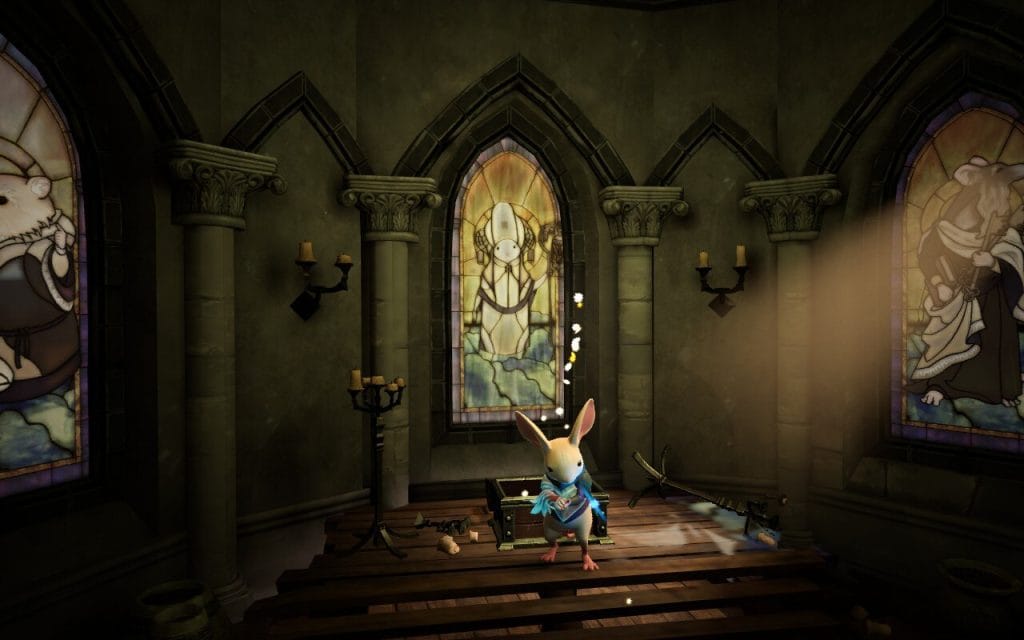
If the game were really interested in the world of Quill, then we would see her interacting with other mice in her hometown or reflecting as she travels. For example, there is a church with stained-glass windows of mice in religious garb. There are no lore collectibles or plaques about who these mice were, and Quill doesn’t comment on them.
But I wondered who they were. What is the spirituality of the mice? Who do they honor? Why doesn’t Quill wear clothes but everyone else does? Instead, Quill’s observations are limited to generic cutscene comments like: “She couldn’t believe this is where the war had been fought!”
At least Quill has her own fights to focus on, which are strong enough to make up for the lackluster story.
Jump Around
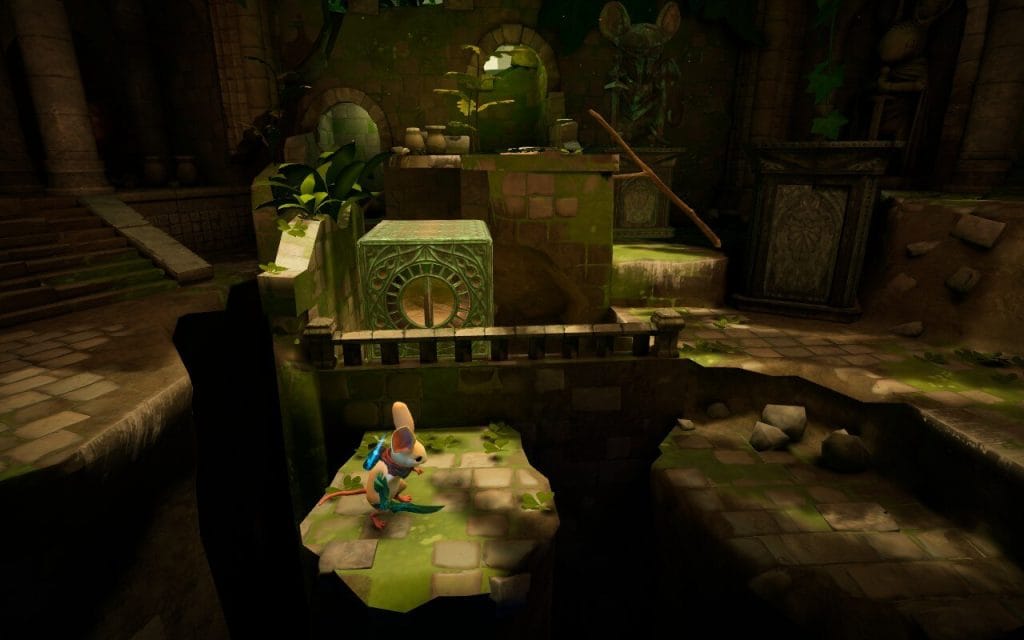
The main thrust of gameplay in Moss: The Forgotten Relic is the dungeon-crawling puzzles (which I’ve only recently learned to appreciate) to help Quill get through each level. This is where the game shines. Players control both Quill and the Reader’s powers. The Reader can magically move certain items or interact with things that Quill can’t. I can connect vines that she can climb, take control of a mechanical scarab, or heave a massive statue to a pressure point.
Moss: The Forgotten Relic will appeal to fans of games like Tunic or Paper Mario.
At first, these puzzles start off fairly easy, but they get significantly more compelling as the game goes on. I enjoyed the dexterity challenge of trying to control Quill with one joystick while simultaneously using the Reader-activated magical power with the other. There were many levels that I said out loud, “Oh, nice!” after I figured it out or managed it just right.
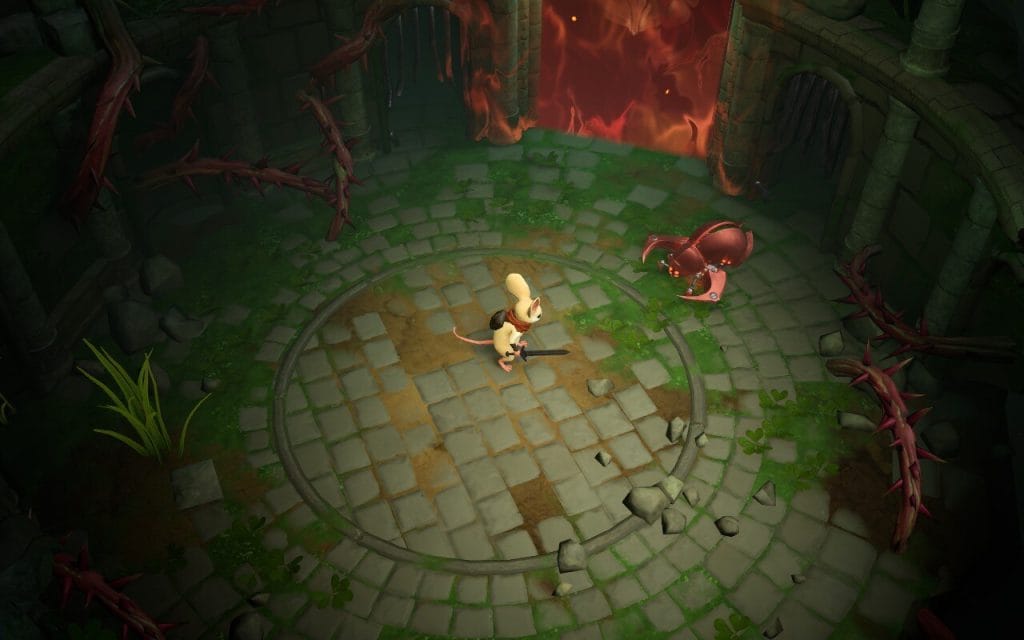
Moss: The Forgotten Relic is very forgiving; if Quill dies or falls into the water, she simply resets at the last checkpoint or the beginning of the level. I really appreciated this, especially as compared to another recent mouse game that is famously punishing.
This especially picks up during combat, which is straightforward but fun. Quill dodges around the map, flamboyantly swinging her sword. Her main enemies are mechanical scarabs, though there is a late-game enemy that straight up obliterates Quill, which shocked me, taking the cozy out real quick. Both Book I and Book II culminate in exciting final levels that require the player to utilize everything they’ve learned.
Communication Skills
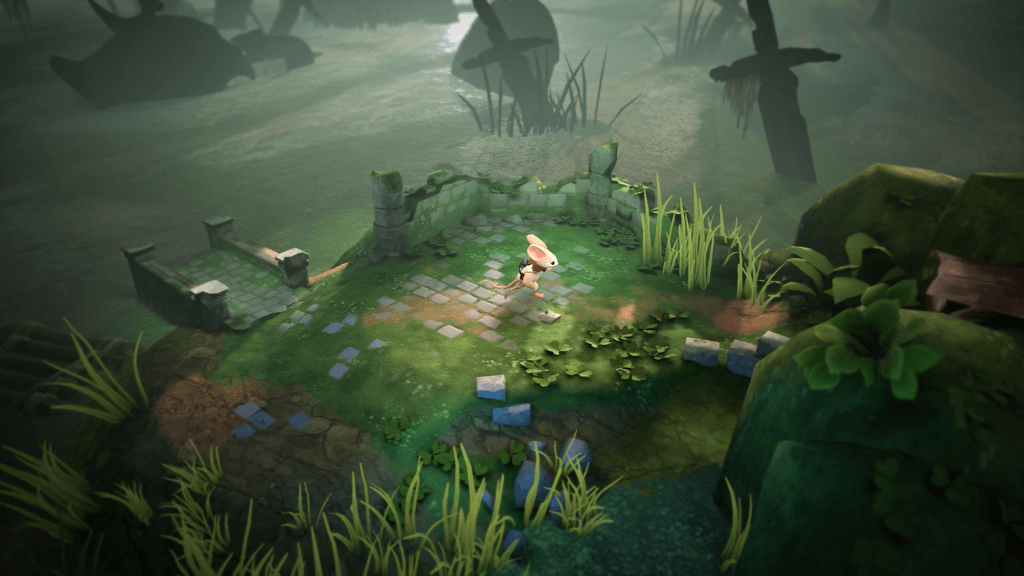
The vibes throughout Moss are good. In addition to the beautiful visual setting, the audio is great, too. The sound effects make Quill’s journey feel immersive; for example, a swamp level teemed with the sounds of owls hooting, water trickling, crickets singing, and the wind whistling. The music is suitably high-fantasy instrumental, appropriately building in energy as the game gets harder.
Reminiscent of a bedtime storybook, Moss: The Forgotten Relic features just one voice actor. Morla Gorrondona plays the narrator as well as the voices of all the characters, making her voice gruffer for a grumpy old mouse or high-pitched and chipper for a fairy. Gorrondona does a great job with what she’s given, adding to the lush storybook feeling.
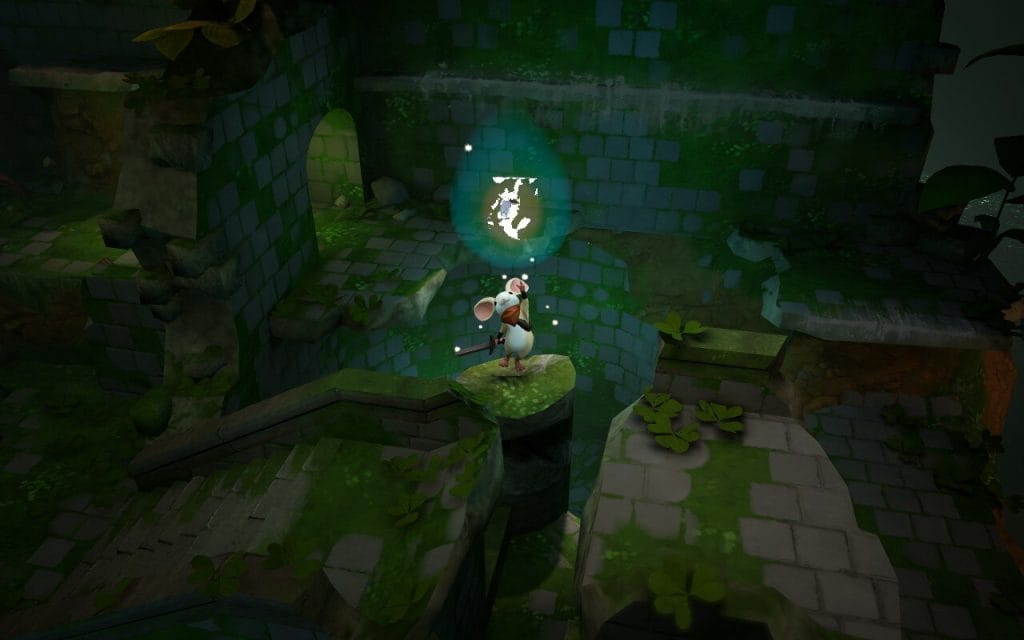
Moss: The Forgotten Relic further adds to this mystical vibe by removing a lot of the modern video game trappings. There’s no health bar, no mini-map (or even map), no coins. I loved the clean UX and appreciated not being distracted from the gorgeous gameplay by too many details.
That’s not to say the game wouldn’t have been improved by some signage. There’s some optional areas that are not clear at all; I missed one entirely because I simply couldn’t figure out what the game wanted me to see. Similarly, in Book II, the game introduces a climbing mechanic… but doesn’t tell you. I jumped around a level for 10 minutes with no idea of what I was missing before I eventually just watched someone’s YouTube playthrough and learned about the climbing skill that way. It didn’t help that the game was occasionally a little glitchy; for example, I did a side quest and received some cool armor, but when I left the game and came back, the armor was gone.
Still, Moss: The Forgotten Relic delivers on its main promise: being a non-VR version of itself.
Final Thoughts: Free From the Prison of VR
Moss: The Forgotten Relic can occasionally be quite frustrating, and I think a lot of that has to do with the transition from VR. I felt that the game’s convoluted narrative existed mostly to justify why Quill could have a magical bond with an all-seeing player as the Reader which is inherently VR-related. Additionally, Book II has some platforming moments that feel like they would be easier to perform in VR than in a traditional 2D view, and the auto-controlled camera does have a couple clunky moments.
Similarly, the beautiful but empty environments seemed to count on impressing players through the immersive VR experience without accounting for the transition to a more standard platformer. Still, I’m impressed that Polyarc has managed to make this game into a version I can finally play.
Quill is, without a doubt, the best part of Moss: The Forgotten Relic… I would do anything for this mouse.
Moss: The Forgotten Relic is the perfect way to play Moss if you don’t have a PSVR headset and you’ve been wanting to try Moss ever since its 2018 debut. The Forgotten Relic is billed as the definitive experience, and I agree. The original 2018 Moss is great but way too short; I finished playing it in about 2.5 hours, and the story ends abruptly. Moss: Book II spends more time on plot and weaving in levels, and together, they feel like the complete game.
I imagine Moss: The Forgotten Relic will appeal to those who enjoyed playful games like Tunic or Paper Mario; it’s frequently described as a Zelda-like. So, if those things float your boat, you might like this, too. Fans of environmental puzzles, delightful character design, and straightforward combat will love Moss: The Forgotten Relic. But if you don’t like those things, then you won’t like Moss — even though the mouse is really, really cute.
Score: 8.5/10
Moss: The Forgotten Relic, developed by Polyarc Games and Blackbird Interactive and published by Polyarc Games, releases July 16, 2026, for PC, PlayStation 5, Xbox Series X/S, and Nintendo Switch 1 & 2. MSRP: $19.99. Version reviewed: PC (via Steam Deck).
Disclaimer: A review code was provided by the publisher.

Amanda Tien (she/her or they) loves video games where she can pet dogs, solve mysteries, punch bad guys, play as a cool female character, and/or have a good cry. She began writing with The Punished Backlog in 2020 and became an Editor in Fall 2021. Amanda also does a lot of the site's graphic designs and podcast editing. Amanda's work has been published in Mothership, Unwinnable Monthly, Poets.org, Salt Hill Journal, and elsewhere. She holds an MFA in Fiction from the University of Pittsburgh and a BA in Creative Writing from Columbia University. Learn more about her writing, visual art, teaching, graphic design, and marketing consulting at www.amandatien.com.