
PRELUDE: MISERY
2025 has not been an uplifting year for many people.
Humanitarian crises like the genocide in Gaza, the war in Ukraine, refugees crises in Syria and Sudan, and many more atrocities continue unabated. Domestically, millions are losing access to healthcare, ICE imprisons legal residents with impunity, reports of politically-charged acts of violence fill the airwaves, AI might be coming for everyone’s jobs, and the economy teeters on the edge of an imminent recession—depressing bylines race across our feeds at what feels like a higher rate than ever before.
It was a harrowing year even in the space of our niche interests here, with monopolistic megacorporate consolidations subsuming the landscape, news of studio layoffs coming monthly (if not weekly), and continued union-busting efforts throughout the industry.
Perhaps I’ve simply gotten worse at compartmentalizing the state of the world from my personal mental health, but this year the state of, well, everything weighed on me more than ever before. We live in a time where it feels like capitalism and the pursuit of profit takes precedence over everything else, choking out creativity and art (and more) in the process. It brings to mind a quote that continues to rattle around in my head:
“It is easier to imagine an end to the world than an end to capitalism.” – Mark Fisher in Capitalist Realism: Is There No Alternative? (Zero Books, 2009)
It is easier to imagine an end to the world than an end to capitalism.
Mark Fisher in Capitalist Realism: Is There No Alternative? (Zero Books, 2009)
Anyway, comics!
On October 2nd, 2024, DC Comics released the DC All-In Special, a single issue story that introduced the Absolute Universe to the world. While the founding details of the Absolute Universe are mired in all of the minutiae that makes superhero comics appealing to the enfranchised, and bizarrely obtuse to the uninitiated, the foundational concept is straightforward. The primary DC Comics universe is influenced by hopeful, positive, optimistic energy, creating worlds where superheroes are largely accepted, beloved, and triumph over evil. The Absolute Universe is its anathema. The energy of the Absolute Universe is tainted by Darkseid — the chief big bad of the DC universe — and his malignant, ruinous influence.
“If that world is driven by life, by hope…then this one would be driven by challenge, by turmoil…”
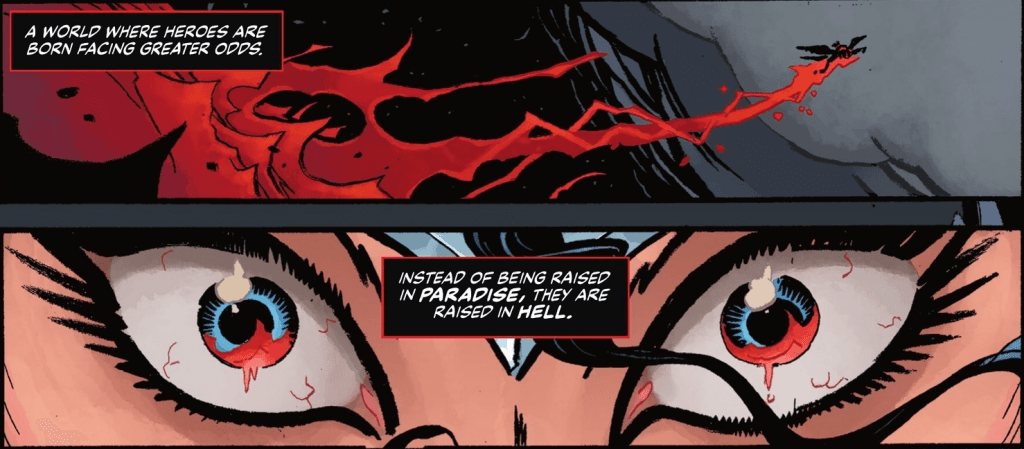
“Where all their advantages are gone. Where they are the small chaos, rather than the system itself. A world where hope is the underdog. Where it is the villain, the opposing force.” — Darkseid, DC All-In Special
The Absolute Universe is not a post-apocalyptic hellscape: Civilization and society still exist, the sky does not bleed red, demons don’t swarm in the sky. But it is poisoned at its core, mired in misery, born unto it, a grindstone of a world that slowly wears at your soul until hardship becomes normalcy.
How do you win in a world that is designed to push you down and keep you there? A world that grabs you by the throat and forces you to the ground, to breathe in dirt and dust. Forget winning: How can you even hope to survive in a world like this? This year, more than ever before, oppressive thoughts like these also crossed my mind.
One month after the release of the DC All-In Special, Donald Trump was elected as the 47th president of the United States.
In spite of what felt like the crushing weight of, well, everything, people continued to live their lives, went to work, and in some cases, wrote stories. Such is the power of stories: In times of peace they can serve as warnings, premonitions of things to come, distractions and respites from a sobering reality; in times of strife, they serve as uplifting reminders of a future that is within grasp, so long as we can deign to envision it.
And so, surprisingly — or perhaps not so surprisingly — 2025 was an uplifting year for one genre in particular: superhero stories.
Some of the most aspirational media ever written are superhero stories. Superheroes are often derided as corny, trite, childish, and silly. Truthfully, sometimes those descriptors are accurate. But other times, they are the stories of the moment and the stories we need. And so we turn back to the Absolute Universe. The universe where heroes are the small chaos, where hope is the underdog, where the moral arc of the universe might not bend towards justice. But iron sharpens iron, and no world is beyond salvation.
Kindness and compassion are all that will save us now. Wonder Woman believes in you.
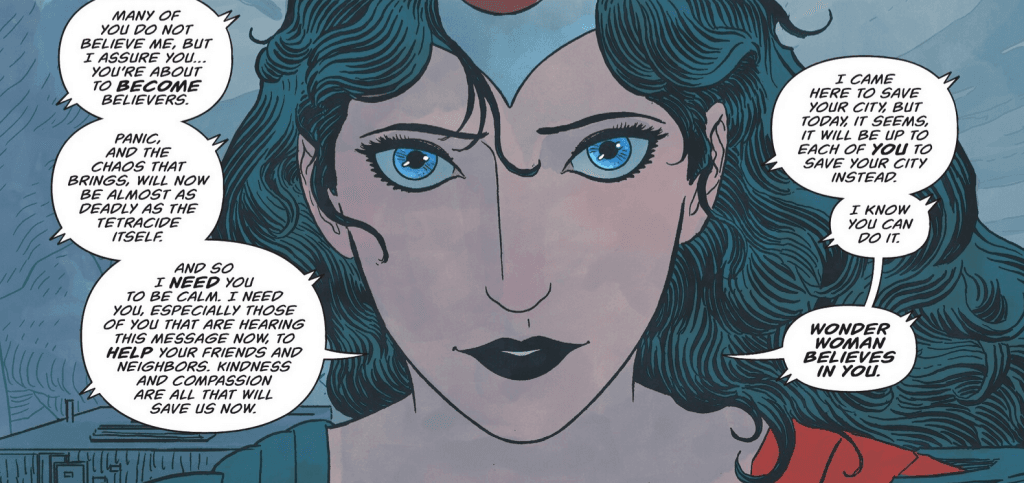
ACT I: LOVE AND KINDNESS IN ABSOLUTE WONDER WOMAN
An additional founding feature of the Absolute Universe is that every hero has been divorced from a key component of their origin story. In most incarnations, Wonder Woman — Diana of Themyscira — has a generally happy upbringing on the utopic paradise of Themyscira, raised by her mother Hippolyta alongside her Amazonian sisters. No men are allowed on Themyscira, and none have resided there in centuries—truly, it has earned the moniker of Paradise Island.
In Absolute Wonder Woman (October 2024 – present), the Eisner-award winning series written by Kelly Thompson and illustrated by Hayden Sherman, Diana is not born on the utopic paradise of Themyscira, surrounded by loving friends and family, living a life without men in theocratic bliss.
Instead, she is raised in Hell by a witch.
A scorned woman imprisoned by the gods, Circe of Aeaea is in solitary confinement in a lonely pocket of Hell. Apollo delivers the infant Diana to Circe under the guise of some divine plan. Circe is initially somewhere between loosely dismissive of and outright apathetic towards the infant Diana. She has little reason to care for a baby, even if it is one that has arrived by way of deific intervention. (Also of note is that in DC canon, Circe has historically been a mortal enemy of Wonder Woman, though she has no specific predisposition to dislike Diana here.)

But the innocence of a child is a powerful thing — and Diana’s curious, loving nature is too much for Circe to deny. Diana befriends snakes, beasts, and hellacious monsters of all kinds, and eventually breaks down Circe’s walls, too.

The backbone of Absolute Wonder Woman is this wonderful mother-daughter relationship between Circe and Diana; the way in which they learn, care, and open up to each other. Wonder Woman, as a character, has always been about love. The Absolute Universe, as it is wont to do, pushes this concept to its limit: Even in Hell, love can save us still.
Diana’s love transforms Circe, changing her from a bitter and lonely woman to a nurturing and caring mother; in turn, Circe teaches Diana everything she needs to know. She teaches her ancient magicks to defend herself from danger and crafts her the tools and weapons she will need to master to face down true evil, all to help Diana fulfill her destiny: to save the surface world above from its destined doom.
The truth is, our lives now may not be so different from life in the Absolute Universe. The planet is dying, we might be alone in the universe, hope is the underdog, and the moral arc of the universe might not bend towards justice. Things might not end up okay.
Absolute Wonder Woman is not a saccharine work. It is not so cloyingly sentimental to say that love and kindness is all we need, but it is hopeful enough to say this: Love and kindness is the start of something, something that can hold evil at bay. Hopeful enough to say, with its whole chest, that even in this divided world, there is a reciprocal, transformative power in love, in compassion, in kindness. If Circe and Diana can love and support each other in Hell and find amongst themselves the capacity for such a thing, then surely I can do the same, even in this world that can feel more divided than ever.
All we need are kindness, compassion, love…and being armed to the teeth with the greatest weapons imaginable. (Those might be the things that push Diana over the edge into superhero territory, compared to us. This is a comic book, after all.)

How do you win in a world that is designed to push you down and keep you there? A world that grabs you by the throat and forces you to the ground, to breathe in dirt and dust. Forget winning: How can you even hope to survive in a world like this?
ACT II: HOPE AND ACTION IN SUPERMAN
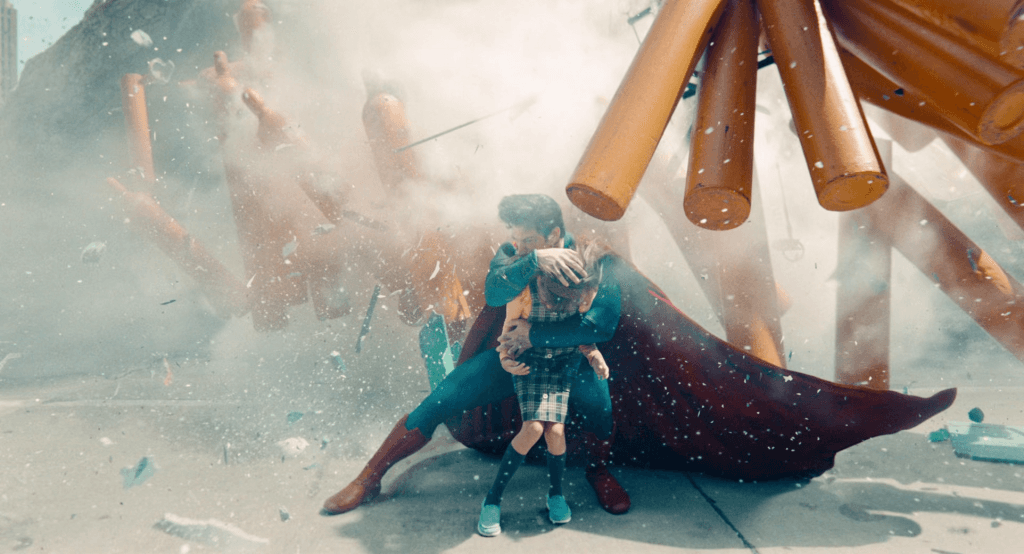
I love Superman. And I loved James Gunn’s 2025 Superman, too.
Was it a perfect film? Of course not. Maybe it wasn’t even a great one, but I’ve been waiting for a good Superman movie for ten years, so you’ll have to excuse me if my feelings towards the film are extremely irrational.
When I say “good,” I don’t mean “good” in reference to its critical reception, box office pull, Cinemascore, or perception in the eyes of film Twitter. I just wanted a culturally relevant movie that I could point to and tell my friends and family “See, this is what Superman is all about, do you understand why I love this character so much?” A Superman movie that could pierce through the veil, the armor, of the cynical modern audience and make him relevant again. James Gunn’s Superman delivered on that promise and more, and I was over the moon about it. I really cannot overemphasize, in the midst of all the shit happening around us, how much I fucking needed this movie:

Go on YouTube and you can find a dozen or more video essays discussing this film. Numerous words crop up often in these videos, but if I had to pick the most common one, it would be “hope.” It’s not just in the content of these videos, either, but in the comments, the reactions, even anecdotally: “Hope” was the word that came up most often.
What did this movie do so well to engender such a reaction?
Superman, the film, but also Superman, the character, is a fantasy. It is more than fantasy, it is a patently ridiculous movie: The protagonist can fly and shoot lasers from his eyes, Guy Gardner’s haircut exists, Krypto the Superdog is a character, there are nanites and clones and temporal rifts and aliens. And most ridiculous of all, someone actually intervenes to stop the corporate-backed proxy aggressor state of Boravia (definitely not Israel) from invading the technologically inferior occupied neighboring territory of Jarhanpur (definitely not Gaza), which in today’s sociopolitical environment feels like the most unrealistic thing of all.
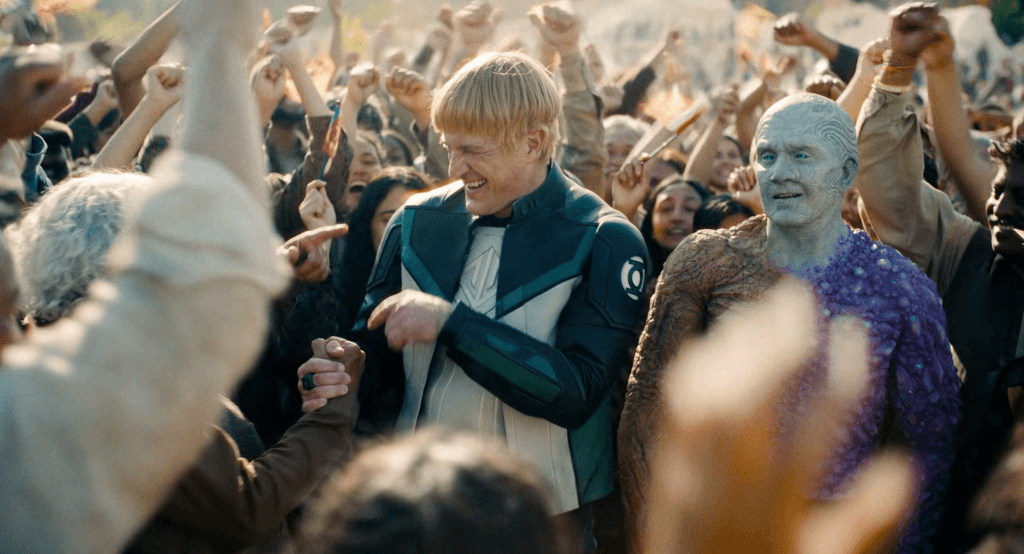
Superman does not shy away from this. It does not attempt to portray realism, it instead portrays possibility. I find it meaningful that in this movie, the superheroes learn that Boravia is invading Jarhanpur in the same way that we receive news in the real world: by seeing it on a news channel on a television. When you and I see news of war on a screen, all we can do is stand by idly. There is nothing we can do to stop it. Superheroes, on the other hand, do not stand idly by. (“Wait,” I can hear you say. “Superman doesn’t do anything to save Jarhanpur.” We’ll come back to that!)
That is the power fantasy inherent in Superman — all the good incarnations of him, at least — and it’s the core of what makes this film feel so imbued with hope. Grant Morrison, author of what is widely considered the greatest Superman comic run of all time, All-Star Superman (November 2005 to October 2008), puts it better than I ever could:
“Superman’s key word is action… Superman says “do it now.” Action! …He gets in there, he gets shit done, he protects the vulnerable and that’s what it’s all about. If you’re weak, if you’re in trouble, if someone’s coming to mess you up, Superman steps in and punches the guy out. He’s not Christ, he doesn’t tell you to turn the other cheek…And that’s why he’s so brilliant, because he punches out bullies on behalf of good people. He’s the guy who has the muscles, who has the power, and he says “if you mess with these people, I will punch you out. And I think we need that guy right now, we really do.” —Grant Morrison on Comic Book Couples Counseling
Why does Superman fill people with hope? He inspires people because he does shit. He protects people, he takes action, he saves lives! (Was there some recent portrayal of Superman that was defined by his inaction and unwillingness to save people? I can’t quite recall. Must have been a fever dream.) Superman is a power fantasy, the power fantasy that for once, someone with power will do the right thing. Stand up for the weak, protect the vulnerable, listen to the oppressed, provide them a voice from which to speak.
And yes, Superman doesn’t actually go to Jarhanpur. While the Boravian military is advancing on Jarhanpurian refugees, Clark and his dog are fighting his evil clone in a transdimensional rift that is actively pulling Metropolis apart. (Of course he is, it’s a comic book movie!) Who actually saves Jarhanpur? The Justice Gang, who are inspired by Superman to take action instead of being mired in whatever jurisdictional or legal justifications they believe themselves beholden to. People were dying, Lois, and the Justice Gang saved them. Does anything else really matter?
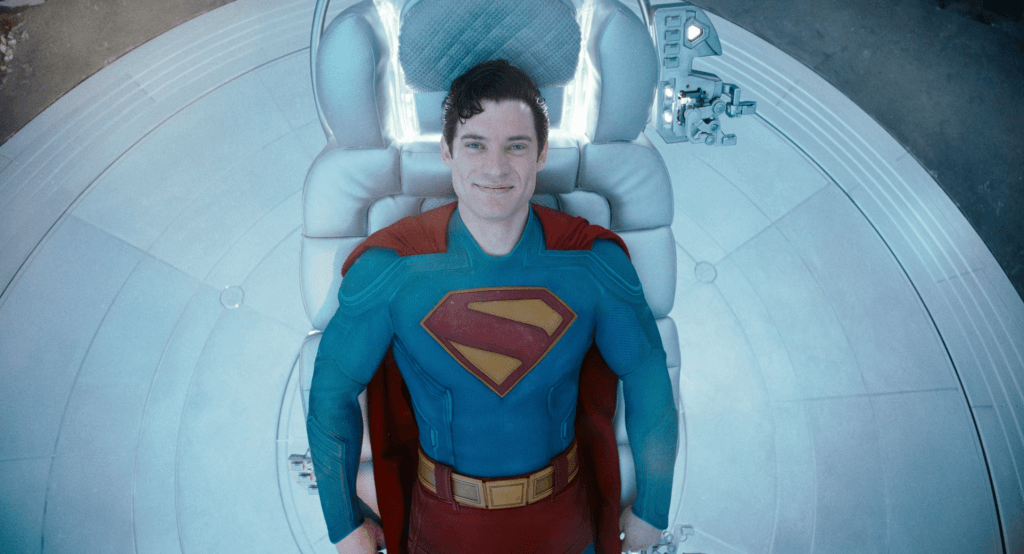
One final aspect of this film that I found notable: Superman is not alone in this tale. Some critics have described this as a flaw of the film, that it was somewhat overstuffed with characters and names and groups and so on. I thought this element was endearing, actually. James Gunn’s Superman is not just about the possibility of a future enabled and inspired by heroism; it strives to showcase different kinds of heroism. Heroism of all kinds from many different people.
No one can stop bullets, fly at supersonic speed, or laser robot cops in half the way Superman can, but everyone has their own gifts, and thus has something to offer. Saving the world from Luthor doesn’t come down to just Clark and his powers, but the combined efforts of so many people, metahuman and not, who have interacted with Clark throughout this movie and his life.
There’s Eve Teschmacher, the air-headed blonde who, out of love, sends the necessary evidence to incarcerate Lex Luthor for his crimes. You can’t forget Lois and the rest of the Daily Planet’s intrepid and lively crew, all without superpowers, truth-seekers all who write and publish the exposé that lands Luther behind bars. There’s also Mr. Terrific and his rational, logical intellect; Krypto the Dog saving Clark from…numerous threats, really; Ma and Pa Kent’s kindness and trust in Clark (this scene makes me cry); and Mali, the falafel cart owner who helped Superman up after his defeat to the Hammer of Boravia. Mali, who begs who Superman not to give up before being executed, whose sacrifice ultimately moves Metamorpho to decide to free Clark from his interdimensional prison, which kickstarts the chain of events that results in Luthor’s imprisonment and the Justice Gang preventing a genocide in Jarhanpur.
Look around: There are opportunities for heroism everywhere.
ACT III: FAITH AND TRUST IN DISPATCH
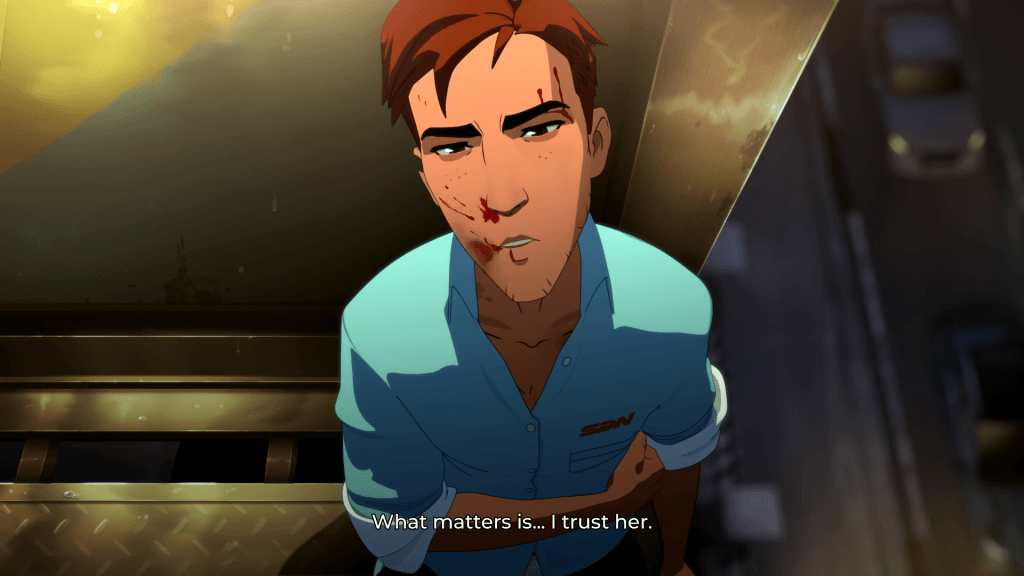
Dispatch, the debut game by AdHoc Studio, has taken the world a bit by storm recently. It’s an episodic choose-your-own-adventure style game that was billed as a “workplace superhero comedy.” It’s quite good: sharply written with a reasonably compelling gameplay loop that elevates it from being just a lightly interactive television show, though it easily could have been just that.
The gist of Dispatch is thus: It’s Hoosiers with a superhero flair. A washed up coach/former superhero —Robert Roberston III, FKA Mecha Man — is tasked with whipping a team of miscreant former villains into a bona fide superhero team that, eventually, will save the world (or, at least, their corner of California). Sprinkle some Brooklyn Nine-Nine vibes on top, and you’ve got the idea.
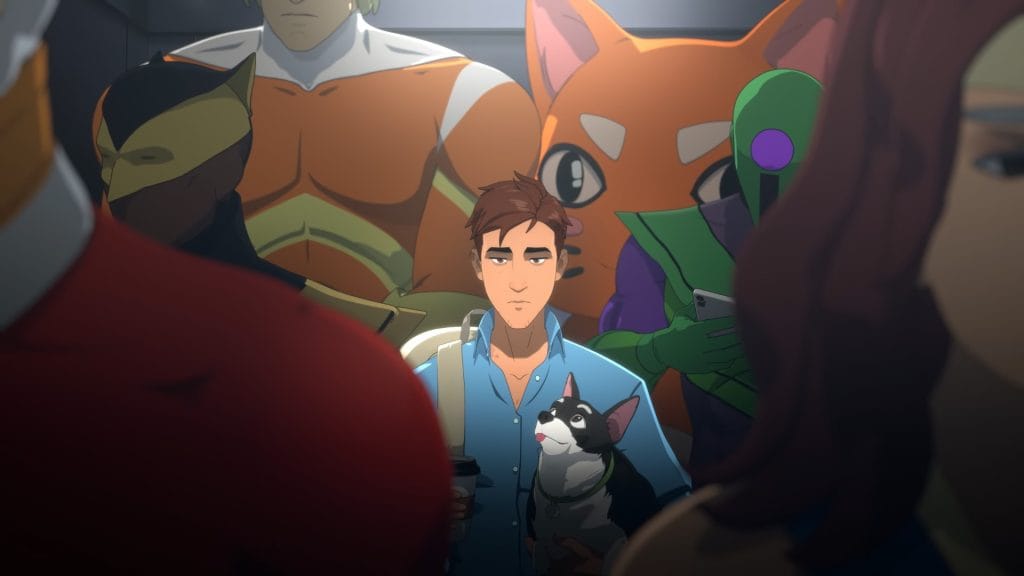
While Dispatch delivers jokes and banter at a rapid pace, it’s not just a comedy. AdHoc Studios is comprised in part by former Telltale Studios talent, and there are drama bona-fides on display here. The decisions you make play a part in the outcome of this story, and there are two major axes that the game revolves around. The first is your choice of romance —Blonde Blazer or Invisigal, which is a compelling choice but not one we’ll examine today (“neither” is also a valid third option. For the record, I’ve been Team Blazer from day 1).
The second and personally more interesting binary outcome revolves around Invisigal’s morality. Can you reform Invisigal, influencing her to turn towards heroism, or do you fail her as a mentor and allow her to fall to villainy?
Invisigal suffers from a belief in, one could call it, superpower determinism — a belief that the nature of one’s powers influences their course in life.
As a choose-your-own-adventure game, the player faces several key decisions that influence Invisigal’s fate. What makes Invisigal a compelling character is that she is an exercise in trust and faith. Invisigal is far from perfect. She makes errors in judgment, she acts rashly and without group approval, she places herself and others at unnecessary risk, and there are severe consequences for the actions she takes.
The point of interest here is that Dispatch is not structured like a decision tree, where Invisigal lives in some scenarios and dies in others. There is no one outcome where Robert can swoop in to save Invisigal; Rather, her fate is tied directly to her character development.
Even when Invisigal screws up, makes mistakes, hurts the people Robert cares about, there is always a choice. Do you believe that she had everyone’s best interests at heart, even if she acted irrationally? Can you choose to forgive her by judging motivations instead of the consequences?
In the end, it’ll always be easier to press a button to forgive someone than to do it in your actual life.
Robert’s primary goal for agreeing to manage his team of barely-reformed fuckups is the promise of being able to become a superhero again. Robert himself is powerless, but operated as a third-generation superhero under the moniker Mecha Man, piloting a giant robot suit passed down to him by his father. He’s forced into an early retirement when the Astral Pulse (a MacGuffin that powers his suit) is taken, ultimately destroying his suit.
[WARNING: Spoilers ahead for the last few episodes of Dispatch. To proceed reading without spoilers, scroll until you see the END OF SPOILERS image.]

It’s revealed during Episode 7 that Invisigal used to work for Shroud, the primary antagonist of Dispatch. She wasn’t just part of Shroud’s crew; she’s the one who actively placed the bomb that destroyed the Mecha Man suit and put Robert into a coma for months. Shroud is also the man that stole the Astral Pulse, and killed Robert’s father, by the way, so there’s a lot of animosity between the two men. On top of that, Invisigal defies Robert’s orders and goes rogue at the end of Episode 6.
The result is that she ends up in a near-death situation, and has to be saved by Robert’s best friend, Chase, a fellow superhero with super speed, but with the downside that activating his powers again might kill him due to his advanced age. He survives, but just barely, falling into a coma where his chances of survival are unclear. The hits just keep coming for Invisigal.
When the truth of Invisigal’s allegiances are revealed to Robert, there is, of course, a three-pronged dialogue choice. Most people opted to forgive Invisigal, which makes sense: Most players are goody-two-shoes when it comes to these kinds of games. The ability to forgive her is boilerplate — I would have been shocked if that wasn’t an option, but it’s the back-and-forth here that really elevated this scene and, frankly, the game, for me:
I love this response from Invisigal because it’s true. Robert has not processed the severity of what was just revealed. Invisigal destroyed the Mecha Man suit — the legacy of three generations of superheroes —severely injured him, putting his life at risk, ruined his future, threatened her fellow former villains’ livelihoods, and endangered the life of his best friend. He has not fully contemplated the weight of her actions and the extent to which her actions have wreaked havoc onto his life.
But what our Robert Robertson III knows is how much Invisigal has tried to become a better person. How much her heart is in the right place, how much she wants to be a superhero:


Forgiveness is difficult. To put your faith and trust in someone who has betrayed you is hard. Not to get too personal, but this was a lesson I had to learn this year too. Historically, I haven’t been someone who forgives. I’ve stopped talking to family for a decade for one reason or another, and 2025 was the year I made overtures to rectify that. Life is too miserable, and short, to hold grudges forever.
(I’m not saying I’m a saint, either — I’ve done things that needed to be forgiven, and I’m grateful that I have been.)
These days more than ever, it’s easier to fall into the trap of negativity, hatred, and judgment. To be scorned, hurt, or betrayed by someone and to say that you’ll never forgive them. It’s even harder to forgive someone when they suffer from setbacks and failures, even when you know someone’s heart is in the right place.
[In our universe] where heroes are the small chaos, where hope is the underdog, where the moral arc of the universe might not bend towards justice… No world is beyond salvation.
What Dispatch exemplifies in the character of Robert Robertson III is that while Robert may not have powers, he does have a superpower: It is his faith, trust, and forgiveness towards the members of the Z-team that uplifts them, makes them believe in themselves, and ultimately reforms from a dysfunctional group of former criminals into a team of true superheroes. It’s a heartfelt theme that elevates Dispatch from just a good story to a great one, and I was happy to have it in this year of turmoil.
ACT IV: ABSOLUTE BATMAN SAYS FUCK NAZIS
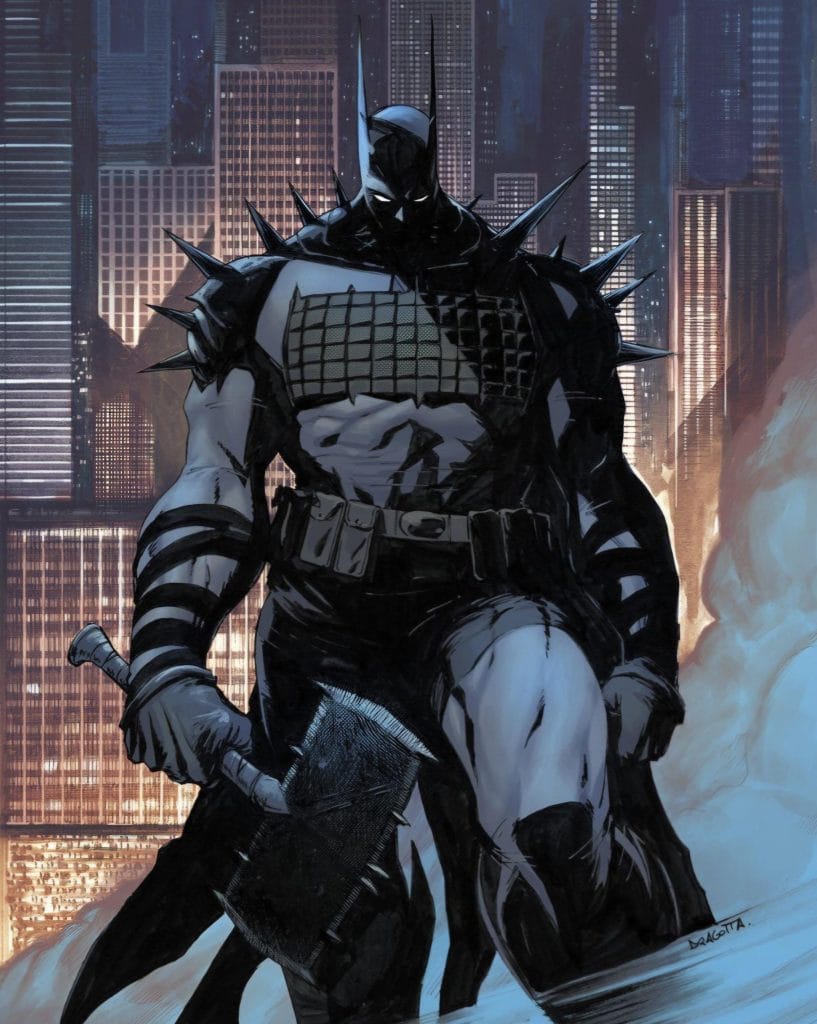
It would be impossible to bring two corners of DC’s Trinity and not mention the last: Batman. Somehow, someway, Batman always muscles his way into every facet of DC Comics, and such is the case here. Literally.
I mean, holy shit, look at that fucking guy.
I could continue the format and wax poetic about Absolute Batman and how this Bruce differs from the others, the nuances and themes there. But the point I want to make here is more self-explanatory, so I’ll let the pages do the talking. Without further ado, some panels from one of my favorite issues of the year, Absolute Batman Annual #1 (October 2025), written and illustrated by Daniel Warren Johnson:
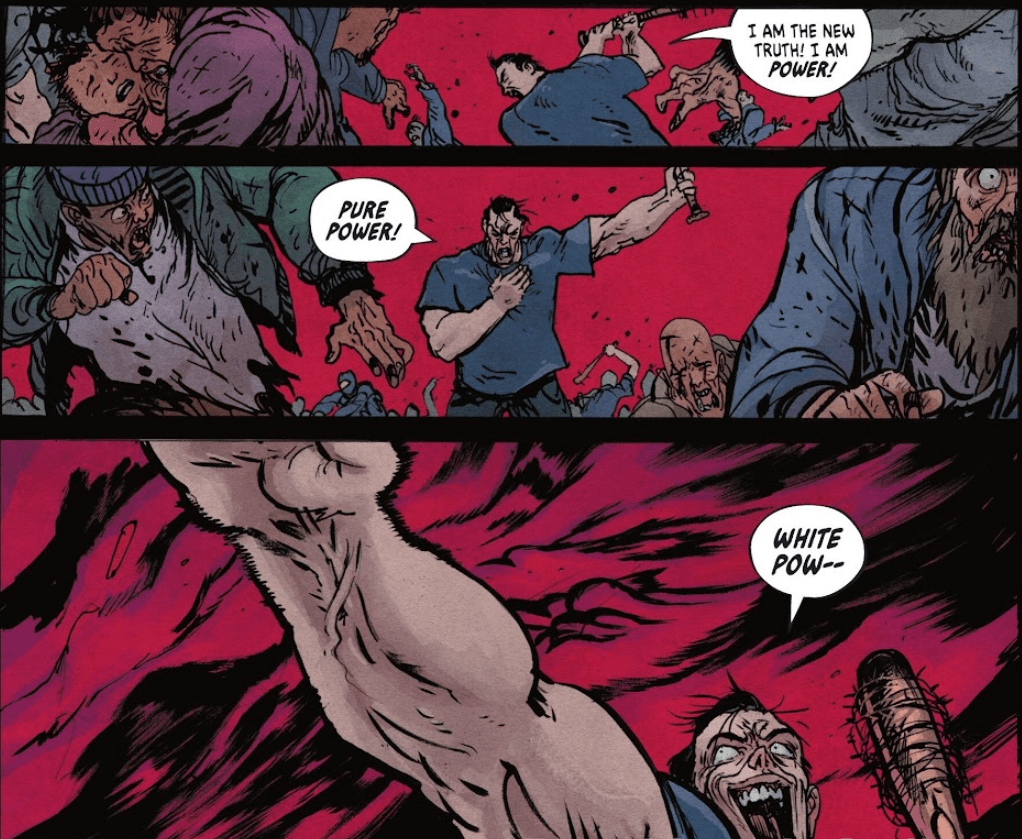

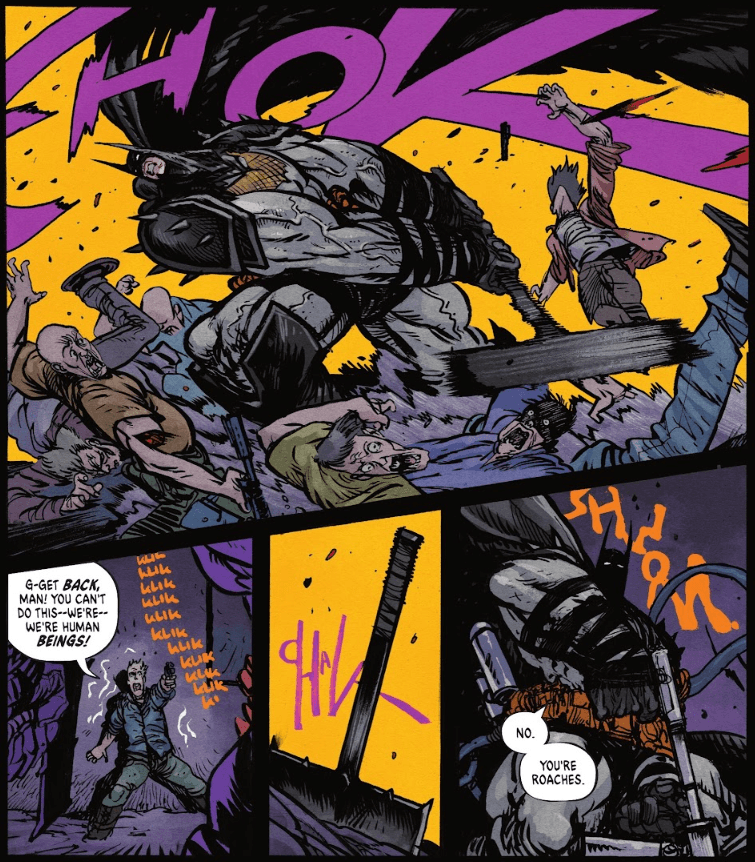
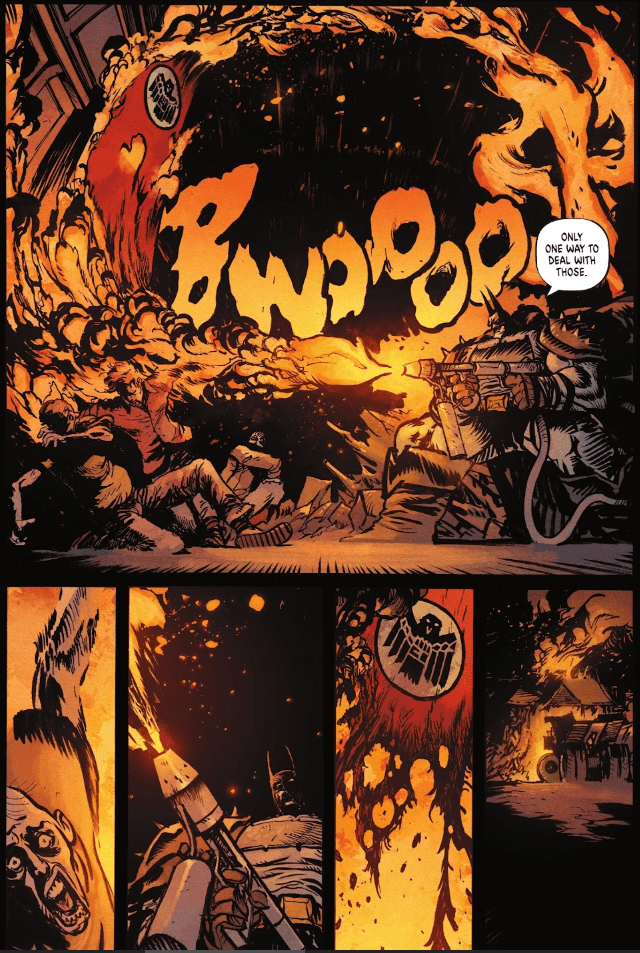
I don’t have much more to say about this.
ACT V: CLOSING THOUGHTS
2025 was a tumultuous year for many, including myself. Even in such times, we can find solace in all sorts of things, and superheroes were that for me this year. This year’s thematic obsession with capeslop brings joy and amusement, but also hope — right when it’s needed most.
Look around: There are opportunities for heroism everywhere.
I hope you took something away from my musings, even if it was just a laugh. Let’s look forward to a brighter 2026!

Huge video game, comic book, and anime fan. Spends way too much time watching things he doesn’t like. Hates Zack Snyder. Mains Falco.