

Warning: Narrative spoilers ahead for most of the Resident Evil entries, including Requiem.
After spending a few very fun hours with its ninth main entry, I took some time to ruminate on Resident Evil’s title. I’ve felt rationally that its Japanese name, Biohazard, was by all accounts a much better name. It was straightforward, described the themes and genre succinctly, and didn’t feel quite as goofy as its Western counterpart.
When asked by GamesRadar, Capcom’s then Senior Director of Communications Chris Kramer said that he found the name Resident Evil, selected because a DOS game also called Biohazard had taken that trademark, to be cheesy. Even series creator Shinji Mikami agrees, saying in an interview with the same site that he finds the name “stupid,” and despite Kramer’s claims otherwise, that he had no say in its choice. When even Capcom staff doesn’t like that title, it would be easy for me to go to bat for Biohazard.
But a part of me still feels attached to Resident Evil. I know it’s goofy, as Kramer himself flatly admits that the title was simply chosen because the game was set in a mansion, a literal evil residence. And I’ve witnessed and told many a joke about it. I can’t even begin to recall how many times I’ve said something like “these residents sure are evil,” when playing these games to score cheap laughs from friends. Yet I still couldn’t shake my attachment.
At first I thought it was just the mere-exposure effect at play, given how long I’d been playing these games. I still remember my high school self, fresh off the first Project X Zone, going to buy Resident Evil: Revelations and throwing in Resident Evil 4 and Resident Evil 5 for good measure. I remember very, very well how even back then, as I played RE4 and immediately knew it was one of my favorite games ever, I also knew just how dumb it was.
And as I neared the final hours of Resident Evil Requiem, when Leon S. Kennedy’s way forward is blocked by a pile of rubble toppled by a mad scientist with a rocket launcher and he decides the best way forward is to drive up the side of a toppled skyscraper and jump with no visibility as to what’s on the other end, I now wondered about its creators: “Do they know how dumb this is?”
And Just How Dumb Can It Get?
If you’ve never played a Resident Evil game, you may not realize how consistently ludicrous it is. This series is home to monsters and villains so over-the-top that you’ll cackle harder at them than you do most outright comedies, on top of some legendarily groan-worthy one-liners. And all of it is delivered with some of the cheesiest voice acting in the business. Play Resident Evil 5 and try not to burst out laughing at everything Wesker says. It is dumb in the most straightforward sense, and applying any logical thought to it leads to the conclusion that the in-universe events could only be the result of people acting without logic.
Sometimes, its illogic lies in the writing and plotting. My favorite example of this is in Requiem, where the villains are presented as fairly serious characters despite how, by all measures, they are hilariously incompetent. All of their assumptions about the main heroine Grace and the mysterious Elpis project are not just wrong but completely off-base. When they fail to make any progress through good old-fashioned genetic engineering, their master plan is to take Grace to a secret lab in a bombed-out Raccoon City to ask her a password she does not know.
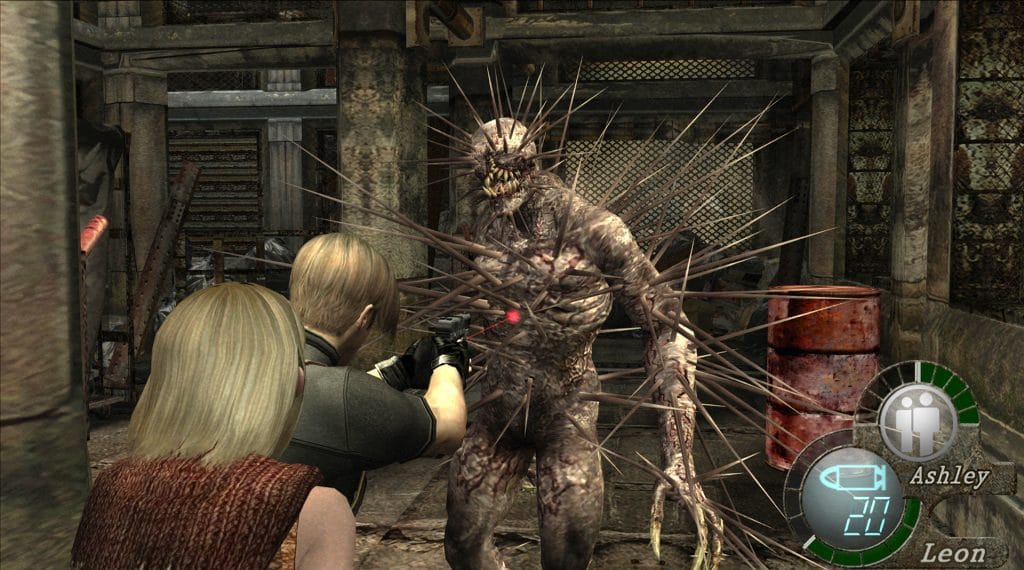
Resident Evil 4 is still the reigning series champion in its sheer volume of nonsense. My first time through, I believed there was no way someone could write all of Leon’s ridiculous quips and devise the bizarre scene where he runs away from a giant statue of the diminutive castellan he’s trading said quips with and not realize how uproariously funny it all was. Some fans apparently thought Leon was so unserious that it must have been the result of a butchered translation, though a comparison by translator Anna Caristiona shows that many of his famous lines are almost exactly the same. I’m happy to say that he remains so unserious in Requiem that he can’t stop joking even as he’s dying from a terminal illness.
Nowadays I can’t help but compare RE4 to the obviously absurd film Lupin the 3rd: The Mystery of Mamo, with both having a focus on biology-based science fiction, international conflict, diminutive gaunt antagonists, and Ada Wong mapping fairly close to the role of Fujiko Mine. But given the franchise it’s a part of, Mamo is clearly trying to be funny. As time went on and I kept seeing Resident Evil go through various tones, from its early entries to its latest, it became much harder to confidently say the same.
Every entry, even the reviled Resident Evil 6, either has moments of audacious spectacle or glorious cheesiness, no matter its prevailing tone. But it isn’t clear how much any of them mean it, and looking deeper into the creators’ perspectives further complicates this matter.

From the Mouth of Mikami
Shinji Mikami openly stated in a 2023 interview with IGN that he thinks the script for the original Resident Evil 4 was a “half-assed scenario that [he] wrote in just two weeks.” This isn’t surprising given that development on RE4 was so turbulent that, as Mikami openly admitted even back in a 2001 IGN interview, it spawned an entirely new series: Devil May Cry.
At face value, this is Mikami copping to writing a bad script. But it isn’t as simple as him phoning it in or just making it bad on purpose. He also expressed delight that RE4’s 2023 remake understood “the backbone of each character.” It’s hard to believe he didn’t care about or put meaningful effort into them if he valued their integrity enough to comment on it.
He also noted in the aforementioned GamesRadar interview that he had genuinely considered making the original Resident Evil an openly comedic game and subsequently chose not to. That it still ended up with such laughable writing and voice acting that Capcom is still making “Jill Sandwich” jokes to this day was just the result of hiring English-speaking actors who lived in Japan, according to former Wesker voice actor Pablo Kuntz.
Then again, current Capcom is clearly aware of the cheesiness of that memetic moment. And considering that, and how their recent titles and slightly more serious remakes still feature moments like Leon backflipping off a wall to avoid chainsaws even though it puts him in more danger than just walking backward, it can’t be said with certainty that they’re not trying to be a bit silly.
Every entry, even the reviled Resident Evil 6, either has moments of audacious spectacle or glorious cheesiness no matter its prevailing tone.
This even extends to some of the series’ marketing. For the remake of Resident Evil 4, Capcom released promotional videos with the game’s characters rendered in the style of World Masterpiece Theater, known for adapting children’s classics like Heidi and Anne of Green Gables. But quirky marketing doesn’t necessarily entail that the product itself is meant to contain that quirk.
All in all, there just isn’t a clear-cut answer. While I’m inclined to believe that the series started out in complete earnest, unintentionally fell into the realm of farce, and then at some ambiguous point embraced that tone intentionally, most of the evidence for that is circumstantial. There is no definitive statement of creative intent that acknowledges whether the consistently madcap tone is deliberate or not.
I say none of this to disparage Resident Evil as a series, since I adore how dumb it is. However, it is also true that something being generally dumb does not require that it is only or always dumb. And oddly enough, it was reflecting on that title that I came upon a realization.

Resident Evil Is High Art, Actually
I am far from the first person to point out that Resident Evil does, in fact, have themes. Others in the wake of Requiem’s release have taken note of it continuing in the capitalism-critiquing tradition of the films of George Romero, himself a fan of the series who directed a Resident Evil 2 commercial and pitched a script for a potential film.
Resident Evil’s criticisms are particularly focused on the abuses of human life by corporations seeking profit and power (or, in the case of RE4 or Village, cults). That much is plain to see, but even beyond the plot, there is another level that brings it from window dressing to a genuinely meaningful part of the experience. And much of it is down to the locations and what they represent in the narrative.
The Umbrella Corporation presents itself as an average pharmaceutical company with good intentions, but is dead-set on the production of bio-organic weapons (BOWs) to profit off of global conflict. The first game happens because Umbrella needs to stress test their biological weaponry against Raccoon City’s elite police squad, S.T.A.R.S. They choose to do this in the Spencer Mansion, a lavish abode hiding a horrific lab beneath its premises.
In Resident Evil 2 and Resident Evil 3, the Raccoon City Police Department is home to good people like the S.T.A.R.S. team and Marvin Branagh. But because Chief Brian Irons is in the pockets of Umbrella, S.T.A.R.S. is unable to get the word out about Umbrella, and the T-virus they were developing contaminates Raccoon City’s water supply, turning so much of its population into monsters that it has to be wiped out in a missile strike. RE4 and Village both center around cults that have taken over remote rural areas, with 4 in particular noting the cult’s close ties with the local aristocracy.
Even in Resident Evil 7, which scales things down to normal guy Ethan Winters versus a small family of mold-infected maniacs, the Baker family themselves are victims of a shadowy organization deeply entrenched with powerful institutions accidentally setting a bioweapon loose on them. It’s a BP spill or a DuPont chemical dumping, only the biohazard is a little girl forced to be a weapon, corrupting a normal family into a literally toxic one.
Descending into Hell
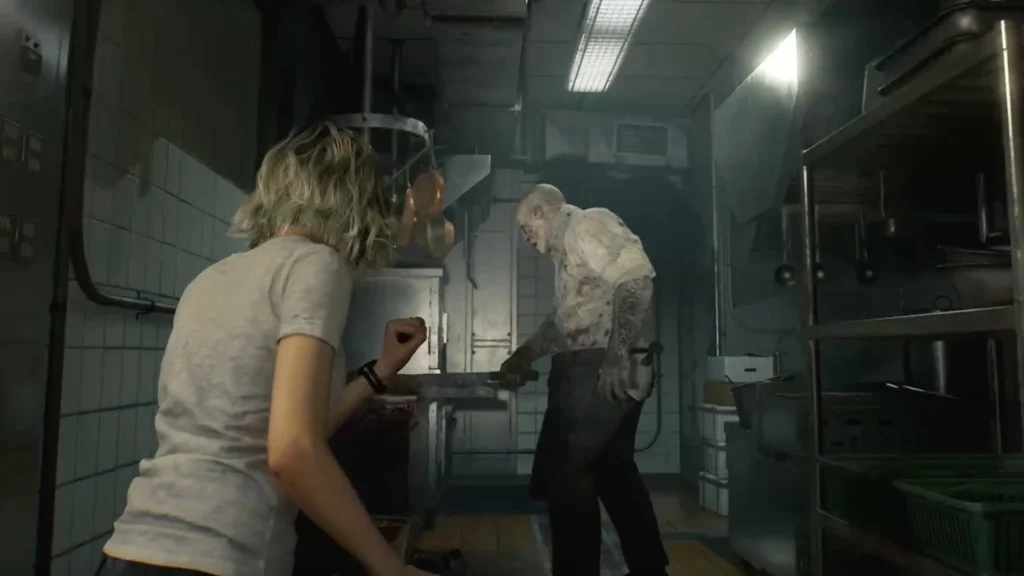
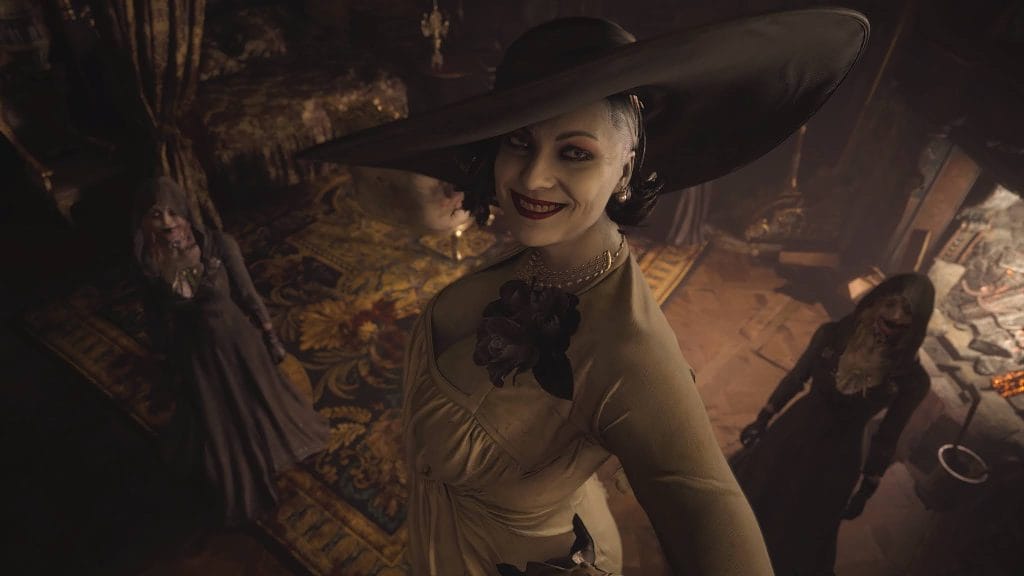
The obvious recurring theme here is that of establishment organizations: capitalist, law enforcement, and religious, hiding their malice beneath a veneer of prestige. Requiem applies this to the medical industry with Rhodes Hill Chronic Care Center, a sanatorium that failed in treating its patients, with its director ultimately using them as undead obstacles for the protagonists.
Whether it’s the Spencer Mansion from the first game or Rhodes Hill from the most recent, the best entries of the series focus on institutions that are malicious to their core, wrapped in artifice and ostentation. And its heroes have to journey into the heart of these locations and root out their evil from within.
Not every entry follows this pattern precisely. The controversial RE5 and RE6 change locations enough that they can’t establish a strong enough environmental narrative. They’re more focused on portraying what global BOW-based warfare is like, but this class-based narrative usually holds for the best entries. Some of them, like RE2 and RE4, even have the player start in the domain of ordinary people, the greatest victims of these evils, before moving into the ornate halls obscuring the evil and diving deep enough to find its core, almost always taking the form of a lab.
In this light, the zombies are not symbols of societal breakdown or decay threatening the status quo. They are, by and large, victims of a figurative rot turned literal emanating from those in power. The pretense of these elites, down to their classy accouterments, circuitous puzzles, and confusing key systems, is superficial, merely present to obscure their corruption.
It may not have been intended as the deepest thing, but that it might’ve been accidental and yet still reads so clearly is impressive in at least some regard. Because rest assured, it may still very well have been pure chance given what we already know about Resident Evil.

It’s Still So Dumb, Though
In some ways, Resident Evil reminds me of The Misfit at Demon King Academy, a light novel series with an anime adaptation, which aired in 2020. When assessed from a distance, it appears to be a completely rote dime-a-dozen power fantasy. But at the time it aired, certain anime enthusiasts, such as Geoff Thew of the YouTube channel Mother’s Basement, began seriously lauding the show, not for being subversive, but instead for playing all its tropes completely and utterly straight, with no winking to the camera or self-aware snark.
Fans weren’t sure if the writer was just trying to make the coolest story ever, or if these bizarre scenarios were jokes. And as Thew notes, the portrayal of certain scenes as explicitly comedic and certain characters as designated comic relief muddies the waters even further.
To me, this is also the core appeal of Resident Evil’s tone. It shifts between ridiculous spectacle and a straightforward, serious tone so much that it’s hard to tell if the ridiculous parts are themselves meant to be taken seriously.

However, it’s arguably even more ambiguous because it’s begun to wink at the camera in the recent titles. Ashley will incredulously comment on Leon jumping on chandeliers in the Resident Evil 4 remake, Grace will remark on the ridiculous placement of keys to important rooms in Requiem, and Resident Evil: Revelations 2 pays winking homage to multiple corny lines from the original game.
If the series really isn’t self-aware, why is it clearly trying to be, and why isn’t that self-awareness applied consistently?
But just as often as the absurdity is commented on, it is even more often played off entirely. No one notes just how impractical Leon’s chainsaw-dodging backflip is in RE4make, and Moira Burton’s dialogue in Revelations 2 is so laden with profanity that it makes her eye-rolling at her dad’s old jokes feel a bit hypocritical.
If the series really isn’t self-aware, why is it clearly trying to be, and why isn’t that self-awareness applied consistently? Honestly, I could not care less as to why. I enjoy being able to read into these games however closely I want to while not needing things to make perfect sense. If it were more clear in its intent, if I knew how it wanted me to feel, that could take some away the magic.
The Evil Lives Here
Granted, even if a concrete answer as to how intentional this all is emerged, it overall wouldn’t change the fact that it’s not clear in the moment-to-moment experience. And because of that ambiguity, anything resembling an actual concrete writing flaw can be turned into a meta-ironic joke with the right mindset.
This is why I don’t care that the evil plan in Requiem is dumb. If this series is so farcical even at the best of times, why should I be required to take any part of it seriously? As writer Joshua Rivera has said, Resident Evil has always been kind of hilarious, so why get mad if it still indulges in that camp and excess now and again? It can offer both the best of survival horror and goofy action movie nonsense, and they can coexist wonderfully.
And so we come back to the title: Resident Evil. On the one hand, yes, it is describing that the evil, in this case zombies, are contained within a residence, and by RE2 that doesn’t even seem to apply anymore. But on the other hand, it is directly and eloquently describing the character of its many horrific settings. These are not places turned bad or ruined by a zombie outbreak; they contain, as Merriam Webster would put it, a resident evil. An inherent evil.
This I can say is probably unintentional. By all accounts, the title was chosen simply for being on the nose. Even the man who created the series thinks it’s stupid. But to me, it being stupid, yet still containing meaning all the same, sums up the series better than anything else.

Sean Cabot is a graduate of Framingham State University, where he also wrote articles for the student paper before writing for RPGFan. In addition to gradually whittling down his massive backlog, he enjoys reading comics, playing Magic the Gathering, watching as many movies as possible, and adding to his backlog faster than he can shrink it.