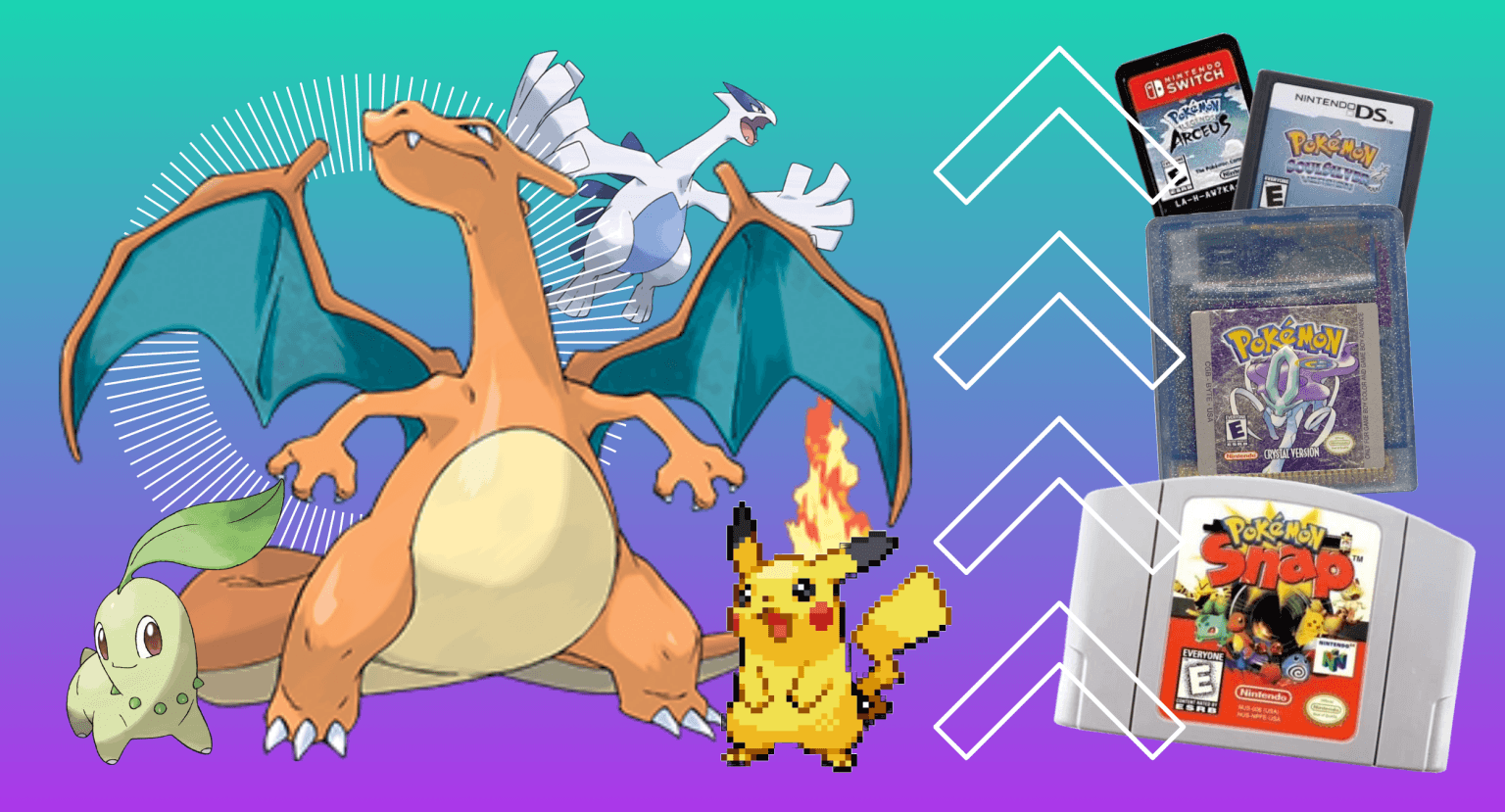

2026 is a year of big video game anniversaries, and I’m sure for many folks across the globe, the biggest by far is the 30th anniversary of the release of the original Pokémon games in Japan. Pokémon hasn’t just dominated the gaming world for the past three decades; It’s become one of the biggest media franchises in the world, with continued successes in television, film, collectible card games, and merchandise.
Beyond the ubiquity of Pokémon as an intellectual property, the franchise’s core video games — and even some of its noteworthy spin-offs — have been essential to the culture of the medium, as well as the proliferation of myriad game genres and mechanics. Speaking from personal experience, Pokémon Red was the first game I played that had turn-based RPG mechanics. Pokémon Snap introduced me to the concept of taking photos within a game decades before “photo mode” became a standard feature for many AAA games. Heck, I had never even heard of mystery dungeon-style games until Pokemon Mystery Dungeon.
Honestly, I’m not sure I have to say much at all to convince anyone of the importance of Pokémon in the broader entertainment landscape. All I’ll add is that I don’t think I personally know anyone who regularly plays video games who’s never been sucked into a Pokémon title. Our list of the best games in the series absolutely reflects that, especially how different games from different eras keep doing the same thing: bringing us in.
– Written by Sam Martinelli
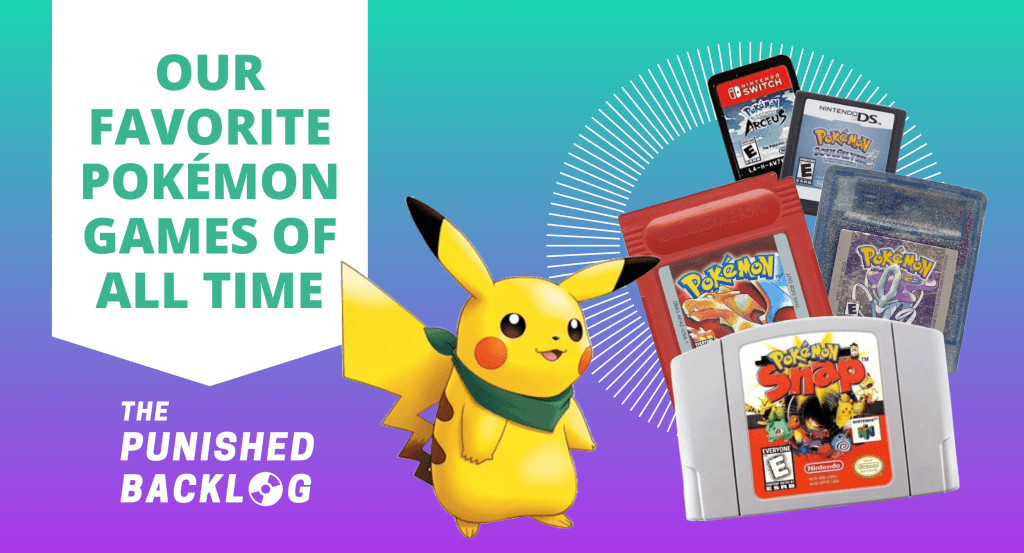
Our 12 Top Pokémon Games of All Time
Here are our favorite Pokémon video games across all platforms, listed in release order.
Want to jump to a specific entry? Use our table of contents:
- Pokémon Red Version (1996: Japan, 1998: North America)
- Pokémon Yellow (1998: Japan, 1999: North America)
- Pokémon Snap (1999)
- Pokémon Gold (1999: Japan, 2000: North America)
- Pokémon Crystal Version (2000: Japan, 2001: North America)
- Pokémon Sapphire (2002: Japan, 2003: North America)
- Pokémon Colosseum (2003: Japan, 2004: North America)
- Pokémon Mystery Dungeon: Explorers of Sky (2009)
- Pokémon SoulSilver (2009: Japan, 2010: North America)
- Pokémon Black (2010: Japan, 2011: North America)
- Pokémon GO (2016)
- Pokémon Legends: Arceus (2022)
- Honorable Mentions

Pokémon Red Version
In a sense, Pokémon got it right the first time.
To be clear, I’m not suggesting that the first generation of Pokémon games is inherently better than any subsequent generation. In many ways, they’re the least polished experiences, with a confusing item management system, an unbalanced combat meta, and a simplistic type-strength-weakness arrangement. In terms of quality-of-life features, scale, and monster art (as much as I love chonky Pikachu…yikes), the very first games in the long-running franchise hold up fairly poorly, and I wouldn’t recommend them to folks who have never played them before.
HOWEVER, if you played Pokémon Red when it first came out — especially if you got it with an Atomic Purple Game Boy Color on a flight to Fort Lauderdale to visit your grandparents as an early birthday present, as I did in January of 1999 — you never forgot how special it was, and never will. The wealth of possibility emanating from the tall grass outside of Pallet Town felt enormous. The excitement I had seeing my beloved Charmander evolve into Charmeleon has rarely been matched in gaming since. Locations that are tiny by comparison to modern-day games felt vast and full of possibility, as I never knew what kind of little creature I’d run into next. I remember exactly where I was when I beat the Elite Four for the first time, when I caught Mewtwo, and when I learned about (and thoroughly exploited) the MissingNo. glitch.
Later Pokémon games would clean up the messes of Gen 1, and even remakes like FireRed/LeafGreen and Let’s Go Pikachu/Eevee would refine the mechanics of the originals for something that better resembles a cohesive video game. But no other generation of Pokémon will be quite as Earth-shattering as that first one. The original 151 monsters remain the most iconic of them all, and Pokémon Red remains the most important game in the series, at least to me.
Also: Charizard is on the cover, and he’s still the coolest damn pocket monster there ever was. Don’t @ me.
– Written by Sam Martinelli

Pokémon Yellow Version
The first Pokémon game with full color combined the best of Blue and Red, releasing as an enhanced version of its predecessors. And of course, you got Ash Ketchum’s original starter: Pikachu. Very much based off of the anime, the game featured redesigned sprites to emulate the TV show (Team Rocket trio, Nurse Joy, and Officer Jenny), which had become extremely popular following the original games’ release.
Just like the TV series, your Pikachu in Yellow followed you around and prompted you to build a friendship, first game in the series with this mechanic. Unique to this game as well was the sound Pikachu made, using its iconic call from the series rather than the digital beeps from Red and Blue.
Although the title did not contain all 151 original Pokémon, it is the definitive way to experience the Kanto region. While this is the first and only Pokémon game I owned, it brought me dozens of hours of joy as I attempted to relive moments from the show. Just like Sam, I had the Atomic Purple Game Boy Color, and if it was in my hands, you better believe I was playing Pokémon Yellow on it. I even had the original guide (which got beaten up to shreds because of how much I used it) and my older brother to guide me through this first pocket monster experience and, I wouldn’t trade those memories for the world.
Lastly, Surfing Pikachu was available if (and only if) you traded under special conditions that allowed you to reach the unique “Pikachu’s Beach.” Too bad I never got to see it…
– Written by Vaughn Hunt
Pokémon Snap
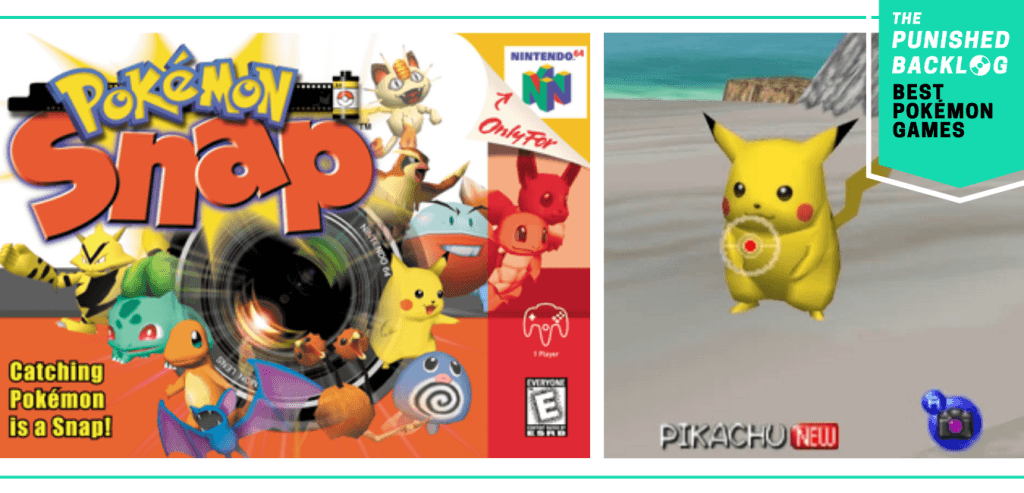
“Welcome Back!” I can still hear the mechanical yet cheery lilt in Professor Oak’s voice as he ushered me into his futuristic laboratory with staring, dead eyes and a mouth that lurched open and closed in a single frame. Pokémon Snap was a weird game when it came out in 1999, and it’s still weird today. In a franchise that has changed remarkably little over its long run, the game’s photography focus was a massive departure from the usual Pokémon modus operandi of battling adorable, elemental animals.
Pokémon Snap was born during an era when Nintendo was still experimenting with its megahit franchise featuring fighting pocket monsters. Interestingly enough, the game debuted as Jack and the Beanstalk at 1997’s spring Tokyo Game Show. When Nintendo struggled to market their fairytale photography game, they whipped out a bit of good-old corporate synergy to create the Frankenstein monster that is Pokémon Snap.
When a level begins, the player plops down in a scenic locale on a cart rolling down a railroad track. The player glides along, camera in hand, as Pokémon dash across the screen from all sides. As our intrepid photographer racks up points by snapping pics of unique Pokémon, they unlock new tools like apples or a flute to manipulate Pokémon into posing in interesting places or fighting each other in front of the camera. When the player reaches the end of the track, they teleport to Professor Oak’s Lab, where he rates the quality of the past run’s photos and bestows additional new items and locations.
The game’s vibe lands somewhere between cozy and creepy. For the most part, it’s a laid-back, pleasant experience. However, I could never shake the feeling that there was something unnerving about it all. In the first level, a Meowth is assaulted by a group of Pidgey unless the player interferes. Later, three Koffing chase down Jigglypuff in the background of an otherwise serene cave. Though bright and colorful, the world never felt entirely friendly.
Despite being a quick game to play through, there’s more challenge and more mystery than would be expected from this weird little spinoff from 1999. The unique gameplay experience along with the feeling that I might have missed one last secret behind one last bush kept me thinking about the game all these years later.
– Written by Matt Plaus

Pokémon Gold Version
Pokémon Gold is the blueprint.
Okay, technically it is not the blueprint—that belongs to the real classics in Gen 1. However, Pokémon Gold was my blueprint: the first video game I ever played at just six years old. I vividly remember unwrapping the game on Christmas morning, and then shrieking and rolling around on the floor, not just because I was a fan of Pokémon at that point, but because I had watched my brother play Pokémon Blue on his Game Boy for hours, whining for my turn.
Finally, with Pokémon Gold, my turn had arrived.
I have so many memories of playing this game, from making myself carsick while playing on a 12-hour drive up the coast to see my grandparents to battling my brother’s Pokémon using the Game Boy link cable. Even nostalgia aside, Pokémon Gold took the original game’s blueprint and perfected it, adding excellent new features that deepened a player’s immersion into the Pokeworld.
The art was better, with new colors breathing life into the Johto and Kanto regions. The dark and steel-type Pokémon became some of my favorites. Where would I be without Umbreon (my favorite Eevee evolution to this day) and loyal Houndoom? Plus, there was just more stuff— more gyms, more pokeballs, more pokemon, more items! You could even breed your own Pokémon—a six-year-old’s first taste at playing God.
My favorite feature at the time was the game’s internal clock that influenced specific events and brought the world of Pokémon closer than ever. This feature was both a boon and a bane as a kid. I remember sneaking onto my Gameboy Color at night to find specific Pokémon and getting busted by my mom for staying up past my bedtime, or rushing to get back to a medical center before nightfall to avoid certain obstacles while my poor team’s health was low.
To this day, Pokémon Gold is the one Pokémon game that I played the longest, to near-completion. It is the only version where I started multiple saved versions with each starter, though Cyndaquil remains my favorite. Maybe my devotion to Pokémon Gold has to do with being a kid with very few responsibilities. Or the fact that I had a limited selection of games to play. Or because it finally put me on the same level as my brother. But maybe Pokémon Gold was just that good— the first game that taught me how fun playing games could be.
– Written by Lauryl Fischer
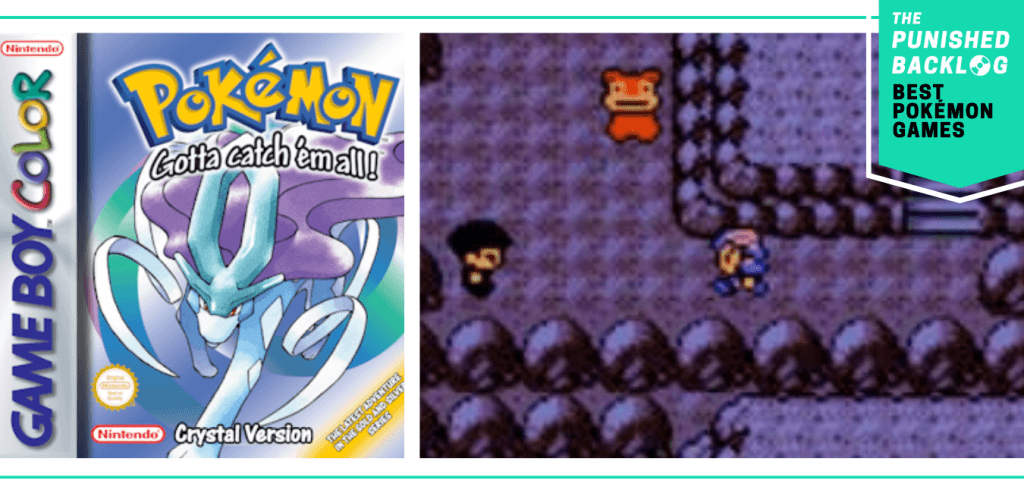
Pokémon Crystal Version
In the late ‘90s, I prepared a short book report-like presentation to convince my parents to let me not only buy Pokémon cards, but try one of the video games on my brand new Game Boy Color. They were highly skeptical of the “weird animals fight each other” franchise taking the world by storm. Eventually, they agreed to Blue and later Yellow and Silver. I enjoyed them all greatly, but it wasn’t until 2000 and the release of Pokémon Crystal that I truly became obsessed.
Crystal changed everything by allowing players, for the first time, to pick a female avatar. Suddenly, I could really see myself exploring the Johto region. That girl (“Kris”), with her bright blue zigzag pigtails, was me. Growing up, I was an absolute tomboy and a secret nerd. I was always the odd girl out on the sports team or the honors science class. With the release of Crystal, Game Freak was saying, “Hey, we see you. You belong here, too.”
It felt like the gender-inclusivity extended to the actual Pokémon, too. Crystal’s featured legendary was Suicune, one of three epic cat-dog creatures that could be awakened. Unlike Gold and Silver’s legendaries, Suicune could be stumbled upon in a field pretty early in the game, inviting an immediate sense of wonder. Suicune’s blue and purple tendrils gave it a distinctly feminine look. Additionally, one of the three starters, Chikorita, has a very Latin-coded female name, including its coquettish grin and necklace-like studs.
Furthermore, Pokémon Crystal cemented the second generation’s excellent standards. The game maxed out the Game Boy Color’s color palette. It continued to play with the real-time internal clock introduced in Gold/Silver which enabled more events and unique catches, including with the mysterious Unowns. Notably, Crystal introduced the Battle Tower which created a challenge that lasted long after the Elite Four — it’s become a feature of almost all mainline games after. Unique to the generation, Crystal’s sprites were animated upon entering into battle, adding a lively sense of zest to gameplay.
Pokémon Crystal changed my life personally as a gamer, and it also introduced new features that continued to influence the franchise for decades. Plus, that semi-translucent sparkly blue cartridge looked so freaking cool!
– Written by Amanda Tien
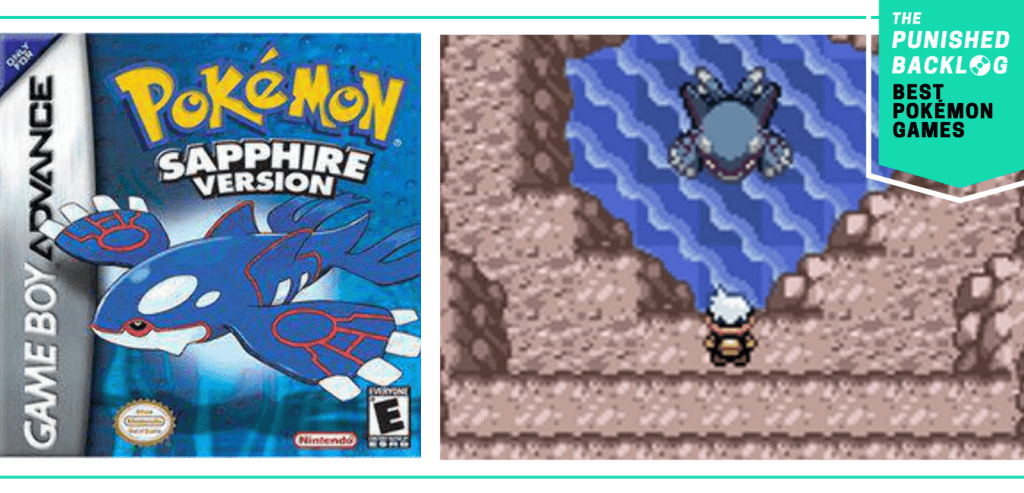
Pokémon Sapphire Version
The third generation of Pokémon games demonstrated such a leap forward that it still, to this day, impresses me. As I’ve shared earlier in this piece, Crystal was my favorite, but it was Sapphire that made me believe the franchise could keep truly evolving. (Unfortunately, the following generations might beg to differ. The selection of games here in this list is telling not just of our collective age as writers, but also of a floundering within the formula.)
I previously wrote about Pokémon Sapphire in our “Most Hyped Games List,” talking about how I spent the summer before its release printing out reams of Japanese forum preview screenshots. It lived up to its hype, and then some. There is so much to love about this generation: double battles, planting cool berries, competing in “coolest Pokémon” contests, secret bases, WEATHER!!!, different evil agendas by which version you get (Team Aqua trying to take over the whole ocean?! Big goals), the legendary puzzles, running shoes (thank you).
I was particularly mesmerized by Sapphire’s legendary monster Kyogre, a massive, ruby-veined sea beast that seemed to represent all of the mystique and possibility of the unknown. Even on that tiny screen (that at the time felt massive), I could tell that Kyogre was both graceful and strong. Its Bulbapedia entry reads, “Kyogre is believed to be the personification of the sea itself, and is described in legends and myths as the ‘maker of oceans’ who created the world’s oceans and expanded them by generating heavy tidal waves.”
I grew up on-the-move, but my grandparents lived by the ocean. Even as my daily life made do with deserts and mountains, I could always count on Kyogre to make waves that would carry me home.
Shout-out to Clint who wanted to write about Pokémon Emerald but who, alas, got the flu and couldn’t write about it. This one’s for you, buddy.
– Written by Amanda Tien

Pokémon Colosseum
My Pokémon fandom is a complicated one. Growing up, I never gravitated to collecting cards and catching Saturday-morning TV runs quite like I did for other properties (cough, Yu-Gi-Oh!, cough). In terms of pocket monsters, I always thought Digimon was cooler — that 2000 movie remains a certified banger — which meant that my time with Pokémon was largely relegated to Halloween costumes, Pikachu plushies, and, of course, the video games.
To be clear, I don’t mean that as an afterthought. When I first was introduced to video games (by my cousin, much to my parents’ chagrin), it was with a Gen 1 cartridge on a Game Boy Color. I never looked back. Pokémon Red, Pokémon Silver, Pokémon Sapphire… the early games captured my imagination with their snappy battles, deceptively large worlds, and captivating soundtracks.
Yet, decades later and with scores of gym badges to my name, there remains just one Pokémon game that ever rivaled the coolness of Yu-Gi-Oh! or Digimon — and that’s Pokémon Colosseum for the GameCube. Explosive 3D battles: check! Entei, Raikou, and Suicune: check! A dude named Wes with shades who rides a massive motorcycle around a Mad Max-ian desert: check times infinity.
Beyond that “X” factor, much of Colosseum’s appeal can be chalked up to a phenomenon that feels frustratingly foreign today: Its publishers (Nintendo and The Pokémon Company) were simply willing to take a risk. They funded a development team, Genius Sonority, from scratch to work on it. They approved the first 3D Pokémon adventure not set in a stadium or involving a camera. And, most importantly, they weren’t afraid to deviate from the now-tired mantra, “Gotta catch ‘em all!”
Was it everyone’s cup of tea? To the contrary: For many, Colosseum strayed too far from the fundamentals of the franchise, from the dreary setting to the ditching of wild Pokémon. For me, though, that’s what made it excel. Never before had I played a Pokémon game so firmly dedicated to its atmosphere, worldbuilding, and style. Years later, I still wonder why Nintendo never managed to revisit it.
– Written by David Silbert
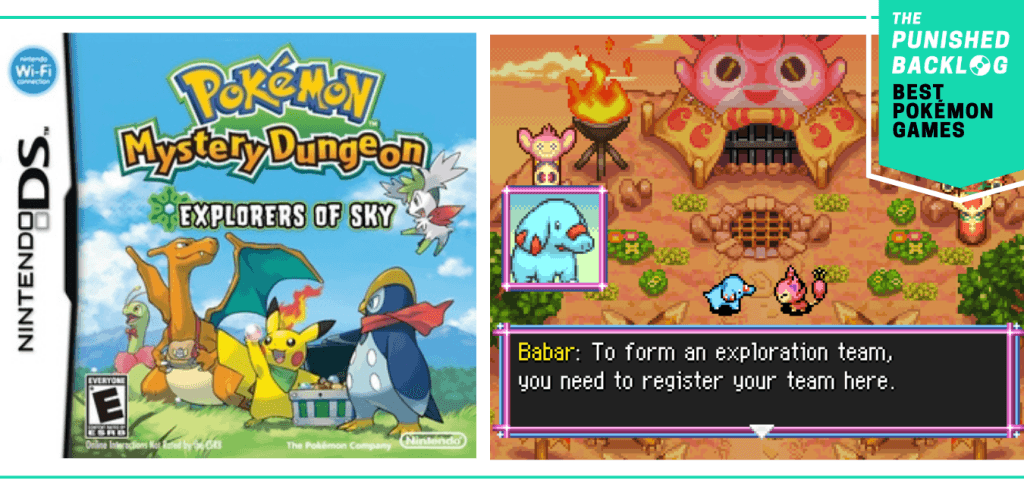
Pokémon Mystery Dungeon: Explorers of Sky
Picture this: You’re a kid, probably about 10 years old, with your Nintendo DS in the back of a car on a road trip. Your parents acquiesced to about a dozen requests for a new Pokémon game. You’ve just loaded it up, and started a new game. Your family’s gossiping back and forth fades from your mind as a simple background of pulsing waves begins filling your eyes. You’re entranced as the game asks you quick morality questions, testing you. Then, it asks you to put your finger on a ribbon, and boom… You’re now a Pokémon.
Pokémon Mystery Dungeon: Explorers of Sky is a spinoff in the franchise, as you play a human transformed into a Pokémon. You join a real Pokémon in a rescue team, exploring dungeons, fighting enemies, making friends, and gathering resources as you learn more about who you are, why you’re there, and what your new purpose could be.
Perhaps it was just because it was my introduction to tile-based RPGs, but the Pokémon Mystery Dungeon series seems tailor-made to my loves. It has the straightforward yet satisfying nature of Pokémon battling, but adds spatial qualities and super basic tactics to shake up the formula. Combat favors you, as you go first when making attacks, but a series of traps, piles upon piles of enemies, and the slightly random behavior of your allies (which you still have some control over) make every level a battle of attrition between you and your resources, making you take calculated risks fairly often.
While I do adore the combat of this side-franchise, I really enjoy the story of this game. You spend a lot of time with your allies at Wigglytuff’s Guild. You see side stories with them as the main character (many of which are incredibly difficult tests of your skill) and get to know them as more than NPCs that you say hi to on the way to your next story beat. The game itself covers a ton of ground – existentialism, finding your purpose, ambition, curiosity, mystery, betrayal – but takes its time to build to big plot points with the help of the dungeons themselves.
I truly believe this is one of the best spinoff franchises in the Pokémon family, with Explorers of Sky refining the gameplay and story to a nearly perfect degree.
– Written by Jason Toro-McCue

Pokémon SoulSilver
Look, I’m just gonna come out and say this: I’m cheating here. Pokémon Silver Version is my favorite game in the series, and it’s 100% nostalgia bait because it was the first game I truly felt like I was playing on my own (Blue Version was my OG, but at three years old I was a hair too young to fully grasp the gameplay at the time). We’re not here to talk about why I love the original Silver Version, though, because years later, SoulSilver was released as an absolute slam dunk remake, allowing me to play the game I loved so much with an older lens of appreciation.
SoulSilver doesn’t reinvent the wheel; It simply brings you back to what you remember playing as a kid, and more. Seeing Johto realized in full color is a huge gift on its own. I always appreciated the design of this region — something about it feels older, more mythical than the other regions. The overall regional design and the music that came along with it form a perfect immersive map to explore, and Soul Silver remembers that. Where the game takes a turn is that, for the first time since Yellow, we can not only have a Pokémon following us on the map, but we can pick which one it is too. The small changes like this breathed a whole new life into a game I already adore, and it makes the journey feel brand new all over again.
And of course, everything you love is still there. The Johto legendaries are as tedious to track as ever (except Suicune… good quality-of-life updates including the Crystal features!), the (spoiler alert) reveal that you can play through the Kanto gyms hits just as good as it did in 2000, and yes, Trainer Red is as hard to beat as ever. SoulSilver (and by extension, HeartGold) realizes something important about Pokémon as a whole: just because something is already perfect doesn’t mean it can’t be improved, but it can still aim to be the very best, like no game ever was.
– Written by Mark Bowers

Pokémon Black Version
By the time Pokémon Black released in the United States in March of 2011, there had been ten previous releases in the series. Including remakes but not including spinoffs, that meant players had ten other games that they may or may not have played. Faced with the challenge of what to do for the eleventh release in a long-running series that had already passed its first peak, developer GameFreak decided to say the boldest thing a developer can say: Burn it to the ground.
Gone were your longtime favorite Pokémon, replaced with 156 brand new creatures to discover. While the battle system remained the same, new mechanics like Hidden Abilities, seasonal forms, and triple battles flooded the world. Even the graphics were massively overhauled from the previous Diamond and Pearl releases, with fully animated sprites and towering architecture in Castelia City. Pokémon Black looked like a step forward for the franchise, while also freeing itself from the past.
Pokémon Black was a welcome reinvigoration of a beloved franchise. With an engaging story, familiar but new gameplay, and a world that felt alive, it was the most fun I had withPokémon since Crystal. Add on the PokéWalker, the rare gimmick that is genuinely fun and set the stage for something like Pokémon Go, and suddenly everyone around me was playing Pokémon again. I remember setting up a stage for a charity concert in my high school’s cafeteria, and needing help to hang some lights. I called over to my friends who were supposed to be assisting me, only to receive dead silence from the other side of the room. Because they were all nose deep in their DSes, and idly shaking PokeWalker’s with their feet.
The magic was back in full.
– Written by Gary Wilson
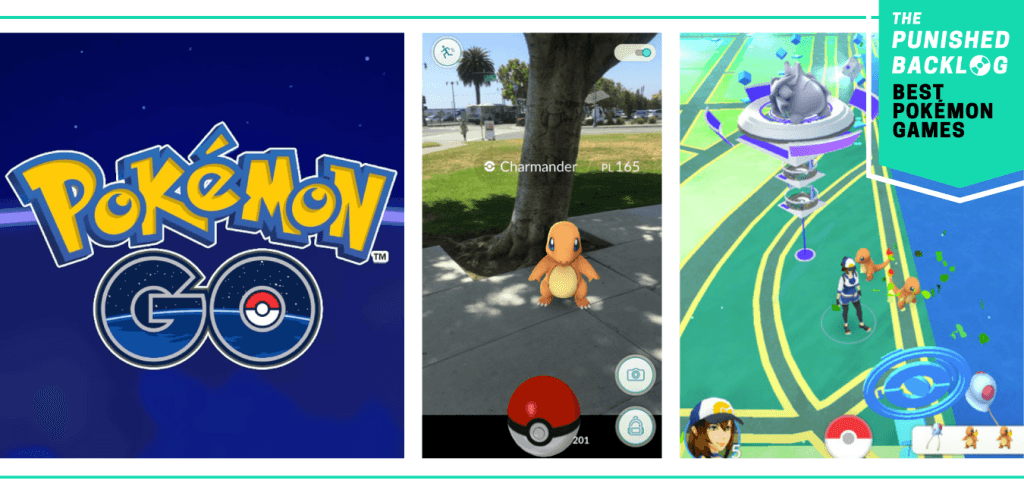
Pokémon GO
If you had a smartphone in the summer of 2016, you were likely part of a truly electric few months of Pokémon GO sweeping cities across the world. A boring trip to the supermarket meant a chance to also pick up a Froakie. Walking the dog yielded opportunities to use your powered up Arcanine to fight in a gym battle down the block. Daily commutes suddenly became opportunities of play and delight, quickly spinning photos of local features and tapping fervently in the hopes to catch another Eevee. Lifelong nerds like myself were overjoyed, but even normies were discovering the fun of turning a regular walk into an adventure.
Since its initial viral release, Pokémon GO has maintained a smaller but steady player base of about 5.7 million people on a daily basis. It’s certainly not a perfect game by any means, but it’s fun and straightforward. Because it’s on a smart phone — far more ubiquitous than a console — and has relatively simple gameplay, Pokémon GO has become a beginner-friendly entrypoint to the beloved franchise. I’ve met (at a respectful and socially appropriate distance lol) a few kids whose first foray into Pokémon was through their parent’s phone for a few precious moments of trying to catch a brightly colored animal. Their parents told me how the game has made them more socially confident, more curious about the world, more willing to go for walks. I have many fond memories of bonding with people over this simple but sweet game.
I once sprinted out of a bar in New Orleans with a few strangers as we tacked down a rare Charmander together, and we high-fived when we all caught it. There was another time I left my beloved Swampert at a gym at a whiskey distillery in Scotland, not noticing that it was so remote that probably very few people were coming to play Pokémon GO; I bonded with my best friend’s younger sister, lamenting over Pokémon that had gotten waylaid (it took several months, but my Swampert got home safe and sound!). When we moved to Kansas City for a year of work, not knowing anyone, my husband and I took nightly walks through our neighborhood together with our phones out, and it became a quiet way for us to bond.
Furthermore, Pokémon GO is unique in the franchise in that it rewards movement and exploration in the real-life world (though sometimes with disastrous results). While I’m not currently playing, Pokémon Go has been an on-and-off presence in my life for the past decade. It made a dream come true for me, and thousands of other people who grew up wishing Pokémon were real, to use the AR feature to picture a Pikachu right in their own home.
– Written by Amanda Tien

Pokémon Legends: Arceus
After the first two generations of Pokémon games, my relationship with the series has waxed and waned. I rarely purchase games in two mainline generations in a row, and there are probably more mainline titles I haven’t played than ones I have. A big part of this is series fatigue — even with new mechanics and bigger worlds, the core of every game is still pretty much the same. But it also felt like Pokémon could be more than just trying to The Best, Like No One Ever Was.
Enter Pokémon Legends: Arceus in 2022, also known as “almost exactly what I’d wanted from Pokémon for decades.”
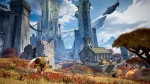
Unlike standard Pokémon adventures, Arceus tasks the player not with besting gym leaders but with building out the Pokédex of the Sinnoh region from Pokémon Diamond/Pearl through catching as many little (or big) monsters as you can. Unlike previous games in the franchise, Arceus lets the player catch Pokémon without entering a battle state; You can simply sneak around in the grass and throw a Pokéball at them in real time. You’re also encouraged to catch as many Pokémon as possible, even ones you’ve already caught, as filling out the Pokédex involves catching monsters in different settings and circumstances.
While not a standard open-world game, Arceus felt more free than any Pokemon title before it. The lack of big cities or towns made every region feel more wild and unpredictable, and the fact that little critters could straight-up attack you (not just challenge you to a standard battle) added another layer of thrill.
Moreover, I just loved the idea of exploring the world of Pokémon from the perspective of a researcher rather than a trainer. Instead of using these little monsters just as a means to an end, you get learn more about them and the lands they inhabit. That feeling alone makes Arceus a special gaming experience, even if a lot of the game was fairly clunky and suffers from late-game grind.
– Written by Sam Martinelli
Honorable Mentions
- “The online multiplayer of Pokémon Sword and Shield that allowed me to explore with my friend in real-time together and catch ‘mons was a childhood dream come true.” – Amanda
- “TCG Pocket makes me inexplicably angry. 8/10″ – Gary
- “The Alola variations in Sun and Moon were cool, I guess.” – Amanda
- “Detective Pikachu doesn’t live up to its promise, but I do love seeing PIkachu in a little Sherlock Holmes hat.” – Amanda
- “New Pokémon Snap was one of my top five games of 2021!” – Amanda
- “PokéRogue is an incredibly addicting fan-made roguelike.” – Gary
- “Is it bad form to say PalWorld?” – Kei
What’s Your Favorite Pokémon Game of All Time?
Do you agree with our list? What did we miss? Share in the comments! You can also check out other Punished Favorites lists like the best Nintendo Switch games, the best Nintendo DS games, and the best SNES games.
Plus, check out our podcast episode about Pokémon!

A video game outlet that blends quality words with inclusive voices. For business inquiries and review requests, reach us at press [at] punishedbacklog [dot] com.





Amanda Tien (she/her or they) loves video games where she can pet dogs, solve mysteries, punch bad guys, play as a cool lady, and/or have a good cry. She started writing with The Punished Backlog in 2020 and became an Editor in 2022. Amanda also does a lot of the site's graphic designs and podcast editing. Amanda's work has been published in Unwinnable Monthly, Poets.org, Salt Hill Journal, Aster(ix) Journal, and more. She holds an MFA in Fiction from the University of Pittsburgh. Learn more about her writing, visual art, graphic design, and marketing work at www.amandatien.com.



David is the founder of The Punished Backlog. He has a problem finishing games he starts.
Just beat: Hollow Knight: Silksong.
Working on: Yakuza 0, Iconoclasts, Metroid Prime 4: Beyond.
Can't wait for: Demon Tides.
Follow David on Twitter at @David_Silbert to keep up to date with all things The Punished Backlog.


Gary is a jack-of-all-trades video game enthusiast based in Boston, MA. A semi-professional fighting game player, even less professional Apex Legends player, and even less professional adult, he spends most of his time poking at strange indie gems and reading about the need for more diverse voices in gaming criticism. He invites anyone to recommend anything he's missed in the gaming world via Twitter or BlueSky, where he can found under the username @grtnpwrfl. When he isn't spending his time playing games, Gary is an avid New England Patriots fan and frequent hiker.


Jason graduated from Northeastern University with a degree in English and Game Design. For him, video games are not just an art form, but one of the greatest mediums to tell a story.
When not perpetuating the game journalist stereotype of being awful at a game and blaming the game for it, Jason likes writing short fiction novels that never get past chapter two, and playing Dungeons & Dragons.




Lauryl loves exploring storytelling in all its forms—books, movies, TV, and video games! She can be convinced to try any game once, but has a soft spot for indie puzzle platformers with distinctive art and accessible games that foster community. When not working her day job in K-12 educational publishing, she roams from cafe to cafe in search of perfect writing ambiance.



Matt has loved video games since he played Super Smash Bros. on an Nintendo 64 in the year 2000. Today, the games he plays most often are puzzlers, Souls-likes, and roguelikes, but he really loves any single-player game that's challenging and/or has a great story.
When he's not gaming, Matt's a public policy nerd who will talk your ear off about how well-designed government forms are the lost gateway to utopia.



Mark is a contributor to The Punished Backlog, often promising articles and occasionally delivering when he actually commits to it. Mark games mainly on his PS5 and his Switch, and some of his favorite games include God of War, Ghost of Tsushima, The Witcher 3: Wild Hunt, and his all time favorite, Red Dead Redemption 2. When not gaming, Mark is an avid fan of all Boston sports teams and his Villanova Wildcats. He also loves hiking, skiing, and traveling across the U.S.




Sam has been playing video games since his earliest years and has been writing about them since 2016. He’s a big fan of Nintendo games and complaining about The Last of Us Part II. You either agree wholeheartedly with his opinions or despise them. There is no in between.
A lifelong New Yorker, Sam views gaming as far more than a silly little pastime, and hopes though critical analysis and in-depth reviews to better understand the medium's artistic merit.
Twitter: @sam_martinelli.


Vaughn Hunt is writer who has loved video games since he picked up a controller. His parents wouldn't let him buy swords as a child (he wanted the real ones) so he started writing, reading, and playing video games about them. A historian at heart, you'll often find him deep into a rabbit hole of culture, comics, or music.