

How do cats feel about their owners? This question has been the subject of a substantial number of research papers, think pieces, and diary entries from insecure cat owners. The results of these inquiries have been inconclusive. Maybe cats love their humans. Maybe they just think our faces make for a nice snack after we die.
After spending dozens of hours playing Edmund McMillen and Tyler Glaiel’s new game, Mewgenics, I have two far more pressing questions: Do the developers behind classic games The End is Nigh (2017) and The Binding of Isaac (2011) love or hate cats? And has anyone checked their backyards for piles of rotting dead felines?
Gross but in a Kinda Cute Way
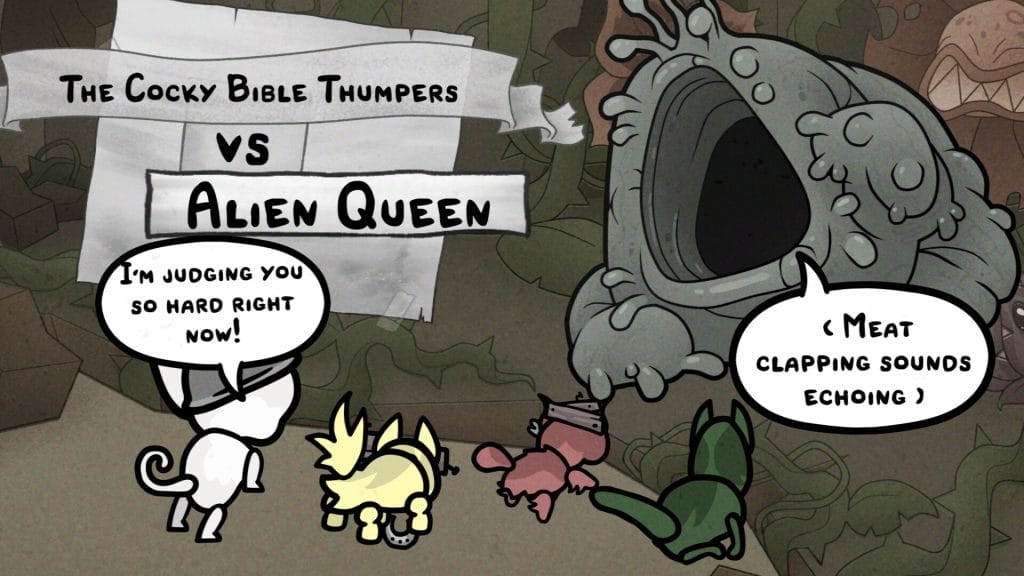
McMillen and Glaiel’s new game is dripping with catmosphere. There’s cat puns, cat heroes and cat villains, cat songs with detailed cat lyrics, and a disturbing amount of cat breeding. As much as the game is obsessed with cats, it’s also particularly cruel to them. You will kill cats by the score (both allies and enemies) as you progress. The survivors don’t fare much better; they collect broken bones and disfiguring injuries as you progress through the game.
On the whole, Mewgenics feels like someone kidnapped and drugged Mega Crit’s Slay the Spire (2017) and Subset Games’ Into the Breach (2018), stuffed them into the corpse of the nastiest, mangiest street cat you’ve ever seen, reanimated the corpse, and presented it to you while playing bizarre, cat-themed, jazzy hits. And I’m obsessed with it.
The music of Mewgenics is particularly phenomenal. Each level has its own theme song that jingles along in the background throughout each encounter. However, when a boss fight begins, lyrics from the perspective of the boss start playing to the tunes you’ve been humming along to for the past 30 minutes. This clever touch raises the stakes.
Despite the feeling that everything has been dipped in a layer of cat puke and trash, the cartoony art is fun and easy to look at. Enemies are visually distinct, and the UI is generally intuitive to work with.
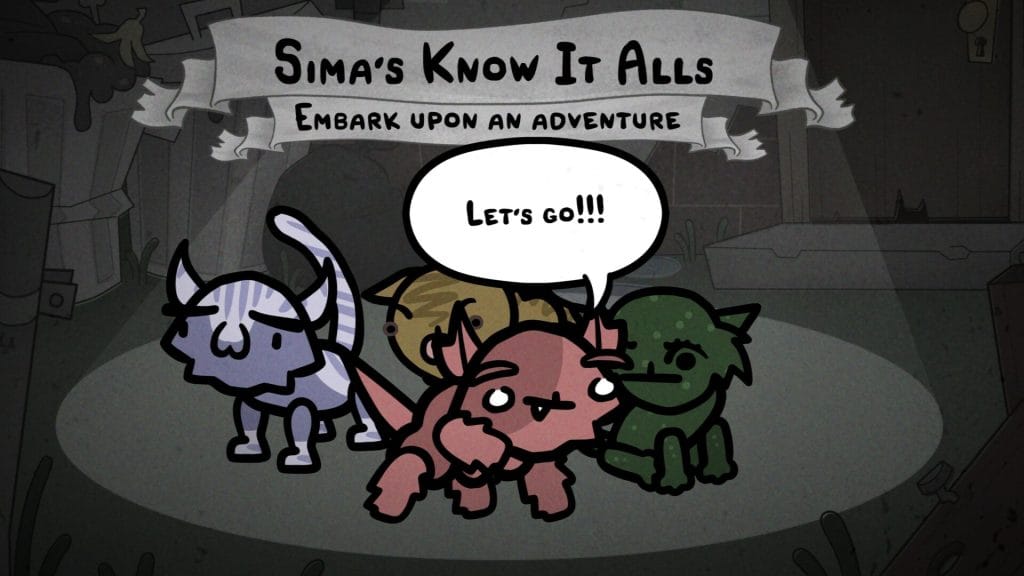
The story is sparse and mainly a vehicle for breeding a cat army. You wake up after being resuscitated by a mad scientist. He presents you with three cats and tells you to choose two of them. After a brief tutorial where another NPC shows you the ropes of combat, you’re on your way. Overall, Mewgenics is packed full of the same humor, charm, and cartoonishly disturbing flair that permeated The Binding of Isaac.
The Making of Kittens
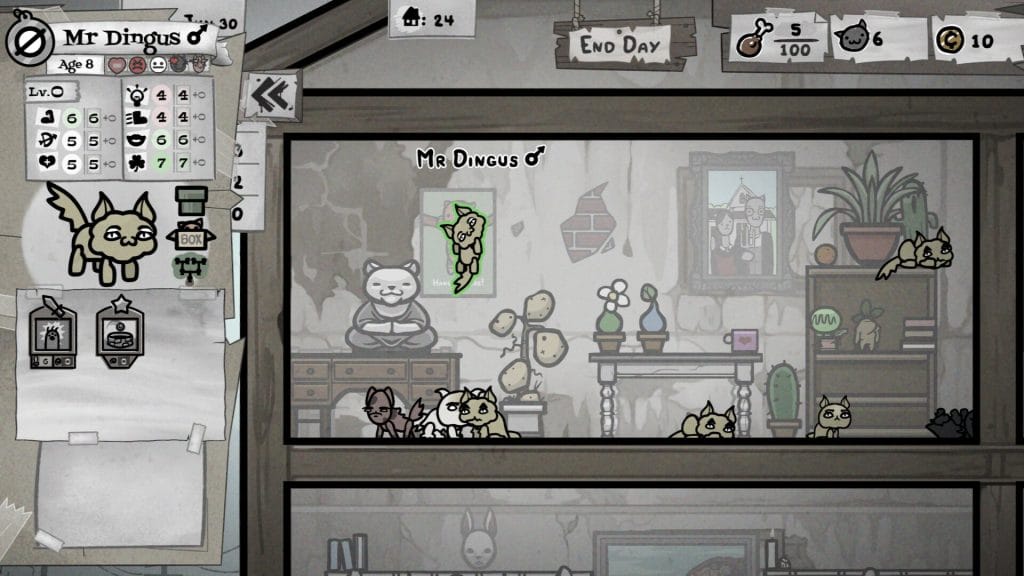
The gameplay loop in Mewgenics is split between basebuilding and squad-based combat. You begin each in-game day at your house, looking in at its feline inhabitants as they aimlessly wander around and poop. Cats in your possession at any given time are a mixture of strays that show up randomly, veteran cat warriors who survived past runs, and kittens that are born when any of your adults decide to breed — which the game shows in more detail than maybe I’d like.
In this base-building phase, you spend the day buying items from NPCs living in your neighborhood and pairing off the cats you would most like to breed. You can purchase household items and furniture for rooms in your house to increase that room’s stats. This affects the number and quality of cats willing to live and breed there.
At any point you can click “end day” and enter the nighttime phase. This is when cats eat, fight among themselves, and breed. Each cat must eat one food item each night it lives in your house, so it’s up to you to ensure you have enough food in storage to keep your cats alive.
If you’re thinking of getting attached to any of your cats, don’t. The game trains you early and often to think of your cats as disposable. When you’re starting out, your cats will drop like flies as you engage with the challenging combat system. Even at home, cats can become useless from old age or get killed from fighting one another. On top of all of that, each cat can only be selected to go out into the neighborhood, explore, and fight one time. If they make it home alive, they can never be put onto an exploring squad ever again.
Veteran cats have three uses: They can defend your home when bosses occasionally show up looking for a fight, they can pass down their best traits to their progeny, and they can be donated to one of the NPCs who populate your neighborhood. Each NPC has different requirements for which cats they will accept. Donating a sufficient number of cats to a single NPC unlocks new dialogue in addition to upgrading your storage, unlocking new items, or expanding one of the stores.
Catfight
Once you’re satisfied enough with your cats to begin an exploration run, you can select a squad of between one and four cats to throw in a cardboard box. You assign each kitty in your party a class by giving them a collar. Each collar modifies the cat’s stats and confers unique abilities. Finally, your party is ready to explore the neighborhood.
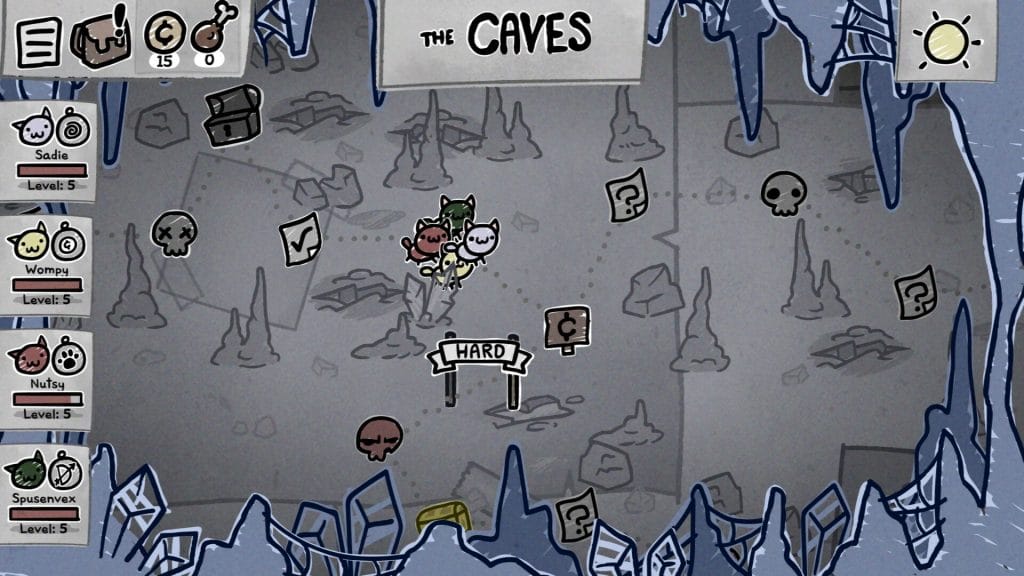
Once your squad hits the streets, you’ll receive a map of the neighborhood. Much like Slay the Spire, the map has a series of nodes — combat, event, store, mini-boss, and boss — that must be completed before you can return to the house. If you successfully kill the boss of an area, you can choose to return home, retiring your current squad for good but saving the loot and items you’ve collected for future runs. Or you can continue on to a more difficult area with the same squad.
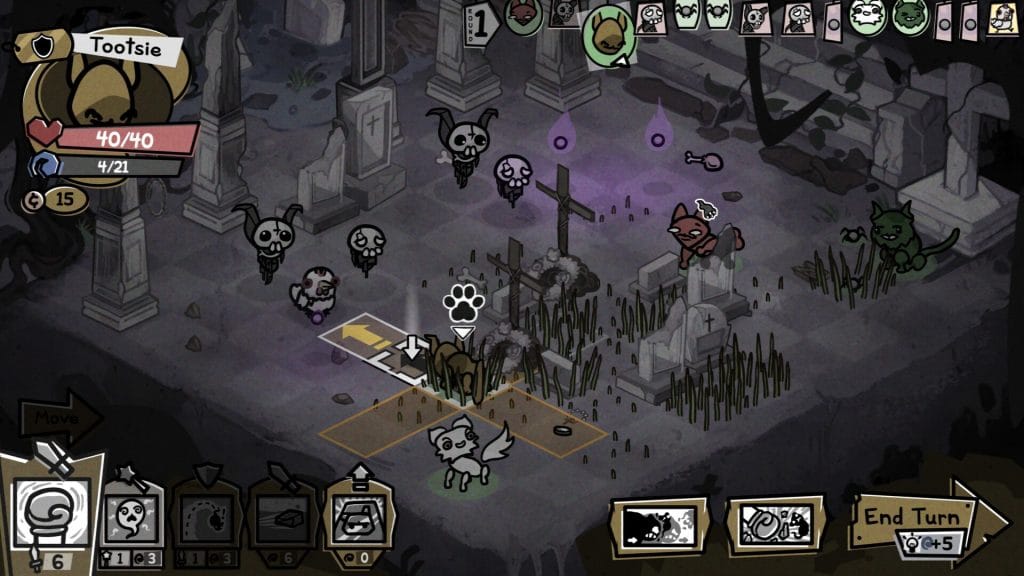
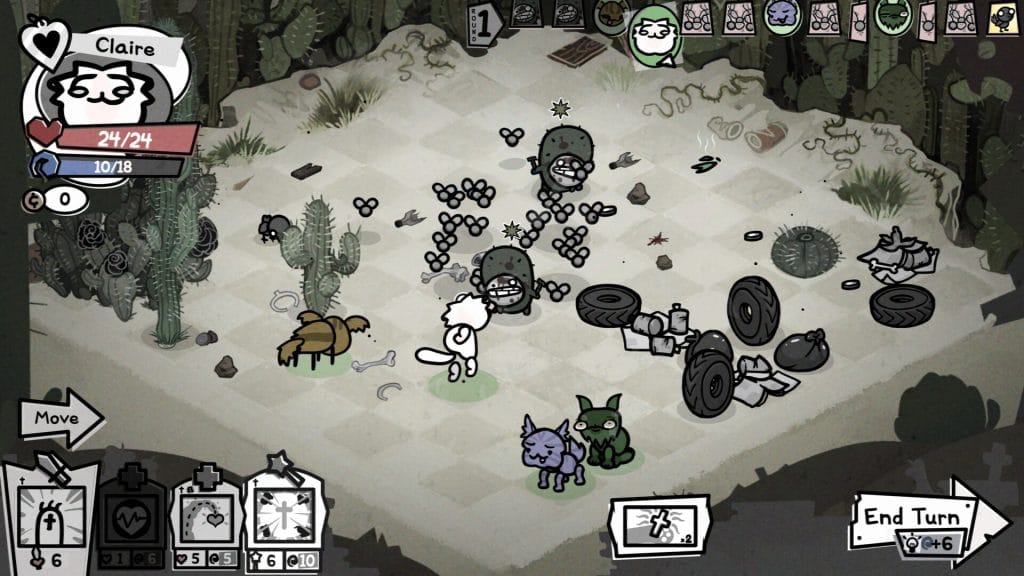
Combat nodes are the most common you will encounter. When combat begins, you are confronted with a 10-by-10 grid full of environmental hazards and enemies. In turn-based combat, you must push your cats around the field of play using an impressive variety of abilities to defeat all enemies on the field.
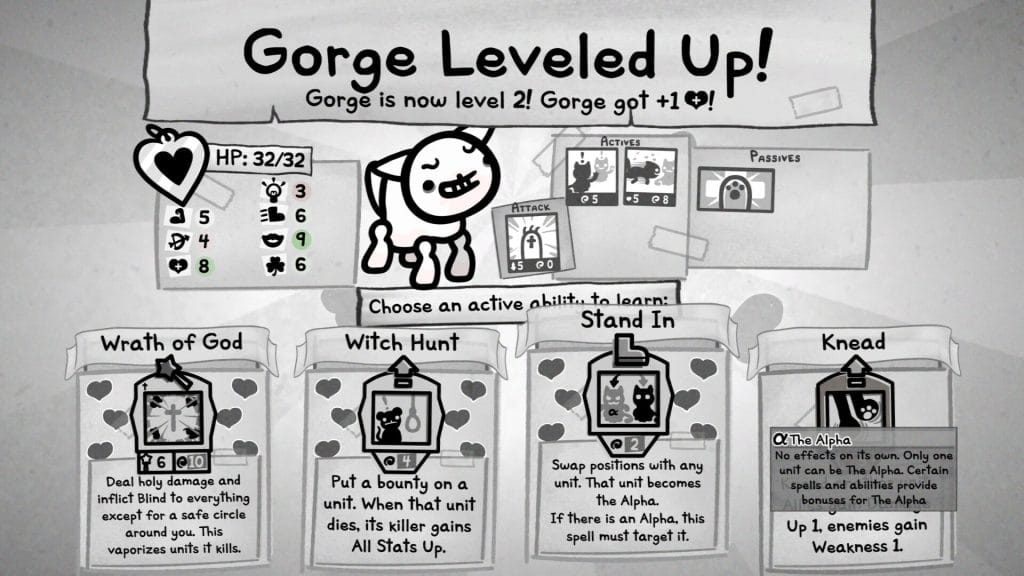
Every time you win a combat encounter, one of your cats levels up, letting you choose from one of several randomized new abilities, passive bonuses, or stat bonuses. These abilities stack and synergize quickly. By the end of the run, properly leveled-up cats will be zipping around the field of play, dealing massive damage and providing critical support to their compatriots.
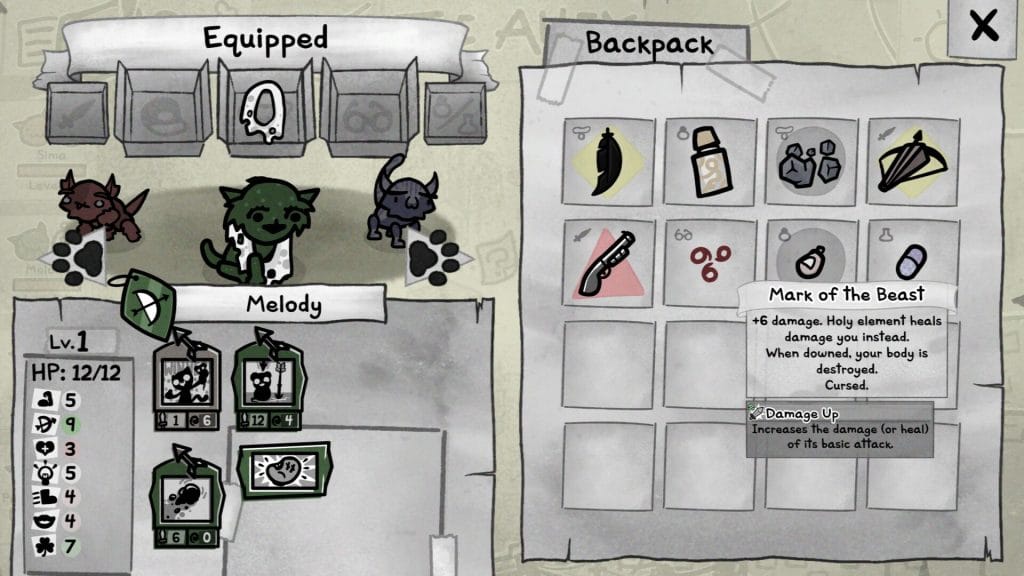
Item management is absolutely crucial for success in Mewgenics. You obtain items by killing birds (random spawns that hang around combat encounters for a few turns), purchasing them from shops, or receiving random rewards. These items have a wide variety of effects, including providing extra armor or increasing attack damage. They are essential for providing the power necessary to get through a difficult turn or survive a powerful attack. Additionally, they can be stored in your house between runs. If cats successfully return home after a run, they donate their items to your stockpile to outfit the next generation. If your squad gets wiped out, you lose everything, which can have devastating effects on future runs.
If an individual cat runs out of health, it is knocked out for the remainder of the combat encounter, and it receives a permanent injury that confers a permanent stat reduction. For example, a cat with a broken leg permanently suffers from minus one speed. If all cats in your party are knocked out, the run is lost. All of your cats die permanently, all equipped and stored items are left behind, and all money and food earned in the run are lost. You return home, and the cats you left behind wait for brethren that will never return.
The Litterbox
Although I’m really enjoying my time with Mewgenics, there have been some sticking points. With so much variety in encounters, items, and abilities, you will face a wide range of difficulty challenges based on random chance. On runs with optimally bred cats, powerful items from the outset, and a few strong early upgrades, your team will mow down the enemies with no problems at all. However, a ragtag team of strays that start with nothing but a lighter and some catnip can get stomped on by even early combat encounters.
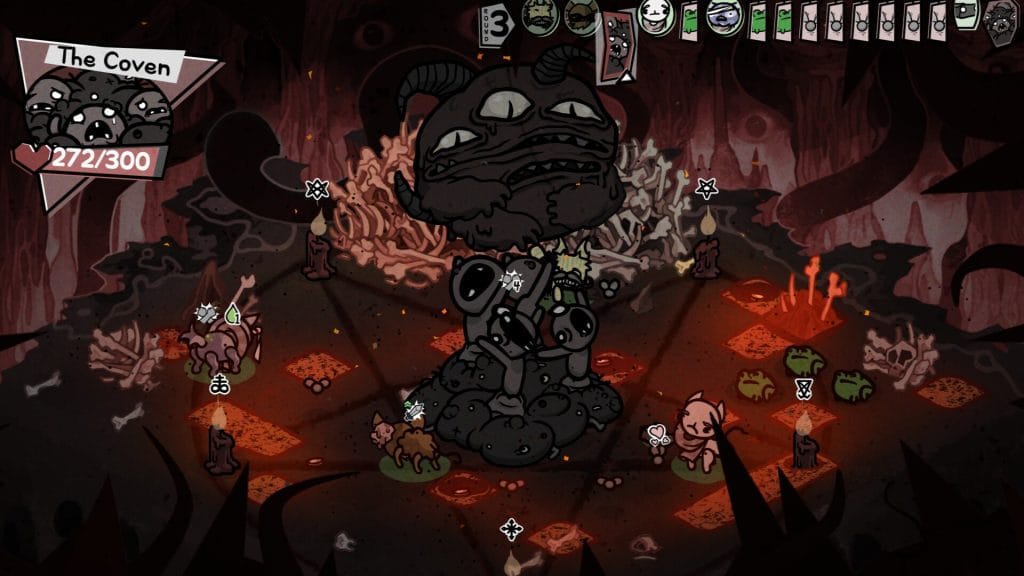
As a result, it is especially heartbreaking when you lose a late run of fully leveled kitted-out cats. Once, my cats died on the last turn of the last boss fight of the third level of a run. I had to spend three runs upgrading and breeding cats until I had a team with similarly high-leveled stats and an equivalent arsenal of items before I was ready to attempt the same boss fight. On the one hand, this is good. Fights have high stakes and remain a challenge, even with a strong team. On the other hand, taking multiple runs to rebuild was incredibly frustrating — especially because each run is long. Once you unlock new areas, runs can span two or three locations, and a single run can take up to two hours.
Additionally, I’m having trouble getting my head around properly breeding cats. Cats pass down their base stats to kittens. Kittens can also be born with random genetic mutations that affect their base stats; some are bad, some are good. Adding additional furniture to a room affects whether cats want to breed or fight, whether the cat with the higher or lower base stat passes down their genetics, and the likelihood and type of mutations.
On the surface it seems simple, but I have so far had a hard time predicting what will happen each night. The night before an important boss fight, one of my best veterans was killed in a fight in my very own base. Another time, many of my kittens were born with extremely negative mutations. I think it’s because of excessive inbreeding, but it can be really hard to tell.
In short, hitting that “end night” button feels like rolling dice with high stakes. Getting low roll kittens is frustrating, and losing a veteran cat in a fight is even worse. Not only do you lose a potentially valuable fighter against a boss, but veteran cats are extremely valuable for donating to NPCs. A dead cat (unsurprisingly) isn’t nearly as valuable for donation.
Right now, the cat-breeding section of the game feels like it could use some additional clarity. Because having a good cat army is absolutely critical to the game, it’s a bit frustrating that this core mechanic can be such a crapshoot.
Final Thoughts
Make no mistake: Despite its silly cat theme, Mewgenics is a brutally difficult roguelike with no easy mode as far as I can tell. Some runs of mine were particularly punishing; I spent hours breeding a set of cats and carefully curating synergized powers only for a single overlooked enemy’s unexpected ability to tip the scales against me and end with a squad wipe. Overall I am a person who enjoys difficult games, but some minor issues with power balance and the breeding system can make Mewgenics feel frustrating.
That being said, I am having an absolute blast with Mewgenics. Even after playing for over 30 hours, I can tell I have only cracked the surface of what the game has to offer. For full disclosure, in that amount of time, I have gotten about halfway through Act II. Like many roguelikes, the game’s difficulty and design demand many playthroughs and hours to build up your arsenal of resources and personal skill to beat the entire game. There is a genuinely impressive number of enemies, items, and ability synergies that are incredibly satisfying to discover.
I’m looking forward to exploring new areas, experimenting with new ability combinations, and breeding new genetically monstrous kitties for many more hours. Based on how addicting Mewgenics is, I have a feeling I won’t be the only one.
Score: 8.8/10
Mewgenics, developed by Edmund McMillen and Tyler Glaiel, releases on February 10, 2026, for PC (via Steam). MSRP: $29.99. Version reviewed: PC.
Disclaimer: A review code was provided by the developers.
Update (2/23): Our Mewgenics review launched as a review-in-progress. We’ve since added an amendment based on Matt’s latest experiences with the game, with an additional 20 hours of playtime. His score, which has been finalized, remains unchanged from the initial publication.
Read on for Matt’s final, final thoughts.
Mewgenics Review Update
After another 20 hours of gameplay, I’ve had some amazing runs, some terrible runs, and I… still haven’t made it out of Act II. Two runs in particular exemplified my time with Mewgenics! and demonstrated perfectly the best and the worst of the game.
First, the good run. It started off terribly. My cats were being downed left and right. I was barely holding on, and I was certain the run would never make it out of “The Desert,” the first level in Act II. Then the best thing happened: In a single encounter, two of my cats were downed and their bodies were desecrated, consigned to true death. I almost rage quit and abandoned the run right there. But the deaths of these two cats that weren’t able to hack it allowed me to focus on leveling my two superior cats. Together, these two heroes, a tank and a necromancer, slaughtered their way through two levels, “The Bunker” and “The Core,” alone. Those two little guys murdered their way home and forever into my heart.
Second, the bad run. Things started off amazing. I put together one of the strongest teams I’ve ever sent to adventure in the world of Mewgenics. From the get go, this crew was an all-star team. In particular, my thief was dealing insane damage and my tank gained a perk that forced all enemies to focus their fire on him. This crew felt unstoppable. Then, 45 minutes into the run, my thief lost a random check at an event node. He gained a trait called madness, which forces a cat to view every other character on the board as an enemy, no matter what, and does not allow you to control their actions. So, after one random event I had no control over, my best damage dealer exclusively hunted my second strongest character on the board. There was nothing I could do. The run was immediately dead in the water. To be honest, it was hilarious. I would be completely on board with this type of game design, but each run is just too long for this type of shenanigans.
I really like Mewgenics. The gameplay is fun, the music and art are incredible, and there is an insane amount of content and enemy variety. In so many ways, it is something incredibly special. The biggest thing that holds it back from being truly phenomenal is the amount of randomness. It’s everywhere: events, leveling up, shops, cat breeding, move order, and mini-boss match-ups. Alone this would be fine, but coupled with genuinely long runs, it becomes less cute when something you couldn’t see coming and couldn’t plan for completely derails an hour of progress.

Matt has loved video games since he played Super Smash Bros. on an Nintendo 64 in the year 2000. Today, the games he plays most often are puzzlers, Souls-likes, and roguelikes, but he really loves any single-player game that's challenging and/or has a great story.
When he's not gaming, Matt's a public policy nerd who will talk your ear off about how well-designed government forms are the lost gateway to utopia.