

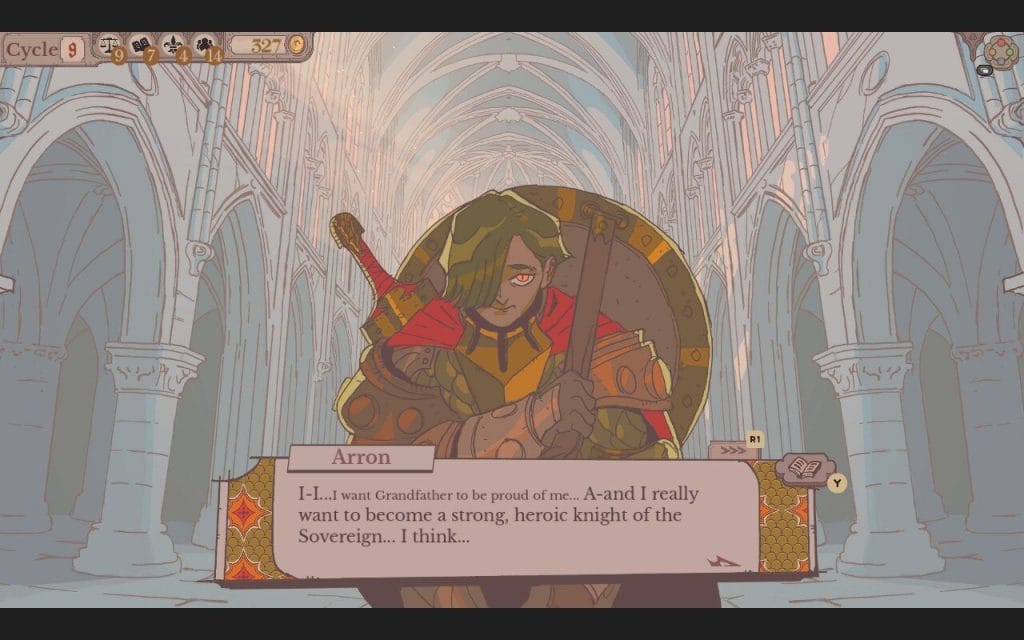
I say I don’t play favorites, but I do. When I look at my Round Table, I know there are some knights for whom I would do anything to make happy, and others are simply pawns. If Arron, a timid but curious young man from a tough home, wants to spend time hunting down an ancient griffin fossil, I’ll happily say yes. But that guy who always wants me to murder people instead of negotiating? Eh, I’ll send him to fight giant crabs instead, and I don’t care if he complains that it’s boring. These are just a few examples of decisions I made as a royal leader in Sovereign Tower.
In Sovereign Tower, developed by Wild Wits Games and published by Curve Games, players take on the role of a new monarch. In this narrative-driven management game, out tomorrow, you’ll hear requests from citizens, create (or ruin) alliances with neighboring kingdoms, and, most importantly of all, closely manage a Round Table of knights. I can’t wait to dive back in so I can start my New Game Plus.
A Whole New World
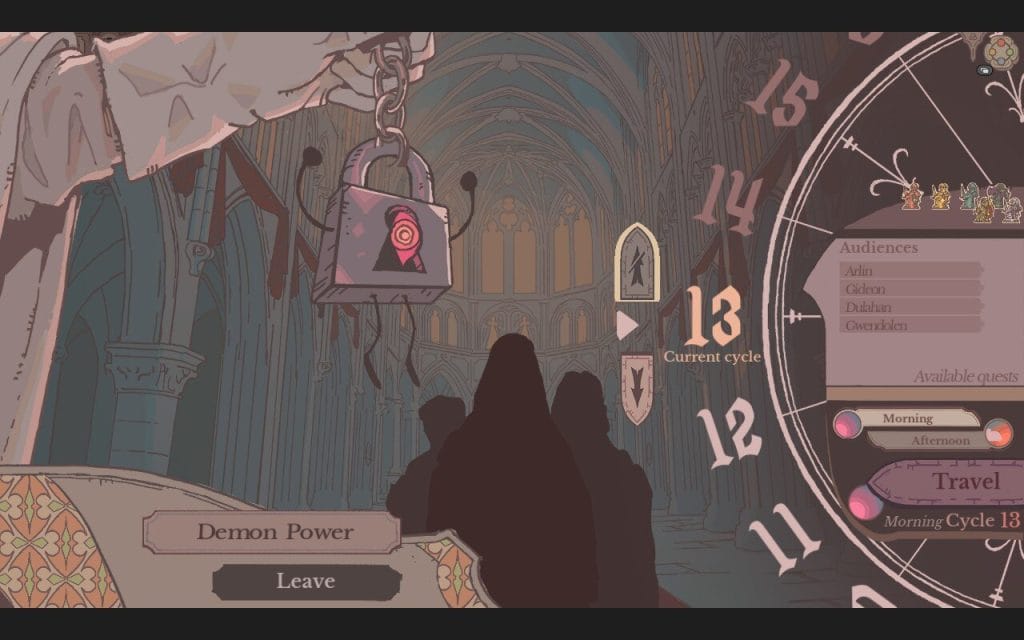
Players take on the role of a leper-on-the-run who happens to be chosen by a magical, semi-sentient tower to be the next ruler of the land. The newly appointed Sovereign is surprised, but not mad about the promotion. The titular Sovereign Tower has a variety of magical enchantments upon it, including a beautiful talking statue who protects you from getting sicker, and a talking demon padlock in the crypts that can help you rewind time — for a price. (More on that later.)
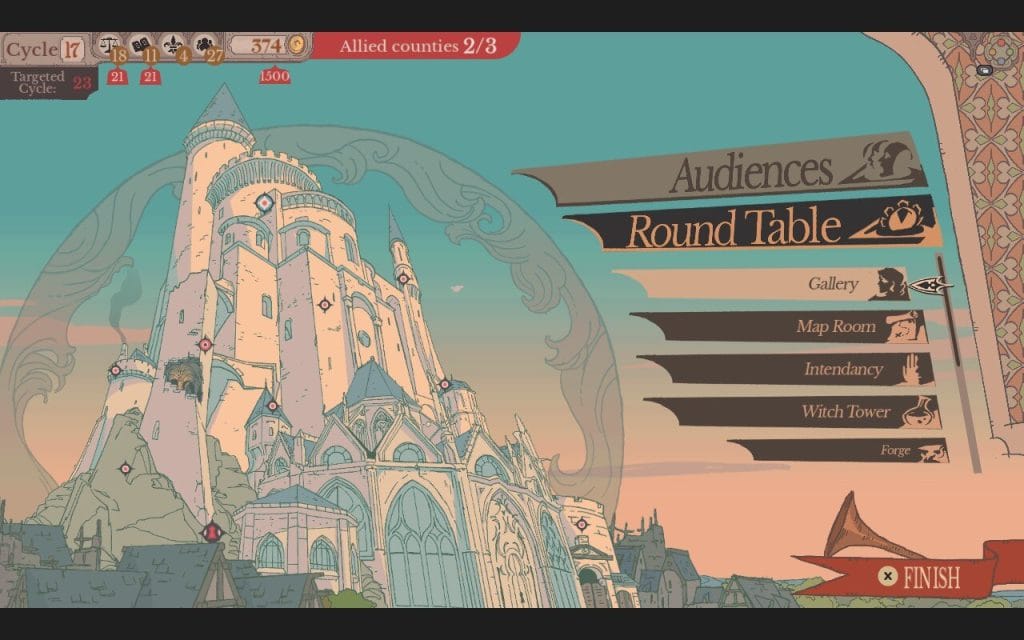
Each cycle (a few days in-game), you begin with an Audience. Here, you’ll receive a mix of commoners, nobles, merchants, and academics who come to court to make requests. Both major and minor quests are doled out here. Then, you take care of other business — like sending a letter, reviewing a colorful map, fixing armor, or packing a snack for your favorite knight — before going to the Round Table.
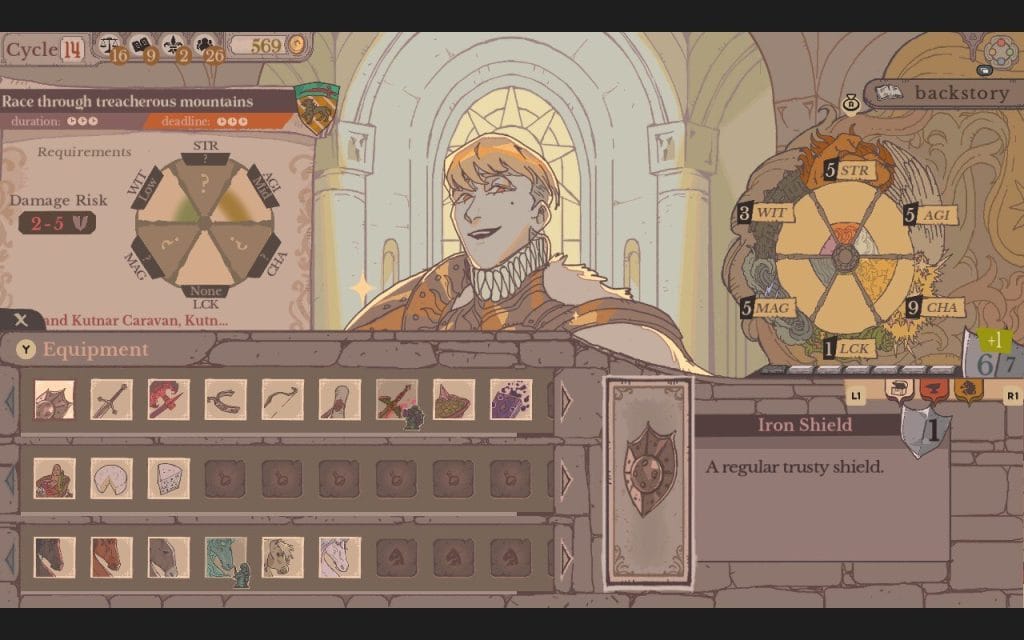
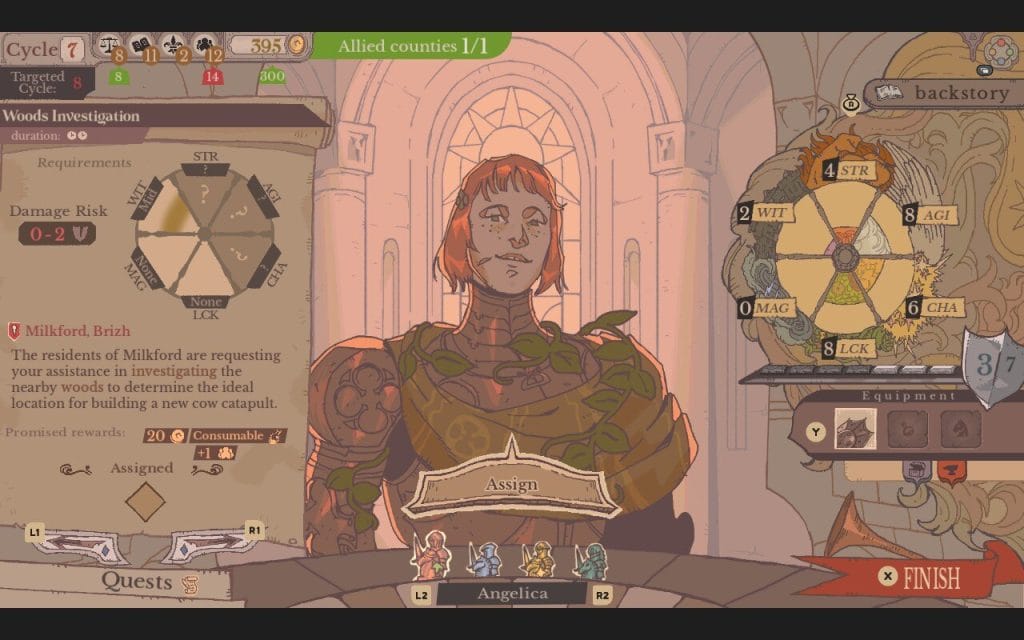
The meat of the game takes place at the Round Table. Each cycle carries with it major quests with ticking deadlines (e.g., Get rid of that dragon attacking your new ally or they won’t be your new ally for very long) and minor contracts (e.g., Try to negotiate with a cursed goose at the public bathhouse). You begin with just a few knights, but soon more will join as they hear of your success. Each knight has different skills (which you can increase via an RPG-like skill menu), and each quest has different needs. Additionally, each knight has preferences and fears that affect their likelihood of success and experience earned on a quest.
I spent the majority of my time min-maxing my Round Table. For example, Goberto comes from a region known for cheeses, and he will perform better if I give him that nice crumbly cheddar. However, that cheese also improves charm, and Gwendan is trying to impress a village at their annual ice skating competition. Someone who is scared of the dark won’t perform well trying to do a rescue mission from a cellar prison. This variety of factors makes for a fun puzzle, at least for a logistics sicko like me.
You’ll build relationships with your knights (including optional romances) as the game goes on via short conversations at the Tower or in the Court, which can unlock new quest options or fun little details. You can fire knights in Sovereign Tower by opening up the Tower Menu and then the Glossary (not the Round Table, as you might expect) and choosing the “Dismiss” button. This is helpful because there is a cap on the number of knights you can have (increasing over the course of three chapters to a total of 10). In the Glossary, you can also check your relationship progress with the knights, which may unlock other quests.1 I found myself getting very attached to my knights because the writing and artwork were so freaking good.
Illuminated Manuscripts
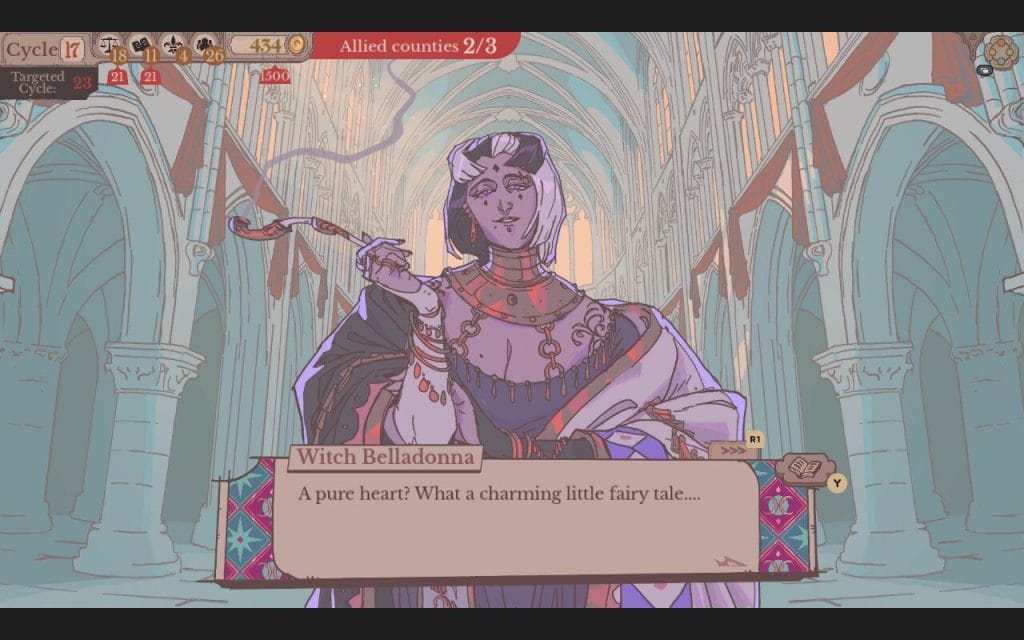
Sovereign Tower is a visual delight, with character portraits that are particularly lush. The art style never ceased to impress me. The game is also accompanied by a few thematically appropriate instrumental songs (and one occasional vocal track) that heighten the setting.
While characters are beautifully illustrated in Sovereign Tower, there is no voice acting and no fluid animation (characters do have a few expressions and positions), so the words have to really pull their weight. And, luckily, they do.
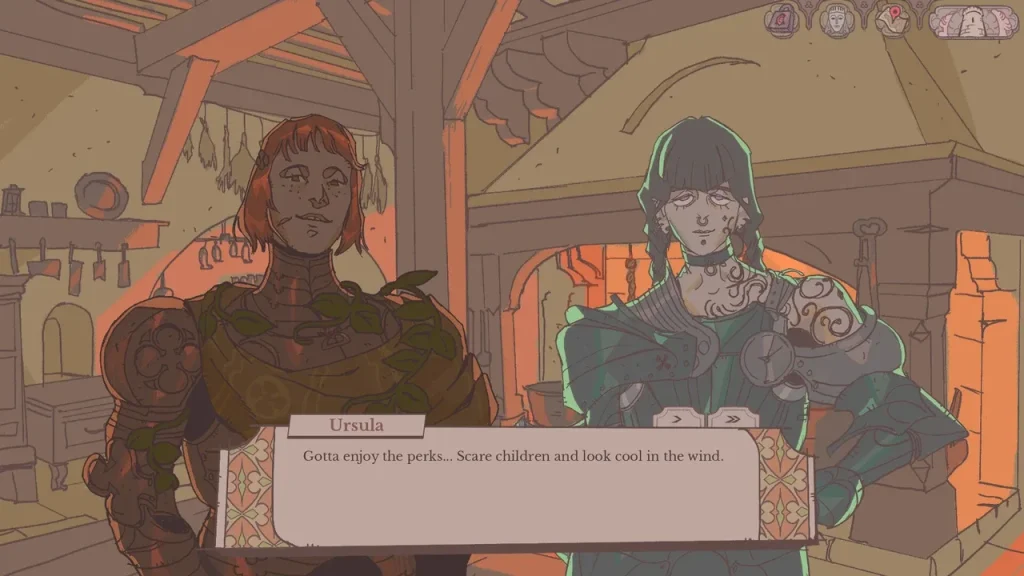
The writing is charming and evocative. I was totally invested in every choice I made. There is a lot of heart to the characters in Sovereign Tower; everybody has something they yearn for. The game’s also just funny, which keeps it feeling fresh even when a lot of the experience is simply reading.
The game is more than the average visual novel game due to its knight min-max puzzling, but it does heavily rely on the written word and relatively still frames of characters. That being said, the narrative of Sovereign Tower is as rich as the kingdom you’ll end up leading.
Sovereign Tower also works on the big picture level. It has a strong central story around your leadership as you try to secure peace (or not) in the land, as well as many minor plot threads with all of your knights. I was impressed at how intricate all of these quests and events were; there is absolutely no way to see everything in one playthrough. Even with the game’s helpful rewind mechanic, I was already thinking of things I’d want to do differently in my next run.
Just Can’t Wait To Be King
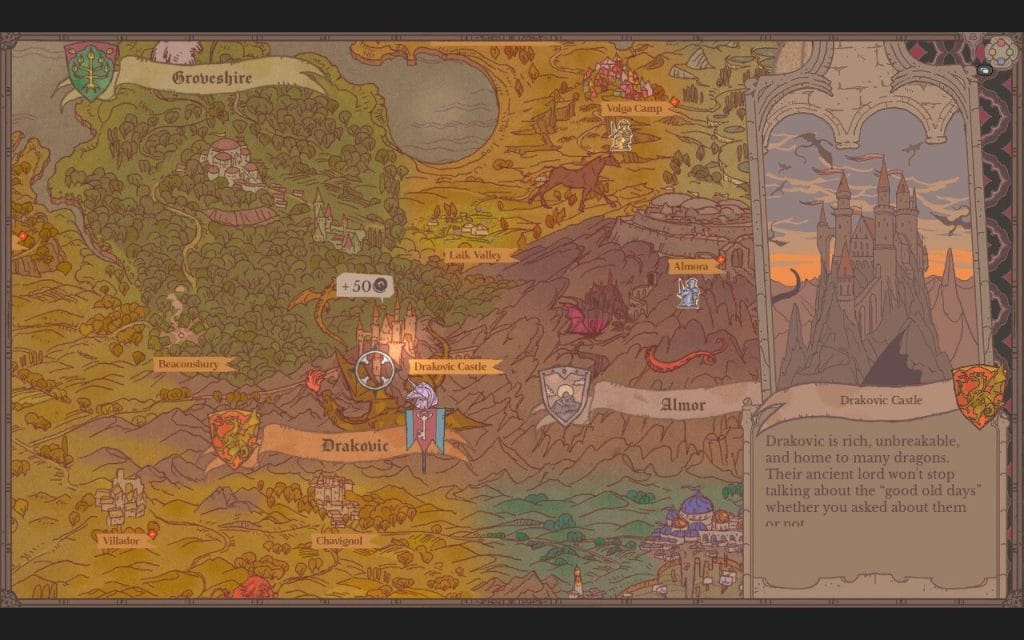
Sovereign Tower carefully manages the delicate balance of lore through its gameplay. Sovereign Tower’s opening hours are incredibly well-paced, gently introducing more and more mechanics to help you make your knights the best they can be. I found the management mechanics at both the macro-level (like other medieval ruling games such as Reigns and Yes, Your Grace, or even Frostpunk) and the micro-level of choosing specific knights and quests (kind of like the map room in Dragon Age: Inquisition or the assignment of superheroes to missions in Dispatch) to be rewarding. I felt, as Sovereign, that I truly was making a difference in the world around me.
The court Audiences — aside from main story beats — that you get per cycle are randomly pulled from an allotted bucket of events. So, even if you rewind to make sure that Angelica the animal lover is available for that quest with the silver bird, you may not get a townsperson with that exact request again. This actually kept the whole game feeling fresh for me; I could try my best, but I never could quite plan for what was coming. It kept me on my toes!
And that in of itself is something I really enjoyed about Sovereign Tower. Not to toot my own horn (or medieval trumpet) too much here, but… I am really good at resource management and logistics min-maxing games. But Sovereign Tower is actually pretty difficult. I failed the first “boss battle” multiple times. When I first played the game’s demo during the June 2026 Steam Next Fest, I accidentally killed one of my knights on his first quest. I felt genuinely panicked when I was worried I wouldn’t curry enough favor with my noble population in time before a big negotiation.
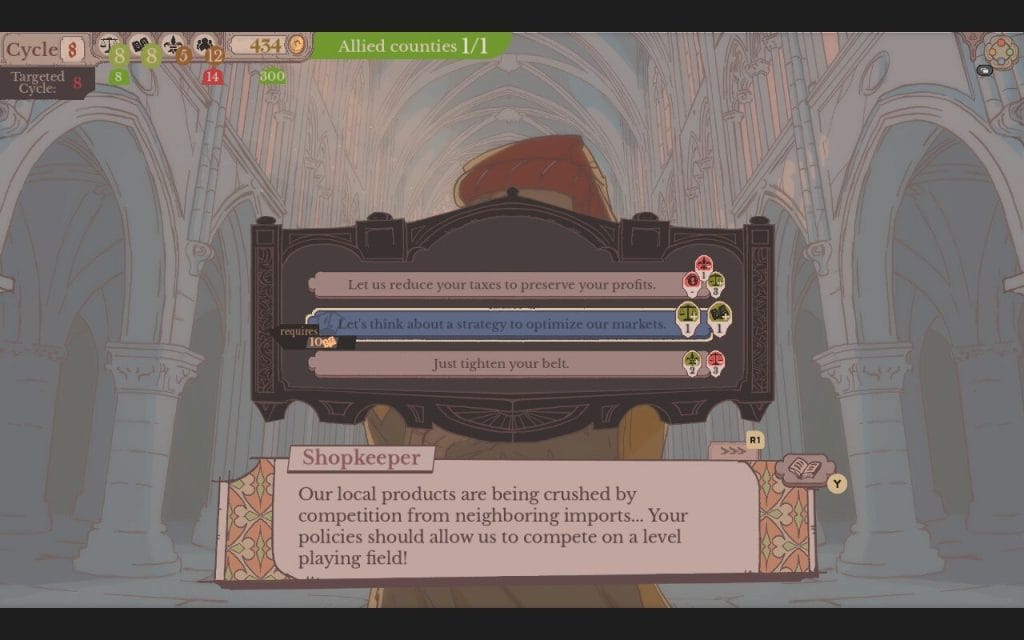
I loved the challenge of playing “on Sovereign mode” in Sovereign Tower, in which the game auto-saves and the only way you can redo choices is by making a deal with the devil. Even with being able to rewind, success is still quite hard to achieve. I enjoyed that, though; in many games like this, it’s too easy to succeed.
Here, I felt the real push and pull of having to make hard decisions for my kingdom. Sometimes they’re meaningful questions — should I make child labor illegal even though it will reduce my nation’s profits — and other times a bit sillier, like should I make fish soup the national dish?
Decisions abound in Sovereign Tower. I was locked in for several days in a row; when I wasn’t playing, I was thinking about it. And perhaps because I was paying attention so closely, I did notice a few hiccups with the experience.
Heavy Is the Crown
Wild Wits Games, a French indie studio, has made a handful of other games before, but this is their most ambitious by far. Most of my critiques with Sovereign Tower have to do with what I believe might be scope creep or polish, a common struggle for indie devs.
First, I was ultimately satisfied by the game’s story ending, but I still had unfinished side quests that I was trying to finish by the time I hit credits. Because the game ticks forward on a clock and there is a Big Final Confrontation, Sovereign Tower ends whether or not you are ready for it to. Additionally, because some encounters or “cutscenes” are randomized or locked behind certain relationship goals, it can be hard to tell what to prioritize as you race toward the end of the game. Again, I’m happy to play the game on New Game Plus (and, even just an hour in, I’ve already found it to be a rewarding and different experience than my first run through), but I think this hard boundary is worth noting.
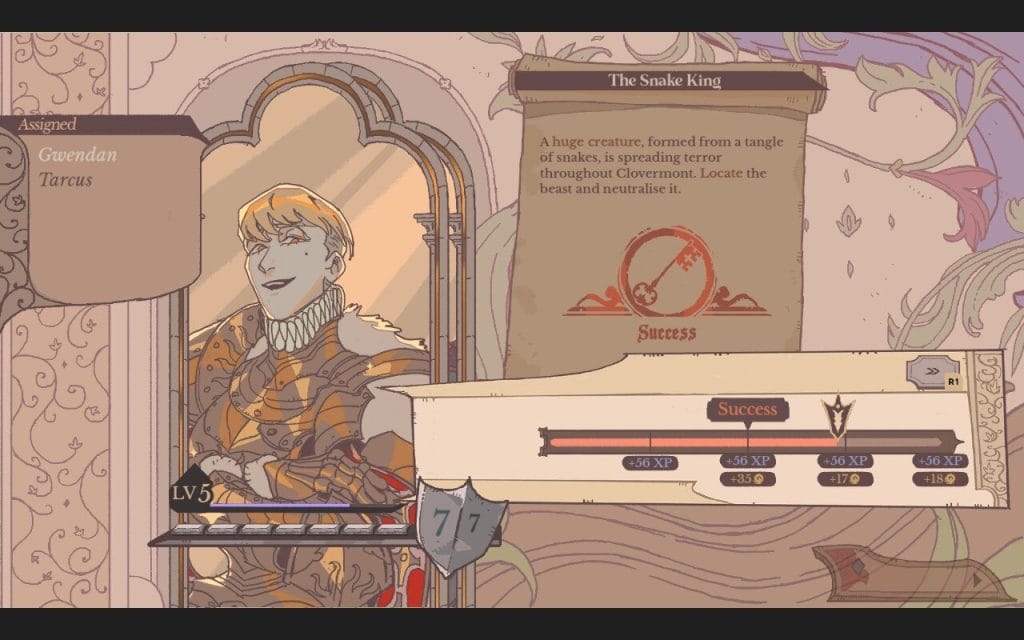
Similarly, there are a few other factors that could be improved for the user experience. Knights earn experience points that can be allotted to one of six different skills (like Charisma or Strength), and these skills affect how likely they are to succeed in different quests. I don’t mind that knights can’t be re-skilled (it feels more “realistic”), but I was annoyed that their skill upgrade menu only appears briefly once a quest has been completed and, even then, only if a knight has a skill point to spend.
Weirdly, when the upgrade menu flashes up, players have to opt in to view the menu before they can spend a skill. If you just click “enter” or “A” (as you do a lot of during visual novels), you’ll navigate away from the menu. Thus, I accidentally skipped the upgrade menu multiple times, thus missing the opportunity to upgrade my knights (which is critical) for an entire cycle of quests. Having access to this menu at any given time would greatly improve the player experience for me, especially when I want to consider balancing out the skills of all of my knights.
If you like games that put you in the king’s seat, you’ll love Sovereign Tower. It’s a lot of fun to hear requests from the populace, make decisions, and maximize knights’ loadouts for their quests.
Because the writing is so good and the plots, both big and small, are interesting and engaging, I was disappointed when the narrative loop wasn’t closed on a quest. Major quests earn you a fun follow-up audience, and some minor ones include a tiny pop-up (like literally a sentence) sharing how things went. But no other quests do. So, someone might come begging the Sovereign to handle a situation, and I’d be so moved that I’d send knights out immediately… But then there was no plot follow-up, only an indication of whether or not my knights had succeeded or failed. Again, this was likely a scope choice as there are probably close to 100 quests in total, but it was still a bummer.
Lastly, there were some grammatical errors in the latter half of the game that were in the version I played for review. It’s nothing egregious (especially given the studio is French), but this always irks me a little when a game is heavily reliant on the written word. This can often happen with visual novel games because there’s just so much writing, and the late-game text doesn’t get copy-edited as many times as the earlier game because it’s simply been in development for less time.
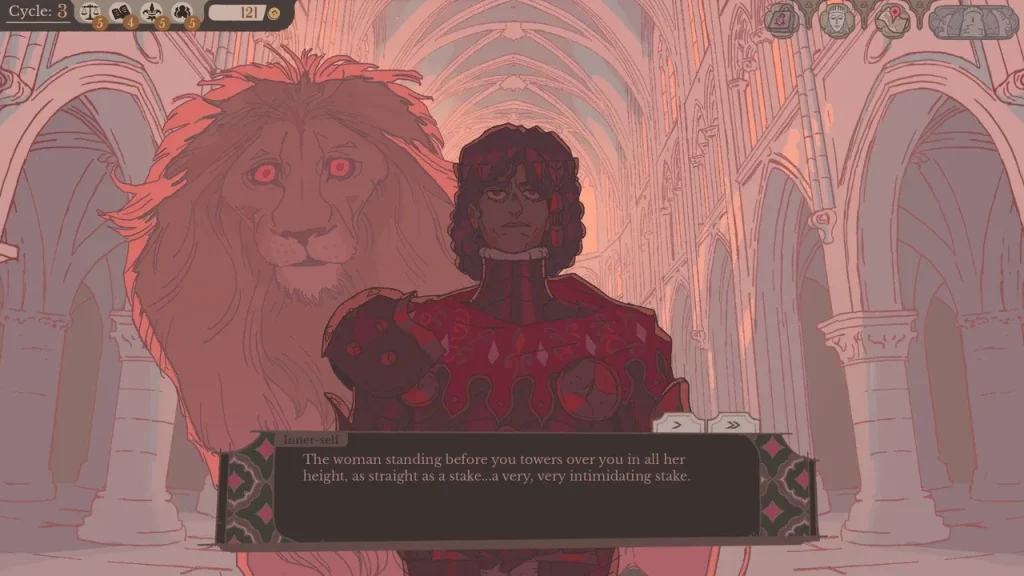
That being said, there was one text choice in particular that struck me as odd. Early on, the Sovereign is not explicitly gendered (and an assistant even points out that they could “look like anything” under the mask), but in the late game, a few characters refer to the Sovereign as he/him. It caught me off-guard, especially since the Sovereign’s actions, story, and choices are in no other way gendered; they can try to romance characters of all gender identities. I have more thoughts on this, so I might write more about it separately, and again, this may have been patched out in later updates for the game. For the purposes of my review, it’s just worth noting that the game can be a little inconsistent at times with its text, especially in the latter acts.
Still, the developers behind Sovereign Tower clearly love their game. I noticed a few little bugs (again, nothing game-breaking) during my playthrough, and the devs have already released patches even during the review window. This bodes well for the future of the tower and all those who live there.
Final Thoughts: A Magical New Management Sim
Overall, Sovereign Tower is a great visual novel and management game. There are so many fun mechanics and details. For example, by building up a reputation with certain decisions — like kindness versus tyranny — you can unlock new types of leadership, which gives you unique dialogue options. It would take me too long to name every interesting thing that this game does for both its format and its genre. My first playthrough took 16 hours, but that included a lot of demon-fueled rewinding of time; you could probably get through faster, but then again, why would you want to? This game is about investing in your kingdom and knights.
If you like games that put you in the king’s seat, you’ll love Sovereign Tower. It’s a lot of fun to hear requests from the populace, make decisions, and maximize knights’ load-outs for their quests. However, if you don’t like details or making decisions or reading, you probably won’t enjoy it.
The game is more than a bog-standard visual novel game due to its knight min-max puzzling, but it does heavily rely on the written word and relatively still character frames.2 That being said, the narrative of Sovereign Tower is as rich as the kingdom you’ll end up leading. I had a blast wearing the crown.
Score: 8.5/10
Sovereign Tower, developed by Wild Wits Games and published by Curve Games, releases on August 6, 2026, for PC (via Steam). MSRP: $19.99. Version reviewed: PC (via Steam Deck).
Disclaimer: A review code was provided by the publisher.
Footnotes
- Update (8/26/2026) – In the pre-release version I played for review, I could not find a Dismiss option or the Approval Relationship tracker, and I found it very frustrating to not be able to curate a Round Table group that met my play style. However, players commented on my review that these features were (now) available, so I booted up the game again today and verified that this had been implemented. I have adjusted my review accordingly, though my original score still stands.
Update (8/19/2026) – Players commented on this article to say that there was indeed a Dismiss Knight option and an Approval tracker, but I had not played the game since a few days post-release and could not verify. I added footnotes describing what other players had described in the comments.
Original publication (8/5/2026) – I played a review build provided by the publisher, and we published our review at embargo, before the game officially launched. My review included criticism of a lack of a “Dismiss Knight” option or an Approval tracker. ↩︎ - “Bog standard” is British slang for “commonplace, basic, ordinary.” I almost always have Great British Bake-Off on in the background while I work, lol; it’s my dog’s favorite show. Really. It’s a long story. ↩︎

Amanda Tien (she/her or they) loves video games where she can pet dogs, solve mysteries, punch bad guys, play as a cool female character, and/or have a good cry. She began writing with The Punished Backlog in 2020 and became an Editor in Fall 2021. Amanda also does a lot of the site's graphic designs and podcast editing. Amanda's work has been published in Mothership, Unwinnable Monthly, Poets.org, Salt Hill Journal, and elsewhere. She holds an MFA in Fiction from the University of Pittsburgh and a BA in Creative Writing from Columbia University. Learn more about her writing, visual art, teaching, graphic design, and marketing consulting at www.amandatien.com.






Please do a separate review about being called he/him! I went in expecting to be gender neutral (demo) and got called a King and as a woman who really didn’t expect that, it caught me off guard and lowkey took me out. It’s one thing to *know* I’m playing as a man but the game felt like it was keeping the character gender neutral on purpose and none of the decisions etc made it seem necessary to be male or anything either. So I’d love your opinion.
Thanks so much for this comment! I agree 100%. It really caught me off-guard, especially since visual novel games either have a very specific gender identity from the get-go OR they let you choose pronouns and it’s not a big deal. I will definitely consider writing me about this; I appreciate your encouragement.
You aren’t playing a man. This is touched on at the beginning in a discussion with your advisor: the Sovereign can/could be any gender behind the mask, and it doesn’t matter. But some subjects will still default to referring to the person behind the mask as a King/man due to their own biases.
Thanks for your comment! I appreciate that, but in the version I played at review which was at embargo before the game’s official launch, the character is explicitly referred to as he/him in the latter hours of the game. This other commenter may have also played that same version; I believe the he/him pronouns were still in the game at launch. Perhaps the developers patched it out in response to player feedback and also adjusted the beginning, which would be great!
Game is great, but your review has several errors (unless they were patched in later). You can dismiss knights, there is an approval tracker, and Arron isn’t so endearing when you have him grow.
Thanks for commenting, however, as far as I can tell, there is still no ability to dismiss knights and there is no viewable approval tracker (there are skill trees, but approval/disapproval affinity is tracked dynamically behind-the-scenes). These features did not exist at launch which is when my review appeared at embargo; there are also no patch notes from the developers that share these factors as added-on qualities. Other game guides and Wikis confirm this; the only way to “dismiss” a knight at this time is to have them die. (A few knights have specific quests, such as Gwendan, that can… Read more »
I believe you can dismiss a knight from their stats page. It’s the button in the corner that says “dismiss.” Easy to miss, since the game doesn’t bring attention to that or to the fact there’s a cap on your number of knights (although you can ask them to come back later and then dismiss someone else, which I assume is the purpose of the “come back later” option in the first place). Personally, I think it would be nice not to have a limit on the number of knights, since there aren’t that many to pick up in the… Read more »
This is a great note, thanks! That option was also not available in the version I played at embargo/launch, but I’m glad they’ve added it. I will make a note in my review to that effect. And I agree, I wish there wasn’t a limit either — can make doing repeat playthroughs for other quests difficult.
Hi,
Loved your review, just wanted to had that you can in fact dismiss knoghts when you are in the “tower” view if you go on the book with all their information. And you also have a tracker of their approval there too. It’s where you can see their skilltree, history, and traits. Almost dismissed a few knights by accident that way.
And the limit is kind of jarring i admit too, there is a looot of knoght to choose, but some are easier to dismiss than other !
Have a great day
Thanks everyone for letting me know about these features! Appreciate that specific instruction, Harper! We had updated the review on August 19 with a footnote sharing player reporting the Dismiss Knight and Approval Tracker features were available, and today I was able to get into the game and verify myself and have updated the review accordingly. We have included historical context on this in the footnotes as well. Exciting to see this greatgame continue to grow and evolve post-launch!