

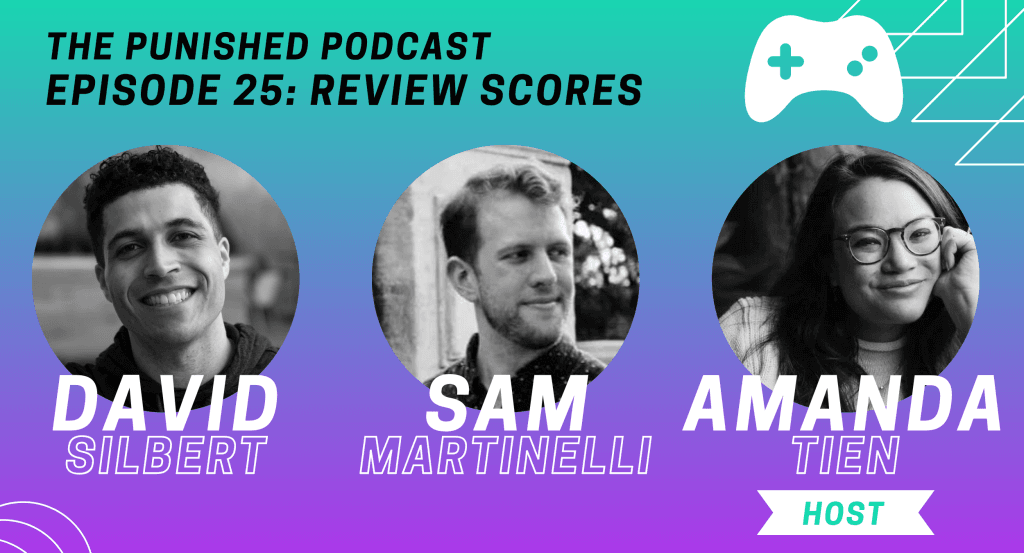
In today’s episode of The Punished Podcast, our site’s editorial team meet to discuss review scores! Review scores are a significant and complicated part of the gaming industry, and they have taken on a life of their own. Our debate covers everything from the existential to the nitty-gritty. We also play a silly game Amanda made up called What’s Your Review Score Score?! Check out a text sample of the transcript further below or go ahead and listen. It’s a good one! (Though, yes, we’re biased.)
MP3 Download | Spotify | Apple Podcasts
Timestamps
- 0:00 – Intros + What We’re Playing Right Now
- 5:30 – Review Scores and Their Role in the Gaming Industry
- 19:24 – Metacritic, Review Bombing, and Customer Reviews
- 23:32 – Writing Games Reviews: A Creative Challenge, Plus Our Lows
- 43:16 – Genre Bias and Expertise as Reviewers
- 50:08 – Getting Personal: Our Review Scale and Our Highs (Including an Amanda Rant)
- 1:08:05 – Analyzing Games in Retrospective
- 1:10:43 – 10/10 Games
- 1:13:03 – Game Show: What’s Your Review Score Score?!
- 1:30:48 – Outros: Good Content Recs
Excerpts
Scored Reviews & the Games Industry
Amanda: “In today’s episode, we discuss review scores as a concept but our comments do not necessarily reflect the views of us as an editorial board of a site because, spoiler alert, as editors, the three of us have pretty different feelings about scores and the role they hold! I’ve been really excited to discuss this with you guys because I think review scores are something we really can’t avoid as gamers, as writers, as editors. Scores are very interesting because they really shape what we are likely to play. So let’s get cards on the table: how do you feel about review scores and the role they have in the industry?”
David: “I approach review scores from a marketing mindset. Like many people who have written for the site, I come from a marketing background. A former boss of mine had said that has always stuck in my mind, ‘You’re not looking to get a Pulitzer. Get the piece done. Perfect is the enemy of great.’ So, when I think of communicating, I think of how and who we serve as an audience. So for us, at The Punished Backlog, it’s people who read the site to get news or our opinions on hidden gems and so on, one of the ways that, in my view, makes the site a little more user-friendly and inclusive is the inclusion of scores. I’m not saying that scores are the be-all end-all of the review experience, and obviously a lot of the conversation around review scores is that people just come into a review and look at the score and then bounce. But I think offering a score allows for users who may not have a lot of time on their hands, who might just want to skim the article or simply want us [as games journalists] to do a bit of the heavy lifting for them so they can read the whole piece and find out what the takeaway is.
“I think review scores offer a lot of consistency. Sometimes it might feel like a constraint, but I think it’s actually liberating. It gives folks on the site — our site or any site — the tools to understand the game. As writers, we can talk about games a lot of different ways and all of our styles are different when we cover a review, but anyone who reads a review on our site, will be able to find a score at the end that will offer some continuity from one to the next [as it aligns to a site-wide scale].”
Amanda: “I like that you talk about review scores from an editorial and site perspective. I think for me, as a gamer, if there’s a game I am really excited to play, I will likely play it no matter what its score is. For example, that’s how I felt about Assassin’s Creed: Shadows — it scored fine but I was like, Yeah, whatever, I’m gonna play that anyway, I don’t care. But then there was South of Midnight, which I was very excited about, but it didn’t score great and so I thought, Eh, you know, I’m pretty busy, so I’ll get to it when I get to it. So, I think it’s interesting that as consumers, we are shaped by those scores. Being on the writing side, we also have a kind of power in that situation. Sam, what about your thoughts? I know you have a lot of opinions about review scores.”
Sam: “I think the classic style of review, the kind of reviews that we have on our site, in a vacuum, they’re totally fine. Review scores are really helpful for a lot of people. For example, if you tell me a game is 10 out of 10, I don’t think it’s actually a perfect video game, but I hear you that it’s a game that you really like in a unique way and that might inform whether or not I play it…. I think what I dislike or that I wish would change is how much of a chokehold review scores and the culture around them have on gaming culture. That is unique to gaming culture. That is not true for any other medium. For example, could either one of you tell me a single scored review for the book Song of Achilles by Madeline Miller? Or could you tell me a score for any book you have ever read?”
(Amanda and David laugh, ultimately saying no.)
“I’ve stopped trying to convince people in my life, who aren’t gamers, that video games are great art because… well, look, we’ve all seen it in the comments section of things that we write. Any time we write something mildly off consensus, we just get hammered for it. Usually by bad faith actors, by bots, who knows. It’s fun to have the conversation about what a game will score in Metacritic, but that becomes just the whole conversation in the culture. Amanda, you were talking earlier about Assassin’s Creed: Shadows, and that got what, an 81 on Metacritic? That’s not a bad score.”
Amanda: “Yeah, exactly, it wasn’t a bad score. But the 80s have become a new low. We culturally have gotten to this point where a game has to score so well for people not to be dunking on something and saying something is trash. Like no, this game wasn’t trash. Was it perfect? No, but it wasn’t garbage.”
Sam: “Yes, and the margins between what we consider to be a good score and a bad score has become so small. Going back to what I was saying about games as art — a lot of the audience doesn’t actually want real games criticism [the way people write film or literary criticism]. They don’t actually want you to get into it and talk about your emotional experience with the game, or these in-depth research op-eds about the role of gender dynamics or the relationship between Call of Duty games and gun manufacturers. They just want to know: Are the graphics good? Is the gameplay good? Is the story good (whatever that means)? And so when we as a culture look at review scores so intently and try to condense the entire game into a score, that the review score is the final word, that’s what I think about. I wish there was more criticism. I wish that review scores weren’t the most important thing in games discussion.”
David: “I think both things can be true. I agree with you wholeheartedly. And I think this is actually a conversation more of the average consumer. The marketer in me thinks that part of our mission as a site is to meet and reach the average reader where they’re at. Games are kind of unique in that the average reader of a video game article is kind of an asshole. The average gamer is not a great person.”
Amanda: “Or at least the one we see verbally online! The Highguard situation is a great example. Sure, did it have the best marketing plan in the world? No. Was it the best online shooter game in the world? No. But the culture of vitriol around it was out of control.”
David: “Exactly, I totally agree, so that’s a great callout, Amanda. Because with gaming, there are so many gamers. When I write anything for the site, I try to avoid writing the word ‘gamer.’ Because for me, the word ‘gamer’ has a negative connotation to the very vocal, annoying people on the internet—“
Sam: “I say it because it’s negative.” (Everyone laughs.)
David: “Whereas I try to use the word ‘player’ because your grandma could play Candy Crush, she might play cozy games, she might play Call of Duty. Think of Skyrim grandma! And it’s a shame, because I wish we lived in the world that you’re describing, Sam, where we could engage in a higher level discourse of ‘Is this game good or not.’ Because really, you can often tell if a game is good or not. Unlike a movie, a game can ship broken. That is something that is unique to gaming. Like Amanda, you had a game that didn’t boot up on your Steam Deck — if it doesn’t work, it doesn’t work! Whereas you could watch a discombobulated film from beginning to end or read a bunch of slop in a book from beginning to end, and try to derive some value from that. Gaming is a tough industry.”
Sam: “Exactly, and that’s what I mean with the margins, too. So many baseline points in a review are given out just for functioning properly. One of the reasons that Nintendo’s big franchises or Sony’s first party, for the most part, release always, even if they’re controversial, is that there’s a baseline level of quality. For example, if you boot up God of War Ragnarok, I think that game is terrific, and maybe not everyone loves it, but it gets good reviews. Because, at the very least, it doesn’t break. The frame rate stays pretty consistent. The graphics are sharp. There’s voice acting for everything. Or same for The Legend of Zelda: Echoes of Wisdom. That’s a game considered by a lot of people to be one of the weaker entries in the franchises, and it kind of is. But even one of the weakest Zelda games still gets an 84 on Metacritic, which is higher than the average game. I’ve spoken to indie developers who have told me they would do anything for one of their games to get an 84 on Metacritic. It’s just so hard for them to make anything that feels that polished, that perfectly constructed, that gives people such an endless amount of play and replay value. Because it’s just hard to do! Most of these games are held together by duct tape. Because of course the bigger, richer companies will have the advantage.”
Amanda: “Exactly! It’s so hard to do! Also, the development time is years. For our [February 2026] Steam Next Fest coverage, I’ve been reading some of these interviews with developers. One person said, ‘I’m excited to share this thing I’ve been working on for eight years.’ That’s a long time to put in your energy, your time, your money (the licenses, [the tech, the education] all of it), to make something that may also just not get good reviews, much less enough reviews! One of the things we talk about (for our Fantasy Gaming league) is that some indie games don’t get enough scored reviews to even get counted in the aggregators. The review scores also then become this weird power. [As a developer] you want the score, but what if it’s a bad score, that’s depressing? It becomes a chicken and an egg thing. How many scored reviews did you get? Did that get you enough fodder or investment to make the next game which then brings financial support that has minimum Metacritic score expectations? It’s all very fraught. The economics of it… I guess with film, there’s the box office. With books, it’s harder and harder to tell what the metrics of success looks like. But with games, it’s interesting that so much of a game’s performance has been sort of exported to Metacritic as a third-party review aggregator.”
Writing Game Reviews
Amanda: “I find writing reviews, using the review scale, as a very interesting creative challenge. As a gaming writer, as someone who’s writing reviews, I find myself very grateful for the opportunity that somebody has trusted me with their work, has trusted our site, to give us an advanced copy of their work with the opportunity to play it and write about it. For some of these games, The Punished Backlog is one of five reviews on the internet about this game. We’re some of the first reviews that come out right after a game is released. I find it an honor and an opportunity to be like, Hey, here’s how I’m giving back to the space. There are people who have been working for years on these games. And being able to play and enjoy these games and to review them and score them, and by doing that, I might help other people find these games who might enjoy them. It might give the developers a sense of, Hey, someone played my game, someone took it seriously. Because we submit to OpenCritic, that helps legitimize it in a way — not that they need our permission for it to be legit or anything, but we are adding scores to the ethos, which makes it more likely for other people to find this game. I take writing reviews and giving scores very seriously, especially if a reader might trust my opinion on something. How can I communicate this game to other people? How can I, without being unduly influenced by these developers, do right by the creators? They are trusting us with our role as media to write something about it. What do you guys think about writing reviews?”
David: “I enjoy giving scored reviews, and I had created that scale years ago. But latching onto something you just said — the opportunity to not only celebrate people who deserve it who may go unnoticed otherwise, but the opportunity to influence a game post-launch is really interesting. Story time really briefly: One of the first reviews I did for the site, almost nine years ago, was a pixelated game called Songbringer. At the time, we really had no infrastructure for the site. We were a no-name. But I had emailed this creator’s personal email and told them I wanted to review it and they had been really nice, like, ‘Sure, I’m happy you’re excited.’ And I remember writing in my review that I had some feedback about how one particular movement felt a little clunky. The developer said, ‘Oh, that’s interesting, that’s the first time anyone’s ever brought it up. So what would be your preference?’ And I told him and he goes, ‘Wow, that’s a great idea.’ Then, lo and behold, he makes a patch and it’s updated and he’s made that change! And it felt so much better.”
Amanda: “Wow, that’s so cool!”
David: “Yeah! And I still remember that, and that was years ago. I think we have more power as authors, as critics, as just general game enjoyers than we probably realize. And obviously some fans who are vocal on the internet have realized they have that power. But I feel like that, when writing a review, I want to give care and respect. But I also have a responsibility to be honest.”
Amanda: “Journalistic integrity, yeah?”
David: “Yeah, and also integrity to the creator themselves, too. To respect their work enough to give them feedback. In some cases, like with that example, some creators will lean in and be like, ‘Wow, thank you.’ But in other cases, we had a writer who was a bit more critical and the game director and I got in a Twitter beef about it.”
Amanda: “Oh no! What?”
David: “Haha, yeah, I never shared that story. He was a little wuss about it. Either take the feedback, or don’t. If you can’t take the heat, don’t step into the kitchen.”
Sam: “Amanda, you asked this question, what do we owe these people? And we owe them nothing except being fair and honest. […] When I’m doing a review, someone is simply asking my opinion on something. No other context is important or necessary. I don’t do that many reviews, and if you wonder why, listen back 10 minutes ago. […] The filmmaker Sidney Lumet said to a critic something like ‘All creativity is a risk… I understand that as a critic, you’re saying something, but I’m the one who is actually taking the risk.’ When these developers give us a code, they’re taking a risk that we may not like it. I come from a journalistic background. I do see myself as trying to be this impartial observer as much as I can. My view is that I can’t be trying not to hurt someone’s feelings, A) because I might do it anyway, and B) that’s not what my role is.”
Listen to the episode for the rest of the conversation!
Credits and Notes
- Podcast Co-Hosts: David Silbert, Sam Martinelli, Amanda Tien
- Podcast Audio & Graphics Editor: Amanda Tien
- Podcast Distributor: David Silbert
- Theme Song Composer: Jason Hulse
Further Reading
- A few of Amanda’s reviews mentioned in the podcast:
- A few of David’s reviews mentioned in the podcast:
- A few of Sam’s reviews and impression pieces mentioned in the podcast:

A video game outlet that blends quality words with inclusive voices. For business inquiries and review requests, reach us at press [at] punishedbacklog [dot] com.





Amanda Tien (she/her or they) loves video games where she can pet dogs, solve mysteries, punch bad guys, play as a cool female character, and/or have a good cry. She began writing with The Punished Backlog in 2020 and became an Editor in Fall 2021. Amanda also does a lot of the site's graphic designs and podcast editing. Amanda's work has been published in Mothership, Unwinnable Monthly, Poets.org, Salt Hill Journal, and elsewhere. She holds an MFA in Fiction from the University of Pittsburgh and a BA in Creative Writing from Columbia University. Learn more about her writing, visual art, teaching, graphic design, and marketing consulting at www.amandatien.com.



David is the founder of The Punished Backlog. He has a problem finishing games he starts.
Just beat: Splatoon Raiders.
Working on: GTA V.
Can't wait for: Ocarina of Time (2026), GTA VI.
Follow David on Twitter at @David_Silbert to keep up to date with all things The Punished Backlog.


Sam has been playing video games since his earliest years and has been writing about them since 2016. He joined The Punished Backlog in 2017 and became an Editor in Fall 2021. He’s a big fan of Nintendo games and complaining about The Last of Us Part II. You either agree wholeheartedly with his opinions or despise them. There is no in between.
A lifelong New Yorker, Sam views gaming as far more than a silly little pastime, and hopes through critical analysis and in-depth reviews to better understand the medium's artistic merit.
Bluesky: @sam-martinelli.bsky.social