
Editor’s Note: In accordance with the BDS movement’s call for a boycott of Microsoft products, we have chosen not to include any games published or developed by Xbox and its subsidiaries. That includes Bethesda franchises such as The Elder Scrolls and Fallout, as well as games in the Forza Horizon series.
Look, I’m not going to bullshit you: We’re doing this best open-world games list because of the imminent release of Grand Theft Auto VI, which appears to be one of the most ambitious and expensive video games ever created. It is the long-awaited next entry in the most popular video game franchise of all time, one notably defined by how it has influenced the concept of the open world in the medium.
Gamers can debate what specifically “open world” means or when the medium truly embraced such a concept. What can’t be denied is A) the abundance of open-world experiences that has emerged over the past two decades or so and B) the incredible impact Rockstar’s 2001 opus Grand Theft Auto III has had on the appetite for these kinds of games. The popularity of Claude’s adventures through the crime-ridden streets of Liberty City demonstrated just how much players wanted long, quiet drives from mission to mission; a wealth of intriguing side activities to break up the intensity of the main story; and a broader sense that this digital world felt alive in some tangible sense. Not every open-world game is exactly like GTA III, but almost every one wants to give players the same sense of atmosphere and possibility.
So, ahead of the launch of The Biggest Game of All Time, we figured now is as good a time as any to celebrate the other titles that presented us with big and awe-inspiring lands across which to traverse. Open-world games might be a dime a dozen these days, but the ones that stand out from the pack have a unique way of reminding us of the incredible potential this art form truly has. And boy, do these games really stand out.
– Written by Sam Martinelli

Our 23 Favorite Open-World Games
As we await the launch of Grand Theft Auto VI, let’s look back at the greatest open-world games ever made. Whether you’re looking to reminisce or want something new to play, you can’t go wrong with any of these terrific titles.
Want to skip ahead? Feel free to jump to a specific entry to read our thoughts:
- Assassin’s Creed Black Flag Resynced
- Assassin’s Creed: Brotherhood
- Assassin’s Creed Odyssey
- Bowser’s Fury
- Bully
- Burnout Paradise
- Cyberpunk 2077
- Death Stranding 2: On the Beach
- Dragon Age: Inquisition
- Elden Ring
- Final Fantasy XV
- The Forgotten City
- Ghost of Tsushima
- Grand Theft Auto IV
- Horizon Zero Dawn
- The Legend of Zelda: Tears of the Kingdom
- Marvel’s Spider-Man series
- Metal Gear Solid V: The Phantom Pain and Ground Zeroes
- Red Dead Redemption 2
- Shadow of the Colossus
- Sleeping Dogs
- The Witcher 3: Wild Hunt
- Yakuza 0
Assassin’s Creed Black Flag Resynced
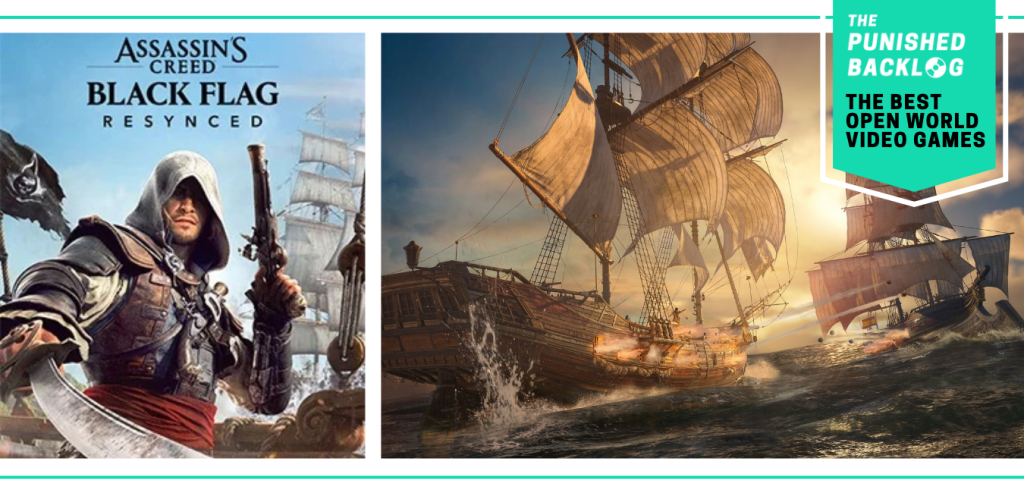
Black Flag is easily my favorite Assassin’s Creed title (either the original or the excellent Resynced remake), and to be honest, it’s not especially close. It has the best main story and protagonist (team Edward Kenway forever!), of course. But most importantly: Black Flag presents the most fully cohesive open world in any game in the franchise.
Sailing across the Caribbean Sea with your crew of pirates is a treat enough on its own, especially with all the sea shanties. But the very idea that you can simply engage with non-stop pirate activity pretty much whenever you like? You can just attack enemy ships and steal their cargo? You can swim onto tiny islands and steal from whatever treasure chests you find lying around? You can sneak your way onto plantations and kill colonizers and take whatever supplies they hide in their warehouses? THAT is immersion, baby!
I love Kenway’s tale of a poor man seeking fortune and freedom in the New World, but some of my favorite moments in any version of Black Flag I’ve played involve just sailing around in search of adventure. Sail the open seas long enough and you’ll find secret hideouts, wild animals to hunt, and tough-as-nails naval skirmishes that will keep your blood pumping for a very long time. Most open-world games present the player with activities like these as simply content to keep you interested for as long as possible, but Black Flag makes sure these activities are consistently fun and (mostly) thematically consistent with the broader narrative at play.
I think I also need to reiterate, just one more time: The sea shanties NEVER get old.
– Written by Sam Martinelli
Platforms: PC, PlayStation 3 & 4, Xbox 360, Xbox One, Nintendo Wii U, Switch (AC IV: Black Flag); PC, PlayStation 5, Xbox Series X/S (Black Flag Resynced)
Assassin’s Creed: Brotherhood
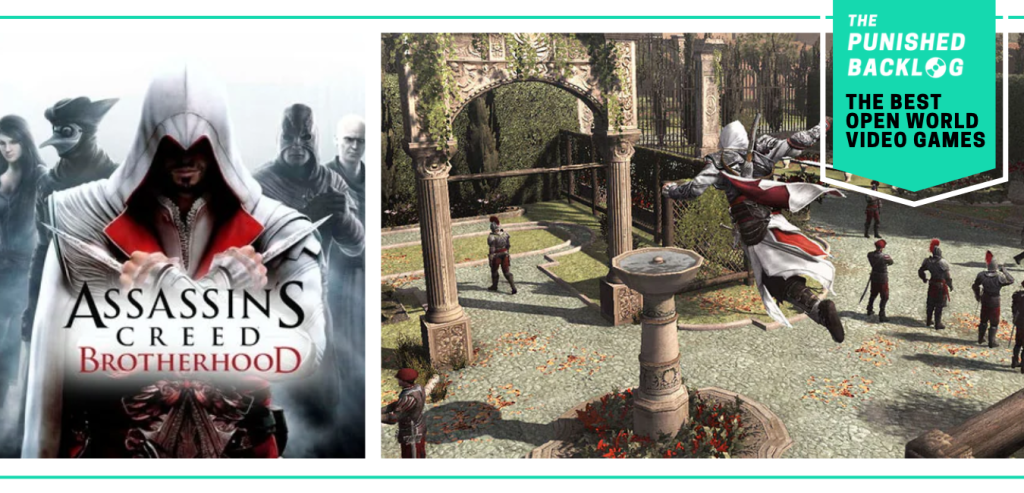
Ubisoft’s flagship stealth series has had plenty of ups and downs, but there’s no denying its lasting influence. “Ubisoft open world” may be a pejorative today, but only because the publisher’s playbook was so strong that every game after Assassin’s Creed felt the need to copy a page. And while the two arguably best games in the franchise — Black Flag Resynced and Odyssey — are already represented on this list, I felt an obligation to include the entry that will forever be my favorite: 2010’s Assassin’s Creed: Brotherhood.
The second game in the Ezio Auditore trilogy, Brotherhood expanded on the strengths of Assassin’s Creed II (released just the year prior) by allowing our suave, smooth-talking protagonist to recruit a team of allies he could then call on whenever needed. Navigating an enemy stronghold but need a guard out of the way? Call in an assassination from above. Got caught and need backup? Have a buddy come to your aid. Or, if you wanted to look really cool, call in the whole team for a massive battle.
The mechanic trivialized an already easy game, sure. But there’s something satisfying about being a wrecking ball in a game like this. You’re an assassin of the highest order, and dammit, AC: Brotherhood made you feel like one. Add in a terrific story that built upon the previous game’s already impressive foundation; beautifully designed dungeons that were a joy to explore; and a massive open world that, at the time, felt groundbreaking, and Brotherhood became an experience I will never forget.
And hey, it’s not part of the open world, but Assassin’s Creed: Brotherhood also featured a terrific suite of team-based and free-for-all multiplayer modes. Ubisoft sure don’t make ‘em like they used to.
– Written by David Silbert
Platforms: PC, Mac, PlayStation 3 & 4, Xbox 360, Xbox One, Nintendo Switch
Assassin’s Creed Odyssey
I remember reading in a New York Times article that Assassin’s Creed Odyssey was going to be used in classrooms to help teach history. I thought, Lol, really, an Assassin’s Creed game? And then I tried it.
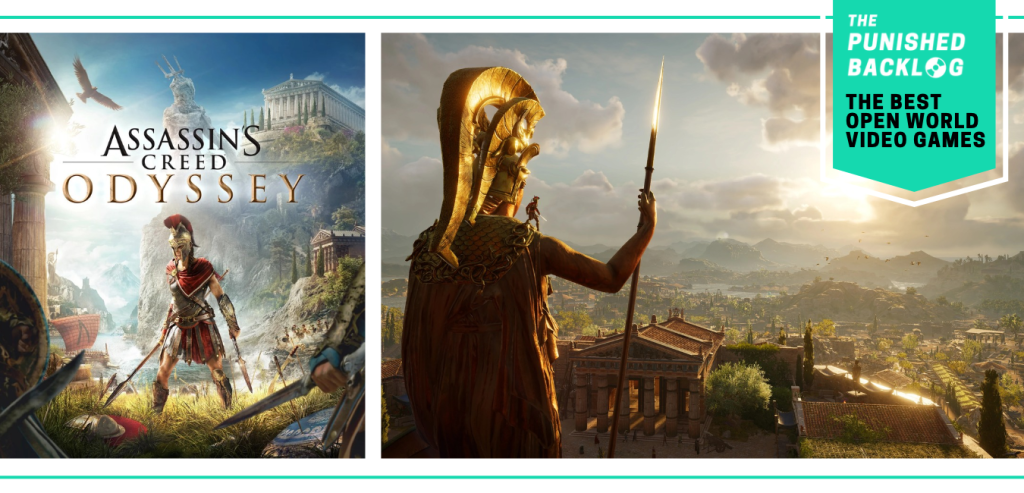
This game is dope as hell. I wish I could just leave the blurb right at that, but that wouldn’t be fair to Assassin’s Creed Odyssey. I had tried AC games before, but I had always bounced off of them. I was immediately invested in Odyssey for two reasons: 1) Kassandra, an absolute badass of a protagonist, and 2) the fidelity and depth of the surroundings. The game’s opening island is gorgeous and feels lived-in. I was sad to leave, just like Kassandra, but soon, the beauty and majesty of the great wide world made me forget all about my hometown.
Assassin’s Creed Odyssey gave players an incredible amount of freedom both on land and by sea. Kassandra could climb mountains, speed across plains, and conquer cities. The ocean felt both vast and conquerable in my boat, fueled by rowing men and sea shanties. Sometimes, I would scope out areas as Kassandra’s companion Ikaros, a golden eagle, just to experience the divine beauty while flying.
By the time I got to Athens, I was fully obsessed with Ubisoft’s 2018 adventure. Once in the great city, I could completely understand the vision of the game’s Discovery Tour mode. I could not believe I was really walking around these ancient monuments. Seeing the markets alive with people was surreal. Climbing to the top of the Parthenon made me gasp.
Assassin’s Creed Odyssey is a ridiculously big game. It shouldn’t work, but it does. Perhaps it’s because the setting of Ancient Greece holds so much mystique and wonder in our society. Maybe it’s that each and every island or city had something worth exploring. It could be that, largely undistracted by all of the Templar/futuristic mumbo jumbo, Ubisoft focused more fully on the “present” action. And sure, is the gameplay the most exciting of all time? No, but I never got tired of drop-kicking a guy off of a gorgeous Grecian cliff, nor of trying to romance the village healer on a remote mountain, nor of sailing the seas with my friends to a destination unknown. In Assassin’s Creed Odyssey, I truly felt the world was my oyster.
– Written by Amanda Tien
Platforms: PC, PlayStation 4, Xbox One
Bowser’s Fury
When Bowser’s Fury was first announced as an add-on/experiment as part of the re-released Super Mario 3D World, I didn’t really know what to expect. Nintendo seemed to be toeing the line between the course-based traditional Mario games and the more flexible structure of Super Mario 64/Sunshine/Odyssey, all within one space. It seemed ambitious! Almost too ambitious for a pack-in to a Mario game no one would call their favorite (except for me).
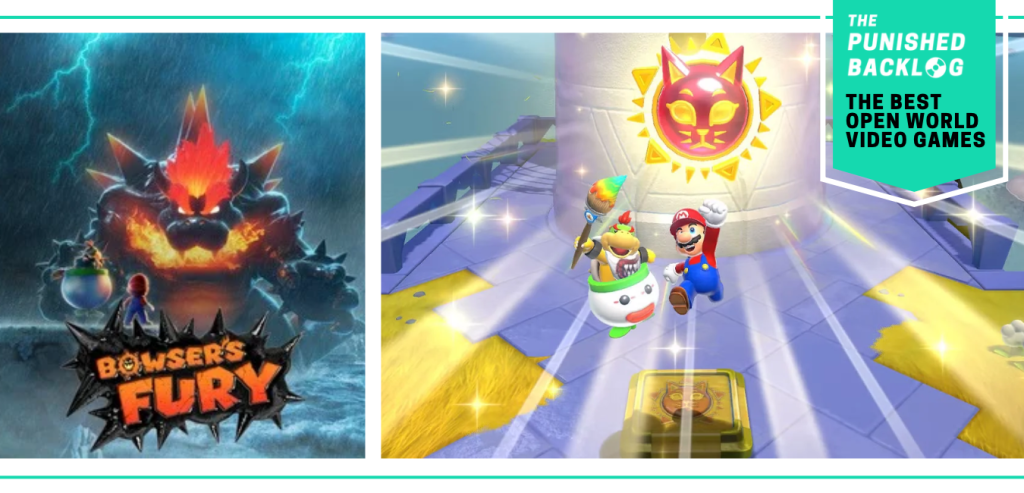
I should have had more confidence. Weird Nintendo is the best Nintendo, and Bowser’s Fury is weird Nintendo at its peak. Bowser’s Fury is one large, flooded world with islands packed around the lake. Each island represents a new biome and challenge, built around opening Cat Shrines dotted around the environment. The world is simple but layered, with different corners to find as you cruise along on a dinosaur named Plessie. The challenges are well structured, the platforming is tight, and the kaiju-sized boss fights are goofy but fun. While not the most complex or feature-rich world, it’s a beautifully pared-down experience that fits the size one might expect from an add-on.
Most importantly, though, Bowser’s Fury proves that a fully open-world Mario game can work. Nintendo can break away from the world-based approach of Odyssey and create a seamless experience for Mario and his pals to explore and discover, without taking away the core elements that make a Mario game, well, Mario. They can integrate courses and challenges into the world, loosen the reins to allow players to choose what they want to do next, and still have it feel like Mario. Bowser’s Fury feels like an attempt to see what non-linear elements players will embrace within the typical Mario structure. And it is an incredible attempt at that.
– Written by Gary Wilson
Platform: Nintendo Switch
Bully
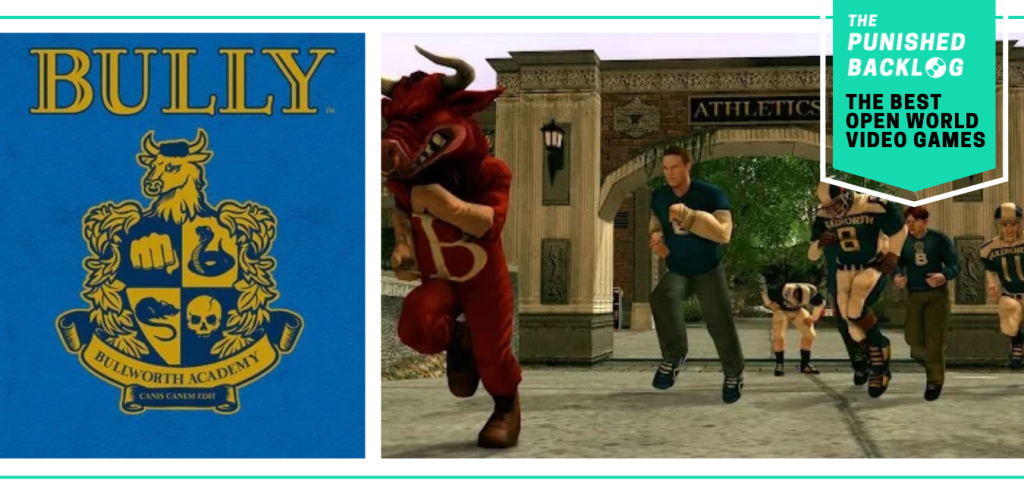
Rockstar Games is famous for its massive open worlds that demand scores, if not hundreds, of hours of investment. Red Dead Redemption 2 requires a serious commitment — not just to its hyper-grounded gamefeel, but to its vast wilderness and dizzying number of missions. Grand Theft Auto V is more arcade-y, but the sheer number of side characters to meet and activities to partake in can distract even the most focused gamer.
But Bully… that game was different. A leaner, meaner, more focused experience, Bully deviated from past games like Grand Theft Auto: Vice City and San Andreas by ditching the wanton violence and police chases in favor of pranks, shenanigans, and truancy officers. As protagonist Jimmy Hopkins, the player attended (or skipped) classes, engaged in school brawls, and leveled up skills that would translate to the world outside of Bullworth Academy.
Paying attention in chemistry unlocked access to stink bombs; learning geography let you find more collectables on your map. Much like Persona and Metaphor: ReFantazio, Bully challenged players to manage their time and resources in a way few other games do. And while yes, Jimmy is ultimately an obnoxious, loud-mouthed brat, there’s an inherent charm to his rebellious nature and no-nonsense demeanor that stuck with me long after the credits rolled.
Bullworth isn’t a college campus, but it might as well be one. Bully nails the feeling of living on your own for the first time, trying the whole “adulting” thing, but also letting your inner kid run amok for another four years until it’s time to get a job. I played it long before I became an adult, and 20 years later, it reminds me how lucky I was back when I had zero responsibilities, deadlines, or cares in the world.
– Written by David Silbert
Platforms: PC, Xbox 360, Wii, PlayStation 2, iOS, Android
Burnout Paradise
Games got better with the launch of Criterion Games’ Burnout Paradise. Not just driving games, or open-world games, or demolition games, or exploration games: all genres that can be attached to Burnout Paradise.
Games in general got dramatically better thanks to Burnout Paradise. It raised the bar for a genre that felt solved, where competitors were opting for photorealism and sim aspects over gameplay innovation. Forza Motorsport, Gran Turismo, and Project Gotham Racing had pushed the market into a visual arms race, both for courses and for cars. Meanwhile, series like Burnout had carved out a niche with its more arcade style of racing, harking back to the days of Daytona USA and OutRun. Innovation in the racing genre was waning.
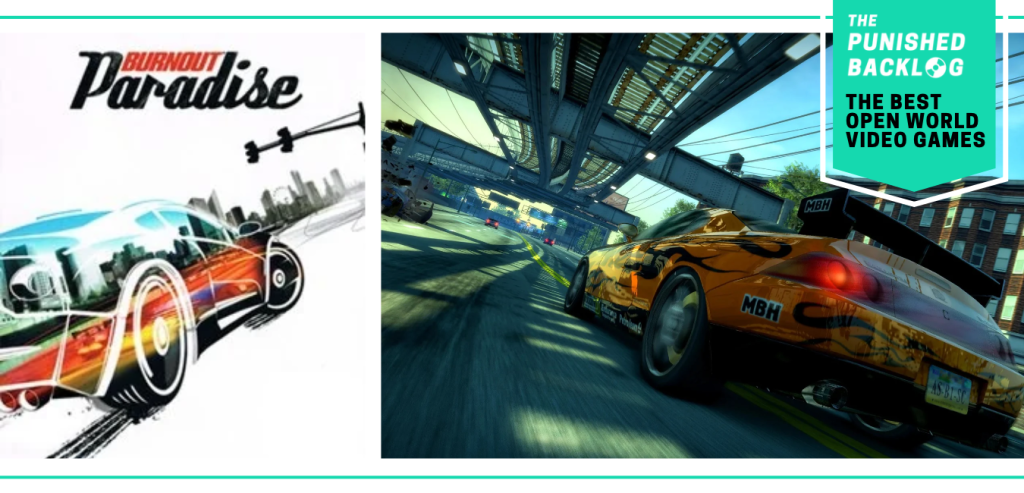
That is, until Burnout Paradise, which was bold enough to try something different. It removed the guardrails and told players, “Just go for it.” Crash where you want, race where you want, find corners with hidden items anywhere. Burnout Paradise pushed to make the world alive, with easy drop-in and drop-out multiplayer that allowed flexibility and freedom everywhere. The rules were gone, and the doors had opened. Anything was possible, because Criterion decided to let players make the fun.
It helps that Paradise City is a vibrant hub of nonsense. The bright visuals make the crashes look awesome, the side streets and corners blending beautifully into vistas and rooftops. The cars pop, even when hurtling through the air at a billboard at impressive speeds. Burnout Paradise is one of the greatest open-world games simply because it leaned into creating a playground: one where anyone can do anything behind the wheel, with minimal rules. Its legacy became games slowly letting players control more and more about their experiences. Games like Breath of the Wild or Minecraft don’t exist without Burnout Paradise proving gamers can find their own fun. You want to race? Do it. You want to crash? Please and thank you.
You want to have fun? Play Burnout Paradise.
– Written by Gary Wilson
Platforms: PC, PlayStation 3, Xbox 360 (original version); PC, PlayStation 4, Xbox One, Nintendo Switch (Burnout Paradise Remastered)
Cyberpunk 2077
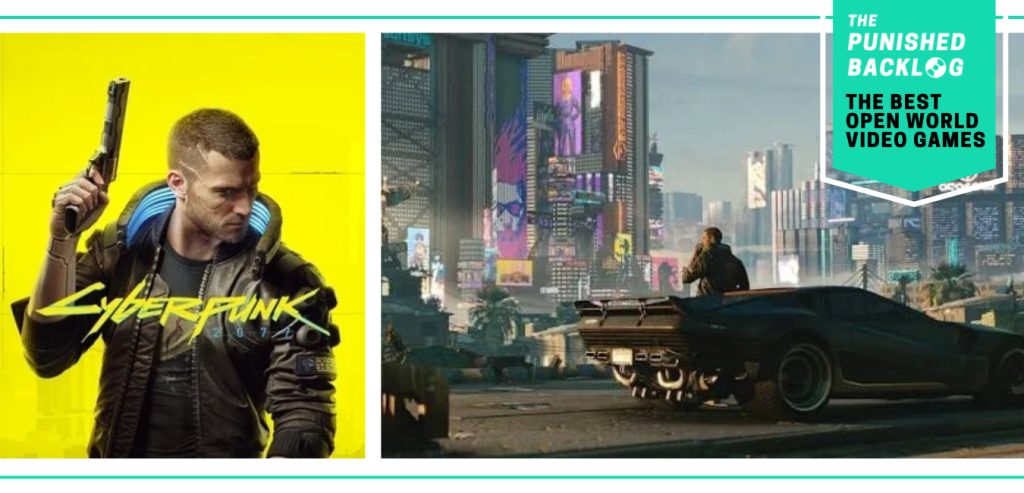
Theseus’ ship comparisons feel a bit played out, but Cyberpunk 2077 started its life in such a miserable state that the current iteration of Night City lacks much resemblance to those early days. Hell, even the bones were bad, as the world was devoid of much life. Cyberpunk 2077 in 2026, however, is a fantastic open-world experience that feels like the natural inheritor of the Grand Theft Auto IV mission structure fused with modern open-world games’ insistence on skill trees.
Cyberpunk 2077 fills its world with so many interesting characters, stories, and scenarios that to experience them all requires playing with protagonist V’s various skill sets. It is a cyberpunk joyride from beginning to end, made even better by the Phantom Liberty DLC. There’s enough room here to make V your own in a way that other Grand Theft Auto clones, even the terrific Sleeping Dogs or Like a Dragon series, never quite provide. Those games have a story that they are hell-bent on telling; Cyberpunk 2077 wants to send you hell-bound as you spiral in, around, and through its vibrant Night City.
– Written by Clint Morrison, Jr.
Platforms: PC, Mac, PlayStation 4 & 5, Xbox Series X/S, Xbox One, Nintendo Switch 2
Death Stranding 2: On the Beach
Hideo Kojima and his team somehow caught lightning in a bottle twice. I enjoyed Death Stranding when it came out in 2019 and immediately had a hard time revisiting it during the 2020 pandemic and beyond. My best friend in graduate school said that the best thing they could do with Death Stranding was streamline the experience. Death Stranding 2: On the Beach does just that: It’s a love letter to Kojima Productions’ previous games, one that delivers on the finest of Sony’s open-world formula.
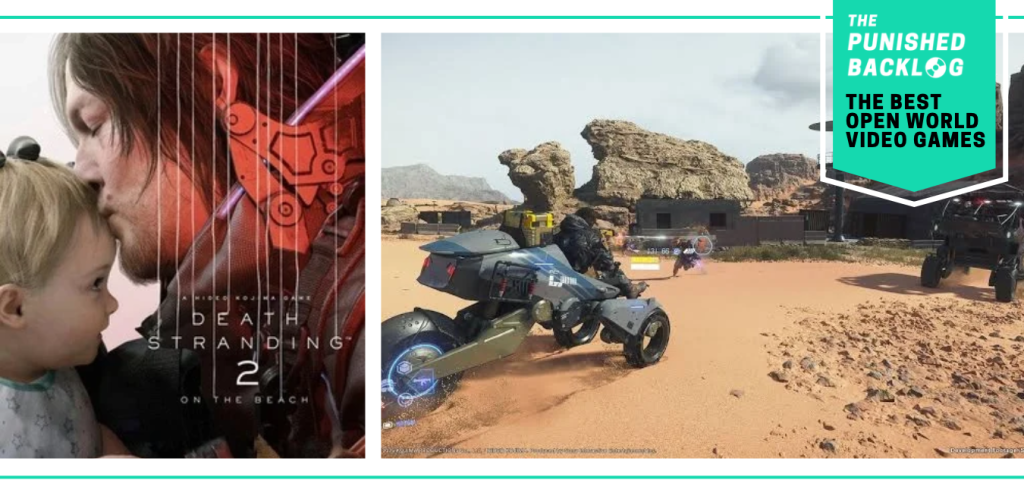
Death Stranding 2: On the Beach is still the best-looking game on PlayStation 5 (begrudgingly, I have to say this will change come November). Norman Reedus’s Sam Porter Bridges is an everyman navigating an open-world simulation of northern Mexico and Australia. Moving beyond the United States-inspired original, Death Stranding 2: On the Beach tells a richer narrative with much-improved navigation tools.
At its heart, Death Stranding 2: On the Beach is a walking simulator where delivery tasks are key. I love just walking around Bridges’ eco-weird world. Much like Kojima’s previous open-world titles, Death Stranding 2: On the Beach is a quieter affair than what players find in many other sandboxes. Combat is so de-emphasized that losing to bosses prompts a “pretend you won” option.
I don’t know if we’ll ever have another experimental film-inspired open world like Death Stranding 2: On the Beach. It feels like a mini-miracle we got this sequel at all.
– Written by Clint Morrison, Jr.
Platforms: PC, PlayStation 5
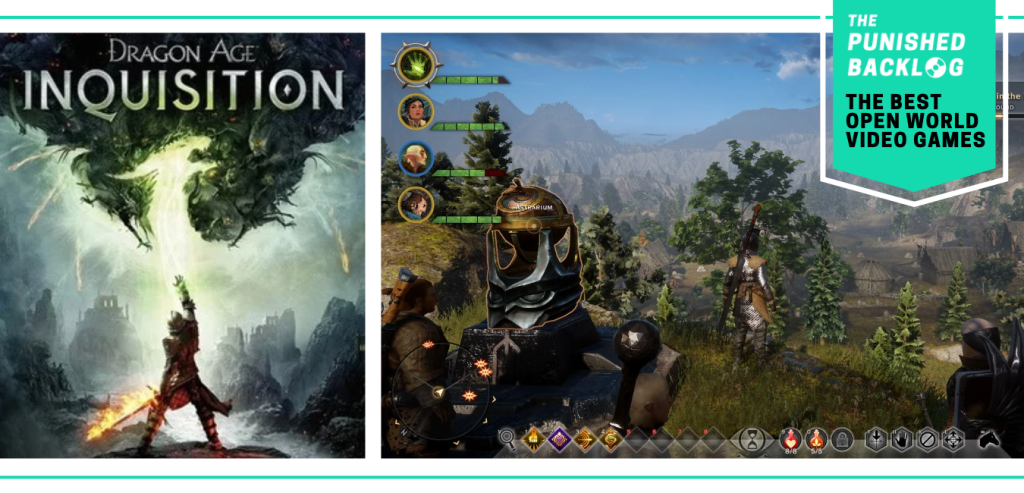
Dragon Age: Inquisition
I will be completely honest: I did not initially sign up to write a blurb about Dragon Age: Inquisition, even though I loved BioWare’s fantasy epic adventure when I played it over a decade ago. But I just didn’t feel the zesty passion that I had to write about it.
But last month, as you likely already know, BioWare was unceremoniously shut down. Writers on our site began to talk in the Discord, and fellow editor David Silbert mentioned he owned all the Dragon Age games but had never played them and now wanted to in honor of the devs. I was like, “Woah there buddy, these are CHONKY GAMES. That would be hundreds of hours of your life, so maybe just play one…” And even though I think Dragon Age: Origins has the most innovative storytelling and Dragon Age: The Veilguard is the newest and shiniest, I found myself recommending Inquisition.
Dragon Age: Inquisition is not a true open world in that there are gates at the far ends of each area. But the lands you do have to roam are massive, full of interesting quests and engaging characters. Your party members talked to each other as you roamed the land, which made me excited to change up my companions to unravel more story.
The initial section is so intricate that it became a PSA among gamers to “Leave the Hinterlands.” My husband and I still reference this with any new game we play, asking, “Have you left the Hinterlands yet?” I’ll always take my sweet ass time in a tutorial section, mostly because I’m having fun marveling at how beautiful things are… and because I’m picking up everything I can find to sell so I can get better weapons ASAP.
Additionally, BioWare did something really cool with a “war room” where players can make choices that affect the world at a high level with partnerships or crisis management. The combination of “in the world” combat and the war room gave the sense that your team of magic Inquisitors was truly shaping the world at a micro and macro level. I’ve never seen another game quite pull it off that way, though Ubisoft certainly tried with Assassin’s Creed Valhalla.
While Dragon Age: Inquisition is not the best open-world game on this list, it is still a great open-world game (and also BioWare’s best-selling game ever). It was the first game to win Game of the Year at The Game Awards, and I wrote in our GOTY ranking list about its influence on the industry. So, no, I wasn’t going to write about it initially. But you don’t know what you got until it’s gone, right? They paved paradise and put up a parking lot.
– Written by Amanda Tien
Platforms: PC, PlayStation 3 & 4, Xbox 360, Xbox One
Elden Ring
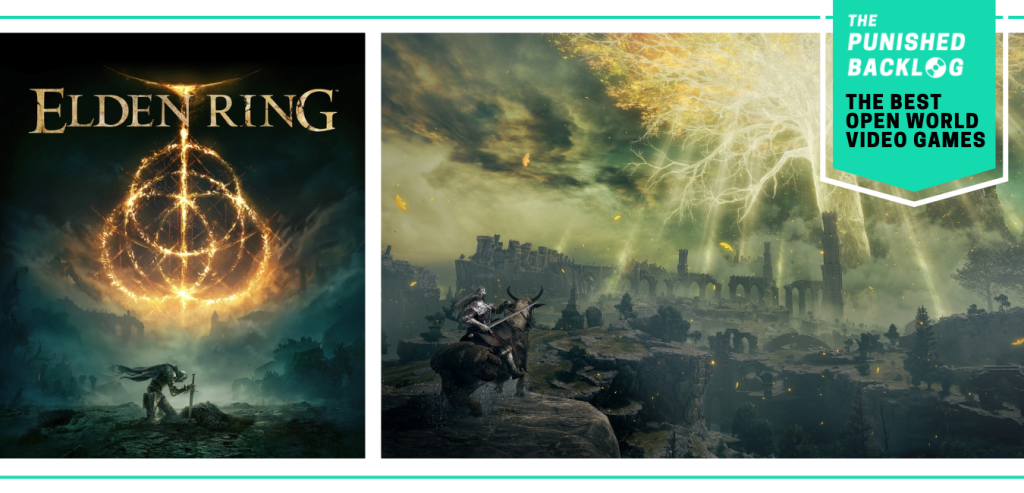
I didn’t even finish Elden Ring, and I know it belongs on this list. Elden Ring still, to me, feels like the future of video games — a world without a quest log, without a mini-map. Exploring The Lands Between based on sheer whim, impulse, and memory was astounding. The promise of an open world like that is one thing, but actually being able to fulfill that promise with complex settings, difficult bosses, and heartbreaking environmental storytelling is another.
FromSoftware’s 2022 fantasy epic Elden Ring is one of the best games I’ve never beaten (but writer Kei Isobe’s love for it always inspires me). The world, and freedom within that world, is what kept me there for so long. And the reason I left is that I was incredibly impatient — I hated dropping all of my Runes every time I died (and inevitably permanently losing them when I then died again without recovering them). In retrospect, I probably would’ve stuck with the game longer if it did have some guardrails (as others have argued); structure would have stopped me from wilding out and going off-track. But that’s also the very thing that made me think it was so freaking cool in the first place.
I still think about this piece Sam wrote a few years ago about his own experience playing Elden Ring and giving himself permission that when he’s emotionally done with a game, to just be done. You know what I also still think about? The moment when I first stepped out from the cramped, dingy hallways and into the glowing light of the Erdtree.
– Written by Amanda Tien
Platforms: PC, PlayStation 4 & 5, Xbox Series X/S, Xbox One, Nintendo Switch 2
Final Fantasy XV
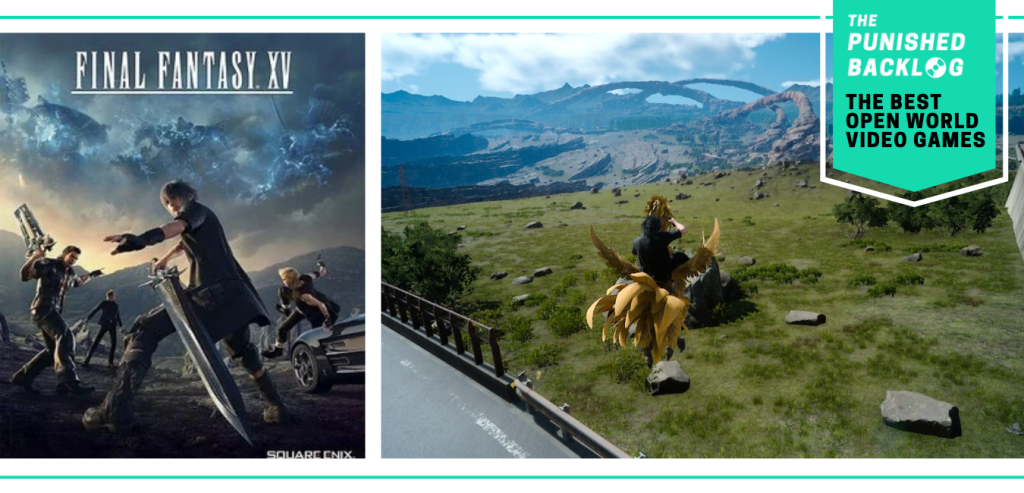
After years of development, Final Fantasy XV released in 2016 to great anticipation. Some people loved it, others had their complaints, but the Royal Edition that was available when I finally got around to playing it had improved the game to its best state. A completely open-world experience, Final Fantasy XV follows Prince Noctis with his royal guard of Gladiolus, Ignis, and Prompto as he tries to bring peace to the world and confront the threat to his kingdom. Along the way, he gets help from his betrothed, Princess Lunafreya, and Marshall Cor Leonis, as well as the Eidolons.
Personally, I found the open-world experience amazing. You’re given the Final Fantasy equivalent of a Rolls-Royce, which is fully customizable, to drive around in with your party, and it’s such a vibe. Of course, you can quickly travel everywhere with fast travel, but cruising around the roadways with the squad blasting throwback tracks from other Final Fantasy games is immaculate.
Along the way to your destination, you may hop out to confront monsters, collect resources while exploring, or obliterate a troop of guards dropping from an airship. The conversations the group has while driving feel immersive and lead to interesting lore bits about the characters and the world. You can even suggest new behavior mechanics. With the ability to travel from the end-game area back to the open-world portion, there’s so much to experience as you take on dungeons, master the arena in Altissia, and even collect ultimate weapons.
I sank dozens of hours into this title and would immediately hop back in for the lovely experience again. Did I mention the car eventually flies? Good luck landing, though…
– Written by Vaughn Hunt
Platforms: PC, PlayStation 4, Xbox One

The Forgotten City
During the sleepy lull of the week between Christmas and New Year’s Eve, I downloaded several games on a subscription service, thinking I’d try each for an hour and move on with my life. However, the very first game I tried in that session was The Forgotten City — and I didn’t even bother opening any of the other downloads.
The Forgotten City caught me totally off-guard with its evocative story, clever gameplay, and beautiful open world. I didn’t have very high expectations going in — all I really knew was that it was originally a fan-made Skyrim mod that ended up being so complex that it became its own game. The final hours of The Forgotten City still stand out as one of my favorite gaming memories; this title can fully rest on its own laurels, especially because of its setting.
In this adventure, players (and local citizens) are stuck in a time loop in an Ancient Roman village that happens to be in the afterlife. The only way to break free is to figure out who is going to break “The Golden Rule” (i.e., commit a sin) within 24 hours. Players have to explore the gorgeously rendered town to investigate which citizen is the troublemaker. However, if the player is caught sneaking around or commits a crime themselves, the loop begins again. Luckily, items stick between runs, and so you might find something in one loop that can help change behavior in the next. I loved that The Forgotten City asked me to get to know this open world really well; the better I knew it, the faster I could get around and try to catch NPCs doing certain actions at different times in the day. The game is part mystery, part RPG, part action-adventure, and I loved every second of it.
Open worlds are difficult, complex, and expensive to make with any kind of fidelity, and it’s part of why indie studios don’t attempt them that often. Developer Modern Storyteller nailed the assignment with The Forgotten City because they kept their scope really tight and focused. The world here feels expansive, detailed, and interesting, and the studio achieved that by focusing on quality over quantity. The Forgotten City was one of my favorite games of 2021, and just writing about it makes me want to return.
– Written by Amanda Tien
Platforms: PC, PlayStation 4 & 5, Xbox Series X/S, Xbox One, Nintendo Switch
Ghost of Tsushima
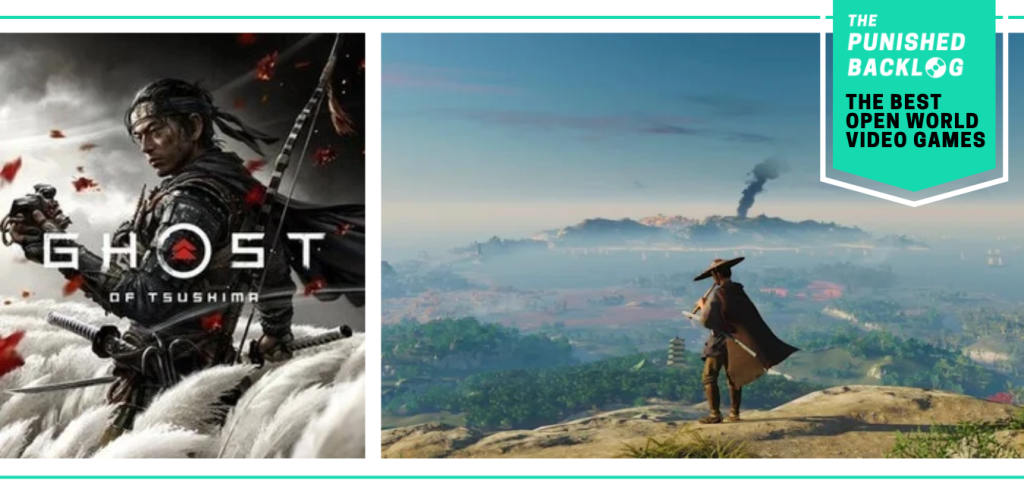
I was skeptical of Ghost of Tsushima until I had a chance to finally play it, discovering the most beautiful game I’ve ever played. Our eponymous “ghost” is Jin Sakai, the surviving member of a war party tasked with stopping the invasion of Japan by the Mongolians. After the fall of his fellow men, Jin makes it his life mission to remove the mainland invaders.
In order to build this world, Sucker Punch Studios spent considerable time visiting the island of Tsushima so they could reconstruct it for the game. As you experience each chapter of Jin’s attempts to drive the Mongols out of his homeland, you travel through the game’s hyper-realistic scenery, which features areas such as a forest in full autumnal bloom, the swampy remains of a battlefield, roaring coasts, the snowy mountain caps of a mountain, and much more.
As much as I loved driving the main quest forward, I found myself drawn to each of the characters Jin meets on his path, such as Lady Masako, and their respective plights. These compelling side stories flesh out the context of Tsushima’s politics, history, and characters. They also bring you deeper into the world, sometimes skipping ahead of the main quest depending on how far you advance them. Similarly, the duels in Ghost of Tsushima are compelling samurai showdowns, with iconic scenery and a unique one-on-one camera angle that emphasizes their importance. Most of the optional collectibles, like points of meditation, onsens (Japanese hot springs), and strikable bamboo shoots, were a lot of fun to experience.
I’d be remiss not to mention the stealth-focused gameplay, which was really well implemented and only got better as the world opened up. Jin has a number of weapons at his disposal that can change the pace of battle, and his ability to operate out of sight does maximum damage to the Mongols, who panic as things go unexpectedly wrong. No matter which way you play, however, Ghost of Tsushima is a delight.
– Written by Vaughn Hunt
Platforms: PC, PlayStation 4 & 5
Grand Theft Auto IV
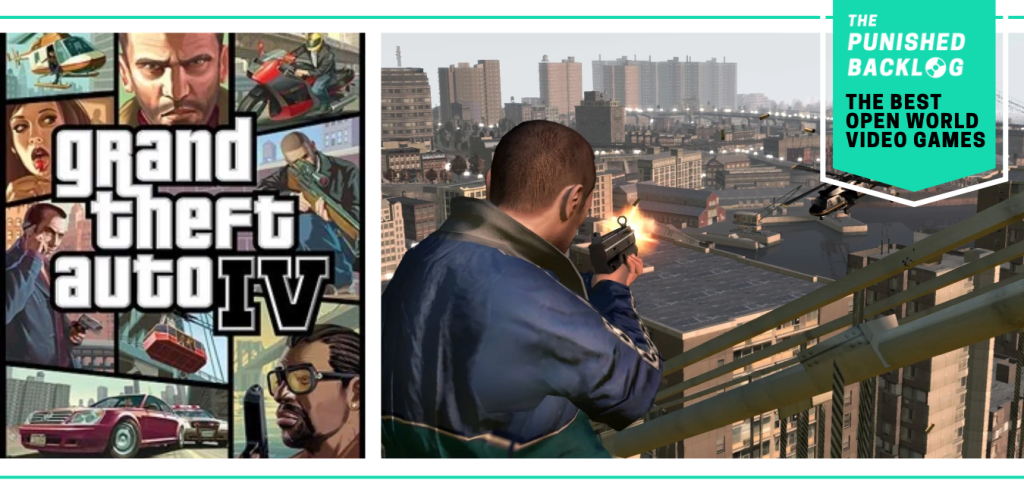
A list of the best open-world games isn’t complete without Grand Theft Auto. The franchise that popularized the genre, GTA goes beyond practically every other open-world title by offering not just a world to explore, but a sandbox to savor. Each American-inspired city Rockstar Games has crafted thus far has its own distinct flair, but all share the same ethos: Come to play, cause mayhem, and have fun.
While each new series iteration has its strengths and weaknesses, Grand Theft Auto IV remains my personal favorite. The story of Niko Bellic, a Serbian immigrant who comes to America in search of riches and revenge, will resonate with anyone who has struggled in this country or elsewhere. His gradual ascent — from the dregs of Liberty City to the upper echelon of organized crime — isn’t one to emulate, of course; he’s a bad dude like most GTA protagonists. But there’s something cathartic about clawing your way up the social strata and kicking some shitty people down in the process.
More than the story, though, Grand Theft Auto IV won me over with its unforgettable open world. Liberty City isn’t just a collection of streets to drive down and pedestrians to (hopefully) drive around; it’s a living, breathing character all its own. The flashing lights of Star Junction (aka Times Square), gorgeous city sunsets, and countless hot dog vendors culminated in an experience that felt truly lived-in. It helps that GTA IV has my favorite radio station in any game ever: the sultry yet smooth Jazz Nation Radio.
Grand Theft Auto IV has since been outdone in scale, but its engrossing story and beautiful city will forever be timeless.
– Written by David Silbert
Platforms: PC, PlayStation 3, Xbox 360
Horizon Zero Dawn
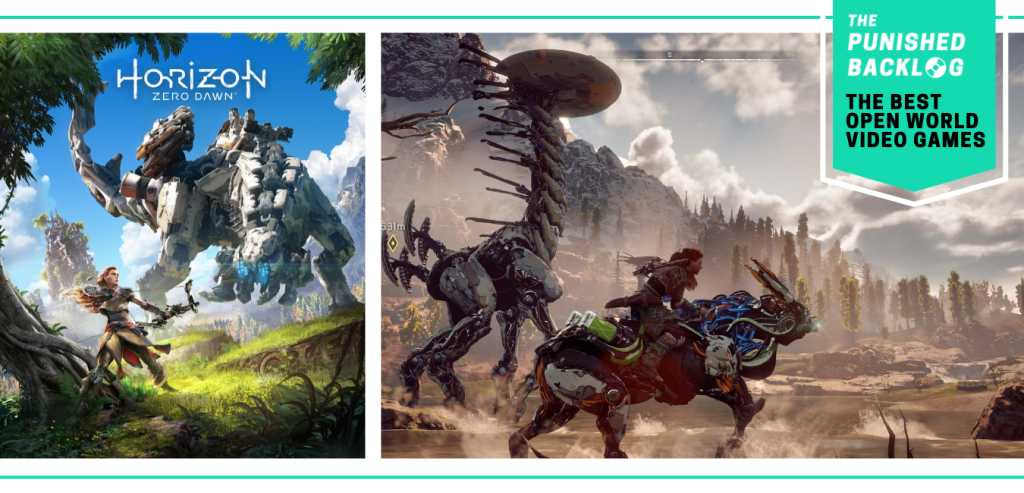
Standing in the wide open plains, tall grasses weaving in the wind, the sun rising, a river burbling, and a herd of robot dinosaurs charging in front of me… Horizon Zero Dawn blew my mind.
Horizon Zero Dawn was the first open-world game that I truly wanted to see every corner of. I spent hours just racing through tundras and meadows on a tamed Strider. Even when the game did the classic “Ubisoft tower thing,” I was still impressed because this game had me climb a giant mechanical brontosaurus to see the map. I kept saying to myself, “Wow.” The technical prowess of the PlayStation 4 was on full display in Guerrilla Games’ 2017 hit.
I was deeply gripped by Aloy’s journey — perhaps because I also was a red-haired young woman who felt like she didn’t belong anywhere. Aloy’s journey in Horizon Zero Dawn is an independent and often lonely one, but as a result, the pace is set by the player. I took my time making my way, enjoying side quests and exploring in addition to pursuing the main storyline. Just like Aloy, I was desperate to try to save the communities I had befriended. I appreciated the care taken to make each town and tribe feel distinctly different. And, all throughout, I was curious to learn exactly what had happened all those years ago to lead to this moment.
I felt a lump in my throat whenever I listened to ancient voice notes of people who feared the climate apocalypse (real) or who were worried they’d never get to say goodbye to their loved ones (also real). Most games’ audio collectibles require players to fully stop what they’re doing, standing still and hitting play from a menu. But I loved that I could still walk through fields as Aloy while listening to emotional stories, especially in the end-game and in the Frozen Wilds DLC.
While the sequel Horizon Forbidden West was absolutely gorgeous and had some fun side quests, it failed to live up to my expectations from the first game. I’ll never forget how I felt, climbing up the wall and seeing all of the Carja Sundom before me.
– Written by Amanda Tien
Platforms: PC, PlayStation 4 & 5

The Legend of Zelda: Tears of the Kingdom
2017’s The Legend of Zelda: Breath of the Wild changed how gamers feel about open-world games. As a massive Zelda fan, I obviously loved every minute of it, yet something felt just a tad bit missing about it. 2023’s Tears of the Kingdom, a sequel set in the same world of Hyrule, gave me everything I didn’t get from Breath of the Wild and more.
Much like its predecessor, Tears of the Kingdom allows players to complete dungeons and story developments in any order they like while traversing a massive open world teeming with little secrets in every corner. What Tears adds, however, is even more immersive simulation qualities, including the ability to construct your own weapons with the Fuse ability and build all sorts of wild contraptions with the Ultrahand ability. All of a sudden, you can defend yourself with a makeshift laser spear or build a wonky flying machine to explore all the floating islands in the sky.
I’ve gushed about Tears so much for this site, particularly how everything in the world feels mechanically and thematically connected and that even the emptiest parts of it (like the Depths, which I found endlessly fascinating) still provide opportunities for immersive play and experimentation. When it comes to its merit as an open-world game, however, its greatest strength is that it leaves no stone unturned. Nearly every hill contains a cave entrance nearby. Every sky island challenges players to find creative ways to travel long distances through the air. Every road in the depths leads to some hidden treasure or abandoned mine. Every single secret or point of interest in Tears of the Kingdom is worth searching for, and that’s not something I can honestly say about many other open-world games, even the ones good enough to make this very list.
– Written by Sam Martinelli
Platforms: Nintendo Switch 1 & 2

The Marvel’s Spider-Man Series
As a kid, there were two things I wanted to be when I grew up: Spider-Man, and a New Yorker. I got to be one of those.
One of the first things I did in Marvel’s Spider-Man (2018) was go uptown to my alma mater, Columbia University. I couldn’t believe how carefully the campus had been re-created. There was my old dorm! My favorite library! The places I sat with my friends for hours! I parkoured off the roofs of buildings I had definitely not snuck up to! I did backflips all over campus, then web-slung to the shitty apartment I lived in after graduation. Exploring NYC in a video game as Spider-Man was, to put it simply, freaking awesome.
In Marvel’s Spider-Man: Miles Morales in 2020 and Marvel’s Spider-Man 2 in 2023, Insomniac gave us even more of the greatest city in the world. While I’m writing about three different games in this blurb, their vision is so consistent that I feel we can get away with a combo blurb. Each iteration got more and more detailed — more boroughs, more trees, more crimes to stop on the street. There were side quests that made both me and David cry. I can count the number of games I’ve gotten 100% achievement completion for on one hand, and Spider-Man 2 (which was my Game of the Year) is one of them. I normally do not care about collectibles or goofy little mini-games, but I loved swinging around so much that I took any and every excuse to stay a bit longer in Insomniac’s New York.
I haven’t lived in NYC for over a decade, but I go back a few times a year. Like millions of other people who have at one time and/or do call New York home, I still love it. But I am also happy in and with my life, and so instead I focus on cherishing the experience as a returning visitor. Getting to explore New York as Spider-Man was one of the best homecomings I could ever imagine. I wish the games allowed a bit more interactivity with the open world (and it’s certainly an incomplete portrayal of the city), but there are some great details. For example, I enjoyed the side quests that allowed Miles to support a local graffiti artist and befriend the owner of a bodega (Bodega Cat Backpack!!!). I love that when Spider-Man lands on the sidewalk, people cheer or ask for selfies or tell him to get out of the way. That’s New York, man.
Just thinking about these games makes me excited for my next IRL visit back — even if I won’t be wearing the Spidey-Suit. Probably. Well, actually, maybe I’ll make it back for Halloween! Perfect. Dreams really do come true!
– Written by Amanda Tien
Platforms: PC, PlayStation 4 & 5
Metal Gear Solid V: The Phantom Pain and Ground Zeroes
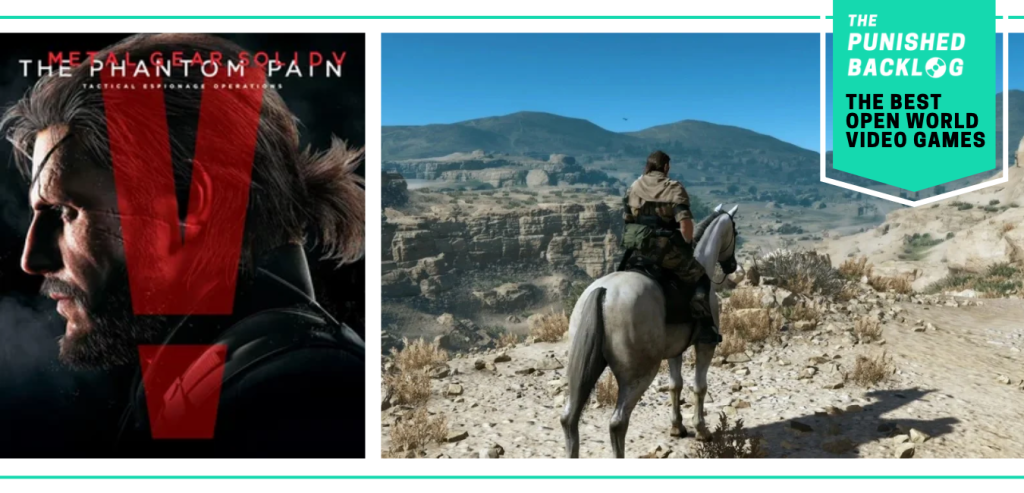
In the mid-2010s, Hideo Kojima and his incredible team gave us two beautifully designed open worlds. In hindsight, Metal Gear Solid V: Ground Zeroes and Metal Gear Solid V: The Phantom Pain feel like the best of gaming’s pre-open-world past and post-2015 present. These spaces were not yet overwhelmed by the Ubisoft bloat, and there aren’t really skill trees or superfluous role-playing elements quite yet.
The worlds around Big Boss in both games felt alive and dynamic, while still mission-based. I’m not sure if either game works without the game design of Metal Gear Solid: Peace Walker. They aren’t perfect by any stretch and feel somewhat sparse when sitting alongside Cyberpunk 2077’s Night City or even the world of Red Dead Redemption 2. The open worlds of the Metal Gear Solid V duology provide space to breathe, allow players to tackle any mission in a variety of ways, and sit with the time given. This autonomy within the design is still unmatched outside of maybe Nintendo’s The Legend of Zelda: Breath of the Wild and Tears of the Kingdom duology.
Both games’ incompleteness intrigues and torments. Notoriously, we are missing the final act due to developer-publisher conflicts. With each new mission and reveal, the world of Metal Gear Solid V: The Phantom Pain felt on the bleeding edge of the original MGS titles. We are left with a figurative phantom pain of what was lost; a ghost of where the open world would go next. It feels like a truly interactive film without closure. It may be more beautiful inhabiting such absence.
– Written by Clint Morrison, Jr.
Platforms: PC, PlayStation 3 & 4, Xbox 360, Xbox One
Red Dead Redemption 2
It’s no secret amongst the Punished Backlog group chat that Red Dead Redemption 2 is my favorite game of all time. I simply adore the story, the characters, and the ambiance. But none of these would exist in harmony if not for the game’s biggest character: the open world.
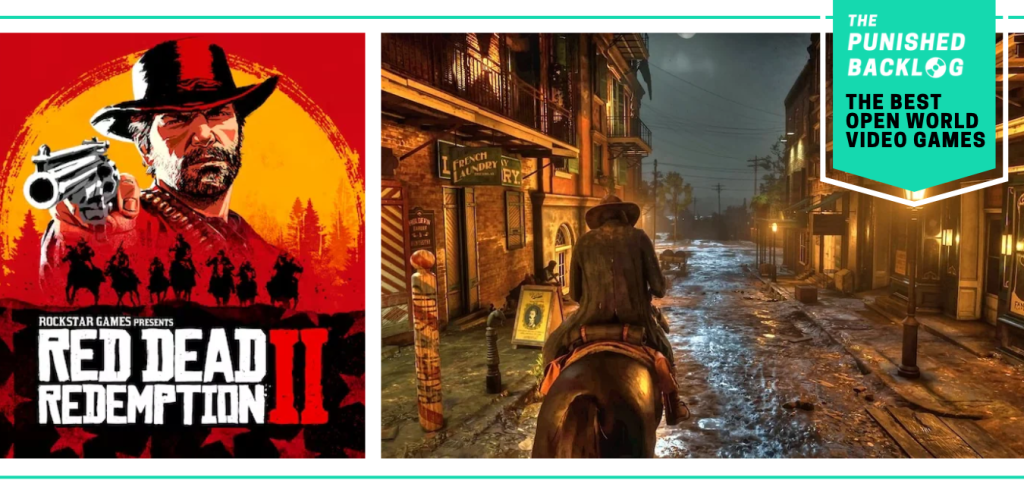
Red Dead Redemption 2 thrusts the player into a time of change in America, as our outlaw protagonists face the end of their lifestyle, desperately trying to cling to the freedom their adventures offer them. Perhaps that freedom isn’t more evident than it is at Horseshoe Overlook, the first real campsite in the game, where the Van der Linde gang settles over a stunning landscape that not only pulls you in, but immediately has you considering the possibilities of this world. Mountains, plains, canyons, and rivers all feel within reach, with more discoveries around every corner. The beauty of America is captured perfectly, and it is easy to get lost with just a quick detour off the path.
Of course, you can make an open world as pretty as you’d like, but without things to do, it can wear thin quickly, and this is where Red Dead Redemption 2 goes above and beyond with its cities and towns. Valentine draws the player into a Jackson Hole-like town at the foot of a mountain, feeling quaint yet still bustling with people starting new lives. Meanwhile, you can feel a more downtrodden and worn-down life in Rhodes, a seemingly struggling southern town bordered by rich plantation owners struggling for control of the region. And I would be remiss not to mention Saint Denis, a clear stand-in for New Orleans, which gives us a taste of a fast-growing city at the turn of the century, with new secrets around every corner.
Each city and town has its own distinct character, opportunity, and occasional despair. They feel real, with actual day-to-day activities to do. Arthur can shop, get a haircut, and even go on a date. It’s up to the player to decide what’s next. And outside city limits, the world is your oyster. Arthur can dig up dinosaur bones, hunt great beasts, track a serial killer, or simply take in the night sky at a campsite. Many of these activities sound menial, but that is the point of this world. The player can rip through the story and nothing else, or settle down and enjoy a quiet moment of a life that is quickly slipping away for Arthur and the gang. In Red Dead Redemption 2’s open world, time is of the essence, and as it passes, so too does the world. It is worth taking the moment to sit, listen, and take it all in, because it may not be the same the next time you pass through.
– Written by Mark Bowers
Platforms: PC, PlayStation 4, Xbox One

Shadow of the Colossus
Shadow of the Colossus is among the most memorable open-world games I’ve ever played. Developed by Sony’s internal team, Team Ico, and itself a spiritual sequel to Ico, the game takes a minimalist approach to offering direction in how you should navigate its world, which is rich with biomes of forest, desert, plains, ice, mountains, lakes, rivers, and everything in between.
There’s an elegant beauty in the simplicity of this world. You play as the Wanderer, attempting to revive a young girl named Wano by entering a forbidden land. Armed with your sword, a bow, and your trusty steed, Agro, you must defeat 16 colossi in order to complete the resurrection.
Unique to this game is the use of your sword as a compass. Each glimmer of your sword, which you lift above your head and let the sunshine reflect off of, takes you closer to the next colossal animal-like being you must defeat. Along the way, it’s easy to get lost exploring the world for lizards that increase your endurance or savoring the fruits that increase your strength.
Although released for the PlayStation 2 in 2005, Shadow of the Colossus had graphics that arguably competed with early PlayStation 3 releases. Contrary to many games on this list where exploration is led by curiosity, wanderlust is a core component of SotC’s game cycle: Finding the colossi always pushes the player to new areas of the map where you’ll discover paths otherwise overlooked. Ironically, increasing strength and vitality becomes more important for exploration than fighting, as you can fall from climbs faster and from greater distances. And, with enough timing, you can jump back to the entrance of the forbidden land where the Wanderer and Agro enter.
Without a doubt, Shadow of the Colossus is one of the best-made games released. Whether you play it on PlayStation 2, where the game feels like a ‘90s anime, or the PlayStation 4 with its cinema quality, you’re in for a special experience.
– Written by Vaughn Hunt
Platforms: PlayStation 2 (original), PlayStation 3 (HD remaster), PlayStation 4 (2018 remake)
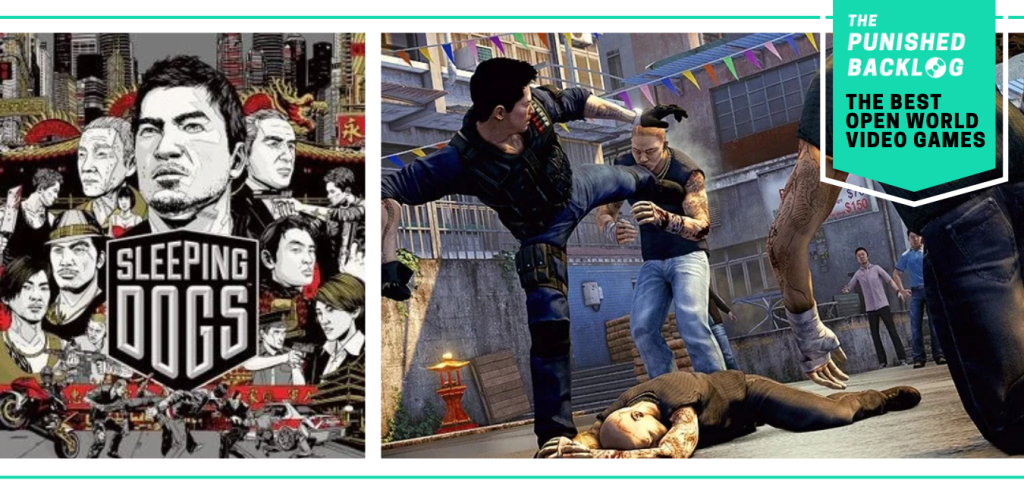
Sleeping Dogs
The spiritual successor to the True Crime series, Sleeping Dogs follows Wei Shen as he navigates the world of the Sun On Yee Triad while undercover as a police officer in Hong Kong. Testing his loyalties to each group becomes a common challenge as his boundaries and morals often clash as he tries to do right by the people he befriends in both circles. The open-world component of this game is pretty standard; there are mainline quests and side quests with various humorous and whimsical plots. Some of them feature recurring side characters, while others are one-off entertaining optional interactions.
The best part of this open-world experience, however, is the fighting and the driving. Wei Shen can make full use of his environment during fights and, coupled with his MMA-like combat style, it becomes a lot of fun brawling with enemies. As much as I love a good fist fight, my favorite part of this game is still the driving. The controls are fluid, well-designed, and create a driving experience that really could have been its own separate game. Instead, it elevates the car chases and optional racing quests to a level that feels unfair when compared to other open-world experiences. Spinning around Hong Kong at high speeds is the best way to see the level design as you familiarize yourself with the city with the most skyscrapers in the world.
It’s a shame we will never get a sequel, but I’ll always recommend Sleeping Dogs to anyone who loves a great open-world game.
– Written by Vaughn Hunt
Platforms: PC, Mac, PlayStation 3 & 4, Xbox 360, Xbox One
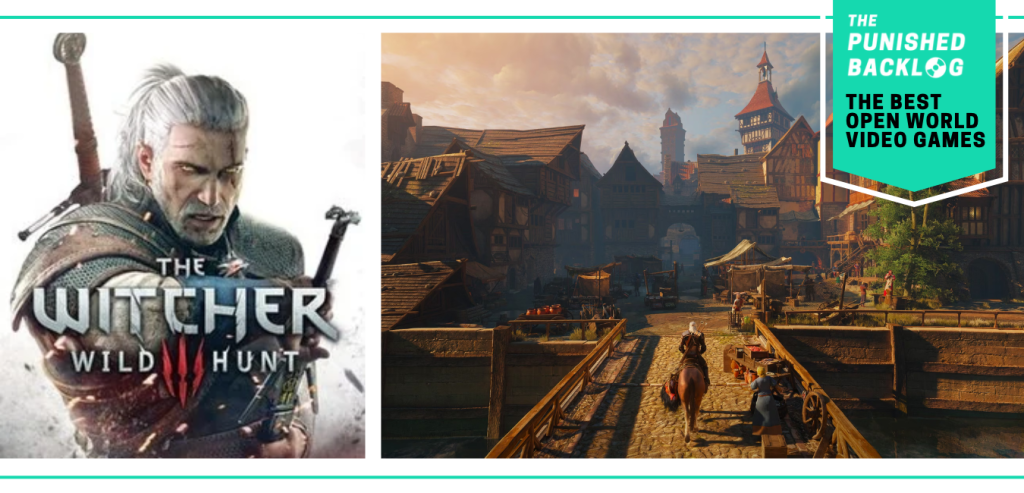
The Witcher 3: Wild Hunt
CD Projekt Red’s 2015 masterpiece The Witcher 3: Wild Hunt succeeds not just through its thrilling story, bloody monster battles, and gorgeous visuals, but through how much it seems to actually care about all the inhabitants of its meticulously crafted worlds. The war-torn swamps of Velen, the glorious fantasy metropolis Novigrad, the snow-laden villages of Skellige, the bright and colorful countryside of Toussaint… every single hill and valley of Wild Hunt teems with interesting characters, lively townspeople, travelling soldiers, and a wide variety of monsters, both friendly and hostile.
Unlike most other checklist-style open worlds, The Witcher 3 goes through the effort of making every single activity meaningful. It’s not enough for Geralt of Rivia to slay a Leshen or recover lost goods; he gets to know the quest-giver, who always has a little more to say than most NPCs typically do. It’s not enough to wander through a forest in search of extra items or enemies to fight; Geralt often also finds treasure maps, letters containing surprising quest info, or even books full of delightful lore along the way. What results is a world where everyone and everything seems to truly matter, and not just in ways that directly affect the player.
I’ve long believed that The Witcher 3 is the greatest role-playing game of all time, with its strongest attributes existing within its open-world design. It’s not enough for these lands to be vast and full of things to do; they have to have purpose, and they need to feel as real as possible. Velen’s ugly bogs and occupied villages feel real. Novigrad’s mean streets and bustling taverns feel real. Oxenfurt’s political tumult feels real. Skellige’s rustic villages and superstitions feel real. They’re real to me, at least.
– Written by Sam Martinelli
Platforms: PC, PlayStation 4 & 5, Xbox Series X/S, Xbox One, Nintendo Switch 1 & 2
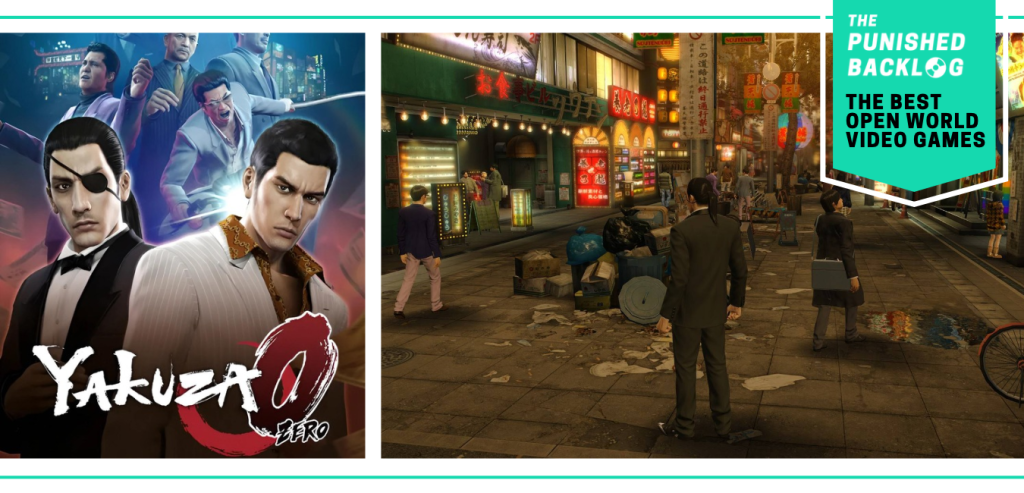
Yakuza 0
Yakuza 0 has been out for over a decade, but I only recently managed to tick it off the backlog. And I’m so glad I did. The origin stories of Kazuma Kiryu and Goro Majima are among the greatest narratives I’ve experienced in a video game, with their healthy blend of drama, humor, batshit crazy fights, and moving heart-to-heart conversations.
But the storytelling isn’t why Yakuza 0 makes this list; the open world is. Its fictionalized depictions of real-world Kabukicho, Tokyo, and Dotonbori, Osaka — Kamurocho and Sotenbori, respectively — are filled with shops to explore, mini-games to complete, and NPCs to befriend. Whether I was building a real-estate empire as Kiryu, managing a hostess club as Majima, or doing something much sillier like racing toy cars or breakdancing on the side of the street, Yakuza 0 made me love every second of every side excursion, with very few exceptions (the catfights are an ick).
Normally, when I sink 70 hours into a game, I’m glad to see it end. With Yakuza 0, I was ready to sink 70 more. I didn’t end up doing so (the rest of the series calls to me), but the fact that I felt the urge says a lot. Don’t let the lack of cars and “small” map size deceive you; Yakuza 0 is an absolutely massive game with a level of detail and charm most open worlds could only hope to achieve. Skip it at your own peril.
– Written by David Silbert
Platforms: PC; PlayStation 3, 4, & 5; Xbox Series X/S; Xbox One; Nintendo Switch 2
What are some of your favorite open-world games of all time? Let us know in the comments!

A video game outlet that blends quality words with inclusive voices. For business inquiries and review requests, reach us at press [at] punishedbacklog [dot] com.




Sam has been playing video games since his earliest years and has been writing about them since 2016. He joined The Punished Backlog in 2017 and became an Editor in Fall 2021. He’s a big fan of Nintendo games and complaining about The Last of Us Part II. You either agree wholeheartedly with his opinions or despise them. There is no in between.
A lifelong New Yorker, Sam views gaming as far more than a silly little pastime, and hopes through critical analysis and in-depth reviews to better understand the medium's artistic merit.
Bluesky: @sam-martinelli.bsky.social



Amanda Tien (she/her or they) loves video games where she can pet dogs, solve mysteries, punch bad guys, play as a cool female character, and/or have a good cry. She began writing with The Punished Backlog in 2020 and became an Editor in Fall 2021. Amanda also does a lot of the site's graphic designs and podcast editing. Amanda's work has been published in Mothership, Unwinnable Monthly, Poets.org, Salt Hill Journal, and elsewhere. She holds an MFA in Fiction from the University of Pittsburgh and a BA in Creative Writing from Columbia University. Learn more about her writing, visual art, teaching, graphic design, and marketing consulting at www.amandatien.com.




Vaughn Hunt is writer who has loved video games since he picked up a controller. His parents wouldn't let him buy swords as a child (he wanted the real ones) so he started writing, reading, and playing video games about them. A historian at heart, you'll often find him deep into a rabbit hole of culture, comics, or music.



David is the founder of The Punished Backlog. He has a problem finishing games he starts.
Just beat: GTA V.
Working on: Fire Emblem: Fortune's Weave.
Can't wait for: Ocarina of Time (2026), GTA VI.
Follow David on Twitter at @David_Silbert to keep up to date with all things The Punished Backlog.

Gary is a jack-of-all-trades video game enthusiast based in Boston, MA. A semi-professional fighting game player, even less professional Apex Legends player, and even less professional adult, he spends most of his time poking at strange indie gems and reading about the need for more diverse voices in gaming criticism. He invites anyone to recommend anything he's missed in the gaming world via Twitter or BlueSky, where he can found under the username @grtnpwrfl. When he isn't spending his time playing games, Gary is an avid New England Patriots fan and frequent hiker.

Clint is a writer and educator based out of Wisconsin. You can often find him writing about Middle English poetry, medieval games, or video games. He received his PhD in English from the Ohio State University. You can find his academic and public work at clintmorrisonjr.com.



Mark is a contributor to The Punished Backlog, often promising articles and occasionally delivering when he actually commits to it. Mark games mainly on his PS5 and his Switch, and some of his favorite games include God of War, Ghost of Tsushima, The Witcher 3: Wild Hunt, and his all time favorite, Red Dead Redemption 2. When not gaming, Mark is an avid fan of all Boston sports teams and his Villanova Wildcats. He also loves hiking, skiing, and traveling across the U.S.