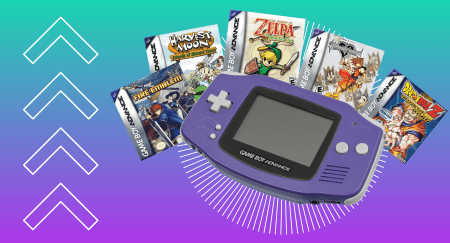


In an era of gaming when players get remakes and remasters of bona fide classics on a regular basis, it’s nice to see titles from yesteryear that maybe didn’t have a big impact during their time get a second chance at the spotlight. WayForward Technologies’ 2005 Game Boy Advance game Sigma Star Saga — a hybrid of a top-down role-playing game and 2D arcade space shooter that garnered mixed reviews at the time and wasn’t exactly a top-seller for the platform — now has the opportunity to shine once again in the form of Sigma Star Saga DX, an enhanced port for PC, PlayStation 5, and Nintendo Switch.
Do the updates and changes to the original game make DX a fundamentally better experience? Despite having never played the original GBA game, I can say with relative certainty that DX is the superior way to play Sigma Star Saga. The updated version adds save states, a rewind feature, and tons of concept art, and even certain elements of the core gameplay received some tweaks in the form of an improved map and decreased random encounter rate. The GBA color palette and cartoony character and creature design all remain as timeless as any of its mid-2000s contemporaries, and the soundtrack feels less compressed (though most of the tracks themselves are fairly forgettable). If you’ve never played Sigma Star Saga before, DX is the way to go.
I suppose that begs another question: Is Sigma Star Saga DX overall a good game worth playing? The answer to that query is a little more complicated. For the purposes of this piece, I’ll be reviewing Sigma Star Saga DX as though it were a brand-new game, since I entered into the experience with virtually no knowledge of its prior existence.

Star Killers
In Sigma Star Saga DX, the player assumes control of Recker, a spaceship pilot fighting for planet Earth who is currently entrenched in a decades-long war with an enemy alien species known as the Krill. Recker’s superior officer orders him to intentionally get captured by the Krill and join their army as part of an undercover operation. Once the Krill take Recker to one of their star bases, they outfit him with a Krill parasite suit that gives him physical advantages, including greater strength and speed, as well as the ability to fly their biological ships. Once he’s got the parasite suit, there’s no going back: As far as the Krill are concerned, he’s one of them now.
What follows is a race across several planets — all with bland, obvious names like “ice planet” and “sand planet” — for control of so-called “bio-matter” in the cores of the planets that will be used for some kind of massive weapon in the war. As the story progresses, the player learns that Recker’s superior officer hasn’t been fully truthful with him, that the Krill’s top brass are also often at odds with one another over the broader war strategy, and that the existence of both sides is much more fragile than Recker first realized.
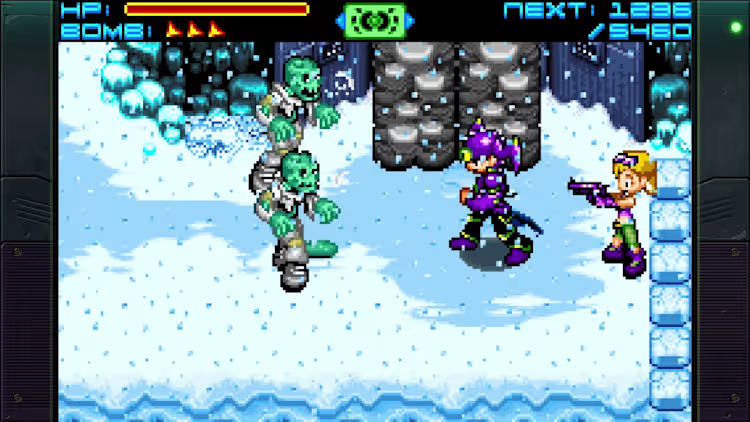
The plot of Sigma Star Saga is simultaneously interesting and rote. It has more twists and turns than I expected — including multiple betrayals, a bizarre “love” triangle, and some genuinely intriguing meditations on the nature of war and how there aren’t necessarily “good guys” in any conflict — yet still relies on a number of tired tropes.
I don’t want to wade into spoiler territory, as I actually found a lot of narrative moments genuinely moving (or at least pleasantly surprising), but for every fascinating and entertaining part of the story, there was a poorly written one-dimensional character or obvious next step waiting right after. The game often succeeds in how it presents powerful warmongers and the inherent ruthlessness of anyone wielding weapons of mass destruction, yet these presentations are frequently interrupted by hackneyed sci-fi racism, one-dimensional characters, awkward dialogue, and tired cliches around female characters (who, of course, are thin and gorgeous and kind of in love with Recker despite him having basically no personality at all).
Overall, I enjoyed my time with Sigma Star Saga DX’s story, though I still found it a bit of a missed opportunity. On the positive side, for a game released just two years after the U.S. invasion of Iraq, its boldness in depicting Earth’s army (which appears fairly Americanized) as perjurious and genocidal is greatly appreciated, as are the various humanizing qualities of the Krill. I also like that there’s a New Game+ that allows for the player to try and achieve a different ending (there are three possible outcomes), so the end of my roughly 10-hour playthrough doesn’t have to be THE end of my time with the game.
On the other hand, I just never really cared about any of the individual characters. The content of the missions themselves is interesting on its own, but the incessant chatter between Recker and companions like Scarlet and Psyme just never landed right with me, as it simultaneously failed to endear them to me and made me question whether they had any depth at all. A good plot and interesting themes can only take you so far.
In the Air and on the Ground
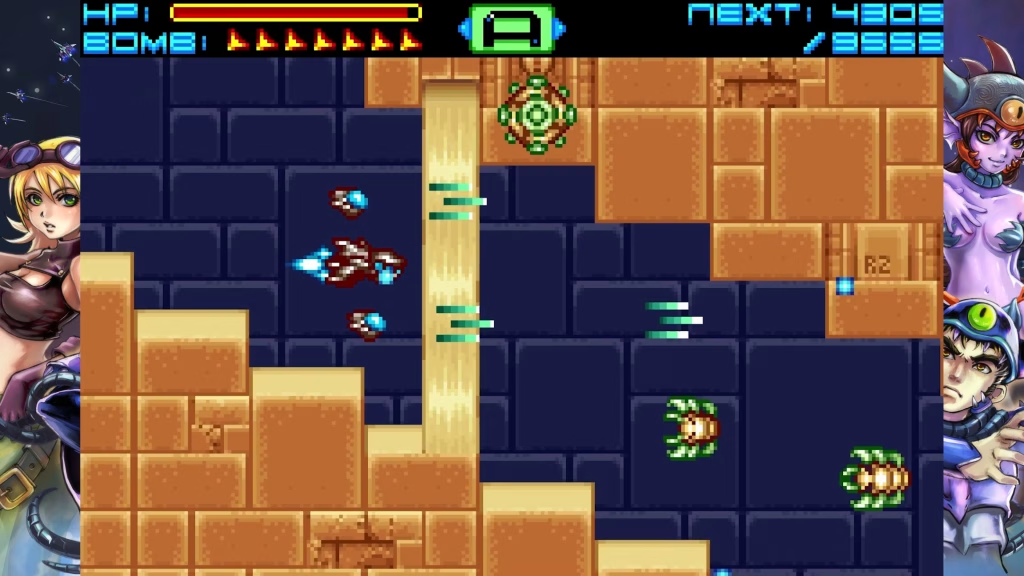
Mechanically, Sigma Star Saga DX thrives in a lot of ways. The gameplay shifts back and forth between 2D ship battles, which look and play a lot like classic shoot ‘em ups like R-Type and Gradius, and ground sections, where Recker moves across various locales from a top-down perspective with gameplay somewhat reminiscent of The Legend of Zelda and fellow GBA title Dragon Ball Z: The Legacy of Goku. The majority of the experience occurs during these ground sections, which take place in every Krill star station as well as the various planets Recker explores.
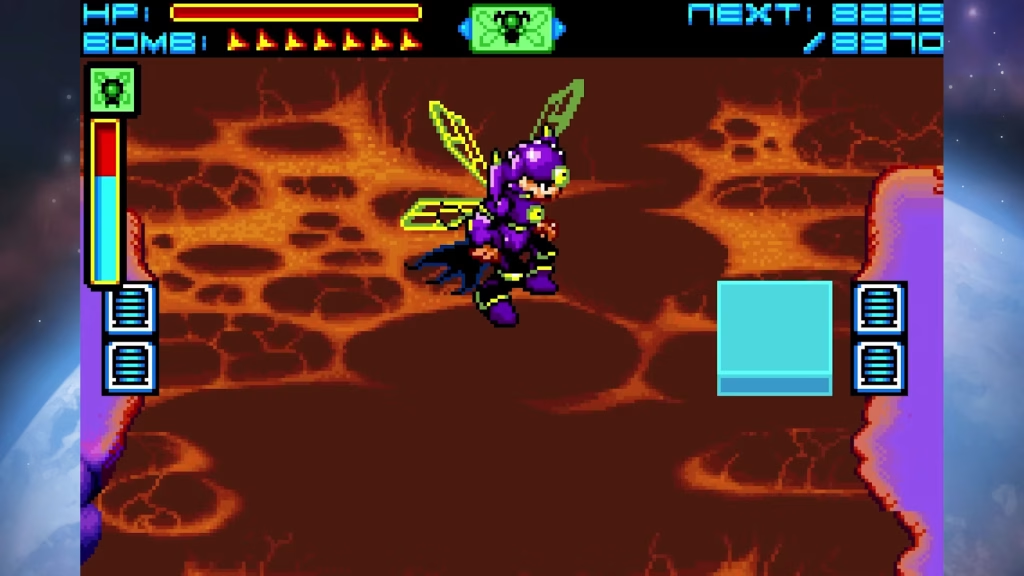
As you progress through the adventure, you’ll collect weapons and items that allow you to battle simple enemies on the ground and solve simple environmental puzzles. At any point while exploring a planet, you can be summoned to a nearby Krill ship, where you’ll engage in arcadey ship battles. During these battles, you’ll gain experience by killing enemies. Much like other RPGs, leveling up restores your health and increases your offensive and defensive capabilities.
Unsurprisingly, the ship battles offer the best and most rewarding gameplay sequences in all of Sigma Star Saga. The mechanics are fairly basic — one button shoots, another allows the vehicle to move faster, another lays a bomb — but gunning down enemy combatants and environmental hazards never gets old. Outside of boss segments at the end of every chapter, which have a fixed set of challenges (and all absolutely rule, by the way), the player has no control over what kind of ship battle the game throws them into. You don’t know if you’ll have a small, fast ship or a big, slow one, nor do you know beforehand whether the challenge is to fight a mini-boss or to defeat a minimum number of enemies. The level of variety, mixed with the inherent pleasures of classic shmup gameplay, makes nearly all of these sequences a joy to play, even if the suddenness of their occurrence can be grating at times.
Adding to the ship battle fun is the Gun Data System, which allows the player to customize how their ships operate in battle. During the ground sections, players can find new Gun Data that falls into three categories: cannon, bullet, and impact. As you progress through Sigma Star Saga, you can play around with different combinations that play to your preferences. Though I often found myself sticking with specific combinations for long stretches at a time, I enjoyed the fact that I had so many options at my disposal. There was no “right” way to win, just the way I preferred to do it.
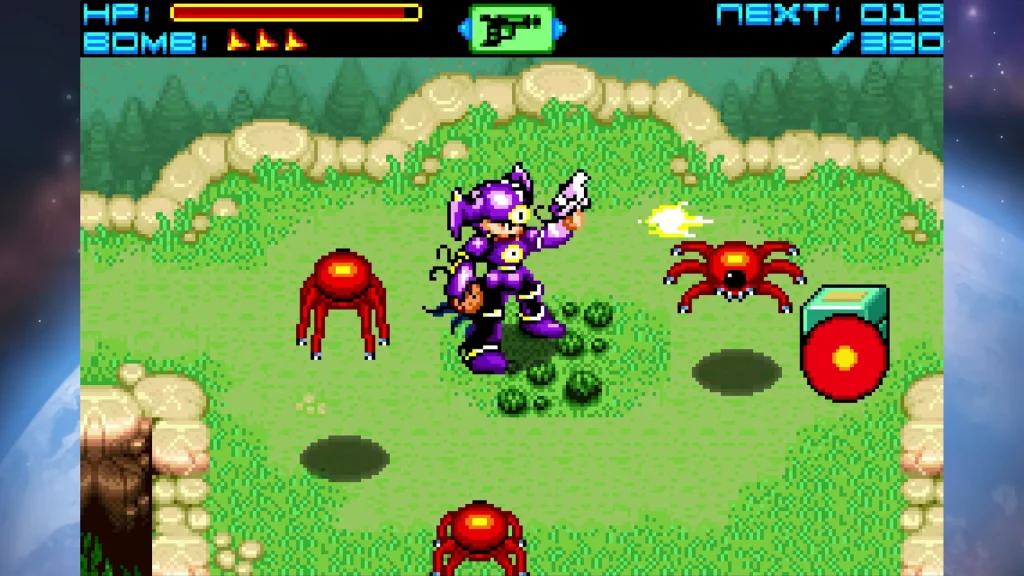
Unfortunately, the ground sections aren’t quite as exciting or engaging. Sure, you get to run around brightly colored environments with some light puzzle solving and simple enemy encounters, but the actual combat of these sections is so easy it borders on pointless. Actually exploring the different planets can be pretty fun, though, especially as you get more items that allow you to float over chasms or scan for hidden objects. Still, I often found myself wishing to be sucked back into space for another ship battle, even if just for a minute. Honestly, the most fun parts of the ground sections were searching for new Gun Data, so even the best of these ground sequences involves preparing for the Good Stuff in the skies.
While the planetary excursions have their ups and downs, the Krill star stations are almost entirely full of downs. Most of the actual story-relevant conversations occur in these spaces, and you are required to take part in various unskippable cutscenes and story moments before embarking on your next mission. These segments are tedious enough on their own, but are even made worse by the lack of a map to help navigate through them. Honestly, this is one of the game’s biggest oversights, since every room on each station looks exactly the same.
Final Thoughts
Ultimately, Sigma Star Saga DX is a tale of highs and lows. The lows can be pretty rough, but the highs are lofty enough that I’d call DX a solid experience in and of itself. It’s a pretty good action RPG overall, but within it is a potentially great game that occasionally gets in its own way.
That said, I’m really glad Sigma Star Saga DX exists at all. Even as The Punished Backlog’s “Old Games Guy,” I have so much more to learn about the broad range of titles released decades in the past, especially ones that slipped through the cracks. Sigma Star Saga may never have been an all-time great game or even a particularly notable hidden gem, but it deserved the DX treatment as much as anything else. The game itself isn’t particularly special, but the fact that I can play it at all is noteworthy.
Score: 7.0/10
Sigma Star Saga DX, developed by WayForward and Mighty Rabbit Studios and published by WayForward, released on Tuesday, April 7, 2026, for PC (via Steam), PlayStation 5, and Nintendo Switch. Version reviewed: Switch. MSRP: $19.99.

Sam has been playing video games since his earliest years and has been writing about them since 2016. He joined The Punished Backlog in 2017 and became an Editor in Fall 2021. He’s a big fan of Nintendo games and complaining about The Last of Us Part II. You either agree wholeheartedly with his opinions or despise them. There is no in between.
A lifelong New Yorker, Sam views gaming as far more than a silly little pastime, and hopes through critical analysis and in-depth reviews to better understand the medium's artistic merit.
Bluesky: @sam-martinelli.bsky.social