
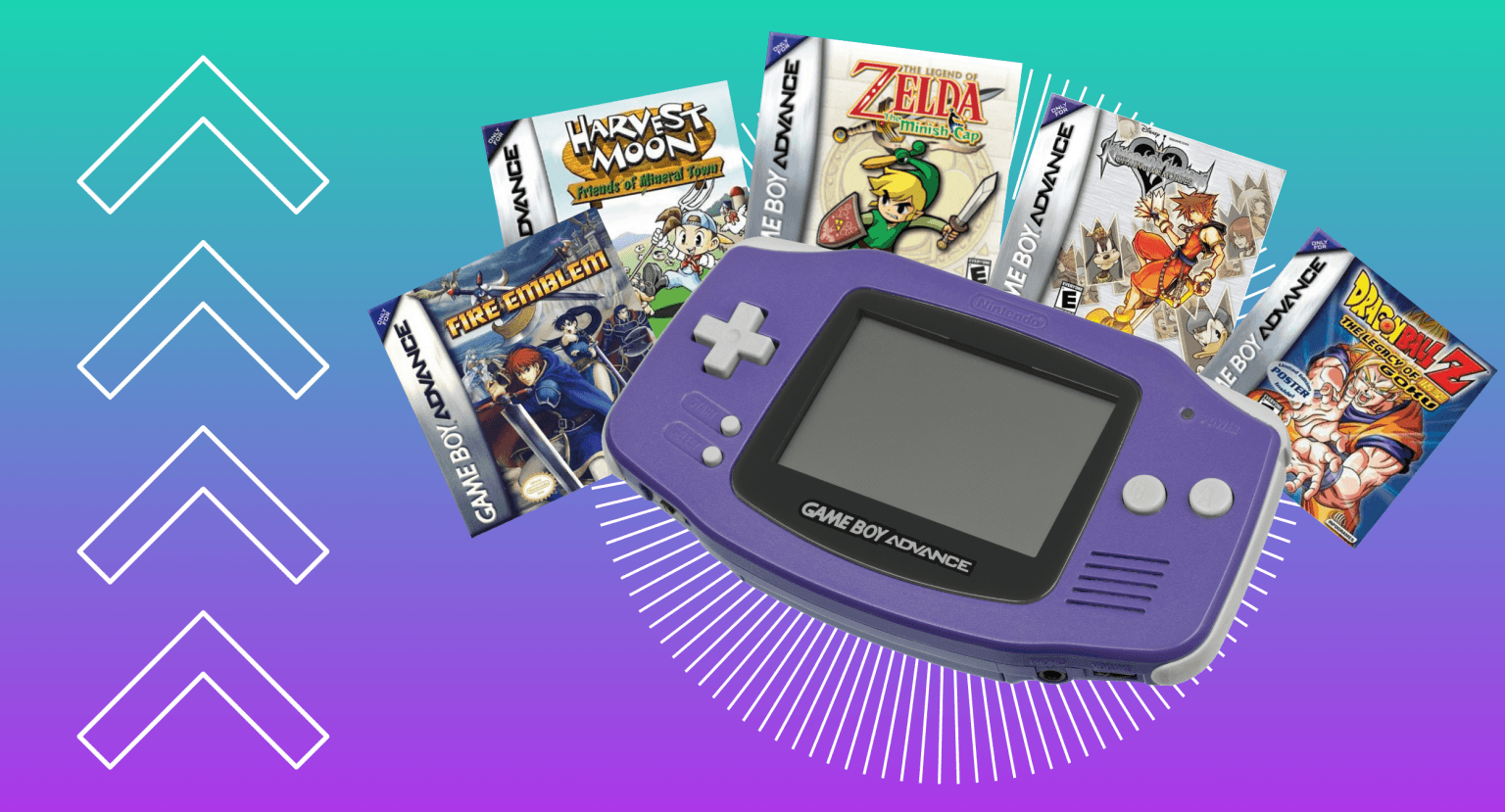

Do you miss handheld gaming? I sure do!
Obviously, there are more ways to play games on the go now than ever before, especially considering the existence of two Nintendo Switches, the Steam Deck, ROG Ally, mobile gaming, and myriad cloud streaming options. Still, it’s not quite the same as having a dedicated little device that fits in your pocket and offers pocket-sized adventures that feel anything but. Few devices have fully embodied that feeling of endless possibility in the palm of your hand quiet like the Game Boy Advance.
Despite largely serving as a souped-up version of its predecessor, the Game Boy Advance offered some of the best that handheld gaming had to offer in the early 2000s. Its library includes tons of incredible original games as well as some truly inspired remakes and enhanced ports of bona fide classics. If you ask anybody who owned GBA what their favorite games were, no two people will give you the same response, but their answer will almost always involve some mix of new (at the time) and old.
This year, Nintendo’s successor to the Game Boy — and the final generation of the Game Boy line of products — celebrates its 25th birthday, and we at The Punished Backlog felt it was the perfect time to remember some of our favorite games for the platform. Some of these were bold new titles that helped shape the early aughts, while others are simply better ways to play games everybody already loved. Either way, the GBA generation was fantastic, and now’s as good a time as any to remember some of its highlights.
– Written by Sam Martinelli
The Best Game Boy Advance Games of All Time
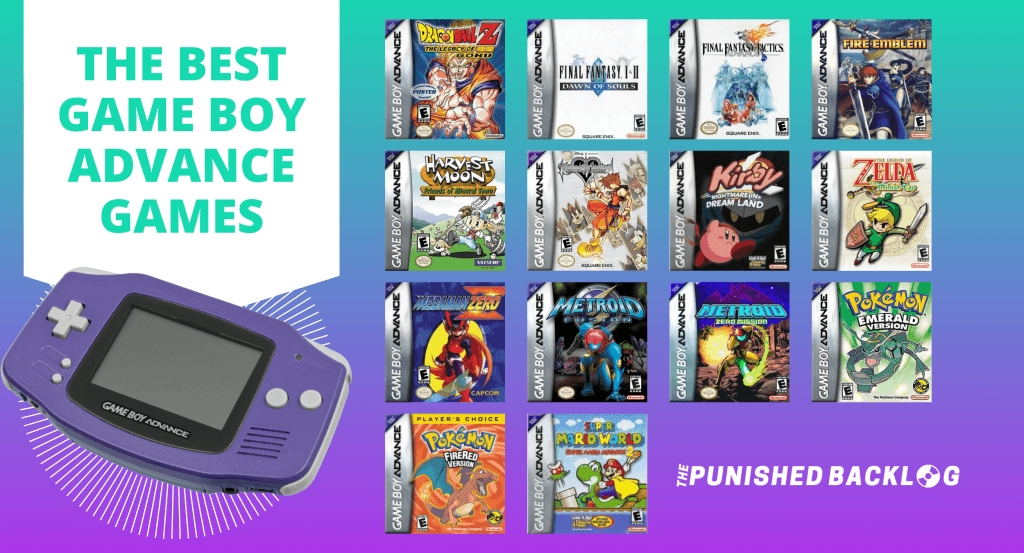
Here are The Punished Backlog’s 14 favorite GBA games ever made, presented in alphabetical order.
Want to jump to a specific entry? Use our table of contents:
- Dragon Ball Z: The Legacy of Goku
- Final Fantasy I & II: Dawn of Souls
- Final Fantasy Tactics Advance
- Fire Emblem
- Harvest Moon: Friends of Mineral Town
- Kingdom Hearts: Chain of Memories
- Kirby: Nightmare in Dream Land
- The Legend of Zelda: The Minish Cap
- Mega Man Zero
- Metroid Fusion
- Metroid: Zero Mission
- Pokémon Emerald
- Pokémon FireRed/LeafGreen
- Super Mario Advance 2: Super Mario World
Dragon Ball Z: The Legacy of Goku
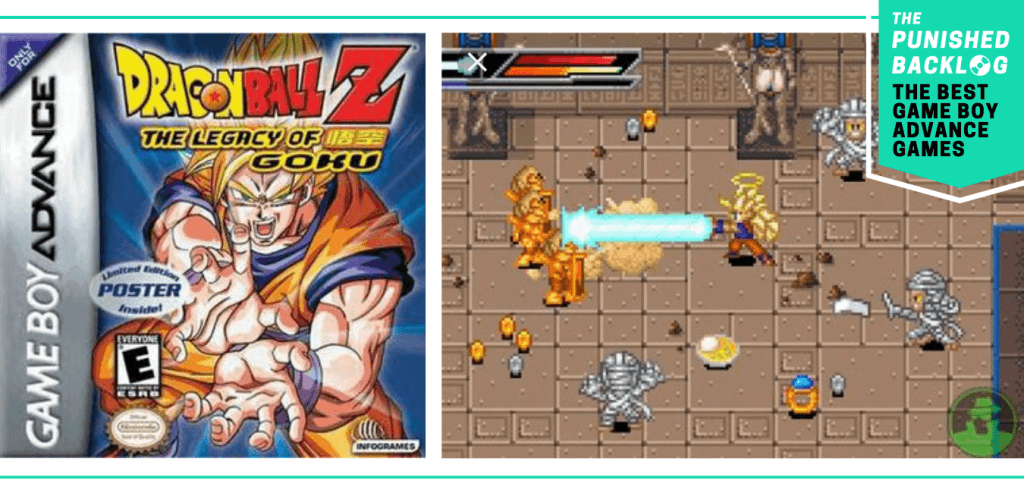
Released in what can be considered the prolific era of Dragon Ball video game releases, The Legacy of Goku was probably one of the best marketed games to kids. It felt like you couldn’t watch a second on a kid’s channel without an ad for the 2D action game popping up. That said, the game itself never quite lived up to the hype.
It was a perfectly okay experience, another entry that recounts the story of Goku starting with the Saiyan Saga and ending with the conclusion of the Namek Saga. For the most part, the gameplay left a lot to be desired given its limited scope and plainness. You punch, you kick, you shoot ki blasts, and sometimes fly. It felt pretty basic to the point of feeling like a web browser game. (I hear the quality of the sequel was a remarkable improvement, but I never made it there.)
Regardless, The Legacy of Goku remains one of the most memorable titles released for the GBA, in addition to having one of the coolest names. Like many Dragon Ball fans who enjoyed the game, I looked past its flaws and enjoyed its take on the IP. For whatever reason, even 2D renderings of iconic moments like Goku’s fight with Raditz, the invasion of Earth by Vegeta and Nappa, and especially the whole Namek saga, made the game immensely satisfying. As a kid, I finished it excited by what I had played, even though it was pretty underwhelming when I returned to it as a teenager.
The final section of The Legacy of Goku where you turn Super Saiyan, though? It almost makes this game worth recommending today. Almost.
– Written by Vaughn Hunt
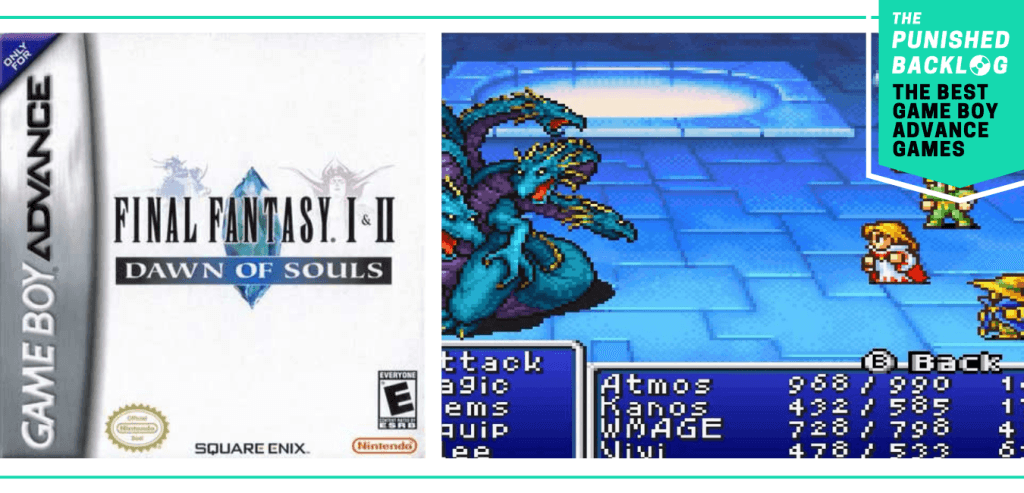
Final Fantasy I & II: Dawn of Souls
If you’re a Final Fantasy fan, the Game Boy Advance era was especially kind to you. From enhanced ports of older games to entirely new adventures, the GBA remains one of the best ways to experience Square Enix’s flagship franchise.
I could easily write about any of the Final Fantasy games that graced the handheld. Final Fantasy IV Advance, with its snappy pacing and heartfelt scenes, made me fall in love with the earlier games. Final Fantasy VI Advance, with its larger-than-life set pieces and terrific characters, solidified my belief in the series. And Final Fantasy Tactics Advance, though not as esteemed as its 1998 predecessor, was a gratifying game in its own right.
But I’ve chosen instead to dedicate this blurb to Final Fantasy I & II: Dawn of Souls, a duology that shows its age at nearly every turn yet absolutely deserves a space on this list. The first Final Fantasy games I ever played, FF I & II transported me to worlds that were as enthralling as they were ruthless.
The original Final Fantasy gave me the power to compose a party to my liking, only to lock me into that decision for the entirety of my adventure. (Want a team of four monks? Go for it! Better stock up on potions without a mage, though.) Unlike the mainline entries that followed, FF I does not offer canonical names for its four warriors of light. For me, that meant journeying the world as myself (Warrior), my brother Adam (Thief), and two close childhood friends: Brian (Black Mage) and James (White Mage). Whereas the world map and its then-revolutionary RPG pitstops (towns, shops, dungeons) were carefully constructed by director Hironobu Sakaguchi and his team, the journey itself was one of my own design.
Final Fantasy II, meanwhile, flipped the script, giving me a preset party — Firion, Maria, Guy, Leon — who, unlike the job-centric band in FFI, were good at absolutely nothing. These were as blank as slates could get, which made the first few hours particularly intimidating. Much has been said in Final Fantasy circles about II’s bizarre leveling system, which rewards players based on how often they use specific weapons/magic or, conversely, how often certain traits (Stamina, Agility, Defense, etc.) are tested in battle. At times, the system is perfectly intuitive; if you prioritize Firion’s axe, he’ll level that weapon up. At other times, it encourages outlandish tactics… like attacking your own party members to increase their HP. It didn’t make for a realistic adventure, but it sure made for a memorable one.
As individual entries in the series, Final Fantasy I & II have been outdone several times over. Packaged together as a sleek, mobile package, however, Dawn of Souls remains a great entry point for a franchise so many have come to treasure.
– Written by David Silbert
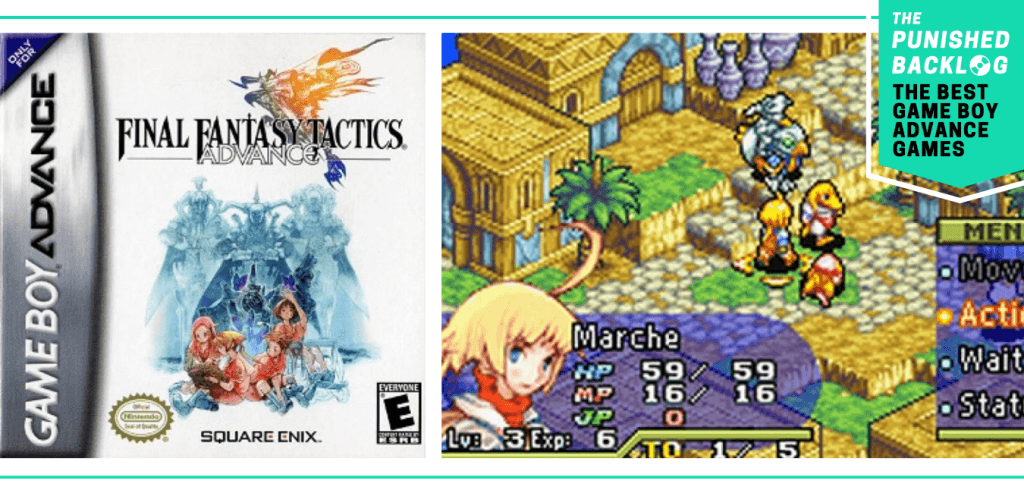
Final Fantasy Tactics Advance
Final Fantasy games don’t stray from wearing their influences on their sleeves. Early titles flaunted its inspiration from tabletop RPGs (like Dungeons & Dragons) and games like Wizardry. The most recent entry Final Fantasy XVI feels like Game of Thrones-lite. My favorite handheld entry (sorry, Final Fantasy VII: Crisis Core) Final Fantasy Tactics Advance has always felt like Square asking: “What if we made a Final Fantasy-Narnia game without Aslan?”
Final Fantasy Tactics Advance follows four children from St. Ivalice: Marche, Doned, Mewt, and Ritz. Instead of finding a magic wardrobe that leads to Mr. Tumnus, the children have a magic book called the Gran Grimoire that transforms their little town into Ivalice (also the world of Final Fantasy Tactics and Final Fantasy XII). Within this fantastical version of their hometown, they take on new roles, meet new creatures, and have grid-based fights.
I have always loved Final Fantasy Tactics Advance, having played it prior to my time with the original Final Fantasy Tactics. As a child, I found the story to be more engaging than the age-appropriate C.S. Lewis books, to the distress of some of my teachers. Revisiting it now, I understand that the story has such potential as political allegory, joy, and a model for forgiveness. I think about protagonists Marche and Mewt’s relationship often and how their ultimate reconciliation makes them both stronger when they return home.
– Written by Clint Morrison, Jr.
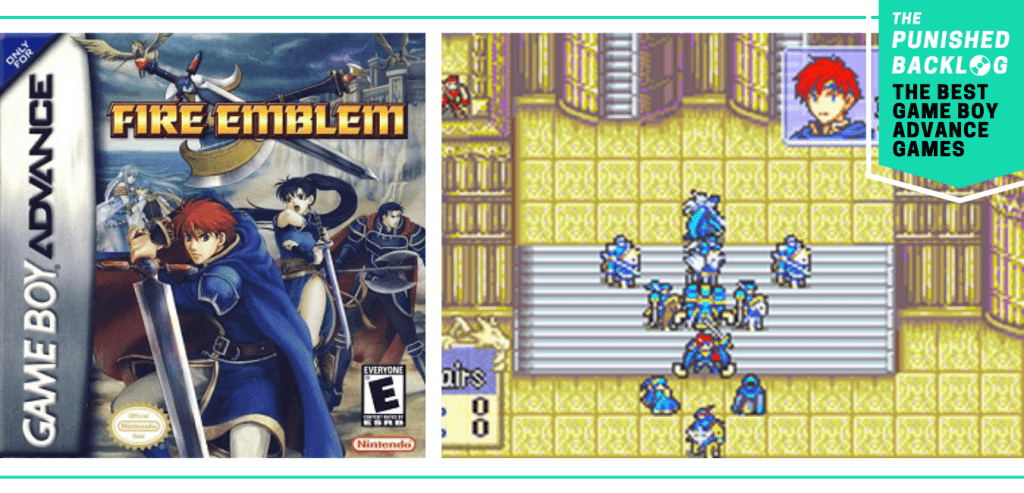
Fire Emblem
It’s hard to imagine a time when Fire Emblem wasn’t venerated Smash Bros. Nintendo royalty, but in 2003, gamers knew hardly a thing of the franchise. 2003’s Fire Emblem — retroactively appended with the subtitle The Blazing Blade — was the first entry in the series to be localized outside of Japan, and remains one of its most classic.
Prior to The Blazing Blade, the first five entries to the franchise were characterized in large part by the ingenuity and risk-taking of series creator Shouzou Kaga. Each game introduced new mechanics, new styles, and the world and locale of the games changed drastically numerous times. Following his departure from series developer Intelligent Systems, the franchise entered an era of stability.
Blazing Blade and its predecessor Binding Blade formed the backbone of a far more consistent and stable trilogy of games, all following the same mechanical foundation and visual style. Foundationally, the importance of Blazing Blade is self-evident — if it had not managed to find success, Fire Emblem likely would have remained a niche, Japan-exclusive strategy game that never reached a worldwide audience.
Blazing Blade is far from the boldest game in the series, but it did just enough to make its splash. It’s one of the most replayable games in the series owing to its branching story structure and layered narrative, which weaves additional perspectives, secrets, and layers atop what ostensibly is fairly standard high fantasy fare.
Lyn and Hector, at least, are standouts amongst the cadre of generically heroic, noble-born Fire Emblem protagonists, and Elibe as a setting features some of the most intriguing nations in series history. (Don’t get me started on the barren mercenary nation of Ilia and the tragedy of their pegasus knights. Sigune and Juno wreck me.) Having Nino face down her former adoptive family, one by one? Cheesing the game with Vaida’s Uber Spear? Louise’s confession to Pent mid-battle during Light? So many core gaming memories of mine were formed while huddled over the unlit screen of my Game Boy Advance, playing deep into the night when I should have been sleeping.
Is there any one element of Blazing Blade that strikes me as the peak of the franchise? No. But above all, it remains the most well-rounded and complete of any game in the series, which made it the perfect springboard to debut the series overseas. No other game in the franchise could have done as well a job at that as Blazing Blade, and I’m thankful for it.
– Written by Keisuke Isobe
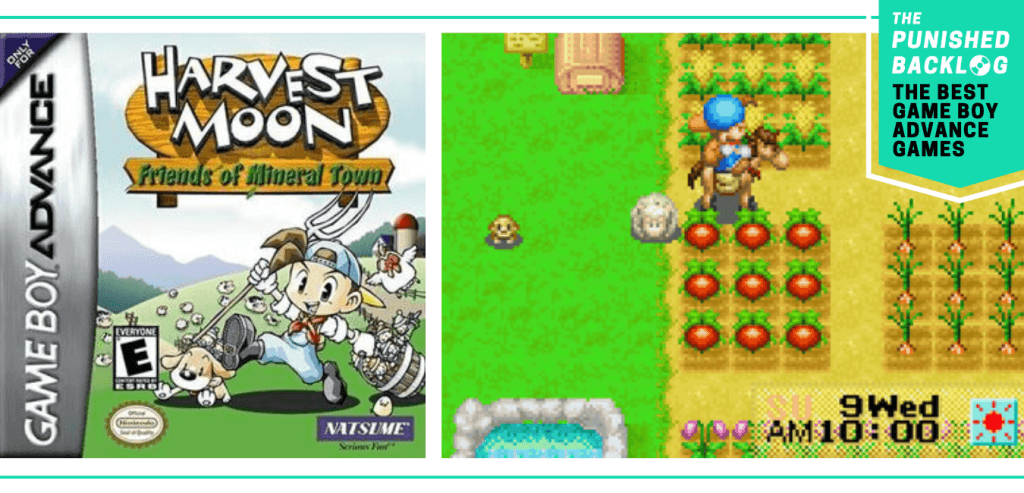
Harvest Moon: Friends of Mineral Town
When I think about what I wish Stardew Valley could be, I think of Harvest Moon: Friends of Mineral Town (2003, Marvelous Interactive). The first cozy farm simulator game debuted in 1996 on the SNES; it was the brainchild of Yasuhiro Wada, who was inspired by his own upbringing. The Harvest Moon seeds flourished, blooming into over 30 entries in the series, including after a publisher dispute resulted in later games being rebranded as Story of Seasons. I first tried Stardew Valley shortly after its release in 2016, and while I admired ConcernedApe’s work, all I could think about was the game I loved growing up.
Without getting too personal, I’ll just say that the summer of 2004 was a difficult time for my family. At a GameStop in Los Angeles, I was awe-struck by the cover of Harvest Moon: Friends of Mineral Town. A smiling farmer stood with his dog and chickens on a wide open field next to his beloved home; it might as well have been another planet. I gathered the Christmas money I had been holding onto for months and spent it on a game I knew next to nothing about.
Friends of Mineral Town was everything I could’ve hoped for and more. The village was painted in pastel colors. A loyal dog and a happy horse made sure I was never lonely. I harvested mushrooms and flowers without worry. I made friends. Each day in Harvest Moon, I had a clear routine with understandable, achievable outcomes. Harvest Moon: Friends of Mineral Town not only made me feel like I was in control, but safe and happy. It was the first video game that truly changed my life.
I felt I really belonged in Mineral Town. Each of its townspeople has an interesting backstory, and what’s more, their lives progress as the game continues. If you don’t marry a certain character, your “rival” for their affection will instead — people move on and live their lives outside of the main character (this is notable, especially compared to Stardew.) I can still recall certain scenes and story beats. It was the first game I played that had seemingly random events, interactions that could only be triggered by hidden variables. It made the world feel alive, and it made me think about how I could add good to my real-life world, too.
Friends of Mineral Town took advantage of the Game Boy Advance technical specs to move beyond the SNES version with more color, more lands to explore, more villagers to befriend. It earned a dedicated refresh a few years later, More Friends of Mineral Town, that enabled players to be a girl (neat!); I played it obsessively then, too, eager to see my old friends.
Whenever people bring up Stardew, I always bring up its roots in Harvest Moon. And, in my opinion, there is no Harvest Moon game more perfect than Friends of Mineral Town.
– Written by Amanda Tien
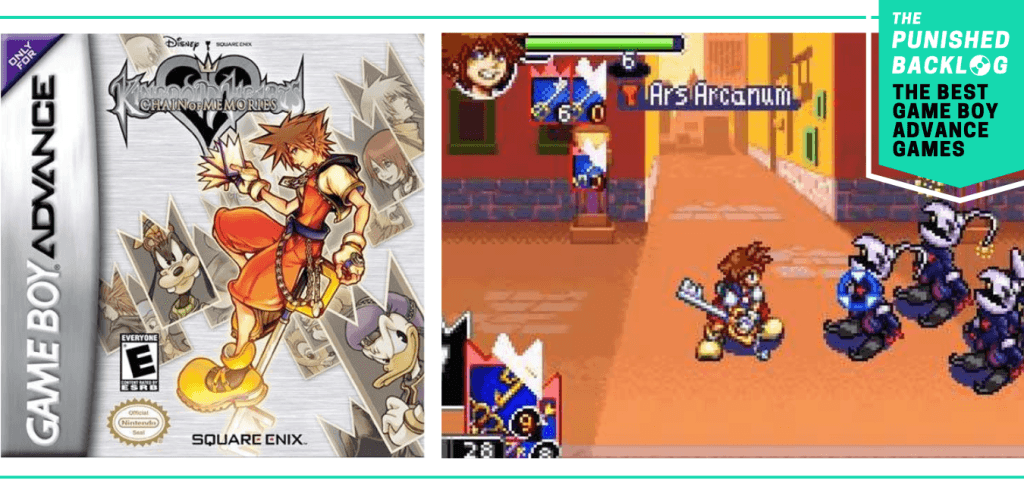
Kingdom Hearts: Chain of Memories
Like many here, my childhood ran on Nintendo. My cousin introduced me to Pokémon; my parents bought me my Game Boy Color and, later, the GameCube. From Super Mario Sunshine to countless Legend of Zelda games, I experienced some of the most important games of the early aughts. And with memories that great, I had very few regrets.
2002’s Kingdom Hearts was one such exception. Incepted by publisher Square Enix as a Final Fantasy spin-off series, Kingdom Hearts — and the subsequent franchise — quickly became iconic in its own right. Cameos from Cloud, Squall, and Sephiroth certainly boosted its appeal, but far more important were its original stories, melancholic worlds, and timeless Disney characters.
Unfortunately, I was unable to play it. I had my Game Boy, my GameCube, and, most recently at the time, my Game Boy Advance; Kingdom Hearts was a PlayStation 2 exclusive. Life was great, but the FOMO I felt without a way to play as Sora, Goofy, and Donald bore a hole in my heart that only a keyblade could fix.
In December 2004, I got my opportunity. Kingdom Hearts: Chain of Memories, a GBA-only sequel to the original Kingdom Hearts and prelude to the then-upcoming Kingdom Hearts II, served as a crucial side story, introducing the mysterious Organization XIII alongside characters like Naminé and Axel. Unlike many “midquels,” which tend to offer fluff over substance, Chain of Memories was the real deal, giving an advanced glimpse into the relationships and conflicts that players would explore in the 2006 follow-up.
I still remember the ad that aired over the holidays, teasing dramatic dialogue, gorgeous 2D pixel art, and a 3D FMV intro against the backdrop of Hikaru Utada’s “Simple and Clean.” After begging for the game I-don’t-know-how-many times, my aunt gifted it to me for Christmas.
I loved it — perhaps more than most, given it was my first Kingdom Hearts game, but I loved it nonetheless. Sora, Donald, and Goofy translated seamlessly to the tiny GBA screen, as did Yoko Shimomura’s brilliant soundtrack (hardware limitations aside). Combat is where Chain of Memories deviated most, taking its predecessor’s ARPG commands and mapping them to cards you draw from a deck. While many lamented the randomness it introduced, I found the system wildly creative — a precursor to modern deck-builders like Slay the Spire.
Chain of Memories will never get the same love as the games that bookended it, and that’s okay. I eventually bought a PS2 and played those two titans, but I’ll always have a soft spot for this unassuming gem.
– Written by David Silbert
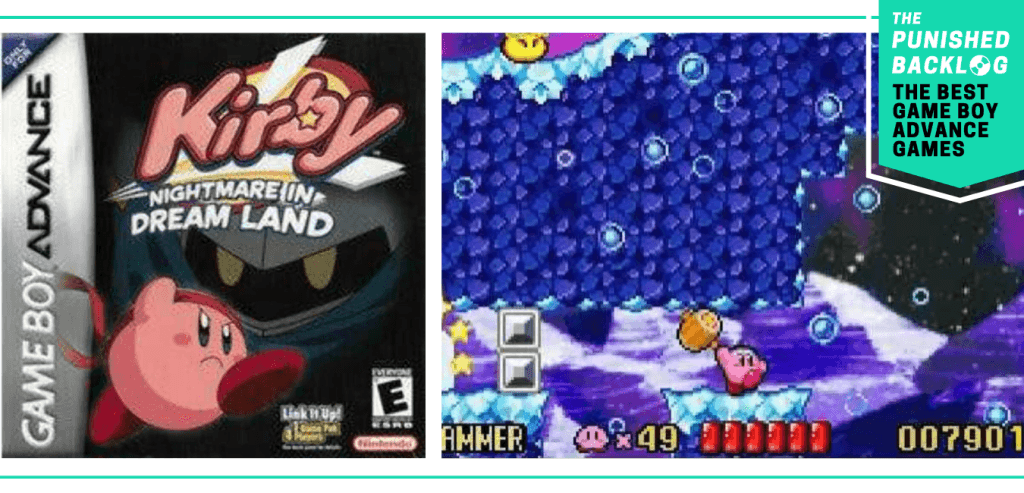
Kirby: Nightmare in Dream Land
Kirby: Nightmare in Dream Land is bolted to my earliest childhood memories. I still remember the commercial and the simple song (which I memorized) that encapsulated Kirby as a character: “Beatin’ up the bad guys, and takin’ away their powers!” My 8-year-old dopamine receptors lighting up at the sight of Sword Kirby and Fighter Kirby wrecking those adorable little enemies. When I unwrapped it that Christmas alongside my Game Boy Advance, it went down as the best Christmas ever. The year I got everything I wanted.
HAL Laboratory’s 2002 remake of 1993’s Kirby’s Adventure somehow exceeded the hype. The pixel art was vibrant. Every character, from the puffball himself to the smallest Waddle Dee, was drawn so adorably I couldn’t help but smile just looking at it. I burned through batteries beating this game and then beating it again on every mode. It was the first game I ever completed 100% on not just easy, but hard mode. I later completed Meta Knightmare, where you blitz the whole adventure in one run as Meta Knight. It was also the first game I ever played where I tried to beat my own speed running record.
The gameplay was addictive, and I loved every single power from Spark to Throw to the elusive UFO. But what truly ensnared me was the soundtrack. “Yogurt Yard” lives in my head rent-free, and to this day, whenever I’m on a peaceful stroll through the park, I swear I hear “Green Greens” start up and get the sudden urge to sprint through the grass (I was a very impressionable child.) I mastered every mini-game, too, with Quick Draw being my favorite.
I still have that same Game Boy Advance 14 years later, and my copy of Nightmare in Dream Land is the one cartridge that survived out of my entire GBA library. Every now and then, I blow the dust off, pop in a fresh pair of AAs, and take a nostalgia trip back to Dream Land.
– Written by Donovan Harrell
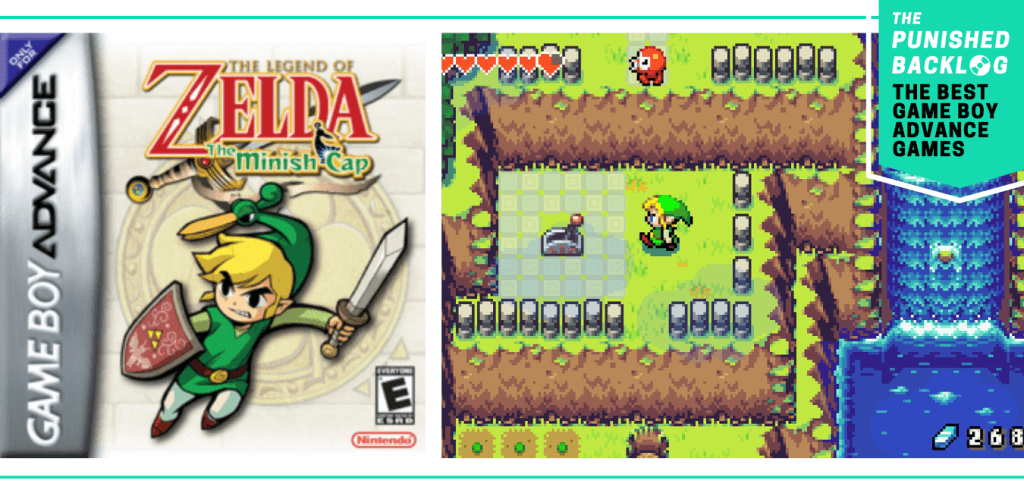
The Legend of Zelda: The Minish Cap
There aren’t actually that many original Game Boy Advance games I’d personally consider all-time classics. The handheld obviously had many, many worthwhile exclusives I’d recommend to basically any Nintendo fan, but only a few have really stuck with me over the years. The GBA’s lone original single-player Legend of Zelda title is absolutely one of them.
Developed by Capcom(!) and released late in the console’s lifecycle, The Minish Cap proved that 2D Zelda games not only could still exist, but could simultaneously recapture the magic of classics like A Link to the Past and Link’s Awakening and present enough of their own unique magic as well. Much like other Zelda titles, Minish Cap takes place in Hyrule and involves Link, everyone’s favorite Hero of Time, saving Princess Zelda from a maleficent magical villain, this time in the form of the evil wizard Vaati. Unlike other Zelda games, however, this one’s main gimmick is that Link’s magical hat — the kindly wizard Ezlo, who was transformed into a talking birdlike hat for some reason — allows him to shrink into the size of an ant, making a fairly small overworld feel a million times bigger.
Given the miniature size of the adventure (pun intended), The Minish Cap doesn’t get the same kind of love as its more ambitious and expansive brethren, like Breath of the Wild or The Wind Waker. It makes up for its diminutive nature by using the whole of the buffalo, so to speak: Every single corner of the game’s depiction of Hyrule teems with little secrets, like discovering miniature people (known as, of course, the Minish) living in the rafters of small houses or even boss fights against massive versions of traditional enemies like octoroks (you know, because Link is small). The Minish Cap only has a few dungeons and doesn’t try anything too grand narratively, but there’s never a dull moment. There’s always another sword skill to learn, another rare kinstone to discover, and more Minish to find hiding in plain sight.
Moreover, another aspect of The Minish Cap that makes it one of my favorites in the series? It has a lot of heart. It really cares about every single character in the game (especially in its bustling Hyrule Castle Town), and it respects every second of the player’s time. It’s exemplary of all the best the franchise has to offer and then some. Ask me about my favorite GBA game, and I don’t even have to think about it.
– Written by Sam Martinelli
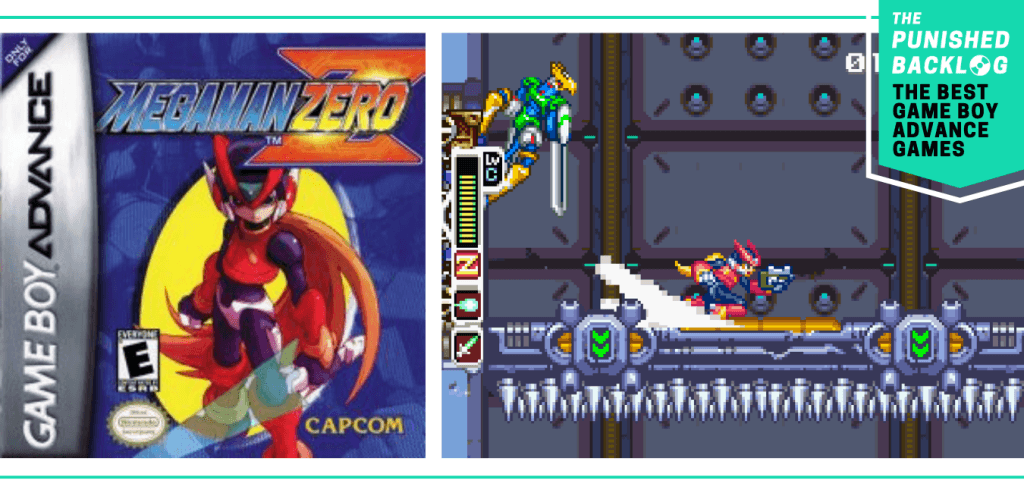
Mega Man Zero
Mega Man Zero came to me a little later in early middle school, right around when I learned how to use emulators (I bought a legal copy later, I swear, FBI). My history with the Blue Bomber started with Mega Man 8, which showed up one Easter morning when I answered a knock at the door, ran outside, found nobody, then tore around the corner of the house and discovered a basket stashed in the yard. Beneath the plastic fake straw sat a shiny new copy. I later picked up Mega Man X6 on a Blockbuster run and got my first taste of Zero, but Inti Creates’ and Capcom’s 2002 GBA spinoff changed everything I thought I knew about the franchise.
This was an entire adventure built around a badass amnesiac Zero on the hunt for his memories, and he was cooler than any version of Mega Man I’d ever played. He had a damn off-brand lightsaber (the Z-Saber), an actual pistol in the Z-Buster, the Shield Boomerang, and a Triple Rod spear. The result felt less like a Mega Man game and more like a metroidvania.
Then there was the upgrade system, which hooked me like no Mega Man had before. Every weapon leveled up the more you used it, unlocking new moves and eventually devastating charged attacks that shredded anything unlucky enough to be standing in front of you. It gave the combat this satisfying RPG loop on top of the twitchy action where you grind out slashes, earn a new saber combo, then go melt a boss with a fully charged swing.
And the game needed every bit of that depth, because it was harder than any Mega Man I’d touched. The smaller GBA screen spawned endless enemies faster than I could react, and the bosses were tough as hell. It took me a minute to wrap my head around the Cyber-Elf system. These little helpers extend your health, reinforce your weapons, and keep you alive. But once I clicked with the rhythm, I was dashing all over the place, mastering every weapon, and carving up every boss until the credits finally rolled.
And I haven’t even gotten to Toru Nakayama’s art. His watercolor anime aesthetic and dynamic character poses are easily my favorite of any Mega Man game.
– Written By Donovan Harrell
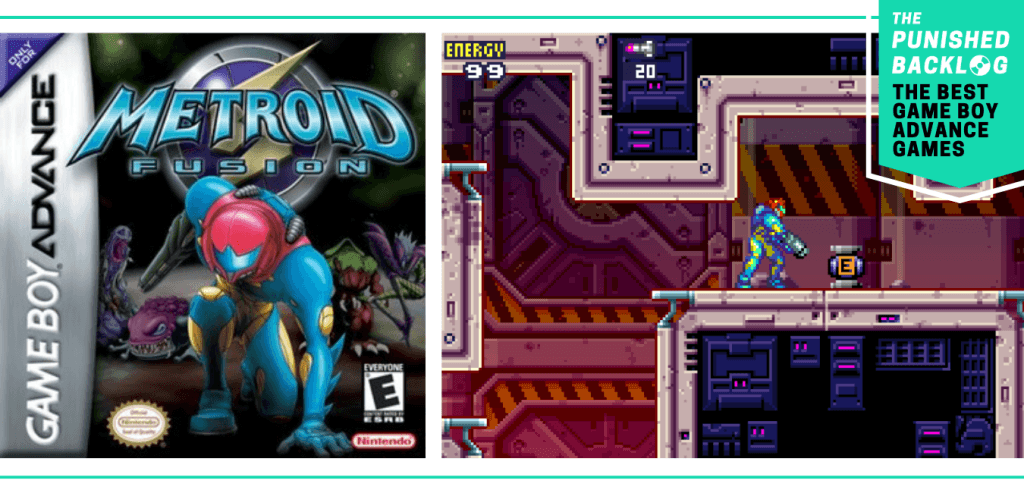
Metroid Fusion
Metroid Fusion is a bizarre game in a lot of ways. Despite being a major entry in a franchise known for isolation and mazelike worlds, Fusion’s first half is completely linear, with an AI telling the player exactly where to go and what to do. Unlike its canonical predecessors, Fusion has a much more detailed plot that even includes occasional inner monologues, with players getting a deeper look into Samus Aran’s backstory than ever before. The game also features probably the most bizarre-looking suit Samus has ever worn, as it’s completely integrated into her body from the start.
These quirks obviously make Metroid Fusion a franchise standout on their own, but they do so much more. Their presence — especially the linearity of the game’s earliest hours — makes the back half all the more incredible.
Fusion presents a turning point around the halfway mark that makes the rest of the experience feel like a totally different game. Instead of progressing in a linear manner and taking commands from an AI, Samus has to navigate the ruins of a space station, discovering the hostile denizens that lurk within its crevasses. The player must do this all while avoiding SA-X, essentially an unkillable clone of Samus that pops up at random points.
That’s where the brilliance of Metroid Fusion lies: It gives you all the tools to succeed and all the information in the world right at the start, then snatches it away from you once you’ve gotten too comfortable. While I’m not sure it’s the best GBA Metroid title, it’s certainly a fantastic game, one that often warrants a replay just to feel those thrills once again.
– Written by Sam Martinelli
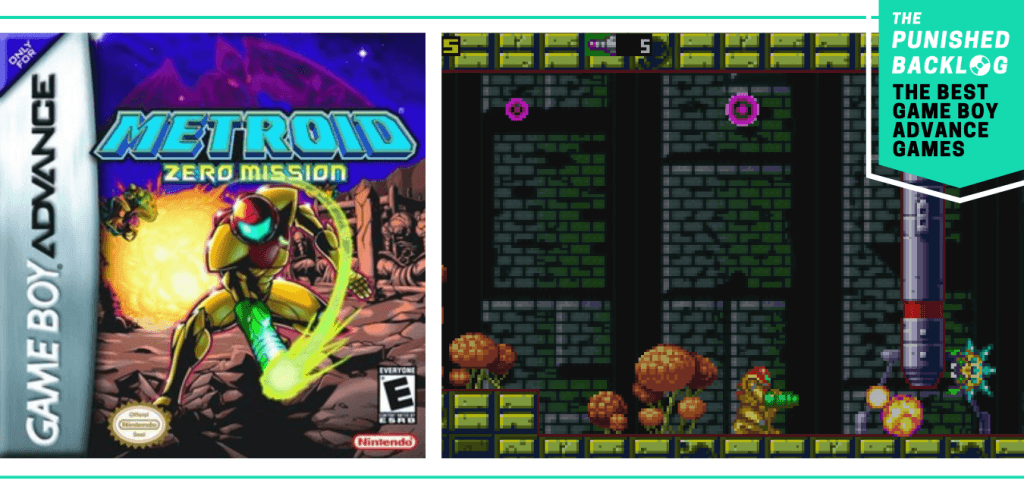
Metroid: Zero Mission
The Game Boy Advance is home to some terrific ports, from the aforementioned Final Fantasy to The Legend of Zelda: A Link to the Past/Four Swords. Yet no rerelease comes close to challenging Metroid: Zero Mission. A from-the-ground-up remake of the original 1986 Metroid, Zero Mission breathes life into a game that even our resident “retro guy” Sam Martinelli has admitted is a tough play in today’s age.
Where the original confounded players with its layout and challenged them with an unforgiving difficulty, Zero Mission adds all the quality-of-life touches you’d expect from a modern metroidvania. An in-game map makes navigation a breeze, while save rooms allow a respite between platforming and/or combat segments. Visually, the game also received a much-needed facelift, the greys of the original replaced with a sea of reds, oranges, and greens. Samus Aran’s debut adventure never looked so good, even on a screen as small as the GBA’s.
I played Metroid: Zero Mission for the first time about five years ago, and the experience has stuck with me ever since. I play plenty of great metroidvania games, yet in many ways, none have topped the highs of Zero Mission. Super Metroid may bring the atmosphere, Ori and the Blind Forest the smoothness, and Hollow Knight the challenge, but Zero Mission successfully synthesizes all three for an experience that to this day remains without equal.
– Written by David Silbert
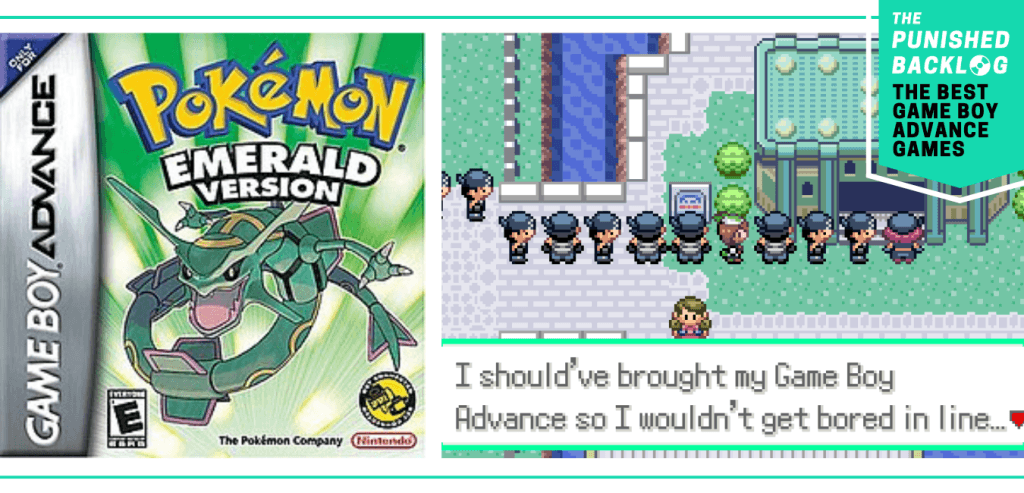
Pokémon Emerald
Pokémon Emerald answers the question, “What if we took one of the best Pokémon games of all time and then added a flying snake-dragon to it?”
The bright green cartridge brought with it many excellent upgrades to the proven formula of Sapphire/Ruby. In the two years since their release and Emerald’s debut in 2004, GameFreak was cooking. Pokémon sprites now had moving animations in battles. Contests were even more complex. The post-game was one of the most extensive, opening the door to multiple regions. The Battle Tower was significantly expanded to the Battle Frontier, offering entertaining but difficult fights long after establishing dominance against the Elite Four and the Pokémon League. You could even go back and fight old gym leaders!
After playing years of Pokémon games, I knew that the formula would be improved but I no longer expected any surprise in the story. But Emerald changed the game there, too. GameFreak pitted players against the bad guys from both Sapphire and Ruby — Team Agua and Team Magma, respectively — to save the seas and the earth. Now, there were more hide-outs, more fights, more adventure. I remember how excited I was when the familiar script changed, culminating in an epic face-off.
At a certain point, the villains steal precious artifacts from the games’ legendary ‘mons, causing Kyogre and Groudon to fight with horrendous rainstorms (utilizing that great weather mechanic). Only the player can save the day by climbing a tower to summon Rayquaza, a long, graceful serpent-fish-meteriote-guy who made everyone meditate and chill out and work together for the greater good.
Any chance I could climb a Rayquaza tower now, actually? I think we could really use him.
– Written by Amanda Tien
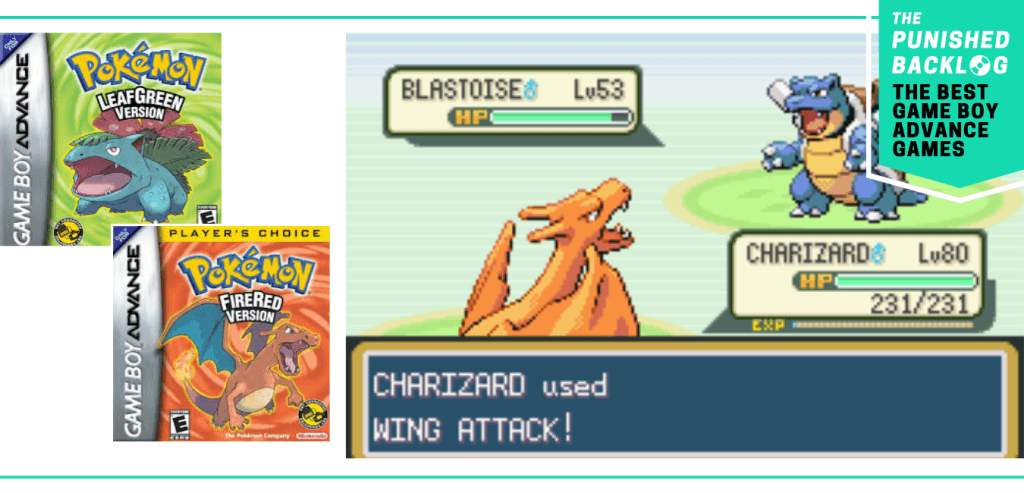
Pokémon FireRed/LeafGreen
Confession time: I never actually played Pokémon FireRed or LeafGreen on GBA. I was a wise man at nine years of age and knew what appeared not to be obvious to everyone else: I had already played this game when I played Pokémon Blue. So, my playthrough was not in 2004 when Game Freak originally released the games, but in 2026 when they were rereleased for the Switch. At least I got to play this game the way the developers intended: on a 65” 4k television.
When it came time to play these games, my three decades of Pokémon experience brought a stronger sense of wisdom. Back in the day, I would focus solely on damaging attacks. As I got older, though, moves like Swords Dance became a mainstay, turning my already great Pokémon into unstoppable machines. Returning to Kanto for the first time since I was a child for a modern playthrough, I knew I would need status moves to truly master the game, and didn’t waste any time getting to them. Tail Whip now would be my friend.
Long story short, that’s how I lost the tutorial in FireRed to my rival at 31 years old. The lesson? Just keep pressing A. It works.
My embarrassing start aside, what amazes me about these games is that you can pick them up after more than two decades, and it’s like nothing has changed. Everything you loved about the original Pokémon games is there, complete with QOL updates (thank goodness for running shoes!) and a fresh coat of paint that makes Kanto pop off the screen. It may be nostalgia speaking, but the top-down pixel design of Pokémon is timeless. The modern 3D designs are better in a technical sense, but they also feel hollow, like we got away from the constraints that made this series great to begin with. FireRed and LeafGreen didn’t try to reinvent the wheel with this remake — they perfected what made the games already amazing, taking advantage of the GBA’s limitations to make something truly special.
And of course, FireRed and LeafGreen leave the most important part of Kanto untouched: The original Pokédex is still there in full. With respect to all other Pokémon gamese that followed, there is just nothing like the classic lineup from Red and Blue versions. Ask anyone who grew up with these games (or at least six of the Punished Backlog writers) and there’s an incredible chance that their favorite Pokémon is from these versions, and Game Freak understood this.
Not all remakes are perfect, especially when it comes to Pokémon, but it is rare when a remake is not just truly great, but also stands the test of time. Pokémon FireRed and LeafGreen do exactly this. Whether you are beginning your Pokémon journey for the first time, or returning to Kanto for yet another new adventure, they are the perfect games to continue on your quest to catch ‘em all. It’s no wonder these timeless classics are now available on Switch. They may just be the franchise at its best.
– Written by Mark Bowers
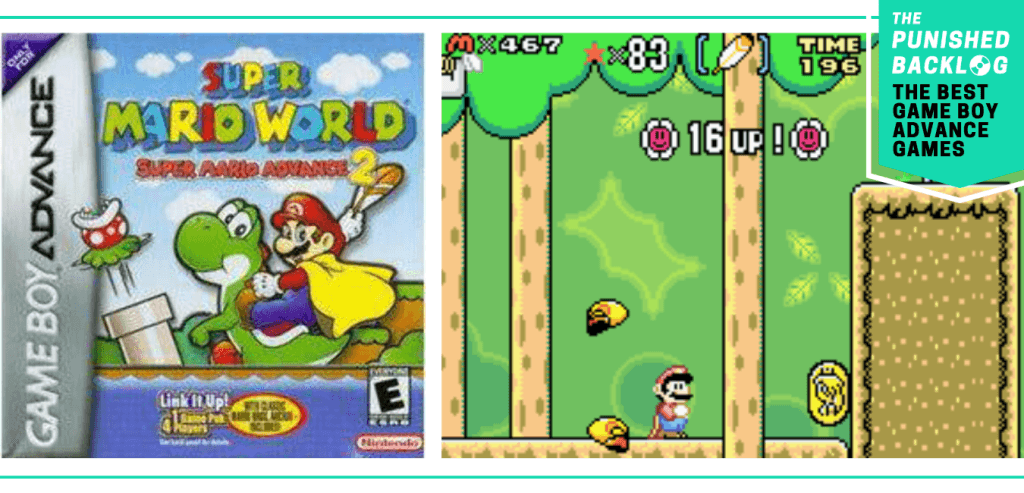
Super Mario Advance 2: Super Mario World
It’s no secret that Super Mario World is my favorite Mario game and one of my favorite games ever made. What I don’t always admit, however, is that my preferred version of the game isn’t the Super Nintendo original: it’s the Game Boy Advance port.
For the most part, when you try Super Mario Advance 2, you are mostly playing the same game as the SNES version Super Mario World. The levels are the same, the graphical style is the same (though a little brighter given the initial design of the GBA didn’t have a backlit screen), the controls and mechanics are mostly the same, and the overall vibe is the same. If the only version of Super Mario World you’ve ever played is this one, I would say you’ve basically played the original Super Mario World.
There are a handful of notable changes in the GBA version from the original, though. As far as I’m concerned, they alter the overall experience in notable ways. First of all, getting hit while equipped with the cape or fire flower power-up brings you down just to big Mario in the GBA version (as opposed to bringing you down to little Mario in the original), making the whole experience a little bit easier. You can also choose to play as Luigi before entering any level, who’s a bit slower than Mario but has a higher, floatier jump. Additionally — and this is something that matters immensely to me and probably not at all to others — but the spin-jump command is mapped to the right shoulder button in SMA2 (rather than the A button in the SNES version), making for a more comfortable gameplay experience on the go.
Lastly, though, this might be the biggest change of all: the addition of voice acting. Much like all the other Super Mario Advance titles, our beloved plumbers actually say things from time to time, though mostly just “yippee!” or “lucky!” or “here we go!” I’ve never felt like Mario needed to be especially chatty for the games to be enjoyable, but I do appreciate that added bit of excitement and hype.
All things considered, you can’t really go wrong with any version of Super Mario World. It’s one of the best 2D platformers of all time, and minor changes here and there won’t sway whether you’ll have fun with it. Still, these seemingly minor changes make Super Mario Advance 2 just a little better than the original Super Mario World in my book, and I don’t think any collection of GBA games is complete without it.
– Written by Sam Martinelli
What’s Your Favorite GBA Game of All Time?
Do you agree with our list? What did we miss? Share in the comments! You can also check out other Punished Favorites lists like the best Nintendo Switch games, the best Nintendo DS games, and the best SNES games.

A video game outlet that blends quality words with inclusive voices. For business inquiries and review requests, reach us at press [at] punishedbacklog [dot] com.




Sam has been playing video games since his earliest years and has been writing about them since 2016. He joined The Punished Backlog in 2017 and became an Editor in Fall 2021. He’s a big fan of Nintendo games and complaining about The Last of Us Part II. You either agree wholeheartedly with his opinions or despise them. There is no in between.
A lifelong New Yorker, Sam views gaming as far more than a silly little pastime, and hopes through critical analysis and in-depth reviews to better understand the medium's artistic merit.
Bluesky: @sam-martinelli.bsky.social


David is the founder of The Punished Backlog. He has a problem finishing games he starts.
Just beat: Splatoon Raiders.
Working on: GTA V.
Can't wait for: Ocarina of Time (2026), GTA VI.
Follow David on Twitter at @David_Silbert to keep up to date with all things The Punished Backlog.




Amanda Tien (she/her or they) loves video games where she can pet dogs, solve mysteries, punch bad guys, play as a cool female character, and/or have a good cry. She began writing with The Punished Backlog in 2020 and became an Editor in Fall 2021. Amanda also does a lot of the site's graphic designs and podcast editing. Amanda's work has been published in Mothership, Unwinnable Monthly, Poets.org, Salt Hill Journal, and elsewhere. She holds an MFA in Fiction from the University of Pittsburgh and a BA in Creative Writing from Columbia University. Learn more about her writing, visual art, teaching, graphic design, and marketing consulting at www.amandatien.com.


Huge video game, comic book, and anime fan. Spends way too much time watching things he doesn’t like. Hates Zack Snyder. Mains Falco.



Mark is a contributor to The Punished Backlog, often promising articles and occasionally delivering when he actually commits to it. Mark games mainly on his PS5 and his Switch, and some of his favorite games include God of War, Ghost of Tsushima, The Witcher 3: Wild Hunt, and his all time favorite, Red Dead Redemption 2. When not gaming, Mark is an avid fan of all Boston sports teams and his Villanova Wildcats. He also loves hiking, skiing, and traveling across the U.S.


Vaughn Hunt is writer who has loved video games since he picked up a controller. His parents wouldn't let him buy swords as a child (he wanted the real ones) so he started writing, reading, and playing video games about them. A historian at heart, you'll often find him deep into a rabbit hole of culture, comics, or music.


Clint is a writer and educator based out of Wisconsin. You can often find him writing about Middle English poetry, medieval games, or video games. He received his PhD in English from the Ohio State University. You can find his academic and public work at clintmorrisonjr.com.

Donovan is a lifelong gamer with a love for fast-paced, single-player action games—especially Devil May Cry, Metroidvanias, indies, and action RPGs. He’s also an “advanced scrub” at fighting games and will play just about anything fun. Donovan is passionate about seeing more diverse characters and creators in the industry—or at least better hair options for Black people. With over a decade in journalism, he joined The Punished Backlog in 2023 to write more about what he loves. Follow him on Twitter and Instagram @dono_harrell.

Looooooove Fire Emblem on GBA!
Well this is certainly a list that’s for sure.
Fire Emblem, but not sacred stones.
Final Fantasy but not 4 or 6. Absolutely mindboggling how 1&2 is on the list at all let alone above 4 or 6.
Harvest Moon, why even put FOMT when MFOMT is the same thing just with more content and bugfixes.
And I can throw a dart at more than half the list and any game I hit would be far below Super Robot Taisen OG 1 or 2 in terms of “best” on the GBA.