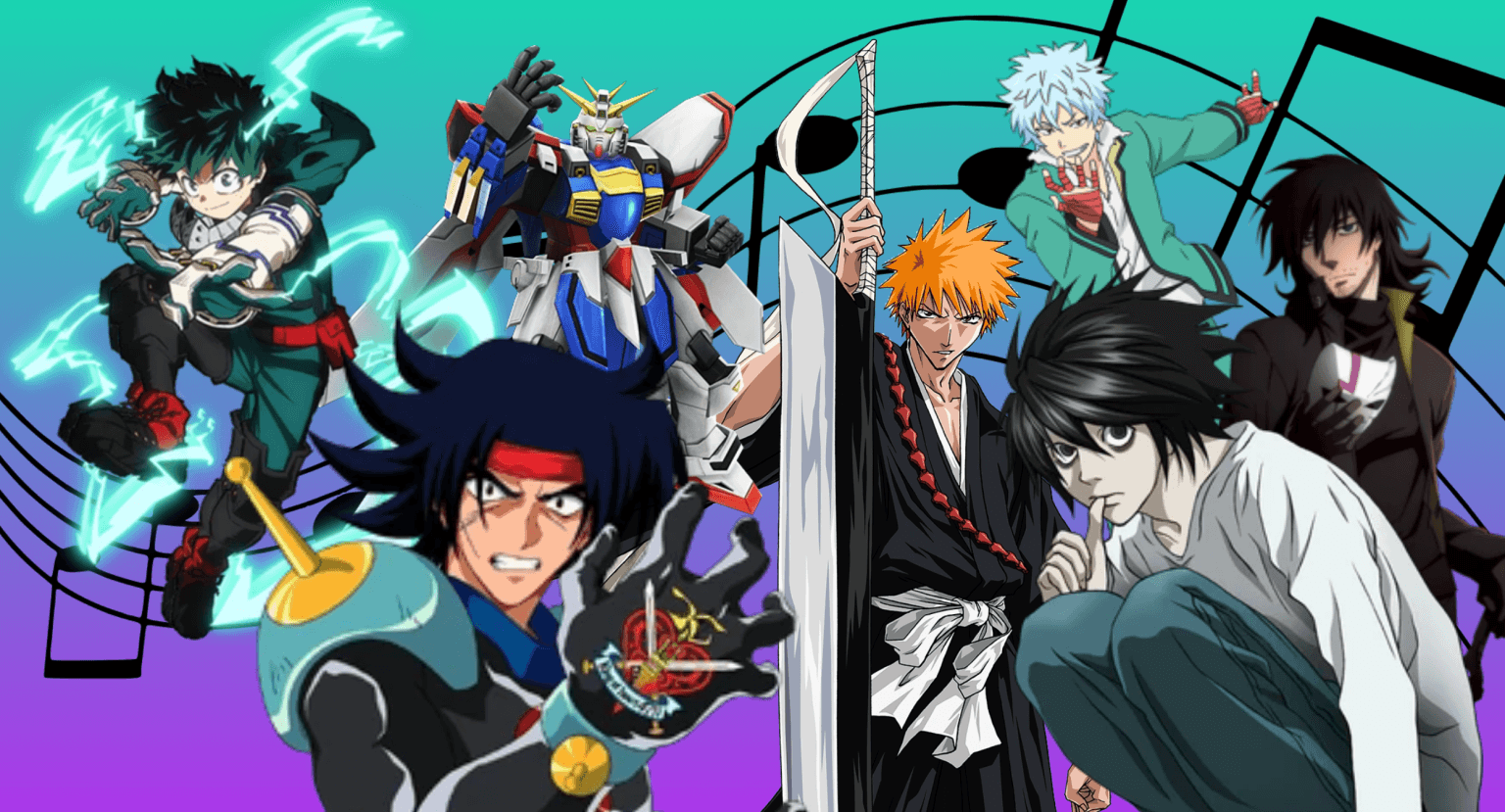

Anime has long been positioned as a visual medium, primarily due to its bright colors and flashy visuals. But, for me, just as integral to the experience was the music. From the heavy synths of the ‘80s and metal riffs of the ‘90s, to the R&B beats of the ‘00s, music in anime has always delivered the goods.
If music be the food of love, then play on! Give me an excess of great pieces, especially those connected to great characters and great moments. To celebrate that love of music, we here at The Punished Backlog have put together a list of some of our favorite anime character theme songs. These aren’t openings or closings (which we’ll probably do one day), or motifs in shows, but pieces of music directly attached to the actions of one or more characters.
From the moment you hear these pieces, the characters they accompany immediately jump to mind. This isn’t an exhaustive list, but rather a celebration of what these iconic characters mean to us. Let’s dive in.
– Written by Gary Wilson, Guest Editor
“Burn, Fighting Spirit, Overcoming Accursed Destiny” – Mobile Fighter G Gundam
Every Gundam fan has that one show that turned them into a fan. Mine is Mobile Fighter G Gundam. When it hit Toonami, my 9-year-old brain couldn’t hang with the dense dystopian politics of the other series, but this one was different. Dragon Ball Z was my favorite anime at the time, and G Gundam scratched the exact same itch: kung fu, a planet-wide fighting tournament, fantastical sci-fi, and wall-to-wall melodrama. Its monster-of-the-week structure got mapped onto its hero, Domon Kasshu of Neo Japan, who spends every episode demanding to know if his opponent has seen his brother before squeezing their Gundam’s head until it pops. It was Dragon Ball Z in a mech suit — with this dope-ass song playing the whole time.
Kohei Tanaka’s battle theme is the sound of my childhood. At 32, goosebumps still dot my body, and chills run every muscle fiber the second those energetic violins kick in to prime the Shining Finger. Domon kicks off his monologue. “This hand of mine glows with an awesome power!” Triumphant horns blare. Drums boom, cymbals crash. Then the main melody drops, and here comes my favorite part: a frantic, jazzy saxophone solo, every bit as unhinged as the rest of the song, hurling me straight back to my living room and that giant CRT.
Domon and I sync up completely, just like he syncs with his Gundam through that skin-tight mocap suit. We both reach out with our right hands, charging through anything in our path. He disintegrates an enemy’s limbs. I knock a lamp off the table. “Shining Finger!” He clutches his opponent’s head in a glowing green fist. I ignore the lamp shattering on the floor. An imaginary conductor waves the whole thing home with one last flourish of violins, and we both squeeze our fists shut.
Then I snap back to the present. The Burning Gundam leg I’d spent hours piecing together lies in pieces. I’ve undone all my work. I don’t mind; I’ll just rebuild it during the next episode.
– Written by Donovan Harrell
“Dance of Curse” – The Vision of Escaflowne
Escaflowne is the legendary mech piloted by the teenage hero, Prince Van, as he attempts to stop the Zaibach Empire from taking over the world of Gaea. Tied together through body and soul, if Escaflowne is damaged, Prince Van also experiences wounds in the corresponding area until the armor is repaired.
Escaflowne is the last resort of a desperate young man fighting a war he can’t win without immense power. Given the dramatic nature of this partnership, the operatic orchestral arrangement “Dance of Curse” encapsulates this tragic relationship perfectly. Fortunately, Prince Van is not alone in his struggles. With the help of Hitomi Kanzaki, a Japanese high school hurdler whisked away from Earth who becomes a priestess capable of reading the future, Van finds hope.
The theme of Escaflowne often appears in moments of emotional upheaval, like the turning point of battle. Escaflowne is the epitome of “a knight in shining armor” with its white luster, but if Van lets his emotions overwhelm him, the armor essentially shadows, turning black and deformed.
The grandiose range of this theme captures the ebb and flow of battles, both physical and mental. Specifically, I love how it surges violently with staccato string movements set against the elegant legato crescendos of the vocals. Essential to “Dance of Curse” are the trumpets, which march the theme forward, building a sense of foreboding, before the percussion arrives for transitions. By the end, the horns overtake the strings, blasting forth with a resounding force I always find thrilling.
Composer Yoko Kanno (Cowboy Bebop, Wolf’s Rain) always delivers. In this particular case, she provides a song wrought with the heaviness and trauma of battle.
– Written by Vaughn Hunt
“Il Vento D’Oro” – JoJo’s Bizarre Adventure: Golden Wind
JoJo’s Bizarre Adventure is famous for its dramatic freeze frames, over-the-top battles, endless music references, and batshit crazy characters. Golden Wind, the fifth part in Hirohiko Araki’s long-running series and my personal favorite, delivers on those sacred pillars with aplomb.
Set in Italy, Golden Wind centers around Giorno Giovana, the latest in a centuries-spanning lineage of Joestars. As a Joestar, Giorno is fated to do battle with the evil, seemingly immortal Dio Brando — but not before embarking on a ridiculous road trip with a band of supportive yet generally unhinged friends. (If you’ve read or watched JoJo part three, Stardust Crusaders, you’ve seen this movie before.)
“Il Vento D’Oro,” which literally translates to “the wind of gold,” may be named after the titular arc, but the song is far better known by its colloquial title: Giorno’s Theme. At the height of JoJo’s popularity, this track was everywhere — in memes, at malls, you name it. And deservedly so! It was a badass theme for a badass character, and a catchy one at that.
The track opens with a groovy guitar lick, followed by a rap verse that culminates with a funky “Brrt, stick up, GIOGIO!” A series of horns join in on the fun, as does a synth. But all that instrumentation is merely an appetizer for the main course (and the part 99% of the internet cares about): a swell of violins along with emphatic vocals celebrating our character and his magical Stand ability. “GIOGIO! GOLDEN WIND! / GIOGIO! GOLDEN WIND!”
The song then breaks into an epic sax solo (which, tragically, never gets airtime in the actual anime to my knowledge). The song takes a few more twists and turns, and just when you think it’s over, composer Yugo Kanno offers up one last hurrah. The song cuts dramatically before the main theme — previously sung — is recapitulated with a somber piano solo, only for the strings and vocals to re-enter for a glorious sendoff.
It’s one of the greatest anime character themes ever put to paper, and a fitting backdrop for one of my favorite anime ever. It’s also just a terrific piece of music in its own right.
– Written by David Silbert
“Senya (Many Nights)” – Naruto Shippuden
Naruto held a particularly special place in my heart growing up. The first of the “Big 3” anime I ever watched, Masashi Kishimoto’s story of a misunderstood ninja’s journey from pariah to village savior helped me navigate high school (and later college) with a curiosity I likely wouldn’t have otherwise had. The show taught me how to be confident, vulnerable, empathetic, and so much more in my teenage years. Yes, watching fights constantly end with Naruto’s “talk no jutsu” was anticlimactic, but it was a worthy lesson in showing kindness in the face of adversity.
The sequel, Naruto Shippuden, upped the ante in many regards, from storytelling and character development to some beautifully choreographed fights. But the clear standout to me, and what elevated Shippuden from a solid anime to a must-watch for shounen fans, was its incredible soundtrack. Whereas the OG Naruto, scored by Toshio Masuda, showcased classic Japanese bamboo flutes and taiko drums, Shippuden expanded its instrumentation significantly under the stewardship of composer Yasuharu Takanashi. From whimsical ballads to sweeping orchestral numbers, the music of Shippuden offered a sense of grandeur to match its much bigger story.
But no track from Naruto Shippuden is perhaps more iconic than the ever-replayable “Senya.” A powerful mix of woodwinds, strings, stoic chants, and expressive singing, the track often accompanied flashbacks to the ill-fated Uchiha clan and the man responsible for killing the entire clan in a single evening: Sasuke’s older brother Itachi.
As with many characteristically “evil” characters in anime, Itachi is much more than his seemingly wanton bloodlust would have you believe. The fate of the Uchihas has just as much to do with him as it has to do with the surrounding Hidden Leaf Village, its inner politics, and the threat of outside actors seeking to do the village harm. “Senya” captures the tragically dark events of that fateful night, while giving us a rare glimpse into the psyche of one of anime’s most complex villains.
– Written by David Silbert
“Judgement Knights of Thunder ~ Legendary Hero” – The Disastrous Life of Saiki K.
I’m so glad that The Disastrous Life of Saiki K. found a dedicated following. This goofy little show about a jaded psychic and his weirdo friends puts me in a good mood whenever I throw it on. And one of Saiki’s weirdest friends is Shun Kaidou, The (self-proclaimed) Jet-Black Wings. Kaidou is an archetypical chuunibyou character, a loudmouthed braggart who acts as if he possesses dangerous secret powers to battle a secret organization. Of course, in reality, he’s just a normal high school student with a tiger mom and very few friends.
With the show taking almost always Saiki’s perspective, an emphasis is placed on his ability to read minds, even when he’d much rather not. As such, Kaidou often provides great contrast between external performance and internal self-image. While he does occasionally buy his own act, he just as often fails to measure up to his displayed ego to hilarious effect. A massive part of why it’s so hilarious is down to his theme, “Judgement Knights of Thunder ~ Legendary Hero.”
The first time it’s used, it punctuates Saiki secretly using his own powers to save Kaidou from a snake. Here, its use is somewhat triumphant, as Saiki notes that Kaidou, despite having no powers, still put himself on the line to capture it. The comedy comes in when Kaidou, thinking the supernatural powers are his, goes on an ego trip, the song trailing off as Saiki takes back his newfound respect.
This is an excellent example of the song’s versatility. Across the series, it alternatively serves as setup, payoff, and unironic catharsis. It plays while Kaidou brags about his dodgeball skill and cuts off when he bungles it, it plays when it’s revealed his “guardian spirit ghost” is actually just a chihuahua, and it plays when he genuinely steps up to protect his eventual love interest Chiyo. At one point the theme plays for her in a rare moment of self-delusion.
Its ability to work in every one of these scenarios is down to how hilariously overblown and rad it is. The echoing cry of “JUDGEMENT KNIGHTS OF-” at the start instantly grabs attention, while its genuinely great guitar riffs make it capable of both sustaining a buildup to a joke and carrying the scenes where characters actually do cool stuff.
Lots of songs can be cool or funny, but rarely are they this good at being both.
– Written by Sean “Psychokinesis” Cabot
“Libera Me From Hell” – Tengen Toppa Gurren Lagann
At this point in Gurren Lagann, Team Dai-Gurren has traveled across time and space to face their sworn enemies: the living embodiment of the will of an entire species, dedicated to preventing entropy at any cost. The team is scrappy, powered by spiral energy — essentially concentrated hype, the literal power of the human spirit. They’ve suffered heavy losses against a seemingly insurmountable foe, but they push forward anyway, honoring the comrades they’ve lost. It’s looking bleak. One of them bravely embarks on a one-way trip to move the team closer to victory.
“Libera Me From Hell” opens with a haunting, operatic prayer in Latin, pulled from a Catholic responsory: Libera me, Domine, de morte aeterna, which translates to “Deliver me, O Lord, from death eternal.” A fitting tone for a dire moment.
Then the vibe shifts.
A piano melody kicks in, and Japanese rapper Tarantula hops on the mic with a braggadocious, rebellious verse — a guy talking shit and hyping himself up as he stares down an impassable enemy. Then the hook detonates: Do the impossible, see the invisible / Row, row! Fight the power! / Touch the untouchable, break the unbreakable / Row, row! Fight the power!
Those lyrics trace back to “Rap is a Man’s Soul…,” which comes in multiple variations during the anime. But the original is Kamina’s, and its full title is a glorious mouthful that translates to “Rap is Man’s Soul! Believe in You’n the Restless Dude Showing the Sky, Listen to Kamina’s Theme With Ears Wide Open!!” And that’s what deepens the whole thing: It all started with Kamina. So, of course his theme becomes Team Dai-Gurren’s, which becomes “Libera Me From Hell.”
Then the song becomes a war. The opera swells back in, louder and faster, and the two genres wrestle for control of the track itself. The opera drowns out the hip-hop. The hip-hop surges back and demands to be heard. At one point, the beat cuts out entirely, and the defiance rings a cappella “Row, Row, Fight the Power!” before, after another sonic battle, hip-hop finally beats the opera and rides its chant to the end.
I love this song because I’ve never heard anything like it — hip-hop, opera, or otherwise. Without the context of the show, I’d imagine it sounds like a mess. But it brilliantly reenacts the plot of Gurren Lagann all by itself. Hip-hop has long stood as a symbol of rebellion, and these lyrics continue that tradition with a nod to some of the most popular protest anthems ever made, from Public Enemy’s “Fight the Power” to Gil Scott-Heron’s “The Revolution Will Not Be Televised.” A prayer for salvation, losing to a fist raised to seize the miracle yourself — that’s Gurren Lagann in a nutshell.
This song has pulled me out of some pretty dark times. And every time, it reminds me of the same lesson: No matter how hard times get, you’re not in it alone. One day, I’ll get “Believe in the me who believes in you” tattooed somewhere on my body.
– Written by Donovan “Who the hell do you think I am!?” Harrell
“L’s Theme” – Death Note
Most of the anime character themes we’ve included on this list are complex. Either they play with instrumentation in beautiful, technically impressive ways, or they introduce motifs that enrich the lore of their respective characters.
“L’s Theme” accomplishes neither. It’s a basic tune, comprised of a piano, a few guitars, and a drum kit. There are no vocals, no solos or flashy riffs, and no general flow to the music beyond simple layering. At just three minutes, it’s also rather short, and a music connoisseur might argue that Death Note composer Hideki Taniuchi left some meat on the bone with his composition.
But that minimalism is exactly the point. Death Note may be a story that spans life and death, but its scenes are far more quotidien. The crux of the narrative is the cat-and-mouse game between Light Yagami, a straight-A student turned killer with a god complex, and L, a genius detective hot on Yagami’s trail who must hide his identity to avoid being written in the titular Death Note. Their respective hunts take them everywhere from Tokyo subway stations and public parks to a university tennis court and neighborhood cafe.
Unlike traditional shounen anime, the two never engage in fisticuffs or shootouts. They rarely even meet face to face, and yet their respective intellects are so strong that their auras are always felt. Even something as simple as eating a potato chip is made dramatic in the world of Death Note.
“L’s Theme” is the personification of that dynamic from L’s perspective. Each time the track cues up and that simple piano melody begins, you know L is about to take the chessboard from Light and — no matter how cornered he may be — turn a losing position into a winning one. It’s one of the most recognizable themes in all of anime, and much like L himself, all we can do is bow down and pay witness to its dominance.
– Written by David Silbert
“Number One” – Bleach
Bleach is lucky enough to be loaded with good music from top to bottom. Fight scenes are punctuated by orchestral chanting, Latin-inspired riffs, and electronic beats, all weaving together to create a soundscape that is singularly Bleach. I could write for hours about how primary composer Shirō Sagisu uses different genres to capture each group within the universe, with the Soul Reapers falling out of a brass military band, the Espada using flamenco and merengue to create an otherworldly feel, and the Quincy dominated by Gregorian organs. But, for all the good work done across the board, it’s the theme of the main character that stands above the rest.
Titled “Number One,” the piece is used whenever our main character, Ichigo Kurosaki, is about to wreck shop. Things can be at their absolute darkest, with the villain standing tall and our heroes strewn about. And then you’ll hear the drums. The wailing character. The electronic breakdown. And then the chorus, asking “If you want to see some action?” And every time, you do. The piece is so good, it’s never been replaced: Even the most recent seasons still use (modernized) versions of Number One whenever Ichigo needs to remind anyone he’s the main character for a reason.
My personal favorite use came in Bleach’s second major arc, as Ichigo goes to rescue an arrested comrade. The rescue goes in a variety of directions, with Ichigo winning and losing in equal measure. But finally, he’s done it. He’s found his comrade and needs to buy time for her to escape. So what does he do?
He dominates three strong opponents without even using his sword. Because he truly is Number One.
– Written by Gary Wilson
“Oikawa Toru” – Haikyu!!
If you look at the ranks of top anime villains, you will find some of the true scum of the earth. People hate the murderous Light Yagami; loathe the genocidal maniac Kenjaku; despise the machinations of Gendo Ikari. But among this pantheon of evil, one person sits alone. On many Shonen Jump-published lists of the most vile and hateful individuals in all of anime, one person appears… well, not most often, but more often than you’d expect for a high school douche who loves volleyball.
Toru Oikawa is, in fact, just a guy who loves volleyball who happens to go to a different school than our main characters. A genius behind the line, his serve sends shivers down the spines of anyone caught unaware. He’s the true King of the Court, who earned his spot among phenoms and geniuses through grit and determination. But he’s technically a bad guy. And people hate him.
Why? I couldn’t tell you. Probably because he’s smarmy and charming, a real asshole, and also just a damn good player. He’s hated like people hate LeBron: He’s better than the players on your team, and you know it. And so you hate him. It’s the only outlet.
Also, his theme is swinging, up-tempo jazz that feels entirely out of place on a volleyball court. But when Oikawa is up to serve, you hear boss music. And trumpets.
– Written by Gary Wilson
“Total Eclipse” – Darker Than Black
Darker Than Black protagonist Hei is an assassin who earned the name “The Black Reaper” before departing the organization where he became infamous to find out what happened with his sister. Following his defection, he finds himself hunted by his former employer, a criminal syndicate, and superpowered beings known as “Contractors.” Fortunately, these Contractors’ powers each come at a cost, which Hei is able to exploit to annihilate his enemies.
Bar none, Hei is likely the most efficient character in anime. When “Total Eclipse” comes on, you know that the climax of the episode is about to happen and the enemy has stepped into Hei’s calculated machinations. The song is driven by a resounding guitar reverb offset by an echoing, hollowed-out percussion that combines for a euphony of sounds that only Yoko Kanno could string together. Leave it to one of the greatest composers of our time to capture the cerebral thrill of an adrenaline rush as a song.
Moreover, Hei’s deliberative nature is perfectly captured in this track. By the time he acts, his enemies are disadvantaged and overwhelmed. His plans often come down to margins of error so tiny that even if he fails, his opponents are afraid of how he will adjust. This persistence and sense of urgency to succeed are encapsulated by the leading guitar, while the background percussion almost feels like it’s counting down to his victory.
If you see The Black Reaper, it’s likely the end for you and all your plans.
– Written by Vaughn Hunt
“You Say Run” – My Hero Academia
My fandom for My Hero Academia is an interesting one. You might think that being both Japanese and a fan of superhero comics and media in general would put My Hero Academia squarely within a demographic cross-section of my identity and interests. Unfortunately, it never quite worked out that way. I never fell in love with My Hero, constantly catching up and then falling off of the manga and ultimately skipping entire seasons of the anime throughout the years. I often took issue with the pacing, or some aspect of the worldbuilding, or the characters mangaka Kohei Horikoshi chose to focus on. (I also despised Mineta in particular; his humor just never worked for me.) Small things, largely a matter of execution.
Despite my minor gripes with the manga and anime as a whole, My Hero Academia still holds a special place in my heart. I can set aside all of my qualms with it because it succeeds at one thing: heroism. The moments that make My Hero shine to me are when it showcases a character standing up for the weak, protecting the powerless, fighting for what’s right, reaching for self-actualization. And many of these climactic moments of heroism are accompanied by one standout track: “You Say Run” (and its many variations).
Now, “You Say Run” is a very ubiquitous part of MHA. It does not belong solely to one character, though it is heavily associated with Deku and All Might — that much is true. So does that mean it doesn’t pass the bar for this write-up? On a literal level, yes, but I would argue “You Say Run” is indeed representative of a character. It’s the same beating heart of My Hero Academia I keep mentioning: heroism.
From the very first moment “You Say Run” plays — in the flashback in episode two when a Quirkless Deku runs toward the Sludge Villain to save Bakugo from near-certain death — it is clear what this song represents. Heroism is not just about dramatic rescues or standing triumphant after harrowing battles against fearsome foes. At its core, it is about taking action to inspire others, to show everyone that it is possible to stand up for what is right, to protect the weak, to give voice to the powerless, and so much more. Deku running into suicidal danger and throwing his notebook at the Sludge Villain is comical in practice. But his absurd act of bravery and heroism reinvigorates a disheartened All Might and pushes him to once again save the day.
You Say Run plays when All Might saves Class A from the League of Villains during the USJ Arc. It plays when Deku pierces Todoroki’s veil of cynicism and persuades him to accept both halves of himself during the tournament arc. It plays yet again when Class A “fights” Deku in season six and they successfully remind him what it means to be a hero.
But for me, my favorite “You Say Run” moment is still in the penultimate episode of season one. It’s probably just because I’m a sucker for any good Superman story, but I cried when All Might showed up to save the students in their moment of true despair. The moment when “You Say Run” kicks in as All Might uses his last 60 seconds of One For All to defeat Nomu and save the students still might be the peak of the show for me.
Go Beyond. Plus Ultra!
– Written by Kei Isobe

A video game outlet that blends quality words with inclusive voices. For business inquiries and review requests, reach us at press [at] punishedbacklog [dot] com.





Gary is a jack-of-all-trades video game enthusiast based in Boston, MA. A semi-professional fighting game player, even less professional Apex Legends player, and even less professional adult, he spends most of his time poking at strange indie gems and reading about the need for more diverse voices in gaming criticism. He invites anyone to recommend anything he's missed in the gaming world via Twitter or BlueSky, where he can found under the username @grtnpwrfl. When he isn't spending his time playing games, Gary is an avid New England Patriots fan and frequent hiker.


Donovan is a lifelong gamer with a love for fast-paced, single-player action games—especially Devil May Cry, Metroidvanias, indies, and action RPGs. He’s also an “advanced scrub” at fighting games and will play just about anything fun. Donovan is passionate about seeing more diverse characters and creators in the industry—or at least better hair options for Black people. With over a decade in journalism, he joined The Punished Backlog in 2023 to write more about what he loves. Follow him on Twitter and Instagram @dono_harrell.


Vaughn Hunt is writer who has loved video games since he picked up a controller. His parents wouldn't let him buy swords as a child (he wanted the real ones) so he started writing, reading, and playing video games about them. A historian at heart, you'll often find him deep into a rabbit hole of culture, comics, or music.


Sean Cabot is a graduate of Framingham State University, where he also wrote articles for the student paper before writing for RPGFan. In addition to gradually whittling down his massive backlog, he enjoys reading comics, playing Magic the Gathering, watching as many movies as possible, and adding to his backlog faster than he can shrink it.

Huge video game, comic book, and anime fan. Spends way too much time watching things he doesn’t like. Hates Zack Snyder. Mains Falco.


David is the founder of The Punished Backlog. He has a problem finishing games he starts.
Just beat: Splatoon Raiders.
Working on: GTA V.
Can't wait for: Ocarina of Time (2026), GTA VI.
Follow David on Twitter at @David_Silbert to keep up to date with all things The Punished Backlog.